Don’t Tell Us The Public “Doesn’t Care” About Incompetence and Corruption. It Has to Care.

The Washington Post broke the ethics story of the weekend, documenting a blatant conflict of interest on Capitol Hill that has many members of Congress making decisions on legislation directly affecting companies in their stock portfolios, and trading the stock contemporaneously with those decisions.

Based on the depressing dialogue on the Sunday public affairs shows regarding the Fast and Furious scandal—-especially the dialogue issuing from panelists who have obviously received and memorized received the Obama Administration and Democratic Party talking points—-I would assume that the American people can’t be bothered with this matter, and think it is a waste of time. After all, according to panelist after panelist who was either a mainstream media pundit or an Obama surrogate, all the American people care about is the economy and jobs. The fact that the U.S. Justice Department may be run by incompetents and law-breakers—who cares? The fact that nobody gets fired for approving a policy that breaks laws and gets innocent people killed—so what? The American people are, we are told, one-track mind morons, unable to focus on more than one problem at a time, and incapable of seeing the interrelations between problems. I wonder–might the fact that Congress may be corrupt and the Executive Branch, including Justice, may be irresponsible and inept have any bearing on the ability of the government to oversee the economy effectively? Don’t be silly, former New Mexico Governor and Clinton acolyte Bill Richardson told us yesterday. The public isn’t that sophisticated. The public doesn’t care about who’s cheating, who’s breaking the law and who’s incompetent! The people only want to talk about jobs! So, apparently, that is all the journalists and pundits should talk about, and all that policymakers should spend their time on.

No wonder none of those Sunday shows spent any time on this Post front page story: Continue reading

Comment of the Day: “Comment of the Day on ‘Young, Gullible, Lazy, Unimaginative and Unbelievable: I Wonder Why This Lawyer Has Trouble Finding A Job?'”

I couldn’t resist this one.

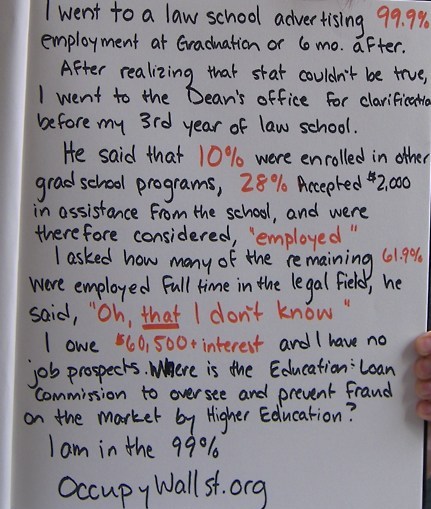
The thread on my post about an Occupy Wall Street protester who apparently was a law school grad and who held a hand-lettered sign blaming his failure to find work, not on the fact that he was standing around in a park holding a sign, but on his law school, has uncovered some unpleasant truths, such as…

  • Law schools are giving degrees to a lot of people who don’t know what to do with them
  • A lot of law school grads have not acquired some of the basic skills, like unbiased analysis, that their training was supposed to convey
  • A striking number of law school graduates identify with whiny unemployed 20-lear-olds holding signs
  • Too many people want to be lawyers for the money, rather than to serve a higher social function
  • Personal accountability is on the wane in America
  • People will believe the damnedest things if it will prevent them from accepting responsibility for their own plight, and
  • Confirmation bias is a frightening phenomenon.

Embodying many of these qualities was the recent post of someone with the apparently ethnic name of Iwantoremainanonymous-–Indian, perhaps?—who  had many observations typical of the thread that I unfortunately cannot permit to be posted, because he not only defied  the Ethics Alarms no anonymous comments rule, but, in his wealth of legal knowledge, disputes that I even have the right to make such rules.

Here is his jaw-dropping, incomplete Comment of the Day on “Comment of the Day on ‘Young, Gullible, Lazy, Unimaginative and Unbelievable: I Wonder Why This Lawyer Has Trouble Finding A Job?'”: Continue reading

The Weeping Bus Monitor: A Half-Million Dollars For Incompetence

Karen Klein is the 68- year-old bus monitor who is the unwilling star of a viral video (below) showing her being insulted and mocked by 12-year-olds on a school bus.

Continue reading

Comment of the Day on “Young, Gullible, Lazy, Unimaginative and Unbelievable: I Wonder Why This Lawyer Has Trouble Finding A Job?”

Back in October of 2011, I wrote a post in reaction to the sign reproduced left, held by an Occupy Wall Street protester who either was an unemployed law graduate or who plays one on TV.   Many are the ethical matters and controversies that have spilled on these pages since, and copious is the water that has flowed under the bridge, but because not very many people, comparatively speaking, read ethics websites in general and this one in particular, it took the better part of a year for that post to reach the laptop of  disgruntled law grad with access to a website for disgruntled law grads. Thus suddenly my name has been taken in vain in several fora where underemployed, student loan-burdened JDs hang out. Some, gratefully, have been kind enough to alert me with comments to Ethics Alarms, expressing their unhappiness with my insensitivity. This, the Comment of the Day, is such a post, by lawyer (presumably) Bobby Wilberger.

I must say at the outset that Bobby is lucky to have this posted, and I must say that because I don’t want another lawyer citing it as precedent. Bobby, who by definition if his post is to be taken seriously, had legal training, apparently didn’t absorb the part about following rules, being honest and truthful and reading documents relating to your work carefully. The posting requirements for Comments, clearly indicated at the top of this page, require a valid e-mail address. Bobby did not supply me with such an address, instead giving me a fake address with the clever suffix of “fake.com”.  This would pretty much ding Bobby if I were hiring, and is consistent with my over-all thesis that if you are an un- or underemployed law grad the first thing you need to do to get to the bottom of your problems is to look in the mirror.

I’ll have more to say after Bobby’s post. Here it is, the Comment of the Day, on Young, Gullible, Lazy, Unimaginative and Unbelievable: I Wonder Why This Lawyer Has Trouble Finding A Job?: Continue reading

Don’t Blame Nixon

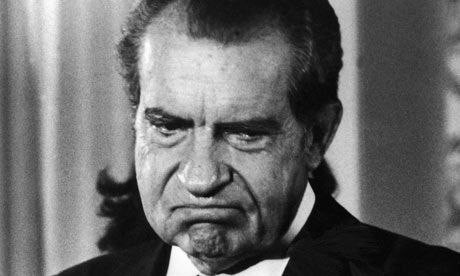
They can’t lay this one off on you, Dick.

I know it is much the vogue in Washington these days for leaders to blame previous leaders for persistent problems rather than to accept accountability and responsibility for not successfully solving them. Trendy though this attitude may be, however, Washington Post columnist Kathleen Parker’s column assigning fault for the U.S. public’s growing and frightening distrust of government institutions to Richard Nixon and the Watergate scandal shows its folly. It flies in the face of history and fairness, and lets literally thousands of subsequent leaders, elected officials, journalists, pundits and assorted knaves and hypocrites off scot-free.

Parker writes,

“Beyond the obvious, Nixon and the Watergate episode did great, perhaps irreparable, harm to the American spirit. A generation already traumatized by a war that ended up killing 58,000 of its brothers, boyfriends, husbands and fathers lost any remaining innocence, as well as trust in authority and faith in governmental institutions. The flag our forefathers raised on the moral high ground looked suddenly shabby and soiled. When even the president of the United States was willing to burglarize the American people, there was no one left to trust”

Oh, nonsense. The Watergate scandal, by the end, was one of the American system’s finest hours. The system worked, and worked on live television for all to see. A brave judge, John Sirica, showed integrity and grit in refusing to cave in to Presidential intimidation, ordering Nixon to turn over the tapes that ultimately proved his guilt. Senators and House members of both parties handled a complex inquiry diligently and well, with ethics heroes emerging on the Republican side, in individuals like Sen. Howard Baker, and the Democratic side, with the inspiring Senator Sam Irwin and others. When Nixon decided to fire the Special Prosecutor, Archibald Cox, who was getting too close to the truth, his own Cabinet member, Attorney General Eliot Richardson, resigned rather than do Nixon’s dirty work. Ultimately, Republicans and Democrats alike on the House Judiciary Committee voted for impeachment, forcing Nixon to resign. Yes, Tricky Dick was unethical and untrustworthy, but Americans had known that—and called him Tricky Dick— for decades. Then as now, too many Americans decided that “policies” trumped character, so they elected a man whose flawed values and integrity was a matter of public record—twice. Nonetheless, when he and his minions violated the law and threatened the principles of democracy, the vital institutions of the House, the Senate, the judiciary and the press showed their strength and virtue. Nixon was corrupt, not the Presidency, not the government. Continue reading

Now THIS Is An Unethical Lawsuit (And a Bonus Ethics Quiz!)

A perfect lawsuit for Jackie!

Not legally unethical, mind you, oh no no no! Remember, a lawyer is not unethical when he brings a crack-brained lawsuit as long as he can muster some vaguely plausible theory to support it. Even if he thinks the case is a long-shot of long-shots, if the lawyer has a good-faith belief that it could prevail without violating the natural laws of time and space, it’s “ethical.” Thus it is that the lawyer for the victims of a car crash caused because the teenaged driver of the other vehicle was reading a text message from his girlfriend can ethically bring a lawsuit against both the driver, Kyle Best, and his girl friend. Continue reading

Ethics Dunce: Sportswriter Jason Reid

I really don’t care how bad you feel, Jason.

In designating national sportswriter Jason Reid an Ethics Dunce because of his sensitive, thoughtful, brave but ultimately unethical column this morning, I don’t intend to suggest that his ethical failing is unusual, or noteworthy for any reason other than the fact that it is universal.

Sometimes we are all like Jason Reid, I think. We all engage in conduct that we suspect is wrong, but we enjoy it. Gradually, truth breaks through our denial and we cannot avoid the conclusion that the conduct is wrong; still, despite the fact that we do not believe human beings should willfully do wrong, we persist in the conduct.

Because we enjoy it.

Reid’s column is titled “Seay’s Death Forces Uncomfortable Questions For Football Fans,” referring to the recent suicide death of former NFL star Junior Seau, the second suicide of a former pro football star in recent weeks. The uncomfortable question is the same one I raised on Ethics Alarms in November of 2009, which tells you how many NFL fans read ethics blogs. I wrote then,

“Simply put, it is wrong to pay money to persuade people to permanently damage themselves for our entertainment. No fight fan can watch Muhammad Ali today, recalling his nimble wit and amusing patter, and not feel complicity in his current near-mute condition, the result of being induced to box after his skills were eroded by time. When we know, and players know, that playing football in the NFL is going to lead to premature dementia for a significant number of players who will accept the risk if the money is right, can we ethically continue to provide that money?”

Sportswriters don’t read ethics blogs either, so in May of 2012, Reid has decided that this and related questions need asking. So he writes.. Continue reading

Comment of the Day: “A Last Word on the Kevin Coffay Sentence”

Brain chemistry?

Michael, who is the reigning Comment of the Day champion, comes up with another here regarding the Kevin Coffay sentence and the mitigating factor in juvenile crimes, supported by brain chemistry research, that adolescents are not as capable of rational decision-making as adults, and therefor should not be punished as severely for their reckless acts. This is his post regarding A Last Word on the Kevin Coffay Sentence.”

“Don’t go overboard with the studies that show adolescents are incapable of being responsible, thinking rationally, or evaluating risks. If you look at such studies, they are done in a vacuum and merely state that older people are BETTER at evaluating risks (duh). The main point is that our brains continue to develop until 25 or so. Much like Titanic research, however, this research is interpreted wildly and without considering evidence to the contrary. Continue reading

A Last Word on the Kevin Coffay Sentence

Keven Coffay, the teen who drove drunk, killed three of his friends as a result and fled the wreck as they lay trapped and dying, has prevailed in his effort to get the original 20 year prison sentence (for involuntary manslaughter) reduced. Now he may be released as early as next spring, on parole from his new, lenient, 8 year sentence. I won’t re-iterate my views on Coffay’s case, which are already here and here. I will make this additional observation.

In his column today, George Will discusses the science behind the growing consensus that life sentences without the chance of parole qualify as “cruel and unusual punishment” prohibited by the 8th Amendment. I don’t disagree with his conclusion, nor do I doubt, as the father of a teen-age son, that the brain chemistry of teens dictate special calculations and analysis when trying to decide on what is just punishment for crimes arising from the recklessness and poor judgment of adolescents as opposed to adults. Continue reading

The Kevin Coffay Tragedy Revisited: Not Vengeance…Survival

Kevin Coffay took the wheel with four of his teenaged friends as passengers. All four were drunk, and by the end of the evening only Coffay and another were alive, three young people having perished when Coffay’s intoxicated driving caused the car to go airborn into a bloody crash. He was convicted by a Montgomery County (Maryland) court of involuntary manslaughter in January and sentenced to 20 years, not in small part because he had fled the scene of the accident, running and hiding in the woods as his friends bled and died in the wreck.

Today he is in court arguing, through his lawyers, that his sentence is too long. I didn’t think it was too long when I first wrote about the tragedy in January, but after reading his arguments and those of his defenders, I have come to believe that the sentence may not be long enough. Continue reading