Latest Ethics Notes On The Hillary Clinton E-Mail Scandal Ethics Train Wreck, Part 3

denial

Continuing from Part 1 and 2…

9. Hillary Clinton’s presidential campaign circulated a draft letter critical of James Comey to former federal prosecutors, implicitly inviting them to comment publicly.  (This is an implied but unenforceable quid pro quo. These people are good...) Eric Holder, naturally, former US attorney general Michael Mukasey and poor, disgraced former Bush AG Alberto Gonzalez heeded the dog whistle, all disgracing themselves in the process.

Not one of them are privy to the evidence involved, and for these men to be using their positions and reputations to level charges and accusations at a high-placed law enforcement official based on speculation and partisan warfare is unethical. It is unfair, and  undermines the public trust. This is always something that former officials should avoid, as a near absolute. The Golden Rule also applies. These men know how hard these jobs are, and what they would have thought about  ex-officials criticizing them. Basic professional ethics principles discourage this.

Holder, of course, is a proven Clinton hack. Gonzalez might even make Comey look better by criticizing him, so thoroughly discredited is he. (My guess is that he’s desperately attempting to fashion a new pubic image.)

Mukasey’s comments may have been the worst of all. He took the opportunity of the current controversy to attack Comey again for his decision not to recommend that Clinton be indicted. (Meanwhile, CNN used his name in a misleading headline implying that he was criticizing Comey for his letter to Congress. It initially fooled me.) Speaking of the earlier Coney statement, he said,

“This wasn’t Comey’s call. It is not his function as director of the FBI to decide who gets charges and doesn’t. It’s his function to gather evidence. And he didn’t fulfill that function very well. But it’s certainly not his function to get up and pronounce on whether charges should be brought or whether a reasonable prosecutor would ever bring them.I don’t think he should have been this fix. I don’t think he should have put either himself or the bureau or the Justice Department in this fix.”

Wrong (1): it was Comey’s call, because Loretta Lynch told the public that Justice would accept the recommendation of the FBI regarding Clinton’s possible prosecution. Did Mukasey follow the story? I guess not.

Wrong (2): Comey’s extensive public statement in July was necessary to ensure transparency and trust after Loretta Lynch stupidly allowed Bill Clinton to appear to be brokering a deal with her. Presumably Mukasey wouldn’t have done that.

Wrong (3): So Comey did notput either himself or the bureau or the Justice Department in this fix.” Obama put them in this fix, by allowing his Secretary of State to skirt security policies. Holder put them in this fix, by operating such a blatantly partisan and political Justice Department that public trust in a fair investigation of the presumptive Democratic Party presidential candidate was impossible. Lynch put them in this fix, by not resigning.

To his credit, Mukasey did dismiss Harry Reid’s and Richard Painter’s Hatch Act nonsense with appropriate disdain, saying, “That’s baloney. I mean, you know, it’s sort of an amusing talking point for three and a half seconds, but it’s not serious.”

10. The issue is not whether Donald Trump is as corrupt and dishonest as Hilary Clinton, or even more so. In trying to shift focus to Trump to allow Clinton, as usual, to wiggle out of the well-earned consequences of her own wrongdoing by distraction, confusion, and diversion, Clinton’s corrupted allies are throwing every accusation and innuendo at Trump that they can concoct or dig up. It-Doesn’t-Matter. Trump is horrible, the bottom of the barrel, UNDER the barrel, at the bottom of a long, narrow pit under the barrel. Understood. That still doesn’t make Hillary less corrupt, less untrustworthy, and less dishonest. Nor less ruthless, cynical, manipulative, venal and totalitarian.

Continue reading

Latest Ethics Notes On The Hillary Clinton E-Mail Scandal Ethics Train Wreck, Part 2

Continuing from Part 1…

I swear, I didn't pick this photo to make James Carville look crazy or nasty. This is really what he looked like today...

I swear, I didn’t pick this photo to make James Carville look crazy or nasty. This is really what he looked like today…

5. The uproar over Clinton’s private server use and possible security breaches being investigated further with FBI inquiries into the newly uncovered Huma Abedin e-mails seems oddly out of proportion to its substance, at this point. The violent reaction of Democrats and Clinton’s campaign is more suspicious than the information itself. The immediate default to accusations of political and professional misconduct is itself unfair and unethical, and reminds those who are open to being reminded of the Clinton habit of bullying and threatening adversaries, including honorable ones. Just as Trump cannot seem to help himself from lashing out disproportionately at every affront real or imagined, the current over-reaction is itself disturbing. There are too many bullies and thugs in the Clinton camp.

6. Next to Harry Reid, the most publicized accuser of Comey has been Richard Painter, a law professor at the University of Minnesota and the chief ethics lawyer in the George W. Bush White House from 2005 to 2007. He has filed a Hatch Act complaint against Comey with the federal Office of Special Counsel and Office of Government Ethics. As with Reid’s accusation, his is unjustified. Unlike Reid, Painter is intelligent, informed and honorable, and I can only speculate why he has jumped the rails like this. Painter argued in a New York Times op-ed on Sunday that Comey’s intent can be inferred from the absence of a good reason for sending the letter.

Huh? He had a good reason, and as a lawyer and ethics expert, it should be obvious. He didn’t want to be accused of lying to Congress, or to believe that he was lying to Congress. That’s an excellent reason. There are others. “Absent extraordinary circumstances that might justify it, a public communication about a pending F.B.I. investigation involving a candidate that is made on the eve of an election is . . . very likely to be a violation of the Hatch Act and a misuse of an official position,” Painter claims. Okay, but there were extraordinary circumstances. Public distrust of law enforcement institutions is at a dangerous, all-time high. Every decision is attacked as corrupt or politically motivated by one party or the other. The particularly volatile  situation of a Presidential candidate being investigated by the FBI was greatly exacerbated by the Attorney General allowing herself to be pulled into an inappropriate and improper meeting with the husband of the candidate under investigation shortly before a decision whether to prosecute was due–I’d call that an “extraordinary circumstance.” Comey has been trying to restore the integrity of the Justice Department, which Holder and Lynch, along with President Obama, has allowed to be seriously soiled. He may or may not have made the right choice, but for Painter to file a complaint alleging intentional political bias based on his actions alone is irresponsible. Writes Jonathan Turley, also a law professor of note, and one who does a better job avoid partisan bias than Painter does:

“Comey was between the horns of a dilemma. He could be accused of acts of commission in making the disclosure or omission in withholding the disclosure in an election year. Quite frankly, I found Painter’s justification for his filing remarkably speculative. He admits that he has no evidence to suggest that Comey wants to influence the election or favors either candidate. Intent is key under the Hatch investigations.  You can disagree with the timing of Comey’s disclosure, but that is not a matter for the Hatch Act or even an ethical charge in my view.”

“Or even an ethical charge.” Bingo. And those are harsh words from the usually excessively mild Turley.

I’m not sure what’s going on with Painter, whose opinions I have followed for years. I have followed him, and even argued with him occasionally, on the excellent legal ethics blog, the Legal Ethics Forum, where he is a contributor. If he is a Republican, he’s either a disillusioned one or a strange sub-species. Most of his posts tilt leftward, and they are almost all political in nature, in sharp contrast to everyone else. He obviously has no respect for the Republicans in Congress, and is as vehemently anti-Trump as I am. Unlike me, apparently, he seems to have allowed his rational contempt for Trump lead him to a damaging bias in favor of Hillary Clinton. Ethics complaints should not be used as a political weapon. Continue reading

Latest Ethics Notes On The Hillary Clinton E-Mail Scandal Ethics Train Wreck, Part I

train-wreck-air

[The first example of an Ethics Train Wreck or ETW (Ethics Alarms Definition: Ethics train wrecks are chains of unethical conduct created by a central unethical action. As the event becomes more complex and involves more participants, it becomes increasingly difficult to sort out right from wrong, and all parties who become involved with the episode in any way are at risk of engaging in unethical conduct themselves, intentionally or inadvertently.) that spawned a second ETW, or sub-train wreck to a train wreck, was the Trayvon Martin-George Zimmerman ETW, which has launched  several (Ferguson, Freddie Gray). I am now forced to designate the Hillary Clinton E-Mail Scandal, previously just a prominent car, perhaps even the engine, on the Hillary Clinton Presidential Candidacy Ethics Train Wreck, as an ETA itself. Since the revelation of the letter FBI director Comey sent to Congress explaining that the investigation into possible Clinton criminal wrongdoing regarding her reckless handling of official State Department communications was no longer to be considered “completed,” passengers have been leaping onto this rampaging juggernaut like there was free Halloween candy on board. I have no choice. In what I fear will be just the first of many, this post will sort out the latest developments.]

1. The word that best expresses the reaction of the Clinton campaign, its media allies and Hillary’s supporters is fury. The emotion in this context resembles the moment in every action film when the super-villain or evil mastermind who was sure that victory was his suddenly discovers that through an amazing confluence of factors, he’s going to lose after all. This comparison is not flattering to Hillary, her minions and her corrupted, but it is apt. They really believe that they deserve to get away with years of unethical and incompetent conduct and more than a year of lying about it, and go into election day with it all a distant memory, sure to be spun as just another conservative “nothingburger” …until the next time.

If there is anything worse than unethical practitioners of politics, it is smug and arrogant ones. To some extent I resent being led so forcefully to schadenfreude, but still, this crew so deserves its present pain!  They also deserve to have voters go into their booths November 8 still uncertain of just how dishonest and corrupt Hillary Clinton is, wondering if, as with Richard Nixon in 1972 (Hillary is this generation’s Nixon, except that he was more skilled, and she has the gender card to play), there are more ugly shoes to drop.

I have written this before and recently, but it bears repeating: Hillary Clinton has nobody to blame for this crisis but herself. She could have played by the rules; she could have turned everything over to State immediately, including the mysterious 30,000 “personal” emails; she could have admitted misconduct and ignorance; she could have been honest to journalists and the public. If she had done these things, the entire episode would have been negated before 2015 was out. Being angry at James Comey makes as much sense as Trump being angry at his various sexual assault accusers, and it is just as much an indication of base character.

2. The news media’s taking the cue from the Clinton campaign and reporting this as a James Comey/ FBI story is yet more proof of news media bias and its efforts to assist Clinton. Comey was cheered by Democrats (and accused of conspiring to clear Hillary by Republicans) for not recommending an indictment of Clinton when the investigation was first closed. We have since learned that his decision was very unpopular among his subordinates. The argument that the same man is now showing political bias against Clinton makes no sense.

Here is the most unethical headline yet in the “Let’s smear Comey for Hillary” division. The New York Times. this morning, on the front page, proclaims: “James Comey Role Recalls Hoover’s F.B.I., Fairly or Not.”

Who’s “recalling”? Nobody who remembers Hoover’s FBI and isn’t trying to impugn Comey unfairly would make this comparison. This is a cognitive dissonance attack, despicably seeking to link Comey to the infamously racist, extorting, power-abusing founder of the FBI. Continue reading

James Comey’s Ethical Conflict

twopaths2

We now know that James Comey’s decision to inform Congress that the Clinton e-mail investigation had been re-opened (If I hear one more Clinton spinner  tells me that no case is ever “closed,” even one that is “completed,” I am going to run naked through the Safeway, screaming dirty limericks in pig latin. Be warned.) was “against Justice Department policy,” specifically the policy of “not acting in such a way as could influence an upcoming election.” Comey understood he was violating these guidelines, sources tell us,but felt he was obligated to do so because he had promised members of Congress he would inform them of any further developments related to Clinton’s email server misuse. Thus he sent a letter to F.B.I. employees after alerting Congress of the (possible) new evidence that necessitated re-opening the investigation. In the letter,  Comey acknowledged that his actions were unprecedented, but explained that…

I feel an obligation to do so given that I testified repeatedly in recent months that our investigation was completed. I also think it would be misleading to the American people were we not to supplement the record. At the same time, however, given that we don’t know the significance of this newly discovered collection of emails, I don’t want to create a misleading impression. In trying to strike that balance, in a brief letter and in the middle of an election season, there is significant risk of being misunderstood, but I wanted you to hear directly from me about it.

According to the Washington Post,  Comey was also concerned that the discovery of the emails would be leaked to the media after he briefed a team of investigators about them, causing the  F.B.I. to be accused of a coverup to benefit Clinton.

Some ethics conclusions:

1. Comey’s actions are consistent with an understanding of the Ethics Incompleteness Principle, which is often discussed on Ethics Alarms:

The human language is not sufficiently precise to define a rule that will work in every instance. There are always anomalies on the periphery of every normative system, no matter how sound or well articulated. If one responds to an anomaly by trying to amend the rule or system to accommodate it, the integrity of the rule or system is disturbed, and perhaps ruined. Yet if one stubbornly applies the rule or system without amendment to the anomaly anyway, one may reach an absurd conclusion or an unjust result. The Ethics Incompleteness Principle suggests that when a system or rule doesn’t seem to work well when applied to an unexpected or unusual situation, the wise response is to abandon the system or rule—in that one anomalous case only— and use  basic ethics principles and analysis to find the best solution. Then return to the system and rules as they were, without altering them to make the treatment of the anomalous situation “consistent.”

Assuming that the “policy” is a sensible and ethical one to begin with (though it isn’t), this was an anomalous case. The FBI, and Comey personally, were rightly under intense criticism for their handling of the investigation. Among other puzzling decisions, Clinton’s aides were given immunity for no apparent reason; Clinton’s interview was neither videoed nor under oath; and Cheryl Mills, who was directly involved in the private server fiasco, was allowed to serve as Clinton’s lawyer when she was questioned. The policy was designed to protect the Justice Department and its component from suspicions of bias and partisan complicity, and the inept handling of the investigation  had already created those suspicions. When such a policy appears likely to have the opposite effect that it was established for, the rational and ethical approach is to make an exception, which is what Comey did.

2. This was courageous. Continue reading

Did You Know Hillary Confessed To Repeated, Intentional And Blatant Unethical Conduct As Secretary Of State? Because She Did…

Confess

Now, to be fair, you may not have realized that Clinton made this unusually candid—for her—admission, because the statement was made in a phone interview with CNN, with a typically ignorant and incompetent interviewer (“THIS is CNN!”) who either doesn’t know the first thing about government ethics, or doesn’t care if Clinton complied with them. Moreover, virtually no mainstream media sources pointed out the significance of what Clinton said, because…well, read the last part of the last sentence.

Talking about the various news reports and new email content that indicated a disturbingly close relationship between Clinton’s Foundation interests—that is, raising money that assists the Clintons’ personal fortunes in various ways—and her State Department duties, which were supposed to occur completely free of such conflicts of interest, Hillary said, straight out…

“I know there’s a lot of smoke and there’s no fire.”

Bingo! Gotcha! DINGDINGDINGDINGDING!

And there we have it, Ladies and Gentlemen, a confession of official wrongdoing! For as an officer of the Executive Branch and a government employee, Clinton was subject to  Executive Order 12731 of October 17, 1990, “PRINCIPLES OF ETHICAL CONDUCT  FOR GOVERNMENT OFFICERS AND EMPLOYEES,” as are all such officers and employees today. That order, which has the force of law, as well as the order it amended, states very clearly, in black and white, that.. Continue reading

The Clinton Foundation’s Confession, (or) “Is The Public Really As Stupid As The Clintons Think It Is?”

stupidity1

Bill Clinton said last week that the Clinton Foundation would no longer accept foreign or corporate money and also that he would resign from its board should Hillary Clinton win the Presidency.

The logic of this, one assumes, is to allay any fears that President Hillary Clinton would allow access and influence to be purchased by foreign powers by contributing to a foundation that exists substantially to line the pockets of the three and to provide a foundation...but the other kind, not the non-profit kind—for Clinton power-brokering, career advancement and mutual back scratching.

______________________________________________

Allow me to pause for a brief expansion on that…

The New York Times, which really is good at telling the truth while deceiving its readers anyway, describes the Clinton Foundation as working “globally to combat AIDS/H.I.V., malaria, childhood obesity and climate change, and promotes women’s rights and other causes.” This is true, but it is also lying by omission, because it intentionally omits the shady side of the story. Here is how Jonathan Chait, as full-throated a Clinton booster as you can find in the pundit ranks, describes the Foundation:

“The purpose of the Clinton Foundation is to leverage Clinton fame into charitable donations. That purpose has important positive effects — shaking loose donations for AIDS prevention and training African farmers and other worthy causes. But it also has the unavoidable side effect of giving rich people a way to curry favor with a powerful elected official.”

Exactly. Perfectly stated, except that “giving rich people a way to curry favor with a powerful elected official” is a euphemism for “quid pro quo,” or better yet, bribery. It is unethical, and also illegal if you can prove it, which is generally hard to do, especially when the “contributions” are designated for worthy causes, though much of them somehow end up paying for the Clintons’ regal lifestyle. Chait’s uncritical assessment of this per se corruption is stated thusly:

“There’s a reason the term politician is synonymous with lying, calculation, and ambition — these are common qualities for politicians. The Clintons are common politicians, motivated in general by a desire to implement policy changes they think will make the world a better place, but not immune to trimming and getting rich in the process. None of their behavior is disqualifying, given the number of elected officials, presidents included, who have done the same”

Translation: “Everybody does it, but the Clintons are just better at doing it and getting rich in the process. Stop bitching.”

That Chait says that behaving this way isn’t disqualifying explains everything, including why the metastasizing  ethics rot in our government will slowly but surely result in the predatory elected official conduct common in Africa if the public doesn’t insist that it is disqualifying, and start recognizing ethically-hollow opinion makers like Chait for what they are…enablers and courtiers.

_____________________________________________________________

Parenthetical discourse over; thank-you for your attention. Continue reading

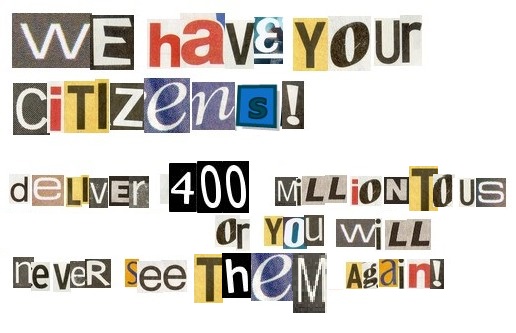
Obama’s Iran-Contra Moment

fake-ransom-note1

As you should know by now, the Wall Street Journal reported

“The Obama administration secretly organized an airlift of $400 million worth of cash to Iran that coincided with the January release of four Americans detained in Tehran, according to U.S. and European officials and congressional staff briefed on the operation afterward.

Wooden pallets stacked with euros, Swiss francs and other currencies were flown into Iran on an unmarked cargo plane, according to these officials. The U.S. procured the money from the central banks of the Netherlands and Switzerland, they said.

The money represented the first installment of a $1.7 billion settlement the Obama administration reached with Iran to resolve a decades-old dispute over a failed arms deal signed just before the 1979 fall of Iran’s last monarch, Shah Mohammad Reza Pahlavi….Senior U.S. officials denied any link between the payment and the prisoner exchange. They say the way the various strands came together simultaneously was coincidental, not the result of any quid pro quo….But U.S. officials also acknowledge that Iranian negotiators on the prisoner exchange said they wanted the cash to show they had gained something tangible….Iranian press reports have quoted senior Iranian defense officials describing the cash as a ransom payment. 

Isn’t this, then, the equivalent of paying ransom for hostages? Continue reading

Ethics Quote—But Not Necessarily ETHICAL Quote!—Of The Month: Supreme Court Justice Ruth Bader Ginsburg

i-was-wrong

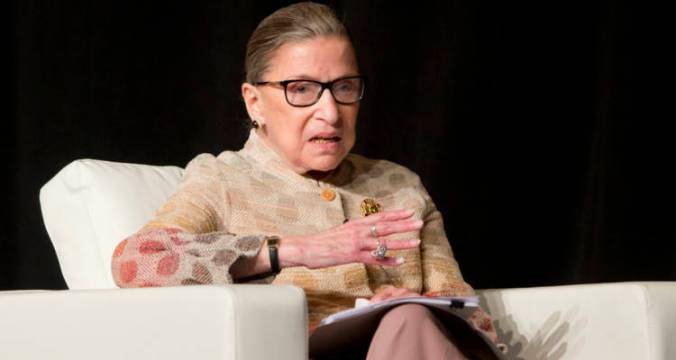
“On reflection, my recent remarks in response to press inquiries were ill-advised and I regret making them. Judges should avoid commenting on a candidate for public office. In the future I will be more circumspect.”

—- Justice Ruth Bader Ginsberg, officially apologizing for making remarks sharply critical of Donald Trump last week, including suggesting (in jest) that if her were elected President, she might “move to New Zealand.”

Observations:

1. Supreme Court justices almost never apologize, and I only say “almost” because I can’t do enough research right now to safely say “never.” They don’t apologize because the don’t have to: they are, ethically, a law unto themselves, and accountable to nobody unless impeached and convicted. (Justice Samuel Chase, was impeached by the U.S. House of Representatives on March 12, 1804, on charges of arbitrary and oppressive conduct of trials; it was a purely political attack. He was, correctly, acquitted by the U.S. Senate on March 1, 1805.)

2. An apology was appropriate, however. Justice Ginsberg proved herself smarter, better, more ethical and more principled than the embarrassing, crypto-facsist “these are not ordinary times” crowd, including the folks at Salon and other left-wing blogs, this guy, and too many of my dear friends on Facebook, whose expressed opinions really are beginning to make me wonder if they will solemnly send me to a Lobotomy Man when I oppose President Clinton’s declaration of open borders, ban on fossil fuels, race and gender quota in all hiring and admissions to (free) colleges, and confiscation of 50% of my property to help pay for national health care including late-term abortion on demand and tax-payer funded recreational drugs.

3. She apologized because any fool could see that her comments did undermine trust in the institution of the Supreme Court, and that her critics were right. Some of my more misguided colleague in the legal ethics field opined that it was silly to think that Justices don’t have political opinions and biases, just as it is silly to think journalists do not, so why shouldn’t she exercise her First Amendment rights? This  lame notion was decisively rebutted by a lawyer whose name I wish I could reveal, except that his comments were on a private list. He wrote in part… Continue reading

Donald Trump Candidacy Ethics Train Wreck Passenger List Update: Georgetown Law Prof. Paul Butler Scores A Perfect Rationalization #28

We're real sorry about this, but these are not ordinary times...

We’re really sorry about this, but these are not ordinary times…

The human ethics train wreck named Donald Trump is now in the process of exposing how thin the veneer of professionalism is for many alleged intellectuals, scholars and lawyers. On an e-mail list of most of the legal ethicists in the country, one of them posted this in reaction to Justice Ginsberg’s unethical and unjudicial shots at Donald Trump:

“I love RBG way too much to be critical of her in any way . Long may she live!”

This opne expression of willful denial, from not merely a lawyer, but an ethics specialist! It is the epitome of one of my father’s favorite quotes, “My mind’s made up, don’t confuse me with facts.” I responded to the list that it was the most depressing statement I had ever read from any of the list’s participants.

Paul Butler’s op-ed in the New York Times isn’t much better. The Georgetown Law Center professor defended Ginsberg’s indefensible comments by arguing that these times are special, and thus suspend the ethics principles that must govern judges if the judiciary is to engender any respect or trust at all. He writes:

“Normally Supreme Court justices should refrain from commenting on partisan politics. But these are not normal times. The question is whether a Supreme Court justice – in this case, the second woman on the court, a civil rights icon and pioneering feminist — has an obligation to remain silent when the country is at risk of being ruled by a man who has repeatedly demonstrated that he is a sexist and racist demagogue. The answer must be no.”

No, Professor, the answer must be “yes.” Continue reading

Ethics Dunce: Supreme Court Justice Ruth Bader Ginsburg

Justice Ginsberg, not giving a damn.

Justice Ginsberg, no longer giving a damn.

Add one more bit of evidence to the pro- side of the debate over whether there should be a limit to Supreme Court tenure. Justice Ruth Bader Ginsburg, 83 and a cancer survivor, has now apparently entered the “What the hell: I’m going to say what I feel like saying” period of her life. How nice for her. The problem is that there are some things an ethical Justice should not and cannot say.

In an Associated Press interview published last week, Ginsberg opined that a Trump Presidency was too awful to contemplate, saying that she presumed Hillary Clinton will be the next president, and that she didn’t ” want to think about that possibility” of Trump being elected instead. Talking to The New York Times, she said, “I can’t imagine what this place would be — I can’t imagine what the country would be — with Donald Trump as our president. For the country, it could be four years. For the court, it could be — I don’t even want to contemplate that.”  Then, in a CNN interview, she got specific:

 “He is a faker…He has no consistency about him. He says whatever comes into his head at the moment. He really has an ego. … How has he gotten away with not turning over his tax returns? The press seems to be very gentle with him on that.”
Law professor Daniel W. Drezner, who teaches at the Fletcher School of Law and Diplomacy at Tufts University,  minces no words over at the Washington Post, nor should he. Like me, he agrees with Madam Justice on the substance of her remarks about, yechh, Donald Trump. Nonetheless, he writes, Continue reading