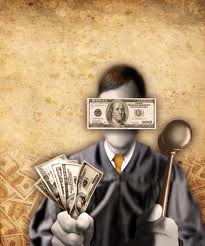
Ethics Hero: New York Courts

Bravo!

New York’s court officials have decided to bar New York’s elected judges from hearing cases involving lawyers and others who make major financial contributions to their campaigns. The New York Times reports that the new rule of the state court system will be announced this week by Jonathan Lippman, the state’s chief judge. “It is believed to be the most restrictive in the country, bluntly tackling an issue — money in judicial politics — that has drawn widespread attention,” said the paper.

The new rule decrees that “no case shall be assigned” by court administrators to a judge when the lawyers or any of the participants involved donated $2,500 or more in the preceding two years. Continue reading

Eroding Public Trust: Obama and General Electric’s “Appearance of Impropriety”

The fact that an official act appears to be sensible and fair does not necessarily mean that it is ethical.

Consider the EPA’s waiver of the new global warming regulations for a stalled power plant project in California. Officials reviewed EPA policies and decided it was appropriate to “grandfather” projects such as the Avenal Power Center, a proposed 600-megawatt power plant in the San Joaquin Valley, and thus exempt them from new federal limits on greenhouse gases and conventional air pollution. The Avenal Energy project, explains Environment and Energy News, is a combined-cycle generating plant consisting of two natural gas-fired General Electric 7FA Gas Turbines with Heat Recovery Steam Generators (HRSG) and one General Electric Steam Turbine.

Translation: It is a huge G.E. contract.

Hmmmm. Continue reading

Dear ESPN: I Know She’s Hot, But Fire Erin Andrews

…or at least suspend her. Show us that a male-dominated sports network can have a modicum of journalistic ethics, and won’t behave like a drooling traffic cop giving a buxom babe a pass for running a red light because she bats her eyes and flashes some cleavage.

You did the right thing in early January, when one of your broadcasters abused a female colleague in a sexist manner; some would say—certainly the fired Ron Franklin—that you reacted a little precipitously, but you are clearly taking a strong stand against gender bias in the workplace, and that’s commendable. Still, don’t you know that what your pin-up, “Dancing With the Stars” reporter Andrews did was far worse? Continue reading

Ethics Dunce Follow-up: Justice Thomas’s False Disclosures

From the New York Times:

“Justice Clarence Thomas of the Supreme Court acknowledged in filings released on Monday that he erred by not disclosing his wife’s past employment as required by federal law.
Justice Thomas said that in his annual financial disclosure statements over the last six years, the employment of his wife, Virginia Thomas, was “inadvertently omitted due to a misunderstanding of the filing instructions. To rectify that situation, Justice Thomas filed seven pages of amended disclosures listing Mrs. Thomas’s employment in that time with the Heritage Foundation, a conservative policy group, and Hillsdale College in Michigan, for which she ran a constitutional law center in Washington.” Continue reading

Ethics Dunce: Justice Clarence Thomas

Will Supreme Court Justice Clarence Thomas be impeached because he failed to disclose his wife’s income, as required by Federal law, for at least five years? No.

Should he be? Probably not, though if it was proven that he intentionally used incorrect information, he could be found guilty of perjury. More likely is a civil penalty. In any event, his wife’s income isn’t a crucial piece of information in Thomas’s case, though his ideological enemies will argue otherwise. Such an omission is virtually never a cause for judicial discipline.

Is it a serious breach of his duties nonetheless? Yes. Continue reading

Ethics Dunce: Colorado Secretary of State Scott Gesslar

Less than a week after taking office, attorney Scott Gessler, Colorado’s newly elected  Secretary of State, announced that he plans to keep working part-time as an attorney for his law firm, the Hackstaff Law Group. In an interview with the Denver Business Journal, Gessler acknowledged that his plan to moonlight as a contract attorney raised ethical issues, but he needed the money.

Well that’s certainly an encouraging ethics orientation! Continue reading

Ethics Quiz: Can You Undo A Past Confict of Interest or Appearance of Impropriety?

In November, Ethics Alarms noted that Melanie Sloan, the head of the ethics watchdog group Citizens for Responsibility and Ethics in Washington, was involved in exactly the kind of Washington insider conflict of interest that the group typically slams politicians for engaging in:

“Melanie Sloan, long the leader and public face of CREW, announced that she is joining the new firm of lobbyist Lanny Davis, a long-time Democratic ally and famous for being Bill Clinton’s most ubiquitous apologist during the Monica Lewinsky scandal…Over the summer,  CREW aligned itself with the for-profit schools industry.  “Today, Citizens for Responsibility and Ethics in Washington (CREW) sent a letter to Sen. Tom Harkin (D-IA), Chairman of the Committee on Health, Education, Labor and Pensions (“HELP”), asking the committee to consider the financial motives of critics of the for-profit education industry,” a July CREW press release began. Later, Sloan again attacked the motives of for-profit school critics in a CREW blog post that linked to an op-ed piece Davis had written defending the for-profit industry. That industry then became a client of Davis’s lobbying firm.

“Got that? Sloan and CREW pushed the interests of Davis’s clients, then Sloan went to work for Davis, where she will, in part, be enriched by the very people whom she assisted in the name of ethics—by attacking the financial motives of for-profit school opponents! This is precisely the kind of D.C. two-step that CREW mercilessly exposes when elected officials do it, and now here is the very same CREW leader who once condemned such corrupt practices, doing it herself.”

Now, for reasons yet undisclosed. Sloan will not be leaving CREW after all.

Does that make everything all right, obliterating the conflict of interest exposed by her decision to take the lobbying job for a firm representing the same interests that CREW had defended? Is the stain of that apparent conflict now erased? Continue reading

Scalia’s Latest Controversy: Does An Appearance of Impropriety Have to Be Reasonable?

Supreme Court Justice Antonin Scalia is once again under critical fire for appearing to feed a conservative bias. He accepted G.O.P. Rep. Michele Bachmann’s invitation to address the Tea Party Caucus next month, as the group holds its first Conservative Constitutional Seminar. Some are claiming that the meeting is unethical, raising the specter of an “appearance of impropriety.” Continue reading

CREW Gets Hoisted: For Ethics Watchdogs, Integrity’s a Bitch

CREW—Citizens for Responsibility and Ethics in Washington—is one of the most active and fairest of political watchdog groups. It has a definite liberal bias, for approximately twice as many Republicans as Democrats manage to attract CREW critiques, but that’s all right: plenty of elected officials from both parties have had their shady dealings exposed by the group, which is notable for its lack of sympathy for Washington’s traditional myths and excuses to allow guilt-free corruption.

An ethics watchdog, however, can never engage in the same conduct it criticizes in others. The reason for this is as much practical as ethical. A group that made a strong case that certain behavior shouldn’t be tolerated by the public in its elected champions doesn’t diminish the validity of its arguments by violating its own principles, but it does symbolically consent to accepting the same standard of review for its own actions that it demanded for its targets. This is what Will Shakespeare called being hoisted by your own petard—blowing yourself up with a bomb of your own construction.

As Shakespeare also noted, the previous quarry of the one who is thus hoisted just love to see this happen. It doesn’t really make what they did any less wrong or the ethics watchdog any less right to have condemned it, but when the critic gets caught doing something similar, it can make the conduct seem less wrong. This also will often guarantee that future criticism by the watchdog will be greeted with more suspicion than respect.

Salon has a posted a well-researched account of how CREW hoisted itself recently, and the prospects for the organization maintaining its previous level of respect and credibility are not good. Continue reading

Should a Prosecutor Be Lenient So A Rich Felon Can Keep His Big Bucks Job?

Good intentions, it is said, pave the road to Hell. It’s an especially direct road when the good intentions are those of a prosecutor who doesn’t have the skills or common sense to reach the correct decision to resolve a rather easy ethical conflict. An ethical conflict occurs when there are valid ethical arguments for diametrically opposed actions, and one must weigh the priorities, implications and likely results in order to make the most ethical choice. Mark Hurlbert, the district attorney for Eagle, Colorado, faced such a conflict, as prosecutors often do. He botched it royally, and that road he’s paving is going to reach far beyond Colorado. Continue reading