artistic freedom
Movie Flop Ethics, Part I: “Richard Jewell” And The Alleged ‘Female Reporter Trading Sex For Scoops’ Smear
The two big flops among movies that opened last weekend were director Clint Eastwood’s “Richard Jewell” and “Black Christmas,” the second attempt to re-boot the 1976 slasher cult film. Both disasters have ethics lessons to teach, or not teach. Let’s look at Clint’s movie first.
“Richard Jewell” made lass that $4.5 million in its first weekend, and has also been snubbed by the various year-end awards. It is based on the now mostly forgotten story of how Jewell, initially hailed as a hero for his part in foiling the 1996 Atlanta Olympics bombing plot, was falsely accused of complicity by local law enforcement, the FBI, and the news media. Conservative outlets loved the film, but the other side of the divide focused on a subplot, as the film’s screenplay suggested that a named Atlanta Journal Constitution reporter, now deceased, used sex to persuade a source to break the story. The Journal Constitution has been attacking the film, denying that Kathy Scruggs would ever used he body to get a scoop. Her colleagues, friends and family all insist that she would not have slept with a source, and reporters around the country circled the metaphorical wagons to proclaim they were shocked–shocked!—that anyone would even suggest such a thing. Jeffrey Young, senior reporter for HuffPost tweeted, “The lazy, offensive, shitty way screenwriters so often treat female journalists infuriates me. Depicting women using sex to get stories is disgusting and disrespectful. It’s also hacky as hell. I was planning to see this movie but not anymore.’ Melissa Gomez of the Los Angeles Times wrote, “Hollywood has, for a long time, portrayed female journalists as sleeping with sources to do their job. It’s so deeply wrong, yet they continue to do it. Disappointing that they would apply this tired and sexist trope about Kathy Scruggs, a real reporter.’ Susan Fowler, an opinion editor at the New York Times tweeted “The whole “female journalist sleeps with a source for a scoop” trope doesn’t even make any sense…”
This would be damning, except that while it may not be standard practice, there are plenty of examples of female journalists doing exactly what Eastwood’s film suggests. Last year the Times—yes, Susan Fowler’s paper—reported on the three-year affair between Times reporter Ali Watkins and James Wolfe, senior aide to the Senate Intelligence Committee, and a regular source for her stories. In October, an employee of the United States Defense Intelligence Agency was arrested for leaking classified material to two reporters, and he was involved in a romantic relationship with one of them. Both reporters are still employed by their respective news organizations, the Times and CNBC, so its hard to argue that sex-for-scoops is being strongly discouraged.
“Melanie Wilkes” Loses Her Defamation Lawsuit…But Was She Right?

A California appellate court yesterday dismissed a defamation lawsuit brought Dame Olivia de Havilland against FX Networks. De Havilland, now 101, is one of the last surviving—and lucid—members of Golden Age Hollywood royalty. Those who are culturally literate know her as Melanie Wilkes, Scarlet’s angelic sister-in-law, in “Gone With The Wind,” Maid Marion in MGM’s definitive “Robin Hood” with Errol Flynn (de Havilland’s most frequent leading man), my personal favorite, poor Bette Davis’s evil tormentor in “Hush, Hush, Sweet Charlotte,” and many other roles in an epic career that won her two Academy Awards. (If you don’t know her, get cracking! What’s the matter with you?)
De Havilland had sued for damages, claiming her portrayal in the Ryan Murphy-produced 2017 docuseries, “Feud: Bette and Joan” about the feud between Davis and Joan Crawford, misappropriated de Havilland carefully nurtured image without her consent, and harmed her reputation by portraying her inaccurately, especially a scene where she is shown referring to her sister, actress Joan Fontaine (“Rebecca,” “Jane Eyre,” “Suspicion”—What is the matter with you?), as a “bitch.”
“When ‘Feud’ was first being publicized, but before it went on the air, I was interested to see how it would portray my dear friend Bette Davis,” de Havilland wrote the New York Times, explaining the suit. “Then friends and family started getting in touch with me, informing me that my identity was actually being represented on the program. No one from Fox had contacted me about this to ask my permission, to request my input, or to see how I felt about it. When I then learned that the Olivia de Havilland character called my sister Joan ‘a bitch’ and gossiped about Bette Davis and Joan Crawford’s personal and private relationship, I was deeply offended.”
“Feud,” she said, represented itself as historically accurate fiction, but falsely portrayed her as a hypocrite “with a public image of being a lady and a private one as a vulgarity-using gossip,” undermining what de Havilland described as a hard-earned reputation for “honesty, integrity and good manners.” Continue reading
Ethics Quiz: Your Swedish Post-Mortem Avatar
Swedish scientists believe artificial intelligence can be used to make “fully conscious copies” of dead people, so a Swedish funeral home is currently looking for volunteers who are willing let the scientists use their dead relatives in their experiments. The scientists want to build robot replicas, and to try to approximate their personalities and knowledge base in their artificial “brains.”
For those of you who are fans of the Netflix series “Black Mirror,” there was an episode closely on point in which grieving woman bought an AI -installed mechanical clone of her dead boyfriend. (This did not work out too well.)
I was about to discard objections to such “progress” as based on ick rather than ethics, when I wondered about the issues we already discussed in the posts here about zombie actors in movies and advertising. Is it ethical for someone else to program a virtual clone of me after I’m dead that will be close enough in resemblance to blur what I did in my life with what Jack 2.0 does using an approximation of my abilities, memories and personality?
I think I’m forced to vote “Unethical” on this one as a matter of consistency. Heck, I’ve written that it’s unethical for movies and novels to intentionally misrepresent the character of historical figures to such an extent that future generations can’t extract the fiction from the fact. (Other examples are here and here.) Respect for an individual has to extend to their reputation and how they wanted to present themselves when they were alive. Absent express consent, individuals should not have to worry that greedy or needy relatives, loved ones, artists or entrepreneurs will allow something that looks like, sounds like and sort of thinks like them to show up and do tricks after the eulogy.
I am not quite so certain about this branch of the issue, however, and am willing to be convinced otherwise. After all, pseudo Jack could stay inside, and only be programmed to do a nude Macarena while wearing a bikini for my wife, while no one else would be the wiser. Or nauseous. And after all, I’m dead. Why should I care? Well, the fact is I do care. For me, this is a Golden Rule issue.
Your Ethics Alarms Ethics Quiz of the Day is this:
Will the Swedes who elect to allow scientists to try to perfect Dad-in-a-Box for nostalgia, amusement, companionship and to take out the garbage be unethical, betraying their departed loved ones’ dignity?
Ethics Quote Of The Week: Peggy Noonan
“Why does all this matter? Because we are losing history. It is not the fault of Hollywood, as they used to call it, but Hollywood is a contributor to it. When people care enough about history to study and read it, it’s a small sin to lie and mislead in dramas. But when people get their history through entertainment, when they absorb the story of their times only through screens, then the tendency to fabricate is more damaging. Those who make movies and television dramas should start caring about this. It is wrong in an age of lies to add to their sum total. It’s not right. It will do harm.”
—-Former Reagan speechwriter and current columnist Peggy Noonan, after citing the material historical misrepresentations in the Netflix series “The Crown” and the new Spielberg film, “The Post.”
I have written about the ethics of misrepresenting history in films many times, always facing the “Lighten up! It’s just a movie!” chorus. As Noonan explains deftly, the stakes are different now, in an age of rotten public education, mass media and internet indoctrination. The first time I wrote about this issue was 2010, in the post “Titanic” Ethics. It concluded in part,
I don’t blame Cameron for not basing his portrayal on evidence that only was clarified years after his film. I fault him for discounting the testimony of survivors, and misinforming the public by plastering a false version on a giant screen for millions to see, knowing that they would trust that a man who would insist that the doomed ship’s china pattern was accurate…Now the film is back, bigger than ever, and false representations of Officer Murdock, “Unsinkable” Molly Brown, the sinking itself, and other aspects of the iconic event will be embedded even deeper into our historical understanding. It didn’t have to be that way, and it is wrong that it is. History, the public, and the 1500 who died that night in 1912 deserve better.
I’ve seen “The Crown,” and like it a lot. The portrayals that Noonan complains about, however, especially the suggestion that Jack Kennedy abused Jackie, rang false immediately. As for “The Post,” which I haven’t seen, Noonan calls out a misrepresentation of a cultural villain whom the film-makers probably thought nobody would rise to defend: Continue reading
Unethical Quote Of The Week: Gateway Pundit’s Lucian Wintrich
“On Friday, June 16, 2017, Laura Loomer, a patriot activist and journalist, took the stage at Shakespeare in the Park’s performance of “Julius Caesar”, a performance where liberals applaud as President Trump’s assassination is shown in full bloody detail. Laura was arrested for speaking out against this performance.”
Lucian Wintrich on the right wing blog Gateway Pundit, describing the disruption of the Shakespeare in the Park “Julius Caesar “production
What makes a blog post especially unethical? Oh, many things: misstatement of facts, ignorant analysis, sensationalism, incompetence, not being able to distinguish right from wrong and good from bad, appeal to bias and stupidity. Wintrich’s post, absurdly called “Proud Conservative Woman Was Arrested Friday at Trump Assassination Play – Help Pay Her Legal Fees *HERE*!” has all of this and more.
The conservative woman, along with her conservative male partner in attempted censorship, has nothing to be proud of. She’s proud of emulating the leftist crypto-fascist students who have been using intimidation and riots to prevent conservatives from speaking? She’s not a patriot, since patriots don’t intentionally ignore core American principles like freedom of expression and speech whenever they feel like it. The word Wintrich is looking for in his limited vocabulary is “hypocrite.”
She was also not arrested for “speaking out” against this performance. This can only be a lie, or Wintrich is too stupid to be allowed to put his shoes on by himself. You cannot be arrested in the U.S. for “speaking out,” and nobody ever is. He is trying to inflame the stupid and ignorant, or he is stupid and ignorant. Laura, the jerk, was arrested for interrupting a theatrical performance that she had absolutely no right or justification to disrupt. Just so there is no mistaking his dishonest, inflammatory and ignorant description as entirely deliberate, Wintrich, the hack, repeats it, writing,
“The left keeps calling President Trump a fascist dictator, but speaking out against assassinating a Democratically elected President apparently gets you arrested in New York City.”
Comment Of The Day: “Ethics Observations On The ‘Shakespeare in the Park’ Trump As Julius Caesar Production”
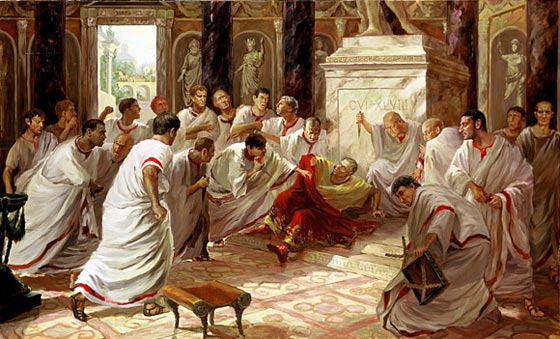
It was a pleasure to see eloquent and thoughtful teacher/blogger Curmie back commenting after a hiatus, and his timing could not have been better, as the controversy over the nightly assassination of a Julius Caesar who appears to be President Trump’s twin has become even more relevant since an anti-Trump zealots started picking off Republican Congressmen with his rifle.
Curmie is a theater professional with keen perspective on artistic freedom and a proven facility with ethical analysis. Here is his Comment of the Day on the post, Ethics Observations On The “Shakespeare in the Park” Trump As “Julius Caesar” Production:
Not surprisingly, I suppose, I’ve been thinking a lot about this story lately—enough to post about it twice on my own blog. Not having seen the production, I can’t say for certain that it does or doesn’t do X or Y. But I wonder if what we’re dealing with here is a variation on the theme of the Second Niggardly Principle.
[Ethics Alarms note: “When an individual or group can accomplish its legitimate objectives without engaging in speech or conduct that will offend individuals whose basis for the supposed offense is emotional, mistaken or ignorant, but is not malicious and is based on well-established impulses of human nature, it is unethical to intentionally engage in such speech or conduct.”]
A couple of points first. Drama, especially in the West, has always been political. I would argue (although I suspect the majority of my fellow theatre historians would disagree) that the Dionysian Festival, generally regarded as the birthplace of formal theatre (although there was almost certainly theatrical activity of some kind before that) was created less to honor Dionysus—a rather obscure demi-god worshipped primarily in Asia Minor—than to consolidate the political power of the tyrant Peisistratus.
Whether or not this is the case, it is unquestionably true that the Dionysia was used as a site for political speeches (e.g., Pericles’ funeral oration), and that the plays themselves commented on contemporary events (e.g., the Oresteia on the reforms of Ephialtes three years earlier, or Oedipus Tyrannos on the plague). Old Comedy—the plays that would have been contemporaneous with the work of the great Athenian tragedians—was explicitly political, often vulgar, and uniformly iconoclastic. These comic critiques of the powerful were seen by the state as an important part of the cultural life, much as the Feast of Fools became a staple of the medieval calendar. Similarly, Americans knew we were going to be all right after 9/11 when David Letterman started telling Bush jokes again. Continue reading
Ethics Dunces: Right-wing activists Jack Posobiec and Laura Loomer, Plus The Instapundit And Anyone Who Applauds Them.
Jack Posobiec and Laura Loomer, adopting the censorious and antispeech tactics of those they despise, disrupted yesterday’s evening showing of the Shakespeare in the Park production of “Julius Caesar” that features a graphic assassination of a President Donald Trump version of Caesar.
Loomer rushed the stage shouting that the scene was an “act of political violence against the right,” and said the play was “unacceptable.” The play was briefly halted, and the crowd appropriately jeered as Loomer was taken away by security. Then Posobiec stood up and shouted, “You are all Goebbels! Goebbels would be proud!” He also also shouted that the blood of wounded Republican Congressman Steve Scalise was on the audience’s hands.
A play is free speech and performance art, in this case, political performance art. The actors have a right to present the play, and the audience has a right to watch it. Nobody has a right to disrupt the performance, no matter what the subject matter is, and no matter what the motives of the disrupters may be.
Jack Posobiec and Laura Loomer are hypocrites. Glenn Reynolds, law professor and USA Today columnist, disgraced himself by writing,
“Is this dumb? Yeah, but that never stopped lefties and now they’re getting to see what it feels like to have your hair pulled.”
…thus endorsing a pure tit for tat, mob ethics, “you do it to us so we’ll do it to you” ethics death-spiral. A law professor. He should be ashamed of himself, especially as the Instapundit, an icon of the Right, a status I have seen him abuse too often already. Continue reading
Morning Ethics Warm-Up: 6/13/17
1. The controversy over the Central Park “Julius Caesar” casting Donald Trump–his stage clone, really—as Caesar continues to be ignorantly argued. What’s worse, Fox News constantly calling the Shakespearean classic an “assassination play” (it’s not, not even close), or people who really would love to see Trump assassinated arguing that there’s a double standard because some professional productions of “Julius Caesar” in recent years cast a black actor as the targeted emperor? Does anyone for a second believe that if a high-profile theatrical production depicted a character as clearly intended to symbolize Obama as the New York City production styles its Caesar as Trump being assassinated in a scene like the one below, there would not have been equivalent, indeed greater outrage?
The most cited production with a black, modern business-suited Caesar had an actor with a shaved head playing the role, clearly signalling that this was NOT Barack Obama. This, however, is “Donald Trump”:
My question is: Does the audience cheer? I bet they do, and I bet that’s exactly what the director wanted. I support the production, and reject efforts to pressure donors into pulling support. Theater is often political, and outrageous, and should be. But the play’s defenders who cite versions that evoked a black leader as equivalent are arguing that people are more upset at a faux Trump assassination than they would have been if “Obama” were slaughtered in Central Park, and that is absurd.
2. Another looming boycott is the effort to punish NBC’s Megyn Kelly for interviewing InfoWars’ Alex Jones, the professional conspiracy theorist and right-wing liar. Because he famously suggested that the Sandy Hook massacre was a hoax—an instant IQ test for anyone deciding to ever pay attention to this jerk again—Sandy Hook parents and their allies are condemning NBC and Kelly for “giving him a platform,” and have succeeded in getting one sponsor, JP Morgan, to drop its ads. How long before both ends of the political spectrum start routinely pushing boycotts of any journalists who “give a platform” to someone their “side” has pronounced as evil? The Sandy Hook victims’ families continue to abuse the sympathy their tragedy evoked by using it to attack core rights using appeals to emotion and little else. Some quotes from the Washington Post story: Continue reading
Ethics Observations On The “Shakespeare in the Park” Trump As “Julius Caesar” Production

In New York City, Public Theater’s free Shakespeare in the Park festival this summer begins with a version of “Julius Caesar“, in which Caesar is played by an actor made up and costumed to look like the current President of the United States, and Calpurnia (Caesar’s wife) is portrayed as a runway model with a Slavic accent. Some of the costumes include Anonymous masks and the infamous pussy hats. When Caesar/Trump is assassinated in the Senate, the murderers are women and minorities.
Oooo! Subtle!
The production has been in previews since May 23, and opens tonight at the Delacorte Theater in Central Park. Criticism of the concept, theater and its financial supporters has been roiling all week, and many have compared the play to Kathy Griffin’s severed Trump head stunt. Fox News reported that it “appears to depict President Trump being brutally stabbed to death by women and minorities.” Well, yes, that’s right. Now some prominent corporate sponsors have publicly withdrawn their financial support, including Delta and Bank of America.
Delta’s statement:
“No matter what your political stance may be, the graphic staging of ‘Julius Caesar’ at this summer’s free Shakespeare in the Park does not reflect Delta Air Lines’ values,” Delta said in a statement on Sunday night. Their artistic and creative direction crossed the line on the standards of good taste. We have notified them of our decision to end our sponsorship as the official airline of the Public Theater effective immediately.”
Bank of America:
“The Public Theater chose to present ‘Julius Caesar’ in a way that was intended to provoke and offend. Had this intention been made known to us, we would have decided not to sponsor it. We are withdrawing our funding for this production.”
Other sponsors, such as Time Warner and the New York Times, have stood fast. Said the Times:
”As an institution that believes in free speech for the arts as well as the media, we support the right of the Public Theater to stage the production as they chose.”
Ethics Observations:
[Do remember that I am a professional stage director, previously the artistic director of a professional theater for 20 years, and that I dealt with donors, individual, corporate, non-profit and government, all that time.] Continue reading
 Ethics Alarms
Michael West has written a remarkable Comment of the Day in several respects. For one thing, it is a comment on a post that is almost eight years old, a record for Ethics Alarms. For another, he becomes the first commenter to comment on the same post under two different screen names. Finally, there is the fact that his point is one with historic validity, yet seldom if ever mentioned by the many critics of James Cameron’s epic yet intermittently ridiculous film, including me. Follow the tag: there are a lot of references to “Titanic” here.
One note in prelude to Michael’s essay: the cruel misrepresentation he alludes to can be partially laid at the now dead feet of Walter Lord, who wrote the influential and popular account of the Titanic’s sinking, “A Night To Remember.” It is an excellent account, but he decided to use Charles John Joughin as comic relief, and the movies, including the one based on his book, distorted his portrayal, which itself seems to have been unfair.
Here is Michael West’s Comment of the Day on the 2012 post, “Titanic Ethics”