Afternoon Ethics Notes, 12/17/2019: Miller, Hillary and the Duke [CORRECTED]

Hark!

1. Lesson: Don’t underestimate the Duke! It looks like John Wayne is stronger than the cancel culture after all.  Earlier this year the Woke Avengers tracked down an old Playboy interview where the actor made some inflammatory remarks about blacks and Native Americans (I thought then and I think now that the Duke was deliberately trolling his liberal critics, but it was still a bad interview.) Predictions were rife that the most enduring, influential and popular screen icon of all time had reached the end of his run. It doesn’t appear so: at least two cable channels are running John Wayne film marathons on or around Christmas.

2. The ethical response: feel compassion for Hillary. There are people who get run over and squashed by life, their own failings, and bad luck. We don’t have to like all of them, but the Golden Rule argues that we should feel some pity and compassion for them, even though many have brought some of their misery on themselves.

I think about this when I see, for example, Marcia Clark, the losing prosecutor in the O.J. Simpson case, and her desperately tucked and altered face as she transitioned into a B-media personality. The earliest example of this syndrome that I can remember noticing was perennial Republican Presidential candidate Harold Stassen, with his dazed expression and bad toupee, who once thought he was going to be President. Dubbed the “Boy Wonder,” Stassen was only 41 when he seemed to be on his way to winning the Republican nomination for President for the 1948 election in which President Harry Truman was widely regarded as both a lame and dead duck. Stassen lost the convention battle, however, to Thomas Dewey, of subsequent “Dewey Defeats Truman!” fame. After that, Stassen ran for President in 1952, 1964, 1968, 1980, 1984, 1988, and 1992 , gradually becoming a laughing stock. (He also ran unsucessfully for Governor of Minnesota,  the United States Senate twice, Governor of Pennsylvania twice, Mayor of Philadelphia once; and U.S. Representative). I just thought he was a buffoon until my father told me about his many accomplishments before his dreams were crushed. He was one of the founders of the United Nations, for example.

As I made pretty clear in 2016, when I wrote almost as many critical posts about her and her generally awful ethics as I did about our current President when he was a candidate, I am not a fan of Hillary Clinton. I’ve continued to write critical commentary about her, because she continues to operate with wildly malfunctioning ethics alarms. She is stuck now, in Kübler-Ross terms, in the first three stages of grief: denial, pain and guilt, and anger and bargaining because she lost the election she was certain she was going to win. (So is the entire Democratic Party.)

Now look at her:

3. Marvin Miller makes it into the Hall of Fame. Yecchh. Marvin Miller was described in his obituary as “an economist and labor leader who became one of the most important figures in baseball history by building the major league players union into a force that revolutionized the game and ultimately transformed all of professional sports.” I have no quarrel with any of that. Miller was a labor activist who did his job extremely well. I would put him into a labor leader’s Hall of Fame—-I’m sure one would get at least a hundred or so visitors a year—without blinking. He no more belongs in the the Baseball Hall of Fame in Cooperstown, NY than I do, but he was posthumously elected to that Hall of Fame last week.
Continue reading
In Sports, Discretion Is The Enemy Of Integrity

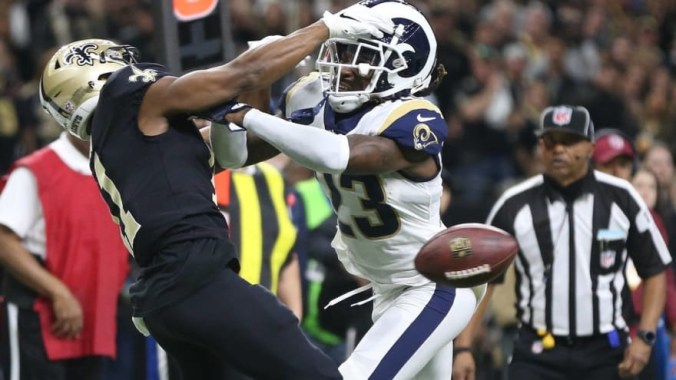
The Denver Bronchos last second win over the San Diego Chargers last weekend was one more game decided by a controversial pass interference call. That rule, with which the NFL has been tinkering and which is now complicated by a video review system, is becoming increasingly controversial this season. Wrote Times football columnist Ben Shpiegel,

[E]very week across the N.F.L.’s vast empire one player interferes with another before a pass arrives — and goes unpunished for it. In these moments, when yellow penalty flags remain lodged in officials’ pockets, aggrieved coaches weigh emotion against reason: Do they challenge the non-call, hoping that by sheer luck it will be overruled by the new video review mechanism? Or do they stew on the sideline, red flag pocketed, and resign themselves to the unlikelihood of a reversal?…After 12 weeks of wasted challenges and lost timeouts, of inconsistency and obfuscation, the league’s erratic application of the defined standard for overturning an on-field decision — “clear and obvious visual evidence” — has made the football masses yearn for simpler times, such as when no one knew what constituted a catch. Over all, through Week 12, 15 of 77 reviews of pass interference were overturned, though nearly half of those reversals — seven of 15 — were initiated by the officials in the replay booth, who are responsible for challenges in the last two minutes of the half… The questionable calls have dented confidence in a mechanism ostensibly intended to restore it after a mess of an N.F.C. championship game, in which Rams cornerback Nickell Robey-Coleman, without consequence, walloped Saints receiver Tommylee Lewis before the ball arrived.

The dilemma isn’t restricted to football. In any sport where an official’s judgment plays a big role in game results, the interjection of technology and the universal broadcast of games has created an integrity crisis. Before multiple camera angles and the  possibility of replays, umpires and referees could blow a crucial call and nobody would be the wiser, or at least would be able to prove that the game was decided by a non-player’s botch. Now, bad calls are there, on a big screen, then the internet, for all to see over and over. The Luddite argument that missed calls are the “human element” and “part of the game” made sense when there was nothing to be done about it. It is ridiculous now. Continue reading

Ethics Catch-Up 11/14/2009: Better Late Than Never

Good morning!

Good Afternoon!

Good Night!

I started this post at about 10 am, and again, and again, and each time another post topic intervened, pushing the daily Warm-Up from the beginning of the day to the end of it…

1. Yet another shield becomes a sword…Add caller ID to the list of useful developments ruined by unscrupulous technology. I was recently tricked by what my phone said was a call by the Social Security Administration, and it included a phone number that I had recently received a legitimate call from, via an agent. This call was a scam. Investigating, I found that there are inexpensive apps available at the Android and Apple app stores with no limitations on who can purchase them that have few if any legal of legitimate purpose. SpoofCard, TraceBust, Fake Call Plus and more  allow a caller to enter any ID they choose, and any number. They also offer menus of background sounds, various voice pitches and other features to facilitate fraud.

When ethics fail, the law must step in, and these apps should be illegal.

2. Mona Lisa Ethics. “Leonardo’s painting is a security hazard, an educational obstacle and not even a satisfying bucket-list item. It’s time the Louvre moved it out of the way” shouted a New York Times sub-headline.” It’s hard to argue with the article’s conclusion….or its author’s contempt.  Here’s a photo of the typical crowd in the Louvre’s room where the Va Vinci painting is exhibited:

The Times observes…

Content in the 20th century to be merely famous, she has become, in this age of mass tourism and digital narcissism, a black hole of anti-art who has turned the museum inside out…Relocated to the Richelieu painting wing, the Mona Lisa reduced the museum’s Flemish collection into wallpaper for a cattle pen, where guards shooed along irritated, sweaty selfie-snappers who’d endured a half-hour line. The overcrowding was so bad, the museum had to shut its doors on several days. “The Louvre is suffocating,” said a statement from the union of the museum’s security staff, who went on strike…[The author] went up with the crowds recently. Things were no better. Now, you must line up in a hideous, T.S.A.-style snake of retractable barriers that ends about 12 feet from the Leonardo — which, for a painting that’s just two and a half feet tall, is too far for looking… visitors…could hardly see the thing, and we were shunted off in less than a minute. …Pathetic new signs [read]: “The Mona Lisa is surrounded by other masterpieces — take a look around the room.”

Morons. These are the fruits of celebrity culture and the spread of the sick addiction to self-celebration. Taking selfies of an art masterpiece only has the objective of proving an idiot was there, for other idiots who are impressed. Meanwhile, those who might really appreciate the painting are  prevented from doing so. Continue reading

The Houston Astros Cheated In Their 2017 Home Games On The Way To The World Championship. MLB Should Strip Them Of That Title.

I’ve thought a lot about this since learning that the Houston Astros, baseball’s best team over the last three seasons and this year’s World Series losing team, has been exposed as cheating by using technology to steal signs during the team’s 2017 Championship season, and perhaps in subsequent seasons as well. Former Astros pitcher  Mike Fiers revealed this week that the Astros deployed a secret center-field camera during home games to help steal signs from opposing catchers, and relaying them to Astros batters. Here is the background to consideration of the ethics question this raises, which is, simply put, “Now what?”

Sign-stealing in baseball is the act of decoding an opponent’s signs, usually the catcher signaling which pitch to throw. Traditional and legal sign-stealing involves a runner on second base decyphering the signs and relaying them to the batter by some kind of physical signal. Using out-of uniform personnel, like employees with binoculars in the stands, or hidden cameras, to steal and relay signs is not legal. It is forbidden, and considered cheating.

Fiers said the Astros had a camera set up in their stadium’s center field with a feed sent to a television monitor in the tunnel next to the Astros’ dugout. Astros players and team employees could watch the live feed and would relay the pitch by banging loudly on a garbage can in the tunnel. Reporters at “The Athletic” confirmed his account. So far, the only part of the scheme that has been proven is the Astros regular season home games in 2017, not the post-season or World Series (although it would be strange if the team suddenly stopped cheating when the games counted most) and not the 2018 or 2019 seasons, though it is a rebuttable presumption that if the Astros were successful doing this in one season, they would continue the practice.

MLB issued a memo clarifying the ban on technological cheating to steal signs in 2019, but no team was under the misconception that using a camera to steal signs wasn’t flagrant cheating long before 2019. Undoubtedly, the Astros will try to use the fact that the MLB guidance came out in 2019, after the team’s 2017 conduct, as a mitigating factor.  It isn’t. Continue reading

Ethics Warm-Up, 11/8/19: “People Who Need To Leave” Edition

1. Clean-up on the baseball aisle! Last April, I wrote a post urging Baltimore Orioles first-sacker Chris Davis to retire and save his desperate team some money, since it is clear that he can no longer play at a major league level despite being paid 23 million dollars in 2019, with a similar amount due him through 2022. At the time, Davis Davis was 0-for-23 with 13 strikeouts and  hitless in 44 at-bats since the previous season, when Davis batted .168, the worst in major league history for a regular, with a horrible .539 OPS (On base percentage plus slugging percentage), and a -2.5 WAR, meaning that the Orioles would have won 2.5 more games with a borderline major leaguer from the minors playing in his place.

Several readers have emailed me asking how things turned out for Davis, who did eventually get a hit, and who was still in the starting line-up frequently enough to hurt the team. The answer is that Davis was better than he was in 2018, but he was still horrible. He batted only .179, with a -1 WAR, and an OPS of  .601. He earned more than $418,000 per hit.

He’s earned almost 119 million dollars in his career, yet appears willing to continue to embarrass himself and hurt his team and team mates for three more sure-to-be-ugly seasons in order to collect another 69 million.

Yechhhh.

2. More on Joy Behar’s terrible, no good, very bad week: The highlight of Donald Trump Jr.’s visit to “The View” came after Behar recited the typical and overly-familiar talking points about Trump Sr.: “[President Trump] called some Mexicans rapists [Correction: He referred to illegal immigrants from Mexico as rapists who were rapists] , he attacked the handicapped, [No, Joy, he mocked a single handicapped reporter, and there is some evidence that he didn’t even do that], he bragged about it” [Huh?], and “We heard the ‘Access’ tape, where he bragged about grabbing women by their genitalia.” [No, he never said that he had personally grabbed any women “by the pussy.” Boy, am I sick of THIS narrative..] Rather than quibble with her, DJT Jr, had come armed and ready, and replied, “We’ve all done things that we regret, I mean, if we’re talking about bringing a discourse down, Joy, you’ve worn blackface.” Continue reading

Comment Of The Day: “Ethics Dunce And Revealed Jerk: Former Houston Astros Pitcher Gerrit Cole”

For non-fans with the imagination to explore them, the Ethics Alarms baseball posts usually involve interesting ethics issues that are relevant to other fields. Perhaps no such post exemplifies this more than the recent essay reacting to a controversy after the 2019 World Series. The favored Houston Astros had lost in shocking fashion to the underdog Washington Nationals in a dramatic seventh game, and its ace pitcher, Gerrit Cole, apparently couldn’t wait to shed his Astros jersey and announce his free agency, which is widely expected to provide him with more than a third of a billion dollars. While the rest of his team was consoling each other and licking their wounds, Cole donned the cap of his super-agent’s company, and proclaimed that he was no longer on the team.

Ethics Alarms veteran commentator Glenn Logan was previously a distinguished sports blogger—though concentrating on college basketball, not baseball—and he authored the following Comment of the Day on the post, Ethics Dunce And Revealed Jerk: Former Houston Astros Pitcher Gerrit Cole”:

I usually demure on baseball-related commentary because I don’t watch professional baseball much, but this one struck me as much more generally applicable than usual:

“Is it ever competent, responsible business to make an established jerk the top salaried employee in your organization? Isn’t that a version of The King’s Pass?”

I think that’s a great question.

So let’s look at this in a non-sports context. Would we be okay as an employer with paying top salary to a talented guy with a well-known public reputation for being a self-centered asshole who is anything but a team player? His results are indisputable, but his personality is abrasive, his maturation is completely arrested at fifteen, his learning curve is as steep as the Nevada Salt Flats, and every time he opens his mouth he embarrasses his employer.

I’m going to say yes. We hired just such a guy as President of the United States. So Americans are either incompetent, or, perhaps, the results are sometimes worth the price.

So that’s the question for whoever Cole’s next employer is. “Is this meat worth the pain?” If yes, then, well, break out the gold card, boys! Continue reading

And Yet Another Evening Ethics Watch, 10/29/2019, Because Everything Has Been Upside Down At ProEthics Lately…

Good evening again.

We’ll have to stop meeting like this.

1. Can’t make up my mind if I want there to be disastrous botched ball/strike call in Game 6 of the World Series or not. It will take one of those—a bad call that turns the game and eventually the World Series around to get MLB off its metaphorical butt and force it to establish an electronic pitch-calling system. Of course, it is worth noting that one of the most devastating wrong umpire calls in history stole a World Series away from the St. Louis Cardinals in 1985, and it took another 30 years for baseball to adopt an instant replay system that would have reversed it.

Don Denkinger was the first base umpire in Game 6 of the 1985 World Series in Kansas City.  The St. Louis Cardinals led the home team Royals by 3 games to 2, and tooka 1–0 lead in the 8th inning. In the bottom of the ninth, Jorge Orta, the leadoff batter for the Royals, hit a slow roller to Cards first baseman Jack Clark. Clark tossed the ball to his pitcher, Todd Worrell, who was covered first base. Orta was out by half a step, but Denkinger called Orta safe, even though television replays and photographs clearly showed that he was out by half a step. Orta eventually scored, allowing the Royals to go  on to win Game 6 by the score of 2–1.

Denkinger was the home plate umpire in the Series-deciding Game 7, apparently driving the angry Cardinals mad. Denkinger ultimately ejected both Herzog and pitcher Joaquín Andújar in the fifth inning, as the game deteriorated into Royals rout,  11–0 . Denkinger accepted that he had made a terrible call, but as was the ethics in baseball at the time, took the position that such mistakes were an unavoidable part of the game. In  aftermath of the 1985 World Series, Denkinger death threats, from Cardinals fans. Two St. Louis disc jockeys doxxed him, giving out the umpire’s telephone number and home address. He was a well-regarded umpire, who at 83 years of age will still sign photographs of “the Call” when asked.

I guess I don’t want to see another umpire suffer Denkinger’s  fate tonight. It is inevitable that there will be a bad call of a strike or ball that makes an umpire a lifelong pariah, unless baseball locks that barn door as soon as possible. Continue reading

Monday Evening Ethics Feature, 10/28/2019: Boo! Lyric Woking! Name-Calling! And Much, Much Worse…

Good evening.

1. World Series ethics observations:

  • It was little noticed, but Houston Astros pitcher Gerrit Cole did something admirable and unusual last night on the way to dominating Washington Nationals hitters and leading his team to a 3-2 lead in the best-of-seven series. At one point in the game, Nationals first-baseman Ryan Zimmerman laid off a tantalizing pitch just off the plate with two strikes on him. Cole could be seen saluting the batter and saying “Good take!” It is rare to see a baseball player acknowledge an adversary’s skill on the field.

I wouldn’t mind seeing such gestures more often.

  • The President not only attended the game last night, but stayed unusually long for a dignitary, who usually go to baseball games to be seen more than to watch. Trump stayed until the 8th inning, when much of the discouraged Nats fandom was streaming to the exits. I wrote last week that I hoped he would subject himself to the fans’ ugliness, and they responded as we knew they would, loudly jeering and chanting “Lock him up!” It was a black eye for Washington, D.C., not President Trump.

Continue reading

Saturday Ethics Pitch, 10/26/2019: Calvin Coolidge Was Right, Baseball is Wrong, And Other Revelations

Here it comes!

1. Oh-oh...I was worried about this. Early in the baseball post-season there were rumors flying that MLB had deadened its baseballs after a 2019 season that saw records shattered for homer frequency. I wrote (somewhere this month: I can’t find it) that if the sport really did mess with the balls at this point it would be a massive breach of ethics, changing the conditions of the game when the games mattered most.

So far, the conspiracy theorists have been bolstered by the statistics.

 Baseball researcher Rob Arthur revealed in a Baseball Prospectus report on October10 that after nearly 20 postseason games, home runs were occurring at at half the rate the 2019 season’s homer frequency would predict. Arthur allowed for the fact that better pitchers and hitters  made up  playoff teams, and still  concluded that the ball was not flying as far as it did during the regular season. “The probability that a random selection of games from the rest of the regular season would feature as much air resistance as we’ve seen so far in the postseason,” he wrote, “is about one in one thousand.” A follow-up report by Arthur again found significant variation in the flight of the ball this postseason.

This isn’t good.

2. It’s not even 2020, and the New York Times isn’t even pretending  to be objective. Two examples from today’s Times:

  • In a story about Tulsi Gabbard announcing that she would not run for re-election to the House, the Times spun for Hillary Clinton, writing, “Last Friday, Hillary Clinton suggested that Republicans were “grooming” her for “a third party run”, though Ms. Gabbard has denied any such plans.” What was notable about Clinton’s smear was that she said that Gabbard was “a favorite of the Russians. They have a bunch of sites and bots and other ways of supporting her so far.”  This is a variety of “fake news” that the Times excels at, telling only part of the story to manipulate public perception.
  • Headline (Print edition) : “Speaking at Black College, Trump Ridicules Obama For Effort on Racial Equity.”  Wow, what a racist! Attacking efforts at racial equity! In fact, the President criticized the paltry results of Obama’s efforts to advance racial equity. He in no way ridiculed Obama for making those efforts.  Again, the Times is now a master at playing to its anti-Trump readers confirmation bias.

Continue reading

Morning Ethics Warm-Up, 10/23/2019: On “Lynching” And Other Things

The day looks good, feels bad…

1. No, “lynching” is not the right word for the Democratic Party/”resistance”/news media impeachment assault. The word worked for Clarence Thomas during the Anita Hill ambush, but someone ought to remind the President that Thomas was and is black.

The correct word is coup. This has always been what the effort to delegitimatize and remove Trump has been, and this is what it remains. “Witch hunt,” which some idiot issued as an anti-impeachment talking point again a couple of weeks ago, is also an inappropriate term. It may accurately evoke the McCarthy-like methods being used, but it is historically and politically confusing, focusing on methodology rather than objective.

The inability of this President and his staff to communicate competently is a dangerous weakness. It has always been so, but now more than ever. The public literally doesn’t understand what is going on, and a clear, credible, trustworthy advocate for the President who is able to explain what is so wrong, so insidious, and so damaging to democracy about what the “Troika of Totalitarianism” (I’m trying to imagine what Spiro Agnew would have called them) have been doing since the 2016 election is an essential bulwark against impeachment and conviction. Even someone like—I can’t believe I’m writing this—Lanny Davis would be an upgrade.  Kellyanne Conway destroyed her credibility with her “alternate facts” gaffe. Rudy Giuliani got himself enmeshed in the Ukraine controversy. Mick Mulvaney proved, with his naive and ham-handed explanation about why there is nothing criminal or inappropriate about any President using the leverage of his office to persuade a foreign government to do something that needs doing, that he isn’t up to the job. And the President is foolish to believe that his tweet-storms are an effective remedy against  a news media determined to tell only one side, the “resistance” side,  of the issues.

Why, for example, isn’t there an advocate for the White House who can point out, clearly, that the misleading characterization in this morning’s Times front page “news” story—the New York Times no longer does “news” involving Trump, only adversary spin—that the President used strong-arm tactics to force the Ukraine to “investigate Mr. Trump’s political rivals”? Joe Biden isn’t “political rivals,” he’s a former Vice President of the United Sates who may have been using his high position to enrich his son and warp foreign policy.

At this point, Joe Biden isn’t an official election opponent of the President either. It is completely legal and responsible for our government to find out exactly what was going on in the Biden-Biden-Ukraine tango, and the idea that a President cannot legally pursue investigation of serious misconduct in the previous administration because the members of it can now be called his “rivals” is, or should be,  a transparent Catch-22 concocted to advance the coup. Is that really so hard to explain? Why isn’t anyone explaining it?

A prominent  reason is that one of the more effective and damaging tactics in the coup attempt has been to intimidate and threaten any competent D.C. professionals who could advise and assist a President under siege. Until the Trump administration, the accepted norm when a patriotic member of the Washington establishment, regardless of party,  was invited to help a President was for the individual so invited to say, “Of course.” This was how President Clinton persuaded Reagan advisor David Gergen to rescue his administration from self-immolation.

Today, any political establishment figure, no matter how well-respected before, can count on being savaged in the news media if he or she agrees to join the administration, as well as harassed if they go out for dinner. The phenomenon effectively gives this White House a lobotomy by making it a huge and risky sacrifice to try to assist the White House.  It also isolates the President, and increases the chances of him making his situation worse out of anger, frustration, and his unfortunate lack of impulse control.

This too has been part of the coup strategy from the beginning: withhold from this President all of the honors, respect, fairness, deference and cooperation every other President has earned as a right of office by virtue of being elected, and eventually he will do something that will justify impeachment.

It’s a coup. “Lynching” just muddies the waters, and in this dirty business, muddy waters is exactly what the “resistance” wants and needs. Continue reading