Unethical App of the Year: BuyPartisan

The un-American app at work. Just what we need...more help at being divided.

The un-American app at work. Just what we need…more help at being divided.

One thing we can be sure of in our capitalistic, entrepreneurial culture: if there’s toxic conduct that somebody can make a buck out of facilitating, someone will.

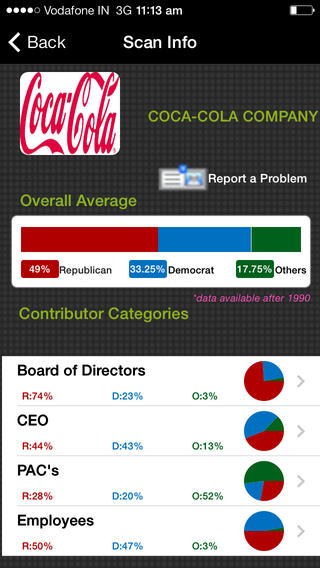
BuyPartisan is a new smartphone app and the inspiration of app developer Spend Consciously. It allows users to receive an instant ideological score on every product, designating the manufacturer or service provider as virtuous or evil, or, as this sick, hyper-partisan, hyper-polarized, disintegrating culture would have it, Republican or Democratic, conservative or liberal.  After the self-righteous, hating-the-other-side-of-the-political-spectrum user scans the bar code on products with his or her phone camera, BuyPartisan (Get it???) accesses campaign finance data and analyzes contributions from the company’s board of directors, CEO, employees and PACs. This allows the happy, political aparthied-loving app user to stick it to any company that doesn’t comport with the user’s narrow, but absolutely right beyond question, view of the world.

Yecch. I want an app that tells me who uses this app, so I can avoid them whenever possible. Continue reading

Shock: CREW Finally Comes Clean… It Wasn’t So Non-Partisan After All!

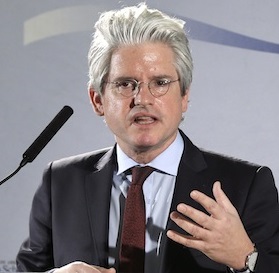
Yes, David Brock really does wear his hair like that, and yes, I admit being biased against anyone who does.

Yes, David Brock really does wear his hair like that, and yes, I admit to being biased against anyone who does.

There is a real need for a fair, non-partisan, non-ideological ethics watchdog organization in Washington, D.C. Unfortunately, what we are stuck with is the Center For Responsibility and Ethics in Washington, headed by Melanie Sloan, and it is none of these things. The only clue on the group’s website, however, is the fact that Republicans are somehow found to be engaging in unethical conduct at a rate of about three times that of Democrats, and the Democrats CREW does criticize are so blatantly unethical that an old, blind and deaf watch dog would be disgusted by the stench. The mainstream news media, and which on the whole is about as unbiased as CREW is, still cites the Center as a “non partisan” source, all the better to attack Republicans with a semblance, though a deceptive one, of objectivity. CREW has operated, and quite dishonestly, as a nonprofit registered under a section of the Tax Code — 501(c)3, which prohibited partisan activity.

To be clear: CREW has done some excellent work flagging unethical conduct by Republicans officials. It is the lying about being objective that makes it an unethical organization. I wrote about CREW’s facade here, and here, and also noted when it briefly dropped is pose when Sloan briefly joined that famously objective operative and lobbyist Lanny Davis’s firm—this is the same Lanny Davis who became a familiar fixture on TV spinning his friend and client Bill Clinton’s conduct during the Monica scandal—shortly after CREW blatantly pushed the interests of Davis’s clients on its website.

Continue reading

Is There An “Almost Naked Lovely Lawyer Principle”?

cathy-mccarthy

Not really.

But it’s complicated.

Cathy McCarthy (above) is a 2013 graduate of Loyola Law School-Los Angeles, and she is sounding the clarion call for the right of bikini model-lawyers to be taken seriously. She wrote…

I graduated law school a year ago after receiving an academic scholarship and passed the California Bar last November on my first try. I am also a model and have had moderate success, building fan base of over 26,000 people where I do mostly bikini promotions. Does this make me better or worse at my job? According to some people, it makes me unable to be taken “seriously” in the business community. In fact, two weeks ago, I was reprimanded by a coworker for my online presence and was told to “handle the situation.”I fought back and was ultimately let off the hook, but this is not the first time that I have faced backlash from colleagues who think that a lawyer should not also get the privilege of “looking hot in a bikini.”

Unlike the case with primary and secondary school teachers, where a published presence on the web that is sexually provocative can interfere with a healthy student-teacher relationship, there is no automatic impediment to a lawyer client relationship posed by the lawyer moonlighting as a bikini model, a fold-out, or even a porn star. The profession acknowledges this in several legal ethics opinions affirming lawyers’ First Amendment rights. Lawyers can express themselves any way they choose, provided that it does not undermine their ability to represent their clients in any way. Continue reading

Woody Allen, James Shigata, And Diversity Casting Ethics

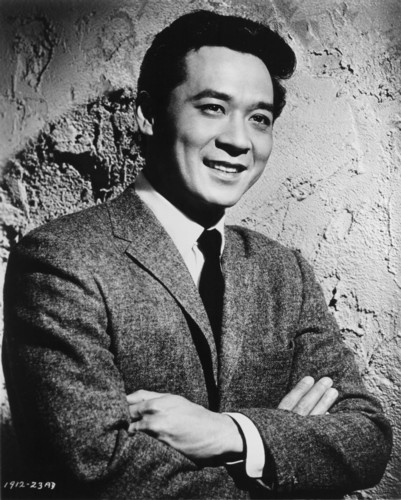
You have no idea who this is, do you? Well, it shouldn't have turned out  that way...

You have no idea who this is, do you? Well, it shouldn’t have turned out that way…

I’m sure you heard about James Garner’s recent death, but were you aware of James Shigata’s passing? Shigata, who died July 28 at the age of 85, was a contemporary of Garner’s, a superb actor, and like Garner, a leading man with leading man looks. James Shigata, however, was of Asian descent, though American through and through, and never escaped the perceived limitations of the shape of his eyes. Though he had a starring role in the hit film adaption of  the Rodgers and Hammerstein musical “Flower Drum Song” and routinely received critical acclaim for all of his film work, but though he got roles on television through the ’80s, he never was able to break through the typecasting straightjacket that deemed him only suitable for “Asian” roles. If you remember him as all, it is probably as the brave Japanese executive shot by Allan Rickman in “Die Hard.”

I thought about Shigata when I read a piece in Salon, noting that director Woody Allen didn’t cast African-Americans in his movies, and that his explanation why didn’t justify the neglect. Prachi Gupta writes, Continue reading

Ethics Dunce: Mary’s Gourmet Diner in Winston-Salem, N.C.

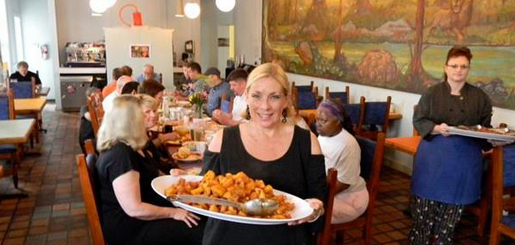
Welcome to Mary's! Some are more welcome than others...

Welcome to Mary’s! Some are more welcome than others…

I wish this were a joke, (thinking back on the previous post) but apparently it’s not.

The diner gives a 15% discount to customers who appear to say grace before eating. Yes, it’s a public prayer discount. Mary’s  has been doing this for years, a co-owner confirmed to NPR. Finally someone posted a receipt with the line item for “15% Praying in Public ($6.07)” to Facebook.

I detest this kind of thing, and so should you, because it is ethically indefensible and un-American to the core. The policy, whether it is well-publicized or quietly implemented as this one was, exacerbates societal divisions and embraces bias and prejudice. There may be a legal difference between this and charging a premium (that is, a penalty) to those who have Obama stickers on their cars or who are wearing T-shirts with the logo of the local team’s nemesis, but ethically it is all the same: splitting the world into them and us, good guys and bad guys, the virtuous and the reviled. All of “Mary’s” customers are human beings, and that is the only thing that should matter in the United States of America.

Now that this offensive policy has been outed, the question is this: Is it unethical for a non-believer to pretend to pray in order to get the diner’s unethical discount for the godly? Of course it is.

It’s also unethical to patronize a restaurant that discriminates against its own patrons.

___________________________

Facts: NPR

Ethics Quiz: Four Young Children Locked In A Hot Car

kid-in-hot-car

Mom and mom advocate Lenore Skenazy writes the Free Range Kids blog, which I have to remember to check out regularly. She is the source of today’s Ethics Quiz, which she obviously believes has an easy answer. We shall see.

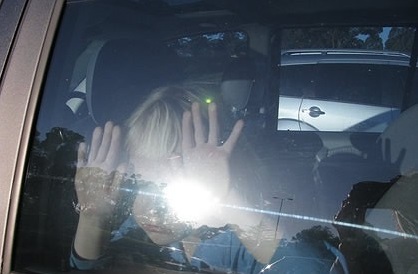
Charnae Mosley, 27, was arrested by Atlanta police and charged with four counts of reckless conduct after leaving her four children, aged 6, 4, 2, and 1, inside of her SUV with the windows rolled up and the car locked.  It was 90 degrees in Atlanta that day. The children had been baking there for least 16 minutes while their mother did some shopping. A citizen noticed the children alone in the vehicle and reported the children abandoned.

Skenazy believes that the arrest is excessive—that the mother made a mistake, but that compassion is called for, not prosecution:

“[T]he mom needs to be told that cars heat up quickly and on a hot summer day this can, indeed, be dangerous. She does not need to be hauled off to jail and informed that even if she makes bail, she will not be allowed to have contact with her children…No one is suggesting that it is a good idea to keep kids in a hot, locked car with no a.c. and the windows up. But if that is what the mom did, how about showing some compassion for how hard it is to shop with four young kids, rather than making her life infinitely more difficult and despairing?The kids were fine. They look adorable and well cared for. Rather than criminalizing a bad parenting decision (if that’s what this was), how about telling the mom not to do it again?”

Do you agree with her? Here is your Ethics Alarms Ethics Quiz of the day:

Was it cruel, unfair, unsympathetic or unkind for Atlanta police to arrest Mosely for leaving her four young children locked in a hot car?

I am an admirer of Lenore Skenazy, but her pro-mother bias led her seriously astray this time. I think she is applying rationalizations, consequentialism and dubious, indeed dangerous reasoning to let this mother off a hook that she deserves to stay on. In her post, she even suggests that the car’s air conditioning was on, though there is no reason to believe that it was based on the reports. If the A-C was on, that changes the situation: I very much doubt that a mother would be charged with leaving four children in a locked, hot car if the car was not, in fact, hot. (One report states that the SUV windows were open, but that wouldn’t support the charges. If the windows were open, then Mosely left her children alone in public, which is a different form of child endangerment, but still dangerous. For the purpose of the quiz, I am assuming that the windows were shut, and that the air conditioning was not on. So does Skenazy.)

Let’s look at Lenore’s analysis errors:

  • She notes that the children were “fine.” What if they hadn’t been fine? That wouldn’t change what Mosely had done in any way, and what she did was irresponsible, dangerous and potentially deadly. Sixteen minutes, scientists tell us, is more than enough time for temperatures in a closed car to rise sufficiently high to cause heat stroke. Mosely, and obviously her children, were lucky—this is classic moral luck—and that shouldn’t be allowed to diminish the seriousness of what she did. (Aside: I just realized that to find that link, I made the same Google search that Justin Ross Harris made before leaving his infant son to die in his own hot vehicle, which has added to the circumstantial evidence causing him to be charged with murder.)
  •  The rationalizations peeking through Slenazy’s excuses for the mother’s conduct are quite a crowd. Along with #3. Consequentialism, or  “It Worked Out for the Best,” there is #19. The Perfection Diversion: “Nobody’s Perfect!” or “Everybody makes mistakes,” it’s twin, #20, The “Just one mistake!” Fantasy, #22. The Comparative Virtue Excuse: “There are worse things,” #25. The Coercion Myth: “I have no choice,”  #27. The Victim’s Distortion, #30. The Prospective Repeal: “It’s a bad law/stupid rule,” and #33. The Management Shrug: “Don’t sweat the small stuff!” There are probably some more, but that’s plenty.
  • If Skenazy believes that the “it was just a mistake” explanation should protect the mother from prosecution here, presumably she would make the same argument if all four kids (or just one) died. A lot of prosecutors feel the same way. I don’t.
  • If Mosley did this once, she may well have done it before, and is a risk to do it again. The best way to teach her not to do it again is, at very least, to scare her, inconvenience her, publicly embarrass her, and use the legal system to show how serious her wrongful conduct was, and how seriously society regards it. There is no guarantee that a lecture from a cop wouldn’t have just produced just an eye-rolling “Whatever…my kids were just fine, and I know how to take care of them” reaction, a repeat of the conduct, and eventually, a tragedy….followed, of course, by public accusations that the police were negligent and abandoned four children to the care of a dangerously reckless and incompetent mother.
  • I’m sorry, Lenore, but this-“How about showing some compassion for how hard it is to shop with four young kids, rather than making her life infinitely more difficult and despairing?” —makes me want to scream. How about not having more children that you can take care of safely? How about recognizing that your children’s safety comes first, with no exceptions, ever? How about meeting the minimum level of parenting competence, and not remaining ignorant about conduct that has been well publicized as cruel and potentially fatal to dogs, not to mention young children? In this case, compassion is a zero-sum game: compassion for the mother means showing none for her children.

When ethics fails, the law steps in. Too many children die every year from this tragic mistake that arises from distracted parenting, ignorance, and poorly aligned priorities. Prosecuting parents like this one for non-fatal incidents is exactly how the law serves as a societal tool to increase public awareness and encourage better conduct. It is in the best interests of Mosely’s four children as well as the children of every parent who reads about or hears her story to prosecute her to the full extent of the law.

_______________________________

Pointer and Source: Free Range Kids

Facts: Yahoo!, WSB
State Of U.S. Journalism: “Conflict of Interest? Oh, THAT Old Thing!”

At last report, rolling in his grave...

At last report, rolling in his grave…

I believe that the field of journalism ethics has been negated, as the news media now routinely ignores the most obvious conflicts of interest, and make no effort  to avoid them, address them, or disclose them.

Case #1: Taking orders from Hamas

 Hamas has published media guidelines instructing Gazans to always refer to the dead as “innocent civilians” and to never post pictures of armed Palestinians on social media. Hamas has prevented foreign reporters from leaving the area, and it is easy to see how foriegn journalists would conclude that the best way to ensure their safety is to avoid angering their “hosts.” Seemingly mindful of these concerns, the New York Times’ reporting on the Gaza conflict from Israel depicts tanks, soldiers, and attack helicopters, while virtually all images from Gaza are of dead children, weeping parents, bloody civilians, ruined buildings, overflowing hospitals, or similar images of pain, carnage and anguish. As Noah Pollack noted in the Weekly Standard website,  a Times photo essay today contains these images:

“…three of Gaza civilians in distress; one of a smoke plume rising over Gaza; and three of the IDF, including tanks and attack helicopters. The message is simple and clear: the IDF is attacking Gaza and harming Palestinian civilians. There are no images of Israelis under rocket attack, no images of grieving Israeli families and damaged Israeli buildings, no images of Hamas fighters or rocket attacks on Israel, no images of the RPG’s and machine guns recovered from attempted Hamas tunnel infiltrations into Israel.”

Is this just naked anti-Israel bias, or is the Times simply trying to report the story without getting its reporters’ into further peril? I’ll be charitable and presume the latter: fine. But that defines a clear conflict of interest that mars the objectivity of the Times’ reporting, and the paper has an ethical obligation, under its own guidelines, to disclose it in every report where it might be relevant.

It has not. Continue reading

Children Make Us Stupid, Or “Why Are U.S. News Networks Assisting Brutal Palestinian Propaganda?”

child victim

“Children make us stupid” is but a corollary to the law often stated here, “Bias makes you stupid.” Our natural bias in favor of caring for, protecting and seeking happiness for children is genetically wired into our being. Thus, in action movie after action movie, when the villain puts a gun to a child’s head, the hero invariably drops his weapon, apparently giving the world over to dictatorship, pestilence or death to save one rosy-cheeked kid. (Well, except for Dirty Harry, who picks off the creep holding the gun to the kid’s head with one well-aimed shot.) The trade-off is really, really stupid, and not ethical either: sacrificing the welfare of the many for a single child is simply illogical and wrong. But to those sentimentalists who don’t strain themselves by thinking, and to cynical politicians who know better but also know that convincing morons is all it takes to win “a majority” ( “…if even one child’s life can be saved…“—President Obama, 2013 State of the Union Message), the human bias that gives irrational priority to children is pure gold.

Obama’s use of the false ethic was  his call for gun control in the wake of the Sandy Hook tragedy, in which an anomalous attack on a grade school was used to make it seem like children were being hunted down like rabbits. We are currently watching another classic demonstration of the “children trump everything” fallacy, and it is both a logical and an ethical fallacy:  the emotional and irresponsible rhetoric over the fate of the unaccompanied South American children being sent to the United States as a predictable response to Democratic promises of a better life, a college education, and eventual citizenship. The fact is that child illegal immigrants are just as illegal and just as undesirable as any other variety: they are just cuter, sadder, less culpable and easier to use to demonize principled opposition.

It is not surprising that the Palestinians, who pioneered using children as suicide bombers, figured out that sacrificing their own kids might be a dandy way to turn public opinion against Israel in its long, mad, apparently endless quest to eliminate the Jewish state. Israel turned over control of Gaza to the Palestinians there, and the Palestinians elected Hamas, which seeks, as written policy, the elimination of Israel. Instead of  using its resources to create a state and a stable infrastructure for society, Hamas spent millions importing and producing rockets, launchers, mortars, small arms, and even drones to do battle with Israel. It built a network of tunnels, and stockpiled the weapons in hospitals, religious sites, and crowded residential areas, using these locales to fire a barrage of rockets into Jerusalem and Tel Aviv. Continue reading

Comment of the Day: “The Obama Outhouse Float: Not Racist, Just Wrong”

Obama float

Rick Jones, a drama professor, deep thinker and superb writer, weighed in on the controversy over the tasteless Independence Day float in Norfolk, Nebraska. (As an aside: did my trip to Nebraska last week unleash something in the Ethics Cosmos? First this story, then the Nebraska judge telling the Supremes to “stfu”?) Rick courageously wades into the messy and contentious area, often discussed here, of racial motivations behind criticism of Barack Obama. Here is his Comment of the Day on the post, The Obama Outhouse Float: Not Racist, Just Wrong:

I’ve written about this incident, as well, and we generally but don’t totally agree.

I’m intrigued by the discussion of racism. Certainly I agree that nothing in the events described qualifies as inherently racist… but I think the word “inherently” matters here. The fact that there is not an obvious racial motivation for what is clearly an intentionally offensive float, one which displays its creator’s “disgust,” does not mean that it is intrinsically devoid of such volition. Even the little boy who cried “wolf” was right once. Similarly, whereas there are those who reflexively scream “racism” at every criticism of the current President, that doesn’t mean that there aren’t expressions of anti-Obama sentiment which really are grounded in the fact that he has a little more melanin than you or I do.

In this case, Ms. Kathurima and her daughter have experienced racism—or believe they have—and you say that you “don’t blame her” for perceiving it in this instance. Nor do I. That Mr. Remmich intended to insult the POTUS, I think goes without saying. Why, specifically, he set out to do so is an open question. Maybe it’s racial. Maybe it’s political. Maybe he knows his neighbors and pandered to their predilections. I certainly don’t know, and I wouldn’t be surprised if he doesn’t, really, either.

I grapple with a variation on this theme constantly in my professional work, especially in the area of communication theory as it applies to aesthetics. Oversimplified a little, the modernist/positivist view is that the sender of a message creates and encodes meaning, and the receiver’s job is to “find” the meaning through a process of decoding. The post-positivist view, however, is to argue that the sender catalyzes rather than creates meaning, that meaning is in fact created by the receiver of the message. To me, the two positions are equally valid.

One of my standard approaches to this dilemma is to suggest to students that “somewhere in this room is someone who has had a major fight with a loved one because what one of you thought you said was not what the other thought he/she heard.” Moreover, whether the “blame” for a misinterpretation should be placed with the sender or the receiver is likely to be influenced in your mind not so much by philosophical or theoretical concerns as by which of those positions you happened to occupy on the occasion in question.

We are left, then, with two significant questions, neither or which I am prepared to answer with confidence. 1). Is the meaning of a communication determined by the sender, the receiver, or by some presumably objective external agent? 2). At what point does a particular reaction pass from confirmation bias into, well, experience?

_______________________

Continue reading

Independence Day Ethics: Historian Hype, Liberal Bias, And The Great Punctuation Mystery

founding-fathers-declaration-of-independence

First, a little background…

I have often found it depressing that historians so often lack the ethical integrity necessary to do their jobs. If there was any profession in which avoiding bias would seem to be paramount, historical research and analysis would seem to be it, but that just isn’t the case. Because historians are academics and scholars, and because academia has become almost exclusively a hot-house of left-ward ideology for more than half a century, too many historians view their duty as using the past to manipulate the present and future.

My introduction to this came early, when I was a fifth grader suddenly fascinated with the U.S. Presidency as the first national election that I could follow approached. I read various assessments of who the greatest of our past POTUSes were, and there was near consensus, it seemed. Washington and Lincoln, naturally, were “the berries,” and they were joined as “greats” by Jefferson, Jackson, Wilson, FDR, and Truman, Democrats all. Teddy Roosevelt was “near great”; Eisenhower was a dud. What a great party this Democratic Party must be! Of course, Jefferson’s racial hypocrisy, Jackson’s lawlessness and persecution of Native Americans, Wilson’s racism and bungling of the peace after World War I and FDR’s complicity in locking loyal Japanese-Americans in prison camps was never mentioned. Over time, I learned that even the most respected American historians were likely to be pursuing partisan agendas. The classic example, of course, was Arthur Schlesinger, Jr., who carefully and unforgivably culled the facts he deemed worthy of revelation in order to add John Fitzgerald Kennedy to that list of brilliant Democratic Presidents. Was I surprised when a large number of prominent American historians signed a petition opposing the impeachment of President Clinton, a Democrat, thus asserting that a degree of dishonesty and lack of trustworthiness that was sufficient in every state in the union to mark a lawyer as unfit to practice was nonetheless not sufficient cause to remove a President from office?

I was not.

This brings us to the Case of the Missing Comma, brought to us by Danielle Allen, a professor at the Institute for Advanced Study in Princeton, N.J., aided and abetted by her left-leaning allies. Allen (who by the purest coincidence has a book out!) claims a major discovery. The iconic sentence in the Declaration of Independence“We hold these truths to be self-evident, that all men are created equal, that they are endowed by their Creator with certain unalienable Rights, that among these are Life, Liberty and the pursuit of Happiness.–”—was not intended to end in a period, as all current quotations and reproductions show, and the official transcript produced by the National Archives and Records Administration indicates.  Allen claims that her extensive research indicates that the period at the end of that phrase almost certainly did not appear on the original parchment version of the Declaration, and was mistakenly included in later versions. Just in time for July 4th (when Allen’s publicist calculated that her “Eureka!” would get maximum exposure) Allen explained to the New York Times that the extra period contributes to a “routine but serious misunderstanding” of the famous document signed by the Second Continental Congress in 1776. Continue reading