Women And Education, Part 2. Comment of the Day: “Ethics Heroes: The Sweet Briar Alumnae And Their Supporters”
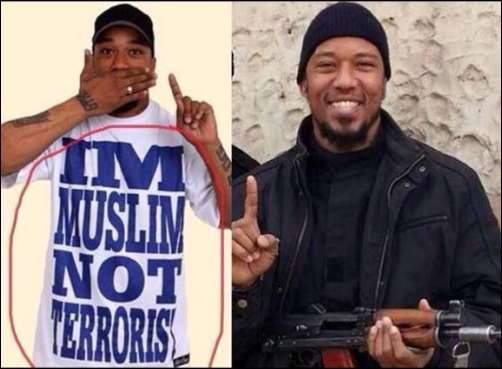
The picture above shows Denis Cuspert, a German rapper and the enterprising creator of the T-shirt he is holding in the shot on the left. The photo on the right shows Denis in his current incarnation, Abu Talha Al-Almani. He formally joined the Islamic State sometime in April 2014. It is believed that he has become the Islamic State’s chief propagandist in the German language, inspiring disillusioned young Germans to become jihadists. In November 2014, he appeared in an Islamic State video holding a severed head.
I saw the photo above online this morning, and it reminded me that I have never made an important point about bias explicit here. Bias causes a lot of problems, in society and in the life of individuals, but those who furiously condemn bias and demand that we should eradicate it from human nature are reckless and ignorant, and often dishonest as well. Bias is a crucial evolutionary feature that allows human beings to avoid making the same mistake twice, or a hundred times. It is linked to trust, and leads to wariness. Without the ability to form biases, every one of us would be fatally naive, and a victim waiting to be harmed. Continue reading
I confess that I initially took little notice of the Tim Hunt episode because I thought it turned out right, and that few would disagree. I think the ethics issues are obvious and unambiguous. Apparently not, as some commentators argue that he was dismissed for “political correctness.”
Prof. Hunt, who is 72, and this is a major factor in his downfall, is a renowned biochemist who was awarded the Nobel Prize in Physiology or Medicine in 2001 for his work on cell division. He was also knighted in 2006. He was addressing an audience at the World Conference of Science Journalists in South Korea this month, and for some reason was inspired to say this:
“Let me tell you about my trouble with girls. Three things happen when they are in the lab: You fall in love with them, they fall in love with you, and when you criticize them they cry.”
This was, as the professor would have known if he were n0t 72 and unaccustomed to the ways of social media, immediately tweeted around the world, making him the target of scientists, educators, students, feminists and almost everyone else but Rush Limbaugh. Horrified and still clueless, Hunt went on the radio to “clarify,” saying that his remarks were “intended as a light-hearted, ironic comment.” This is known as the futile “It’s just a joke!” excuse here at Ethics Alarms, but knights don’t read Ethics Alarms. Continue reading
Extradimensional Cephalopod, Ethics Alarms’ mysterious, erudite, squid-like commenter, offers this fascinating, if puzzling, perspective on the Rachel Dolezal scandal. I think he’s agreeing with my conclusion that this episode exposes the absurdity and corrupting effects of the progressive obsession with race. I don’t know that this was really told to him by a “space alien elementary school teacher,” but it may well have been said by someone who self-identified as one, and if so, what difference, at this point, does it make?
Here is EC’s Comment of the Day on the post, Further Observations On The NAACP’s Self-Made African-American Exec. Continue reading
When I wrote about Rachel Dolezal’s strange and provocative racial charade as my first post of the day, I had not read any other commentary on the subject. I was surprised at the degree to which the subject subsequently dominated the web, as well as the rapidity with which many, though not all, of the themes raised in my various questions were echoed elsewhere—parallels with Elizabeth Warren and Caitlyn Jenner among them. Now that there are some other reactions, as well as some statements from the active participants in this cultural mess—and it is a mess–let me add to my commentary.
1. Some commentators, like Instapundit Glenn Reynolds, appear to think the story is a joke. The tone of some of my earlier comments was intended to be ironic, but this is no joke, and the issues it forces society to deal with, or go into denial regarding, which itself is no joke, are important and perhaps represent a cultural tipping point.
2. Rachel Dolezal represents a crisis for the sloppy thinkers of the left. (There are sloppy thinkers on the Right, too, but this story doesn’t expose them.) They need to choose their words carefully, and so far, I have seen no evidence of that. Modern progressive cant is thoroughly polluted with false constructs, hypocrisy, double standards and absurd mandated beliefs regarding diversity, tolerance and fairness, and this story exposes much of it. I wonder if the progressive activists even realize the bind they are in? It is a dilemma they created themselves by assuming that the pile of contradictions they were amassing would be ignored forever if they threatened and insulted anyone who pointed to it. Dolezal just made their shallow exploration of their own truths untenable. Continue reading
Rachel Dolezal, a prominent civil rights activist, the leader of Spokane’s NAACP chapter, chairwoman of the city’s Office of Police Ombudsman Commission and a professor in the African Studies Program at Eastern Washington University, has been falsely representing herself as black for years. When someone is asked if he or she is really black, and the answers he or she comes up with includes “That question is not as easy as it seems,” and “We’re all from the African continent,” it’s fair to say the jig is up.
Or is it? Although Dolezal’s mother has spoken out about the 37 -year-old’s background, noting that there is no black ancestry that they know of in the family and that Rachel’s self-identification as black seems to arise out of the fact that she was raised with adopted African-American siblings—you know, like Steve Martin in “The Jerk”?—she may well sincerely believe she is black. Then what?
Dolezal’s actual race, if there is such a thing in her case since she sometimes identifies herself as “white, black, and American Indian,” has suddenly become an issue because she has reported alleged instances of harassment and hate crimes. An inquiry has also been opened at Spokane City Hall. “We are gathering facts to determine if any city policies related to volunteer boards and commissions have been violated,” Mayor David Condon, who appointed her to the city oversight board, and Council President Ben Stuckart said in a joint statement. “That information will be reviewed by the City Council, which has oversight of city boards and commissions.”
Stuckart said the council will meet soon to discuss the developments and that he didn’t want to speak for the group until then. “But if this is true I’ll be very disappointed,” he said..
Is Dolezal credible? Is she courageous? Is she deluded? Is she nuts? Or is being black just, as Gore Vidal said about Truman Capote’s death, a good career move?
Some ethics musings:
Continue reading
When I posted with disgust on the Tahera Ahmad story (a Muslim-American woman who reported on Facebook that she was discriminated against by a stewardess and subjected to verbal abuse by a passenger on a United Airlines flight, and that no passengers came to her aid of defense), I noted that the facts seemed hard to believe, and that my commentary was based on a presumption that the account was true without knowing whether they were.
Now there have been two developments that provide additional perspective on the incident, and no enlightenment whatsoever.
First, United announced that it has investigated the incident, and fired the flight attendant. This would suggest that Ahmed’s account had at least some validity…or that the flight attendant got a fat settlement as United fired her to avoid a public relations battle with Muslim groups.
Second, this was posted on FlyerTalk Forums: Continue reading
Slate’s article by Jordan Weissmann, its senior business and economics correspondent, about the largest donation ever made to Harvard University is one of those monstrosities that has great value as an ethics test. If you think his argument is reasonable, then you need help.
Essentially, the Slate piece is the ultimate example of an unethical argument I have focused on before, which can be summarized as, “If you give to what you care about rather than what I care about, then your donation is unethical.”
Unless your contribution is to ISIS, or isn’t really a contribution but an attempt to buy access for your own purposes (like with, to pick an example out of the air, a donation to the Clinton Foundation), there is nothing unethical about a $400,000,000 donation, which is what John Paulson just gave to Harvard University’s endowment for the School of Engineering and Applied Sciences. The school will be renamed after Paulson, which Weissman also finds repugnant. The title of the piece: “Billionaire’s Ego Donates $400 Million to Harvard.”
Let me pause here to note that I refuse to give my money to Harvard, which solicits me regularly. The university is rich, I’m not, and I prefer to give my charitable gifts to Georgetown Law Center, specifically to the student theatrical organization I founded there, which like all theater groups, needs funds. I am sure Weissman finds my contribution unethical as well, because, really, what good are the arts compared to what he has decreed is worth giving to as the “more pressing causes in the world”? As he sees it, that is, but that’s all that matters.
Let me go through Weissman’s many objections that cause him to sneer at Paulson’s charity:
1. “Gestures to Ivy League schools …inevitably have as much to do with the giver’s ego as their sense of altruism.” Yes, and so do almost all philanthropic donations, regardless of source and objective. The motto in fundraising (I was a professional fundraiser for a decade) is that donors give money for their purposes, not yours. People who give a lot of money to good causes like to have some recognition, and they deserve it. Apparently Weissman believes that the only ethical donations are anonymous ones, because that’s modest. I’m impressed by anonymous gifts, though they often have selfish motivations as well: the donors don’t want to be hounded by more fundraisers. Nevertheless, that lack of modesty is so trivial as a flaw in large charitable contributions that to harp on it is perverse. Successful people tend to have egos that are often in proportion to their accomplishments. The construct of the left is, we know, that accomplishments and success are just randomly distributed fruits of privilege, ergo the self-esteem that often results from such success is as unsavory as the privilege that generates it.
This is, to be blunt, un-American crap.
2. Harvard “does not strictly need more money, especially compared to the financially strapped colleges that typically educate lower-income students.” First of all, this is demonstrably false. Harvard does need more money if it is going to expand and improve its School of Engineering and Applied Sciences, secure that school’s financial health in perpetuity, and do so without sacrificing other objectives it deems important. Harvard also educates lower-income students, the best and brightest of them, and thus the best resources money can buy are expended on the students most likely to make the best use of them for the benefit of society. Weissman believes this is wrong, and that the 400,000,000 should be given to lesser schools, with less of a track record of spending money wisely, while educating less promising students.
I am in sympathy with that argument to some extent. The marginal utility of all that money is less at Harvard than anywhere else, and I can envision the donation having a far more sweeping impact elsewhere: giving it to Sweet Briar, for example. That does not mean there is anything wrong in any way with bolstering Harvard’s School of Engineering and Applied Sciences. The donation is an unequivocal, absolute good.
The money could have been spent “better”? That’s your opinion. It’s not your money. Shut up. Continue reading
I don’t understand how this episode could happen as it has been described. I am assuming for the purpose of the post that it did, and thus have almost nothing to add to the story other than to ask “What the hell is the matter with these people?”
Tahera Ahmad, an associate chaplain and director of interfaith engagement at Northwestern, described the alleged incident on Facebook while she was on the United flight from Chicago to Washington, D.C. Friday night.She wrote that she was in tears following an ugly episode that began with her request for a Diet Coke when the beverage service reached her row. The flight attendant had given her an opened can of Diet Coke. When Ahmad requested an unopened can, the flight attendant told her, “Well, I’m sorry. I just can’t give you an unopened can, so no Diet Coke for you.”
Then the same flight attendant gave another passenger an unopened can of beer. Ahmad said she asked why the man was given an unopened beverage can, but she was forbidden from having one. The flight attendant, according to Ahmad, replied, “We are unauthorized to give unopened cans to people, because they may use it as a weapon on the plane.”
Ahmad told the flight attendant she felt she was being discriminated against, and the flight attendant quickly grabbed the man’s beer can, opened it and said, “It’s so you don’t use it as a weapon.” When Ahmad asked for support from other passengers, a man sitting in an aisle across from her said, “You Muslim, you need to shut the fuck up,” Ahmad said.
“What?” a shocked Ahmad said. The passenger looked her in the face and said, “Yes you know you would use it as a weapon, so shut the fuck up.” “Some people just shook their heads in dismay,” Ahmad wrote on Facebook. But nobody rose to her defense.
After the flight, the attendant and the pilot apologized to her, and United issued a lame mea culpa. It doesn’t matter. Everybody on the plane except for Tahera Ahmad should hang their heads in shame.
What the hell is United (or whoever made the “unopened can” policy, if there really is such a deranged policy) thinking? A can of soda is a weapon? There must be hundreds of things in carry-on luggage that would make a more plausible weapon than a soda can. Like pens. Like laptops. Like powercords. Like dop kits. Like electric razors.
Like fists and feet. Ridiculous.
Gee, I always thought they opened those cans to be nice…
What the hell was the flight attendant thinking? Making that excuse to Ahmad, and then handing a male passenger an unopened can right in front of her? What an obvious insult! Continue reading
“Can’t you ever stop thinking about ethics?” my wife said to me a few minutes ago. We were walking around historic Williamsburg, Virginia—I have seminar to teach in a couple hours—and I saw a ceramic wall hanging for sale at the charming Christmas store in the town square. It read…
Maybe it’s an old joke, but I hadn’t encountered it before. I thought it was kind of funny in a “this is a parody of over-the-top, ‘a woman needs a man like a fish needs a bicycle’ seventies feminism” way, but I find myself wondering…
-Would progressives consider this “eliminationist rhetoric?” Hate speech?
-If not, why not?
-Would a gender-reversed version of the joke be funny? Would feminists consider it offensive? Would such feminists defend the wall-hanging? Continue reading
To this, Amy Tabb, a Sweet Briar alum, replied..
Now here is Humble Talent’s Comment of the Day, in response to Amy, in response to Humble Talent, on the post Ethics Heroes: Sweet Briar Alumnae and their Supporters. I’ll have my own post on the topic of “gender segregated” higher education in Women and Eduction, Part 3.