Three Word Summary of “Working at Anheuser-Busch, I Saw What Went Wrong With the D.E.I. Movement”: “It was D.E.I.”

“The principles that built great American companies are simple: Hire the best people, serve your customers well and let merit and financial results determine success. While expanding opportunity and making employees feel welcome are worthy goals, how D.E.I. policies were carried out often strayed from these foundational principles and might have even created other forms of discrimination.”

It might have even created other forms of discrimination! Gee, ya think?

In a jaw-dropping example of the “Tell me something I don’t know” variety of journalism, the New York Times gives us “Working at Anheuser-Busch, I Saw What Went Wrong With the D.E.I. Movement” (Gift link!). Anson Frericks tells us that water is wet with the solemnity of a doctor announcing a cancer diagnosis. He was shocked–shocked!—when his company, having announced its commitment to “DEI,” turned down a beneficial distribution arrangement with another company because “being associated with Black Rifle was too politically provocative, especially in progressive circles.” This, in 2022, two years after the beginning of the George Floyd Freakout, made Anson realize that his employers were more interested in virtue-signalling to the Looney Left than selling beer.

What did he think “diversity, equity and inclusion” was going to mean?

Continue reading

KABOOM! How Can A Company—A CANDY Company No Less!—Possibly Think This Packaging Is Responsible?

Well, there goes my head again, and I really need it this weekend.

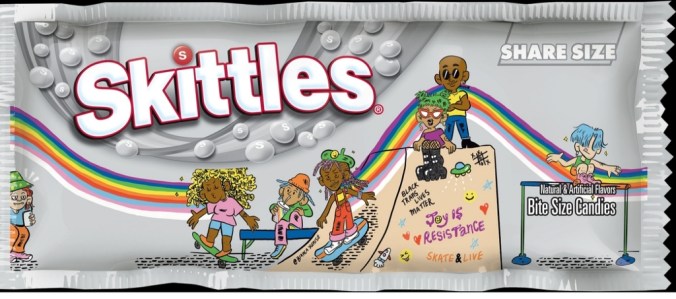
Hold on to yours: this really and truly is one of the “Pride” packages for Mars Inc.’s Skittles:

I don’t understand how this could happen in a major corpoation. In a pluralistic society, it is unethical for products and services to deliberately polarize the public, politically, socially, in any way whatsoever. True, the temptation for rainbow-colored Skittles to try to exploit the LGTBQ propaganda for marketing purposes must have been strong for some marketing execs with the cranial depth of a walnut shell, but the fact that sane parents don’t want their kids proselytized by their candy shouldn’t be that hard to grasp.

If the type is too small for you to read, the legends somewhere under the rainbow include “Joy is Resistance” and “Black Trans Lives Matter,” both of which are semi-incoherent, but the intent is clear. (Is the character with the sunglasses supposed to be in drag? What does “skate & live” mean? Is skating on the rainbow a metaphor for embracing an LGBTQ identity?)This is the equivalent of forced political speech, and the force is being applied to children. Holding that package sends an unintended message, weird as it is, and once that political message is associated with the brand, eating Skittles at all becomes a political act.

Continue reading

Playing Bud Light Spin The Bottle

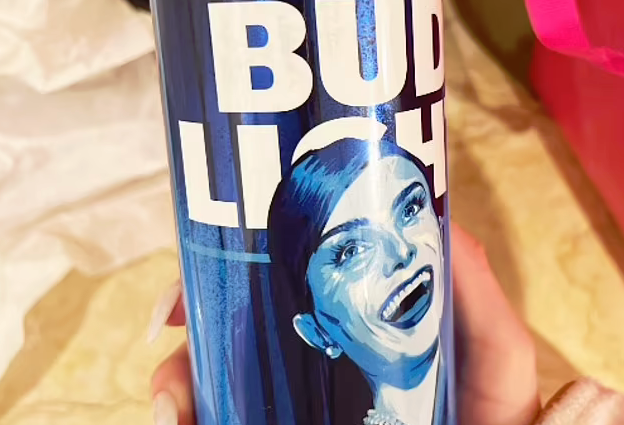
The facts are pretty straightforward. The parent company of Budweiser hired an ambitious, arrogant, woke woman to take over the marketing of Bud Light, which was the best selling beer in America. Having little understanding of the product’s market, and being so infected with wokism that she couldn’t comprehend the depth of the cultural divide regarding the current pro-transgender fad, she made the bone-headed decision to associate the brand with Dylan Mulvaney, a biological male internet performance artist who poses as female, both satirizing genuine transsexuals and celebrating them. From that moment, Bud Light was in a binary trap of its own making with no way out. The reaction against the botched marketing decision was over-whelming, with calls for a Bud Light boycott and a sudden fall-off ins sales. When the company tried to backtrack, including the sacking of its clueless marketing guru, the LGTBQ market also turned on the brand.

Continue reading

Comment Of The Day: Final Ethics Observations On The Bud Light-Dylan Mulvaney Ethics Train Wreck

When I implied that with yesterday’s post about the Bud Light-Dylan Mulvaney fiasco I was through commenting on the matter, I didn’t mean to preclude others from doing so. Here, Michael R. opens up a whole new wing of commentary that I managed to keep shuttered.

Today was also another entry on the episode’s timeline with ethical resonance: The CEO of Anheuser-Busch tried to avoid some accountability in an earnings call with investors by insisting that the whole thing was misinterpreted, was “not a campaign,” and should not have had so much attention attached to it. He also promised investors that Bud Light will triple its marketing spend this summer to undo the damage that the company was not really at fault for. “Anheuser-Busch did not intend to create controversy or make a political statement,” he said, unconvincingly. “In reality, the Bud Light can posted by a social media influencer that sparked all the conversation was provided by an outside agency without Anheuser-Busch management awareness or approval. Since that time, the lack of oversight and control over marketing decisions has been addressed and a new VP of Bud Light marketing has been announced.”

How do investors retain trust in a company with such loose and inattentive management that this could happen? Is just announcing, “Not to worry, it’s all fixed now!” sufficient to restore their confidence?

Just asking, not observing.

Here is Michael R’s Comment of the Day on the post, “Final Ethics Observations On The Bud Light-Dylan Mulvaney Ethics Train Wreck”:

***

I don’t see this as a boycott. I see this as people being done with a product. People boycotting something usually have demands. Bud Light’s former customers aren’t demanding anything. They are just done with the brand.

Let’s see the timeline of events:

(1) Company hires feminist, woke, woman as ‘historic’ hire.
(2) Woke female executive finds that none of her friends use or patronize ‘her’ product.
(3) Woke female executive finds that the customers of ‘her’ product are not ‘cool’ or ‘hip’, like her friends, but are ‘frattish’ and ‘out of touch’. Some of them might have even voted for Trump!
(4) Woke female executive decides that the brand is ‘dying’ despite its great success, so she needs to turn the brand around.
(5) She decides to ‘turn the brand around’ by getting rid of the current customers and attract a new, better clientele.
(6) This turnaround is accomplished by destroying the brand for the existing customer.

Oh, I’m sorry, that was the timeline of events for the destruction of Star Wars.

Continue reading

Final Ethics Observations On The Bud Light-Dylan Mulvaney Ethics Train Wreck

The last time EA visited the corporate cautionary tale was on April 23, here. Today’s post should be the end-point for this particular ethics matter, but you never know.

1. This isn’t going to blow over. Some commenters here and professional woke spinners in the news media tried to make the case that the backlash over Bud Light putting trans performance artist/influencer Dylan Mulvaney on a Bud Light can and featuring the camp figure in a promotion pandering to LGTBQ audiences was short-lived and a “nothingburger.” That has not been the case. Bud Light sales have fallen significantly for the third consecutive week. Beer Business Daily described the response to the campaign as a “shocking deterioration” of Bud Light’s market share. “We’ve never seen such a dramatic shift in national share in such a short period of time,” the newsletter said. Meanwhile, Bud Light’s biggest competitors like Coors Light and Miller Light are gaining consumers while Bud Light loses them.

So the immediate ethics breach here was competence. Corporations are supposed to use marketing to increase sales, profit and favorable views of their products—in fact, they are obligated to. Using marketing and messaging to endorse controversial political positions as self-conscious virtue-signaling is irresponsible, and, frankly, stunningly stupid. Pick your analogy: Bud Light featuring Jane Fonda on a can during the Vietnam war? How about Cindy Sheehan on a can during the Bush administration? It is amazing that Bud Light’s management was so estranged from the views of its own market.

2. It is not the job of corporations to try to change the views of its market.

Continue reading

A Bar Owner Learns That If You Are Going To Grandstand On A Principle You Better Be Ready To Accept The Consequences

At least I hope that he’s learned that. Right now, he looks like a phony, a hypocrite, and an idiot.

First, McKinley Minniefield, the owner of Fairfax Bar and Grill in Bloomington, Indiana, a college town where the woke wun fwee, issued a ringing statement on Facebook informing patrons that those who objected to transgender performance artist Dylan Mulvaney’s embrace by Bud Light would no longer be welcome in his establishment. “We are tired of all of the hate. We are very open to debate and discussion and it’s truly a shame that we can’t have open conversations about this important political and cultural topic,” Minniefield wrote. “Unfortunately due to all of the bigotry and hatred that has surfaced around the Bud Light controversy any patron wanting to voice their concerns about the issue will be immediately asked to pay their bill and leave our establishment.”

How collegiate of him! He’s open to debate and discussion, but not if the views discussed are the “wrong” ones.

“If you are intolerant of other humans of any kind, we ask that you keep your opinions to yourself. Should you feel the need to discuss this matter in public you will be asked to leave. We will not tolerate intolerance here,” the post continued. You would think the obvious contradiction in that last bit would have tipped the bar owner off that he was on metaphorical thin ice ethically, but apparently not.

Continue reading

Incompetent Corporate Exec of the Year Nominee: Anheuser-Busch CEO Brendan Whitworth

As Budwieiser lost billions in value since its Dylan Mulvaney fiasco, the company has remained silent. Any PR consultant would have instructed the company to get out immediately with a statement to stop the bleeding. Finally, the company’s CEO emerged from his bunker to deal with the issue. He had several options, none good. He could stand by his, uh, woman, sort of—two women actually, including his clueless vice president of marketing Alissa Heinerscheid who engineered the disaster, saying that he stood by his staff and supported their decision. That would have been brave, responsible, and stupid.

Or he could grovel an apology, saying that the company had made a dire mistake, and be prepared for the full fury of Woke World and the LGPTQ mob. That would have satisfied no one. Best of all would have been to say that Bud’s intent with the Mulvaney stunt was only to emphasize that its brews were for every American, regardless of sex, gender, race, ethnicity or political persuasion, the eccentrics and pariahs, the guy in the hard hat, the working mother, everyone. He could have apologized to Mulvaney for making her a target by his company’s botched messaging, and promised to avoid stumbling into controversial and divisive issues in the future.

Then he could have gone back to his office, and fired Heinerscheid.

Continue reading