Ethics Hero: Kendra Wilkinson

“I have no talent. I have nothing to offer.”

Are you paying attention, "Sitch"?

With that honest, candid, unadorned, modest and undeniably true self-assessment in a recent interview with People magazine, cable reality show star (“Kendra”) Kendra Wilkinson instantly became an Ethics Hero, a role model for other empty-shell pop culture celebrities, and my favorite Hugh Hefner girlfriend of all time.

Now if Kendra’s integrity could only persuade Nicole Richie, Snookie, “The Situation,” Paris Hilton, Megan McCain, Bristol Palin, Tori Spelling, Lauren Conrad, Heidi Montag, Ivanka Trump, Jack and Kelly Osborne, Michael Lohan, and, of course, all the Kardashians, to make the same confession and voluntarily hurl themselves into a landfill (in Jersey, of course), our trivialized, brain-rotting culture can finally start to heal itself.

But you don’t have to go to the landfill, Kendra.

You do have something offer.

Ethics.

More Airport Encounters: Saying Thanks To An Accidental Mentor

Better late than never.

I previously wrote about the dilemma of whether to impose on celebrities who you encounter as they engage in the necessities of life (though I did not mention the time I was using a Kennedy Center urinal next to Colonel Sanders). I generally have ambivalence about the situation, but when I saw former Senator Alan Simpson standing at my gate as I disembarked at La Guardia, there was no question in my mind. I crossed over to him immediately, shook his hand, and said thank you.

I owe him, you see. Continue reading

Celebrity Encounter Ethics

You're welcome. But now I'll never know what Eddie Murphy is really like!

I run into a lot of celebrities when I travel. I assume everybody does who travels very often; I know that I am better at recognizing them than the average person because my celebrity knowledge spans multiple generations, I have a good memory for faces, and I have always watched way, way too much television. And it happened again today: I was having my usual battles with an airport self-service check-in kiosk, this one in Atlanta, when I realized that the traveler enduring similar annoyances (“We have no record of your itinerary. Please enter the code that we call something other than what it is called on your ticket receipt before you get frustrated and have to wait in line to speak with an agent, because you know that’s what is going to happen.”) was the young actress-singer, Raven-Symone.

She was traveling alone, and it seemed clear that nobody around us had any idea who she was. Strange: doesn’t everyone watch “The Cheetah Girls,” “Dr. Doolittle 2” and re-runs of “That’s So Raven” on the Disney Channel? The encounter immediately sent me into Marshall Celebrity Recognition decision mode: what is the ethical way to treat the rich and famous if you are insignificant and lowly, and close enough to assassinate them? Continue reading

Now Here’s A Terrible Idea: Mandated Disclosures for Photoshopped Images of Celebrities!

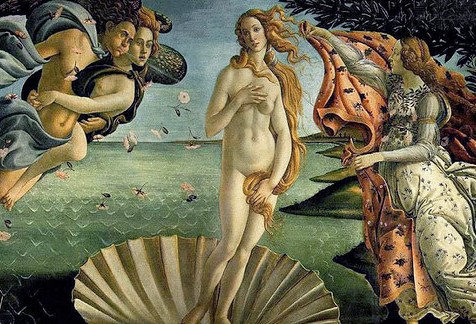
And if you look real closely at the lower left corner, you'll read, "The model for Venus was a short, middle-aged bald man named Gino. His appearance was altered by the painter in the creation of this painting."

Here is another candidate for enshrinement in the Pantheon of Well- Intentioned But Terrible Ideas.

In an article published Monday in the journal “Proceedings of the National Academy of Sciences,” Dartmouth researchers Hany Farid, a professor of computer science, and Eric Kee, a doctoral student, propose a rating system of publicly displayed photographs of models, actors and celebrities to let viewers know exactly how and how much an image has been altered by photoshopping, airbrushing or other means.

“Impossibly thin, tall, and wrinkle- and blemish-free models are routinely splashed onto billboards, advertisements and magazine covers,” the two write. “The ubiquity of these unrealistic and highly idealized images has been linked to eating disorders and body-image dissatisfaction in men, women, and children.” In the interest of limiting the damage caused by unrealistic images of human beauty, the researchers argue that graphic images should include labels that disclose  “geometric adjustments” such as slimming legs, hips and arms, as well as adjusting facial symmetry—reducing a nose in size, or slightly enlarging eyes.  Users of such photos should also flag photometric adjustments that change the appearance of skin tone, blemishes and texture, such as wrinkles, dark circles under the eyes or cellulite, say the researchers.

Please, for the love of God, nobody introduce these guys to Sarah Deming and her lawyer, who are suing the distributers of the film “Drive” because the trailer was more exciting than the movie. And let us all remember this proposal when we are tempted to pooh-pooh accusations that the government is regulating creativity, commerce, art and enterprise right out of existence, and with them, individual liberty as well.The tea parties should use Farid and Kee’s article for recruitment. Continue reading

Ethics Quiz: Is There An Ethical Obligation To Help An Actress Lie About Her Age?

An actress who is, so far, unidentified is suing Amazon.com in federal court for over $1 million in damages for disclosing her age on its Internet Movie Database website, and refusing to remove the reference when she requested, then demanded, that it do so.

She says that IMDb misused her personal information after she signed up for the “industry insider” IMDb Pro service in 2008. Soon she saw that her legal date of birth had appeared on her online acting profile. IMDb refused to remove it.

Now, she says, she is being discriminated against in Hollywood for her age (40), as is its custom. Producers won’t hire her for younger roles, because she’s now regarded as “too old.” Yet she can’t get older roles either, because she still looks much younger. The lawsuit seeks $75,000 in compensatory damages and $1 million in punitive damages.

Your Ethics Quiz question of the day:

Did the Internet Movie Data Base do anything unethical by publishing the actress’s real age without her permission? Continue reading

How Can Anyone Justify Attacking Chaz Bono on “Dancing With the Stars”?

Apparently ABC’s message boards, e-mail inbox and phone messages have been over-flowing with “Dancing With the Stars” fans and others protesting the addition of Cher’s transgendered son to the slate of competitors. Why are they so upset, you ask?

That’s what I’d like to know. I have watched Chaz Bono in several interviews, and he impressed me as a smart, down-to-earth, articulate and thoroughly likable young man in every way. He is straightforward in answering the most delicate questions, and appears to have no other objective than to be happy and, if possible, to provide comfort, inspiration and hope for others who have gender confusion issues.

Now Chaz has been added to the cast of the upcoming installment of America’s favorite competition/reality show, which has always included an odd stew of American cultural figures, from tabloid targets to star athletes to nostalgia cases to reality show comets to novelty choices from the worlds of politics and media. He fits right in (tabloid target/nostalgia division) , and in many ways is an upgrade from the usual B and C-List denizens who usually do the dancing. What in the world is so objectionable about Chaz Bono? Continue reading

Comment of the Day: “The Barefoot Contessa and the Compassion Bullies”

He's young, sick, and poor. His mother must be right, then.

Gary, an occasional commenter, grabs the Comment of the Day with a provocative one on a post from quite a while back. To refresh your memory, a sick child named Enzo Pereda asked the Make-A-Wish Foundation to get him a one-on-one cooking experience with “The Barefoot Contessa,” Ina Garten. Garten refused, and the boy’s mother led an online shaming exercise, condemning Garten, encouraging boycotts of her Food Channel show, and launching other bloggers and media on an anti-Ina rampage. Ethics Alarms’ verdict was that the boy’s mother was engaged in compassion bullying, demanding that this cable celebrity do her child’s bidding, alter her own schedule and priorities, and grant her son’s arbitrary “wish” because he happened to be ill. Garten had no obligation whatsoever to do what someone, or even everyone, might consider a kind act, and the one who was acting unethically was Enzo’s mother.

Gary’s comment goes to the heart of what Ethics Alarms is all about. Here is his Comment of the Day on “The Barefoot Contessa and the Compassion Bullies.”  I’ll have some additional comments at the end: Continue reading

Comment of the Day: “Unethical Blog Post of the Week: ‘But What About Caylee?”’

As comments, accusations and retorts featuring the Ethics Alarms All-Stars were flying around on the blog in reaction to the Casey Anthony verdict and my reaction to some of those reactions (here, here, here, and here), Lianne Best came through with an  especially measured take, one that was immediately cheered by other commenters.

There is nothing wrong with feeling deeply, and emotions are important; after all, Mr. Spock had limitations as a leader. When emotion rather than analysis drives public opinion, however, there is a risk of real harm: those attempting objective analysis may be vilified, marginalized or ignored, and rash, reckless decisions and consequences can result.  (I could, but won’t, argue that the 2008 presidential election was a classic case in point.)  Lianne cuts to the real issue deftly. Here is her Comment of the Day:

“I too often find myself embroiled in emotional opinion, with no basis in facts. It’s easy here: an adorable and completely innocent, dependent little girl was killed. Virtually every human, particularly parents, want to see that vindicated, justice found and brought. That somehow makes it better. But you know what? It doesn’t make it better to go racing off on just a blazing gut reaction, not when people’s lives are affected by our lack of thought and analysis. I was a juror in a kidnapping and murder trial. It was an immensely difficult two weeks, and the decision was agonizing. Luckily, it was also popular; it would have been awful to suffer through loud, manic public criticism of our reasoned decision on top of the process … loud, manic public criticism by people who weren’t there, who knew less (or at least differently) than we did. We have a jury system for a reason, 12 people found Casey Anthony not guilty (13 if you count the alternate juror) and we have to trust them.

“Personally, I appreciate Jack’s cooler head prevailing when my mother’s heart is shrieking.”

Marcia Clark, Exploiting the Anthony Verdict for Her Own Sake

Marcia Clark. OK, this really isn't Marcia, but the real picture of her doesn't look like her either.

Marcia Clark’s article on the Casey Anthony verdict is so tainted with obvious conflicts of interest that it should have been rejected by The Daily Beast…or rather would be rejected by any website more selective and less shameless than the Daily Beast. This would be any fair site that does not deal in over-the-top opinion as a matter of course.

Marcia, like her colleague Chris Darden, is a rather tragic figure these days. The former lead prosecutor in the O.J. case is struggling to make it as a pundit, freshly botoxed and rendered almost unrecognizable so as to be fetching in those close-ups. After she sold the inevitable cash-in book about the Trial of the Century, she has wandered in the C-List celebrity wilderness, and will soon join Newt Gingrich and William Shatner as a celebrity novelist. She will be remembered, quite correctly, as the prosecutor who botched the O.J. murder trial, even if we give Darden an assist for the gloves debacle. (Why cable news shows insist on recycling failures as experts is an enduring mystery, the mystery being “how can the producers look themselves in the mirror after choosing recognizable flops over less well-known but more accomplished authorities?”)

But Clark apparently saw an opportunity in the Casey Anthony verdict to rehabilitate her tarnished reputation, and grabbed it. The result is “Worse Than O.J.!”, a new low in self-serving analysis. Continue reading

Unethical Blog Post of the Week: “But What About Caylee?”

Sad but true: the trial's purpose was not to find justice for Caylee.

If I responded to even one out of a hundred ethically muddled, logically addled posts by the hoard of bloggers in cyberspace, I’d have time for nothing else. Now and then, however, I am directed to a post that typifies the kind of free-floating, fact-starved gut sentiment that rots public discourse in America and that helps keeps the public confused and panicked.

In this case, I was directed to the post by the blogger herself, who managed to annoy me by accusing my post on the Casey Anthony jury of being callous to the victim in the case, two-year old Callie. I re-read my post; there wasn’t anything callous toward the child in any way. Puzzled, I went to the blogger’s page, a blog by someone who calls herself wittybizgal, and called Wittybizgal. Sure enough, there it was: an anguished lament about the verdict in the Casey Anthony trial entitled, “But What About Callie?”

The post is frightening, because I am certain that this kind of non-reasoning is epidemic in the United States, nourished by touchy-feely bloggers, pundits and columnists and made possible by the ingrained habit of having opinions without knowledge. Since their opinions are not supported by facts or reasoning, they can’t be debated. If you aren’t persuaded, you’re just mean, that’s all. That’s no way to decide what is right and wrong, but it certainly a popular way. Here is wittybizgal’s argument, one fallacious step at a time: Continue reading