‘Twas Two Nights Before Christmas Sunday Ethics Warm-Up, 12/23/18: Ho-Ho-Hypocrisy

Merry Christmas!

1. Yes, Merry Christmas, dammit. Those responsible for that moment of doubt and ethical uncertainty every time I encountered a stranger on my just completed Ethics Rock Extreme road trip to New Brunswick, New Jersey deserve to be entombed alive in peppermint and plum pudding.  The greeting simply says, “I wish you to be joyful and happy in a season where people are a little less selfish and a little more ethical: I’m not trying to indoctrinate you into Christianity!” Much of this completely unnecessary addition to holiday stress is due to to jerks—yes, I think the word is fair—like Julia Ioffe, the author of  “Please don’t wish me ‘Merry Christmas’/It’s impolite and alienating to assume I follow your religion.”

I thought Charles Dickens slam-dunked that nonsense definitively in “A Christmas Carol,” followed by almost all the Christmas movies that make the same obvious point except to deliberate holiday wet-blankets like Ioffe. No, jerk, the greeting is an expression of cultural unity among human beings, and the celebration of values that need have not be restricted to religious Christmas holiday because this is also a secular tradition as well. As soon as I get this post up, I’m going to re-post the Ethics Alarms Christmas commentary.

Somebody send it to Julia.

2. 2018 Hypocrisy Award, locked up! It doesn’t matter if you are happy or disappointed to see President Trump pull U.S. troops out of Syria and Afghanistan; you should still be able to marvel at the blatant, shameless, pandering, hateful and, really, laughable—if the cultural fad of denigrating the President of the United States regardless of what he does wasn’t so destructive and wrong— hypocrisy by news media Trump-haters, among others. Glenn Greenwald, who sees the world from a leftward perspective but maintains his integrity, called out MSNBC’s Rachel Maddow, who could be the symbol of the whole nauseating. He tweeted,

The most bizarre aspect of Rachel Maddow’s deep anger over troop withdrawal from Syria is that she wrote an entire book in 2012 denouncing illegal US Endless War without congressional approval – exactly what Syria is. I interviewed her about it here: Funny: citing that interview I did of Maddow’s book on the evils of Endless War without Congressional approval reminded me that she asked me to blurb that book, which I did. Here’s what I said – so ironic in light of her anger over Syria troop withdrawal

This upset Glenn’s loyal progressive followers, one of whom sent this fascinating retort:

“The most bizarre aspect of Glenn Greenwald’s inexplicable credibility is his ability to appear as first an advocate and then an opponent of almost everyone and everything. Can’t choose one perspective.”

See? To people like this—the commenter’s handle is IstandwithMaxine, which pretty much explains everything—is that they have been brainwashed to believe that is is bizarre unless adopts a single  view—theirs. of course, otherwise you are evil–and never alters it or admits that it may need re-thinking when that view leads to dead ends, disasters and pitfalls, no matter what new information arises. Someone like Greenwald, who tries to apply the same standards of analysis and ethical judgment to all regardless of whether it advances an ideology, is just untrustworthy, a traitor.

This cartoon has been circulating online. It is 100% fair and accurate regarding Trump’s critics self-indicting reaction: Continue reading

“Miracle On 34th Street”…An Ethics Companion, Chapter One: “Meet Kris Kringle!”

The Introduction is here.

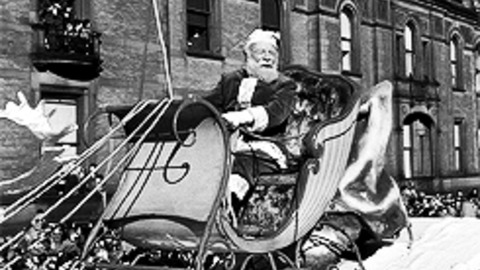
The movie tells us right at the start that 1) the charming old man in the white beard can’t possibly be Santa Claus, and 2) that he’s nuts. That is, he tells adults who are paying attention this as soon as he starts complaining to a New York City storekeeper that his window display has the reindeer mixed up: “You’ve got Cupid where Blitzen should be. And Dasher should be on my right-hand side. And another thing…Donner’s antlers have got four points instead of three!”

Let’s see:

  • No Christmas display has ever distinguished between Santa’s reindeer (except for Rudolph), because the individual reindeer have never had any identifying characteristics in reality or myth. Are we to assume that there are name-tags on the models? If so, why wouldn’t Kris be complaining about the features of all of them, not just “Donner’s” antlers?
  • The names of the reindeer, even if there are flying reindeer, were 100% the invention of the poem “A Visit from St. Nicholas,” or “The Night Before Christmas,” originally published in 1823.  No one has ever claimed that the author had some kind of special info on the actual names of the reindeer when he wrote,

    More rapid than eagles his coursers they came,
    And he whistled, and shouted, and called them by name;

    “Now, DASHER! now, DANCER! now, PRANCER and VIXEN!
    On, COMET! on CUPID! on, DUNDER and BLIXEN!

    …and anyway, if he did, those were their names 120 years before the movie takes place. Nobody has ever claimed the reindeer were immortal, either. I suppose Santa Claus, in a nod to the poem’s popularity (it has been called the most famous poem of all time), could have adopted the practice of always having the reindeer named after the poem’s versions, and when one Vixen dropped of old age, the young reindeer that took her place became the new Vixen.

I suppose. Continue reading

“Miracle On 34th Street”…An Ethics Companion: Introduction

As with most holiday movies, but perhaps more than most, the entire concept of digging into the ethics of the plot of “Miracle on 34th Street”  can be criticized as beside the point. The movie, at least the 1947 original, is a classic; it works dramatically and emotionally, it makes people feel good, and it has held up over time. That’s all a Christmas movie is supposed to do, and if it does it without really making sense or avoiding ethics potholes along the way, so what?

I sympathize with this view. However, our ethical standards and ethics alarms are affected by what we see, hear, like and respond to. If popular holiday movies inject bad ethics habits and rationalizations into our character, especially at a young age, that is something we should at least be aware of by the tenth or eleventh time we watch one of them.

One ethical aspect of “Miracle on 34th Street” that must be flagged at the outset is competence. The film is so effortlessly engrossing and convincing that it is easy to forget how easily it could have failed miserably. Actually, it is also easy to remind oneself: just watch any of the attempts to remake the film. There have been four of these, starring, as Kris Kringle, Thomas Mitchell, Ed Wynn, Sebastian Cabot, and Richard Attenborough. That’s a distinguished crew, to be sure. Mitchell was one of the greatest character actors in Hollywood history. Wynn was nominated for an Academy Award (for “The Diary of Ann Frank”) and Attenborough won one, Best Supporting Actor Award in 1967 for “The Sand Pebbles.” Cabot wasn’t quite in their class, but he was a solid pro, and looked more like Santa Clause than Mitchell,  Wynn, or Richard Attenborough. None of them, however, were as convincing as Edmund Gwenn. He made many movies—all without a white beard— and had a distinguished career in films and on stage, but even audience members who knew his work had a hard time reminding themselves that he wasn’t Kris Kringle while they watched the movie. I still have a hard time. Continue reading

The “White Christmas” Ethics Guide (REVISED And UPDATED)

I’m looking at some holiday movies to add to the Ethics Alarms library of annotated classics—no, ethics and “A Christmas Story” are irrelevant, it being a child’s remembrance and hardly literal–but I might as well begin with  revising and revisiting the “White Christmas” guide, which first appeared in 2012. 

I still like the film—my wife hates it—being a fan of all four stars, especially Bing and Danny, as well as the director, Michael Curtiz.  I do like it a bit less each time I see it, mostly from an ethics perspective, and the successive revisions reflect that.

I still get misty when the old general, played by Dean Jagger, gets saluted by his reunited army unit, which has gathered at his struggling, snowless, Vermont inn on Christmas Eve to remind him that he is still remembered and loved. Nonetheless, “White Christmas” is by far the strangest of the Christmas movies, and also the most unethical. Though everything works out in the end, the characters in the sloppy plot spend the whole movie lying, extorting, betraying, manipulating and generally mistreating each other, always with no recriminations at all, and usually with no consequences either.

In his addendum last year to my original post, Michael West found the film foundering from the second the opening credits ended. He began with the script for the opening scenes—General Waverly* is played by Dean Jagger; Captain Bob Wallace is Bing Crosby, and Private Phil Davis is Danny Kaye:

Opening Scene in the Jeep as they hear the Entertainment show.

GEN CARLTON (To Adjutant): What’s this all about, Captain?

ADJUTANT: A little entertainment for the men, sir. Tonight’s Christmas Eve.

GEN CARLTON: These men are moving up tonight, General Waverly. They should be lined up for full inspection!

GEN WAVERLY (To Carlton): You’re absolutely right. (To Adjutant): There’s no Christmas in the Army, Captain.

ADJUTANT: Yes, sir.

GEN WAVERLY (To Carlton): There’s always a slip-up or two during a change in command. The men get a little loose. But I know I’m leaving them in good hands.

GEN CARLTON: (To Waverly): Thank you, General. (To Driver): Sergeant, take me to headquarters immediately! We’ll have those men turned out on the double!

The Sergeant looks at General Waverly.

GEN WAVERLY: Goodbye, Sergeant. Take the short cut.

SERGEANT: Yes, sir!

The jeep pulls off and makes a half circle. The Adjutant makes a gesture, as if to stop it. Waverly stops him. The Adjutant turns to him.

ADJUTANT: That’s not the way back to headquarters!

GEN WAVERLY: Joe, you know that, and I know that, but the new General doesn’t know it. Or he won’t for about an hour and a half.

ADJUTANT: That Sergeant’ll be a private tomorrow!

GEN WAVERLY: Yes… isn’t he lucky?

SCENE CHANGE TO ENTERTAINMENT SITE:

CAPTAIN BOB WALLACE and PRIVATE PHILIP DAVIS are doing a number on stage to entertain a mass of 200 or so soldiers. GENERAL AND ADJUTANT just starting to take seats, off to one side where they are not noticed by the performers. ABOUT 6 SOLDIERS seated in audience. They look off, see General, start to rise. The General notices them – motions for them to sit down again, indicating he doesn’t want attention called to himself. Captain Wallace sings “White Christmas”.

CPT WALLACE: Well that just about wraps it up, fellas. It’s certainly too bad General Waverly couldn’t be here for this little yuletide clambake ’cause we really had a slam bang finished cooked up for him. I guess by now you know the Old Man’s being replaced by a new Commanding General fresh out of the Pentagon…it’s not a very nice Christmas present for a division like us that’s moving up. The Old Man’s moving toward the rear. That’s a direction he’s never taken in his entire life. Well all I can say is we owe an awful lot to General Waverly and to the way…

GEN WAVERLY: ATTENTION!

Every man is at attention and every head has turned to where General Waverly has taken up a position near the front of the platform.

GEN WAVERLY: Captain Wallace, who’s responsible for holding a show in this advanced area?

CPT WALLACE: Well sir as a matter of fact it was…

PVT DAVIS: …me Sir! It was my idea sir. Uh, I mean when you gotta entertainer sir of the caliber of Captain Wallace, sir…I mean sir…it’s Christmas Eve, sir. And well, sir, I mean that if you were in New York, Sir, you’d have to pay six sixty or even eight eighty to hear a great singer like Captain Wallace, sir.

GEN WAVERLY: I’m well aware of Captain Wallace’s capabilities. Who are you?

PVT DAVIS: Er…Phillip Davis, sir. Private First Class, sir.

GEN WAVERLY: Well, at ease, Davis.

DAVIS: Yes, Sir!

WAVERLY: I said, At Ease!

DAVIS: Oh, uh, Yes, sir, thank you sir.

WAVERLY: This division is now under the command of General Harold G. Carlton, and I don’t want anyone to forget it — not that he’ll let you. He’s tough — just what this sloppy outfit needs. He’ll have you standing inspection night and day — you may even learn how to march. And if you don’t give him everything you got, I may come back and fight for the enemy. Merry Christmas!

ASSEMBLED MEN: Merry Christmas!

GEN WAVERLY: Well, I guess, all I can say is, how much I…what a fine outfit…How am I going… (to Wallace) don’t just stand there, how am I going to get off…?

CPT WALLACE: We happen to have a slam-bang finish…He turns to the musicians, gives the downbeat.

They play “THE OLD MAN,” which is sung by the entire outfit.

ARTY FALLS IN VICINITY…Soldiers crouch…then finish singing.

GENERAL AND ADJUTANT DEPART.

MORE ARTY FALLS, ON SITE…Men scatter. Captain Wallace and Private Davis try to get men to cover. Private Davis man handles the Captain to cover as a wall collapses where he had just been standing.

For starters, we see a mass of soldiers in an open air situation within effective range of enemy artillery fire. A single well-placed artillery round could eliminate approximately 200 soldiers — more than an entire World War 2 Infantry Company (whose authorized strength is about 190-195 men; but given this stage of the war and attrition, this could easily be 2-3 companies of EXPERIENCED soldiers). Someone in the chain of command KNOWS this to be true and authorized this gathering despite the obvious danger. We know for certain that the Adjutant knows what the gathering is, as he answers in line #2 precisely what is going on. But an Adjutant has no command authority, so someone else authorized the gathering. We have to assume General Waverly didn’t know until the Adjutant answered General Carlton’s inquiry based on General Waverly’s later questioning of Captain Wallace. We can’t ever be sure who actually made the decision to have the entertainment occur at that location since Private Wallace, breaking an incredible number of military bearing protocols, interrupts a Captain, to answer a General. This Private, Private Davis, accepts all responsibility for the decision to expose upwards of 2 companies-worth of men to devastating artillery fire.

This information leaves us with two options: Either it really was Private Davis’s idea to have the venue at that location, in which case, Private Davis’s commanding officer and the various commanding officers AND EVERYONE ELSE in their chain of command are colossally INEPT for agreeing to the idea. The second option is that Captain Wallace DID indeed make the decision to have the venue at that site, and now he’s standing there like a lump allowing a subordinate to cut him off mid-sentence, a military no-no, and then allowing the subordinate to take the heat of any potential censure that was forthcoming. Of course, since he’s a Private trying to cover for his boss, he’ll say anything, so I won’t even ding him for the horrible excuse that 200 men should be exposed to German artillery fire because CPT Wallace is a famous singer – we all know it’s worth dying to hear Bing sing…

But of course, even General Waverly doesn’t seem to mind that 200 of his soldiers are idling around with a population density rivaling that of Bombay, just one artillery strike away from having more in common with mist than with humanity. When HE discovered what was going on by the Adjutant’s answer in line #2, he should have immediately ordered the soldiers disperse and had about two dozen commissioned officers who had every ability to stop the farce standing in his headquarters receiving the most royal dressing down of their careers and maybe a few firings.

What possibly does General Waverly think outweighs the need to disperse a mass of soldiers within effective range of artillery? Why, a Christmas music concert of course! It is Christmas Eve, after all!  Now, the Army does a really good job bending over backwards for the morale, welfare, and recreation of soldiers, much more than was ever considered a military precedent. BUT, we learn from the dialogue, the entire division is on orders to “move up tonight.” This somewhat vague description could range anywhere from simply occupying a section of the line to relieve a unit coming back or it could mean they are initiating a major offensive operation. We learn, however, that this movement, whatever it is, is occurring in mere hours. Having experienced large movements of soldiers myself, I know that if a Division is stepping off in a few hours, the men down to the platoon level are ALREADY in their assembly areas doing final preparations. This is apparent to the new commander, General Carlton, who is astonished that the men aren’t doing their final checks of equipment and gear.

Which leads us to the next bit: General Waverly is none too concerned about the unjustifiable exposure he’s tolerating of his…well, now General Carlton’s men…as we know Waverly has just been replaced by General Carlton, who, trope-tastically, we learn is one of those wretched new leaders who is probably horribly incompetent. The movie lets us know early on that he’s a despicable piss-and-vinegar type when he is mad that the men are having Christmas entertainment. Never mind that we now know that Carlton is severely concerned about a huge mass of men within artillery range open and exposed as well as not anywhere near where they ought to be to initiate movement of the entire Division.

The movie also lets us know he’s a jerk because it pushes the whole “fresh out of ________” trope. The usual way this plays out is the “fresh out of West Point” or “fresh out of ROTC” smear applied to new Lieutenants who assume Platoon Leadership with little to no actual experience. Unfortunately, this doesn’t exactly play out on the General level. Yes, the General ranks expanded rapidly during World War II, but an individual didn’t become one by being a complete buffoon (and yes there are always exceptions — but General Carlton, who seems to have a sense of urgency that no one in Waverly’s sphere of influence seems to possess, does not seem to be the exception).

Never mind, we’ll go on with the traditional “smearing of the new guy who replaces the beloved experienced leader.” In the original script I copied and analyzed, the dialogue was OVERTLY insubordinate and actively undermining of the men’s confidence in their new commander. In the corrected dialogue, though cleaned up a lot, there are still hints of undermining the new guy’s authority before he even makes a decision as the commander. There’s General Waverly’s smart-ass “There’s no Christmas in the Army” jab as a response to Carlton’s concern about the location and timing of the entertainment event — which he says “knowingly” to the Adjutant, who, we must remind ourselves no longer works for the Waverly but for Carlton.

There is the extra-rotten move when Carlton, recognizing the imminent danger as well as the horrifying breach of schedule in implementing the plan of operations, indicates he plans to move to Headquarters immediately to begin rectifying the situation and is undermined either by the Sergeant driving Carlton or by General Waverly himself. The driver decides to undermine Carlton’s ability to fix the problem by taking an extra long route back to headquarters. Between a driver and a singing-private, this division is apparently full of the lowest-ranking guys thinking they know best when to leave a behind-the-schedule division exposed to enemy fire just so they can catch a few tunes from Bing. The only other possible explanation is that General Waverly, himself, with a nod-nod wink-wink, authorized the driver to follow the reckless plan to take an hour-and-a-half detour, which we assume will require another hour-and-a-half correction before Carlton can get to Headquarters. Just as with the Adjutant before, let’s again consider that this driver no longer works for Waverly, but for Carlton The Sergeant is being openly insubordinate.

Even if Waverly was not responsible for the three-hour diversion, he immediately became complicit when the Adjutant, in an apparent realization who his new boss is (Carlton), moved to correct the driver but was stopped  from doing so.by General Waverly

The last bit of insubordination and undermining  the chain of command comes from the subtle digs Captain Wallace makes during his speech. His “Fresh out of the Pentagon” disdain undermines faith that Carlton may be a good commander, followed by the snide “not a nice Christmas present” for the division is enough to get any soldier censured. Soldiers and peers WILL whisper about their leaders, but an open act of insubordination like that? Stamped out like a spark in a dry forest… I won’t even address the fact that it’s a COMMISSIONED OFFICER making the openly insubordinate comments and a CAPTAIN no less. He would be dismissed and transferred immediately.

But hey, I suppose Waverly recognized all their rotten conduct when he feebly tried to make things right by saying “hey guys, he’s a good commander, never mind all the stuff we said before and our attitudes we displayed before!” A few moments later, just to do Carlton some justice, the artillery shelling arrives.

Then the movie moves into its funny guilt extortion phase. Army private Phil Davis (Danny Kaye) rescues his smooth-singing captain, Bob Wallace (Bing Crosby) from being crushed by a falling wall in a World War II bombing raid, and injures his arm in the process. (It’s not a plot feature, but the battlefield set for the entire opening sequence is itself unethically unprofessional by being chintzy even by musical standards: it looks like they are filming a skit for a Bob Hope Christmas Special.  I thought it was lousy when I saw it as a kid. Michael Curtiz deserved better; the man directed “Casablanca.” Show some respect.) Phil then uses Wallace’s debt of gratitude to coerce him into accepting the aspiring comic as a partner in Wallace’s already successful civilian act. This is obviously unfair and exploitative, but Bing accepts the ploy with good spirits, and the next we see  the new team of Wallace and Davis knocking ’em dead and rising in the ranks of stage stars.

The act looks terrible. Bing was never much of a dancer, a game hoofer at best, and you don’t feature the greatest voice in the history of American popular music by having him sing exclusively duets. Nevertheless, all we see of the team’s rise is both of them singing and corny dancing inferior to what Bing did with Bob Hope in the “Road” movies.

Never mind. They have a show on Broadway, and as a favor to a mutual army buddy, they agree to watch the boonies nightclub act of “The Haynes Sisters” (Rosemary Clooney as Betty, and Vera-Ellen, of wasp-waist fame, as kid sister Judy. Did you know that in the “Sisters” number, Clooney sang both parts? ). Bing is immediately smitten with older sister Rosemary, but there is a tiff over the fact that younger sister Judy fooled them into seeing their act: she, not her brother, had sent the letter asking for a “favor.”

This is the first revealed of many lies woven into the script. This one is a double beach of ethics: Judy uses her brother’s name and contacts without his permission or knowledge, and lures Wallace and Davis to the night club under false pretenses.

Bing dismisses Judy’s cheat by noting that everyone “has an angle” in show business, so he’s not angry. Rosemary is, though, and reprimands Bing for being cynical. That’s right: Vera/Judy uses their brother’s name to trick two Broadway stars into watching their little act, and Rosemary/ Betty is annoyed because Bing/Bob (Bing’s bandleader, look-alike, sound-alike brother was also named Bob) shrugs off the lie as show business as usual. True, Betty is technically correct to flag the Everybody Does It rationalization, but shouldn’t she be grateful that Bob isn’t reaming out the Haynes sisters and leaving the club in a huff? OK, nice and uncynical is better than nice and cynical, but Bob is still giving her and Judy a break. As the beneficiary on Judy’s angle, Betty is ethically estopped from complaining that Bing/Bob’s reaction was “I don’t expect any better.” I can, she can’t. He should expect better: accepting unethical conduct allows it to thrive.

As we soon find out, however, Betty often flies off the handle.
Continue reading

It Finally Happened: I Am At A Loss For Words….

…because of this…

I cannot think of a sufficiently descriptive headline or even a category for this Christmas display at Saint Susanna’s Parish in Dedham, Massachussetts, and others—yes, there have been others--like it.

Here I was, about to point out the arrogance and anti-religious bigotry of Democratic chair Tim Perez, who just suggested that the only reason anyone opposes abortion must be that they are ignorant and foolishly pay attention to religion, and here is something that supports his view that at least some of those preaching from pulpits on Sunday may not be all that bright, since they have the grasp of reality of a six-year-old.

The dimwit who approved this abomination, Pastor Stephen Josoma, told radio station WBZ, “We try to take a picture of the world as it is and put it together with a Christmas message.” That message this year questions about peace on Earth. He says Jesus represents migrant children being held at the southern border separated from their parents. The wise men represent the caravan of migrants behind the border wall. “Jesus was about taking care of one another. This is not the way to take care of one another,” said Josoma.

How do you even begin to unpack all the ignorance, false logic, bad analogies, historical fatuousness and political nonsense in this statement along with the offensive creche scene it attempts to justify? I’m not up to it. It would probably begin with “There are material differences between 6 B.C. in Gallilee and the 21at Century United States of America. You idiot” and expand out from there. For now, all I will say is that turning Christmas into a divisive, ugly, partisan debate while exploiting the symbols of Christmas into simplistic social justice warrior propaganda is a betrayal of the season, the event, the spirit behind the event, and the cultural purpose it endures to serve.

“Rudolph The Red-Nosed Reindeer” Ethics

Yes, it’s come to this.

The last time I had to write about attacks on the children’s Christmas song “Rudolph the Red-Nosed Reindeer,” it involved a school capitulating to a single Jewish parent who complained that teaching students the song indoctrinated kids into Christianity. (Naturally, the school capitulated, and banned Rudolph.) This time the complaints involve the ancient Rankin-Bass Puppetoon version of the story, which invades our TV sets every Christmas season. Here’s the account of quirky blog Victory Girls, after citing various tweets and blog criticism of the show from newly woke Americans:

Santa is a big, fat jerk and a bigoted, d*ck, apparently. Rudolph’s father was “abusive”. Comet was a terrible coach. Yukon Cornelius is a gun-toting redneck who engages in animal cruelty. GASP! And who isn’t triggered by Burl Ives’ character, Sam the Snowman?! He’s ALL WHITE for crying out loud! If you sing along to any Burl Ives’ Christmas Carols, you might be a white supremacist. Delete all Burl Ives Christmas tunes from your Apple playlist STAT! Never mind, I forgot. These folks would never know how to have a Holly, Jolly Christmas if someone threw it at them and gave it to them gratis and called it a college education.

As a kid in the 70s and 80s, I would look for its listing in the TV Guide. Rudolph the Red Nosed Reindeer was one of my most beloved, go-to Christmas classics and still is. But now, in the days of woke, the story behind Rudolph the Red Nosed Reindeer is “seriously problematic” and those who don’t see it this way have “serious problems”. Those people are, according to the hyper-vigilant SJWs, Conservatives. Whilst making tongue-in-cheek social justice commentary about Rudolph, they have neglected the key takeaways of this story from years ago. Although he was bullied, left out of all of the reindeer games, unaccepted, different-quirky even-young Rudolph was able to overcome and do something absolutely great. He saved the day! He made kids smile. And his story is magical. He didn’t stomp his hooves and whine and go to a “safe space” and resign himself to life being too hard as a red-nosed reindeer and call it quits. He didn’t blame others and become a victim. He didn’t expect special treatment or demand it from his peers because he was different. He may have shed some tears and that’s okay. When given a challenge, he rose to the occasion and excelled and proved his biggest critics and his bullies wrong.

Continue reading

Thanksgiving Week Launch Ethics Warm-Up, 11/19/18: Turkeys

Good Morning.

1. This is weird. The Florida Supreme Court released a long-awaited decision concerning whether a judge’s Facebook friendship with an attorney should be  grounds for disqualification if the attorney is arguing a case before that judge. The 4-3 opinion holds that:

In some circumstances, the relationship between a judge and a litigant, lawyer, or other person involved in a case will be a basis for disqualification of the judge. Particular friendship relationships may present such circumstances requiring disqualification. But our case law clearly establishes that not every relationship characterized as a friendship provides a basis for disqualification. And there is no reason that Facebook “friendships”—which regularly involve strangers—should be singled out and subjected to a per se rule of disqualification. 

I could not disagree more. A friend request from a judge is inherently coercive, and creates pressure on the lawyer to accept. Who wants to tell a judge that he doesn’t want to be his friend? Other bar associations and courts have held that it is improper for judges and lawyers to “friend” each other if there is any chance that the judge will be presiding over the lawyer’s cases, and that is the wiser rule. My own preference would be for judges to stay off social media entirely, except for close friends and family. They can only get in trouble there.

2. And this is much weirder…Apparently an app, ‘Santa Call New 2018,’ briefly available for download at the Amazon Children’s Store, would place a call to “Santa”when kids pressed the ‘call’ button, and Jolly Saint Nick would reply, “Hello there. Can you hear me, children? In five nights, if you’re free, I will look for you, I will find you, and I will kill you.”

Amazon is investigating.

Happy Holidays! Continue reading

I Worry About Cary Grant [Updated]

…and James Cagney. And Kirk Douglas. And Bette Davis. And Rita Hayworth.

Seeing Kirk Douglas at the Golden Globes revived the concern that every Christmas season intensifies for me, when I realize that it is only Christmas that keeps such giants of entertainment past as Gene Autry, Bing Crosby and Dean Martin from fading into permanent obscurity.  The cultural figures who we remember are mostly the beneficiaries of moral luck, not a fair merit-based calculation. It is a random process, and culture, which is significantly defined by who and what we remember and who and what we forget, should not be shaped by coincidence, chance, and random amnesia.

It should not be, but it is. A classic example outside the realm of entertainment is the strange case of  Col. Joshua Lawrence Chamberlain, the hero of Little Round Top in the Battle of Gettysburg, and by some assessments the savior of the Union itself. When the story of Gettysburg was assembled by the battlefield commission, plaques erected and statues placed. Chamberlain’s desperate stand protecting the Union army’s flanks on Day Two of the battle didn’t make the cut. Despite as remarkable a career as anyone from Maine could have, and more than one shining moment of distinction during the Civil War, he was forgotten for more than a century. Then a brilliant, best-selling historical novel, “The Killer Angels,” recounted his heroics leading the 20th Maine so vividly that Chamberlain memory was re-animated, and began receiving the attention from historians that it deserved from the start.

In popular culture, whether a performer’s unique talents and contributions are remembered after more than a generation is now almost entirely dependent on whether there is a film featuring them that is regularly presented on television. Only a handful of performers who have permanently entered iconic status avoid that standard: I’d include Charlie Chaplin, Marilyn Monroe, Fred Astaire, Judy Garland, Shirley Temple and John Wayne in this category, with a few debatable others. (And even the Little Tramp, MM, Fred, Judy and The Duke aren’t necessarily  safe: once Rudolf Valentino, Laurel and Hardy, Lon Cheney, Greta Garbo, Boris Karloff and James Dean could be safely called icons. I doubt one Millennial in a hundred could identify any of them. Marlene Dietrich has a thumb-hold on her iconic status only because of  Madeline Kahn’s film-long send-up of her in “Blazing Saddles.”) Continue reading

The Christmas Asshole, Neil DeGrasse Tyson

“Merry Christmas to the world’s 2.5 billion Christians. And to the remaining 5 billion people, including Muslims Atheists Hindus Buddhists Animists & Jews, Happy Monday.”

What would justify a public figure tweeting that kind of arrogant, hostile, belittling message  at his fellow citizens  on Christmas Eve?

Nothing.

This was one of Neil deGrasse Tyson’s tweets yesterday. I’m sure the nation’s most prominent and least deserving pop intellectual assumed that his many Twitter followers who hang on every word of revealed wisdom he utters  would appreciate his giving Christmas the metaphorical back of his hand, which only means this asshole has a lot of asshole followers.

Why do this? It is not as if there is any delusion among Christmas revelers that “billions” of others in the world do not have the pleasure of celebrating the world’s most inclusive and ethical cultural holiday. Tyson’s intent was not to inform, it was to diminish, using a version of the Golden Rationalization: “Everybody does it;” in this case, “More people do it, so what you do instead isn’t as great as you think it is.”

Asshole. Tyson doesn’t have to observe Christmas, and he doesn’t have to absorb the wisdom that Scrooge learned so traumatically, he need not acknowledge an annual ritual in which we are all encouraged to embrace love, peace, generosity, ethics, respect, charity, empathy, selflessness and hope for at least a day, opening the possibility that the enlightenment may last longer, and even a lifetime, as it did for Ebeneezer.  If he had any decency or common courtesy, however, he wouldn’t try to spoil the holiday for anyone else not so blighted. As Richard Fernandez wrote yesterday, deftly exposing the flaw in fatuous efforts among  various sad enclaves of progressives more concerned with triggering some offense with a “Merry Christmas!’ than with the health of society itself, it is helpful to understand

“…Christmas as playing a role analogous to the fictional baseball field in the movie Field of Dreams: not a place or day but a reverie. To paraphrase the famous speech to Ray, when people come to Christmas, …”it’ll be as they’d dipped themselves in magic waters. The memories will be so thick, they’ll have to brush them away from their faces. …  It’s been erased like a blackboard, rebuilt and erased again.” But Christmas has marked the time. Marked the time because, as C.S. Lewis once adventured,  Christmas is not an idealized memory of childhood but of something glimpsed in childhood.

“These things—the beauty, the memory of our own past—are good images of what we really desire; but if they are mistaken for the thing itself they turn into dumb idols, breaking the hearts of their worshipers. For they are not the thing itself; they are only the scent of a flower we have not found, the echo of a tune we have not heard, news from a country we have never yet visited.”

…The effort to erase Christmas will probably fail for no other reason than that it meets a human need that a mechanical bureaucratic day off cannot fulfill. Humanity needs a time to mark the growth and change in the family, an occasion to renew hopes and put aside fears and a chance to remember something we once knew: that everything’s going to be alright in the end. It really will.

Continue reading

Morning Ethics Warm-Up, 12/17/2017: Sick Of Train Wrecks, Sick Of “Baby, It’s Cold Outside!,” Sick Of Being Lied To. Merry Christmas!

Good Morning, And Merry Christmas!

(and no, my tree isn’t decorated yet. As usual, there were complications…)

1 “You’re one of THEM, aren’t you?” Curse everyone on all sides of the political spectrum who have, by shear repetition, turned the mere act of saying “Merry Christmas!” into a presumptive partisan greeting. A recent study indicates that about 90% of the public celebrates Christmas, not some amorphous holiday, either in its religious or secular form on and around December 25th. There should be nothing malign about the salutation at all, and yes, the polite and pleasant response to “Merry Christmas!” is “The same to you!” or “Merry Christmas!” Yesterday, I received a silent glare and a scowl from a merchant to whom I gave the happy wish, and he was selling Christmas tree stands!

2. Not AGAIN! This is one of those periods during a year when the same ethics issues hang around like a bad odor, and I am faced with the choice of intentionally avoiding them, even though they continue to make news and to be the topic of conversation online and on TV, or to keep covering them no matter how bored I get. In fact, all of 2017 feels that way. Every day now, I have to face a new swerve of the Harvey Weinstein Ethics Train Wreck, and its cultural, ethical, and political implications. (Chris Matthews! Rep. Bobby Scott!). The news media disgraces itself daily in its partisan hatred of the President of the United States. “The resistance” and Democrats (but I repeat myself) continue to unethically push the nation into a constitutional crisis as their remedy for the longest loser’s tantrum in recorded history, and, yang to their yin, President Trump continues to be as unpresidential in his manner, words and actions as I thought he would, but hoped he wouldn’t, feeding the flames of division.

3. “Baby, It’s Cold Outside!”  Here is an article protesting the movement to “ban” (figuratively, not literally), the seasonal duet “Baby, It’s Cold Outside”  for “being insufficiently PC in the sexual assault/harassment realm.” Ethics Alarms called the song “date-rapey” two years ago, so while I don’t exactly want to ban the thing, I am sick of hearing it on Christmas playlists. On Sirius-XM’s “Holly” station, I’d estimate that over 50% of the “Holiday songs” have to do with sex (none have to do with the religious holiday, by design), and I blame “Baby, It’s Cold Outside,” which on the alternative Christmas channel, “Traditions” —where every song is sung by someone who is dead, with the exception of a few hangers-on like Tony Bennett and Johnny Mathis, either of whom could drop any second—“Baby, It’s Cold Outside” is played every hour, sometimes more than once. Pearl Bailey (dead), Steve and Eydie (dead and dead), Sammy Davis Jr, and Carmen MacRae (both dead), Dean Martin (dead). Writes the blogger, Continue reading