Reflections On The Ethical Holiday

Christmas


“Christmas is built upon a beautiful and intentional paradox; that the birth of the homeless should be celebrated in every home.”

—G.K. Chesterton.

“It’s Christmas Eve. It’s the one night of the year when we all act a little nicer, we smile a little easier, we cheer a little more. For a couple of hours out of the whole year we are the people that we always hoped we would be.”

— Frank Cross (Bill Murray) in “Scrooged”

CHARLIE BROWN: I guess you were right, Linus. I shouldn’t have picked this little tree. Everything I do turns into a disaster. I guess I really don’t know what Christmas is all about. Isn’t there anyone who knows what Christmas is all about?

LINUS: Sure, Charlie Brown. I can tell you what Christmas is all about.  Lights, please?

“And there were in the same country shepherds abiding in the field, keeping watch over their flocks by night. And lo, the angel of the Lord came upon them, and the glory of the Lord shone round about them. And they were sore afraid. And the angel said unto them, ‘Fear not, for behold, I bring you tidings of great joy which shall be to all people. For unto you is born this day in the City of David a savior, which is Christ the Lord.’ And suddenly there was with the angel a multitude of the heavenly host, saying, ‘Glory to God in the highest, and on Earth peace, goodwill toward men.’”

That’s what Christmas is all about, Charlie Brown.

—Charles M. Schulz

“Our hearts grow tender with childhood memories and love of kindred, and we are better throughout the year for having, in spirit, become a child again at Christmas-time.”

― Laura Ingalls Wilder

“Then the Grinch thought of something he hadn’t before! What if Christmas, he thought, doesn’t come from a store. What if Christmas…perhaps…means a little bit more!”

― Dr. Seuss, “How the Grinch Stole Christmas”

“Want to keep Christ in Christmas? Feed the hungry, clothe the naked, forgive the guilty, welcome the unwanted, care for the ill, love your enemies, and do unto others as you would have done unto you.”

― Steve Maraboli, in “Unapologetically You: Reflections on Life and the Human Experience”

“My idea of Christmas, whether old-fashioned or modern, is very simple: loving others. Come to think of it, why do we have to wait for Christmas to do that?”

― Bob Hope

“I heard the bells on Christmas Day
Their old, familiar carols play,
And wild and sweet
The words repeat
Of peace on earth, good-will to men!”

― Henry Wadsworth Longfellow

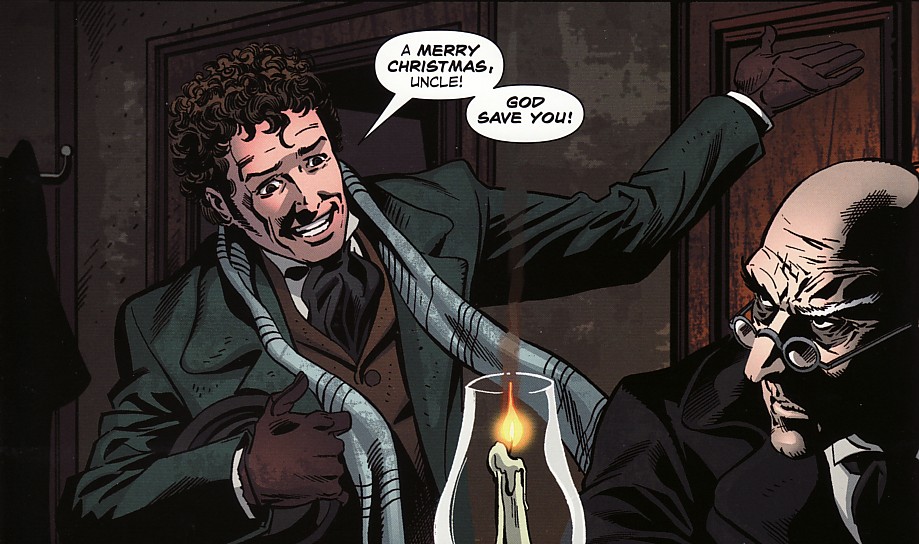
“There are many things from which I might have derived good, by which I have not profited, I dare say,’ returned the nephew. ‘Christmas among the rest. But I am sure I have always thought of Christmas time, when it has come round—apart from the veneration due to its sacred name and origin, if anything belonging to it can be apart from that—as a good time; a kind, forgiving, charitable, pleasant time; the only time I know of, in the long calendar of the year, when men and women seem by one consent to open their shut-up hearts freely, and to think of people below them as if they really were fellow-passengers to the grave, and not another race of creatures bound on other journeys. And therefore, uncle, though it has never put a scrap of gold or silver in my pocket, I believe that it has done me good, and will do me good; and I say, God bless it!”

― Fred, Scrooge’s Nephew, in Charles Dickens’ “A Christmas Carol” Continue reading

Christmas Music Blues

Who are those guys?

Who are those guys?

At the rate things are going, I am certain that before long no pop vocal interpretations of traditional Christmas music will be easily accessible on the radio. This is a cultural loss—it’s a large body of beautiful and evocative music—and someone should have, one would think, the obligation of preventing it. But I have no idea who.

I realized this when I felt myself getting nostalgic and sad as I listened to a series of “Christmas classics.” For one thing, they all reminded me of my parents, whose absence beginning in 2011 permanently kicked my enjoyment of the season in the groin. For another, all the artists were dead. Bing: dead. Frank: dead. Andy Williams, Nat King Cole, Dean Martin, Judy Garland, Burl Ives, Gene Autry, The Andrews Sisters, Perry Como, Elvis, John Denver–dead. Long dead, in most cases. Christmas has become a serenade of dead artists. Except for the narrow range of country music stars for those who enjoy “O Holy Night” with a twang, living pop artists don’t sing these songs. OK, Mariah Carey and Michael Buble. Not many others. Sirius-AM was desperate to find living artists that it has been playing the Seth McFarland Christmas album. Seth can sing, but I’m sorry, but it’s hard to enjoy “Silent Night” while picturing “The Family Guy.”

Current pop stars are, understandably, looking for new Christmas hits that will be identified with them, and those have always been hard to come by. Bing Crosby made annual recordings of terrible entries in the Christmas song market—I just heard a station play a few of them. Gene Autry too: many of his efforts were bombs, though I rather like this weird one:

Continue reading

Comment of the Day: “Comment of the Day: ‘On the Importance Of Christmas To The Culture And Our Nation : An Ethics Alarms Guide'”

Scrooge9

Nesting Comments of the Day again, as Belle’s reflections on how the cultural celebrations of Christmas made her feel “othered” as a child was met with many excellent responses and a lively thread. Pennagain’s (that is to say, the Commenter Previously Known As Penn) comment, however, surpassed tough competition, and thus we have the Comment of the Day on the post, Comment of the Day: “On the Importance Of Christmas To The Culture And Our Nation : An Ethics Alarms Guide”:

First impressions aren’t that easy to shrug off. Belle’s comment that she “was always sure that Ebenezer Scrooge was a commentary on the Jews” reawakened a long dormant spectre of mine. So, Google to the rescue, I went searching for the 65-year-old source and damned if I didn’t find it: My oldest Scrooge image is not from Dickens; it’s from the Rackham illustration of Shylock from Charles and Mary Lamb’s incomparable childrens’ (anyone’s!) introduction to Tales from Shakespeare:

ShylockFiction abounds with misers, a sub-category of villains (often semi-comical: to jeer at), a stock character from Medieval times, especially in children’s stories, who are often more memorable — and way more fun to act out — than are heroes. Miserly villains tend to have the same features and characteristics: mean, suspicious, hoarding good will as well as gold, stooped, narrow-shouldered, and “clay-faced” life-denying penny-pinchers … as is another “Ebenezer” in Stevenson’s “Kidnapped” whose miserliness is ethically and morally beyond villainhood (he changes sides in the middle of a battle), or a father-and-son pair of Chuzzlewits in another Dicken’s classic, or Shylock himself — who has by the end of Scene 1, before he lends the money and (jokingly) adds the “interest” that is the basis of the tragedy, chosen love of money over love of his daughter.

Continue reading

Comment of the Day: “On the Importance Of Christmas To The Culture And Our Nation : An Ethics Alarms Guide”


Belle is a Jewish reader of the recent Ethics Alarms Christmas post who sent  her comment to me off-site, then agreed to have it posted as the Comment of the Day after I requested permission.

She describes a real dilemma that I am very aware of, and thus am grateful for her raising it clearly and directly. I’ll be back with a bit more at the end, but here is Belle’s Comment of the Day on the post, On the Importance Of Christmas To The Culture And Our Nation : An Ethics Alarms Guide

I would like to try to make you understand at least a little why I am SO heartened that my children are growing up with “Happy Holidays” and Chanukah menorahs along with Christmas trees in public places, and how difficult it was for those of us non-Christians who didn’t. I sense that you were so antagonized by your colleague’s aggressiveness and different world view that you couldn’t hear what might have been behind the aggressiveness. You write that “Jews, Muslims, atheists and Mayans who take part in a secular Christmas and all of its traditions—including the Christmas carols and the Christian traditions of the star, the manger and the rest, lose nothing, and gain a great deal. Christmas is supposed to bring everyone in a society together after the conflicts of the past years have pulled them apart, What could possibly be objectionable to that? What could be more important than that, especially in these especially divisive times? How could it possibly be responsible, sensible or ethical to try to sabotage such a benign, healing, joyful tradition and weaken it in our culture, when we need it most?” Continue reading

On the Importance Of Christmas To The Culture And Our Nation : An Ethics Alarms Guide

christmas-hero-H

I don’t know what perverted instinct it is that has persuaded colleges and schools to make their campuses a Christmas-free experience. Nor can I get into the scrimy and misguided minds of people like Roselle Park New Jersey Councilwoman Charlene Storey, who resigned over the city council’s decision to call its Christmas tree lighting a Christmas Tree Lighting, pouting that this wasn’t “inclusive,” or the  CNN goon who dictated the bizarre policy that the Christmas Party shot up by the husband-wife Muslim terrorists had to be called a “Holiday Party.”  Christmas, as the cultural tradition it evolved to be, is about inclusion, and if someone feels excluded, they are excluding themselves.  Is it the name that is so forbidding? Well, too bad. That’s its name, not “holiday.” Arbor Day is a holiday. Christmas is a state of mind. [The Ethics Alarms Christmas posts are here.]

Many years ago, I lost a friend over a workplace dispute on this topic, when a colleague and fellow executive at a large Washington foundation threw a fit of indignation over the designation of the headquarters party as a Christmas party, and the gift exchange (yes, it was stupid) as “Christmas Elves.” Marcia was Jewish, and a militant unionist, pro-abortion, feminist, all-liberal all-the-time activist of considerable power and passion. She cowed our pusillanimous, spineless executive to re-name the party a “holiday party” and the gift giving “Holiday Pixies,” whatever the hell they are.

I told Marcia straight out that she was wrong, and that people like her were harming the culture. Christmas practiced in the workplace, streets, schools and the rest is a cultural holiday of immense value to everyone open enough to experience it, and I told her to read “A Christmas Carol” again. Dickens got it, Scrooge got it, and there was no reason that the time of year culturally assigned by tradition to re-establish our best instincts of love, kindness, gratitude, empathy, charity and generosity should be attacked, shunned or avoided as any kind of religious indoctrination or “government endorsement of religion.”  Jews, Muslims, atheists and Mayans who take part in a secular Christmas and all of its traditions—including the Christmas carols and the Christian traditions of the star, the manger and the rest, lose nothing, and gain a great deal. Christmas is supposed to bring everyone in a society together after the conflicts of the past years have pulled them apart, What could possibly be objectionable to that? What could be more important than that, especially in these especially divisive times? How could it possibly be responsible, sensible or ethical to try to sabotage such a benign, healing, joyful tradition and weaken it in our culture, when we need it most?

I liked and respected Marcia, but I deplore the negative and corrosive effect people like her have had on Christmas, and as a result, the strength of American community. I told her so too, and that was the end of that friendship. Killing America’s strong embrace of Christmas is a terrible, damaging, self-destructive activity, but it us well underway. I wrote about how the process was advancing here, and re-reading what I wrote, I can only see the phenomenon deepening, and hardening like Scrooge’s pre-ghost heart. Then I said…

Christmas just feels half-hearted, uncertain, unenthusiastic now. Forced. Dying.

It was a season culminating in a day in which a whole culture, or most of it, engaged in loving deeds, celebrated ethical values, thought the best of their neighbors and species, and tried to make each other happy and hopeful, and perhaps reverent and whimsical too.  I think it was a healthy phenomenon, and I think we will be the worse for its demise. All of us…even those who have worked so diligently and self-righteously to bring it to this diminished state.

Resuscitating and revitalizing Christmas in our nation’s heart will take more than three ghosts, and will require overcoming political correctness maniacs, victim-mongers and cultural bullies; a timid and dim-witted media, and spineless management everywhere. It is still worth fighting for.

More than five years ago, Ethics Alarms laid out a battle plan to resist the anti-Christmas crush, which this year is already underway. Nobody was reading the blog then; more are now. Here is the post: Continue reading

Ethics Quote Of The Day (Christmas Confusion File): Jonathan Turley

“Best wishes to everyone celebrating Christmas.”

—- Law Professor and blogger Jonathan Turley, wishing at least some of his readers a merry Christmas.

Get ready to duck, Fred!

Get ready to duck, Fred!

Prof. Turley is a lawyer, of course, and trained to express himself with precision. Thus I have to ask: what the heck is he trying to say here?

Is he wishing good tidings only those who, like his family, are celebrating Christmas, and rotten times to the rest? Is he editing the humanist message of Christmas to “Peace on Earth, and good will to those who are putting up Christmas trees and giving gifts, other wise you’re on your own”?

Or, as I fear greatly, given the fact that he is part of the U.S. education establishment and thus prone to have a spine of cream cheese, just observing the trendy political correctness that infects our times, and bowing to those who contrive to take offense when anyone smiles at them and offers a greeting that only says, at minimum, “We’re all in this together, so let’s try to be as good to each other as we can, OK?” Continue reading

Comments Of The Day: “Remembering Christmas Music”

Xmas music

This is a rare collaborative Comment of the Day, as texaggo4 and Penn combined for a fascinating discourse on the trend in Christmas holiday music and its significance in response to my December 23 post, prompted by listening to one too many renditions of “I Saw Mommy Kissing Santa Clause” and “Santa Baby.” It’s a wonderful job by both participants here, reinforcing my conviction that the the debates following the posts are as valuable, or more so, than the posts themselves.

First up is tex, followed by Penn’s response. Here is their combined Comment of the Day on “Remembering Christmas Music”:

Christmas only exists because of Christ. That being said, pull the religion out of the holiday and ultimately the holiday disappears and all of its associated trappings.

Christmas music has several “genres”, not classified nor exclusive:

1) Theological or religious: directly communication the story or the theology of the Incarnation.

2) Modern references to the festivals associated with the Christ-Mass.

3) Modern references to the neo-pagan Christmas folklore…Santa Claus, Saint Nick, Father Christmas, etc.

4) Modern references to the American folklore… Frosty the Snowman, etc

5) Modern references to the post-materialist Capitalist associations with Christmas— Christmas party songs.

6) Modern references to the post-narcissist associations with Christmas…songs about sex….

great.

We all saw this coming…it is predictable. take the religion out of a religious holiday and you can only assume that artistic messages (songs included) pertaining to the Holiday will have less and less to do with the ethical message of the holiday until eventually, watered down, it isn’t even worth playing the secular versions of that Holiday’s music.

What are the secularists complaining about? They asked for this.

Here is Penn’s reply: Continue reading

Jack and The Christmas Gasoline Can

gas-can

OK, it’s not exactly “The Homecoming,” but the way they’re scraping the barrel for cable Christmas movies, you might see this one on LMN yet. I just hope I’m not played by Wallace Shawn

Everything was going swimmingly this Christmas morning. We had opened presents, and now Grace and I were making our contributions to the family dinner later today at my sister’s house. A main feature was Grace’s mother’s recipe for a holiday salad that was part of her family’s Thanksgiving and Christmas meals for decades, and now ours. The recipe:

Two bags of cranberries, chopped

2 chopped navel oranges, with peel

2 chopped Red Delicious apples, also unpeeled

2 cups of chopped walnuts

2 diced celery hearts

1-2 cans of cranberry juice concentrate

Sugar to taste, or not (we leave it out.)

All was well until I cored the apples, bought supposedly fresh yesterday at Harris Teeter. They went “squish,” despite being all shiny and crisp on the outside. This would not do, so I was dispatched to the store to pick up suitably fresh apples, without which grandmother’s famous salad just wouldn’t be right.

I jumped into our car (the one that replaced its predecessor that  had burst into flames for no apparent reason in a mall parking lot—one of the many delightful events of our 2014). The gas-tank-low light was on, as it had been the day before. The gauge now said that I had five miles left, and the nearest station was only a bit more than two away. Well, these things aren’t perfect: my car stopped about 200 yards from the exit to the station, and in the middle of the street.

I called home, and my wife and son prepared to take his car to the station to get enough gas to let me drive the last leg of the journey, but his car, as is its wont, was dead. Meanwhile, I tried to push mine out of the middle of the street on my own, realizing too late that cars in neutral tend to pick up quite a bit of speed going down a grade, and are remarkably hard to steer and brake from outside the vehicle. I was barely able to stop the car from plowing into a parked Volvo by turning it to roll over the curb onto someone’s lawn. I was loath to leave it there untended while I hiked to the gas station, and I didn’t feel like paying fifty bucks or more for roadside assistance, but I was running out of options. Also time, if I was going to find fresh apples while a grocery store remained open.

I hadn’t seen a single car on the road, until an SUV stopped next to me. The driver, a woman in her thirties who was accompanied by her two teenaged sons, asked it I needed help. I explained my plight, and the two young men assisted me in rolling my car off the lawn into something approximating a legal parking space.

“Stay here: we’ll be right back,” the woman said. She was as good as her word, for she soon reappeared, with one of her sons carrying a festive red plastic gas can filled with fuel. The older son helped figure out how to work the damn spout, which had to be assembled. “See, here’s the flaw,” I explained. “The device solving this problem should not require more intelligence to operate than someone getting into this stupid situation is likely to have.” He agreed, politely. Then he poured all the gasoline into my empty tank.

I prepared to reimburse this family of Good Samaritans, but they refused. “Just pay it forward,” the mother said. “We’re glad we could help out.” I shook her sons’ hands, and hers, and wished them all a Merry Christmas. Then I got the apples, and the salad was perfect.

In the Marshall household, this will forever be known the Miracle of the Christmas Gas Can.

Let us sing!

(to the tune of “Good King Wenceslas” :

1. Jack’s wife said “You must go out.
We’ve an apple crisis!”
Never would he dare refuse ;
Better to fight ISIS.
So he set out in his car,
Though t’was low in fuel
Til it sputtered to a stop
(Boy was he a foo-oo-el!)

2. Shifted into neutral then,
It rolled t’ward disaster.
Jack would soon be chasing it,
As the car rolled faster.
Pulling hard with all his might,
He changed its direction
Rested then on somebody’s lawn
Waiting for collection.

3. Up now rolls an SUV
Driven by a stranger
“Trav’ler, tell us, how can we
Help you stave off danger?”
Her sons helped him move the car;
There would be no ticket.
Jack composed a secret wish,
As if he could pick it.

4. “Find a can, and bring me gas
This would be a blessing.
Yet I’d be a total ass
Their Christmas to be messing.”
Suddenly they all drove off,
Telling him to stay there
Still he doubted they’d return
Heeding his mayday there.

5. Damn! The time was running out,
And the stores were closing.
Should he not get gassed up soon
Hope would be foreclosing.
Hark! The SUV returns,
With a gas can brimming
Welcome sight more lovely than
Firs with all their trimming.

6. “Let me pay you,” Jack implored.
For I owe you greatly.”
“No, my friend, just pay it for’d.
That’s what’s right innately”
Therefore learn the lesson well
Be you high or lowly
If we all are ethical
Every day is holy.

I’m Dreaming Of A Zombie Christmas

Zombie Nativity

I didn’t say it was a pleasant dream.

Hmmm, how should I describe this? I would say that a law is being used to violate the First Amendment rights of an unethical jerk who is intent on abusing them.

Or, in the alternative, Jasen Dixon may just be an idiot.

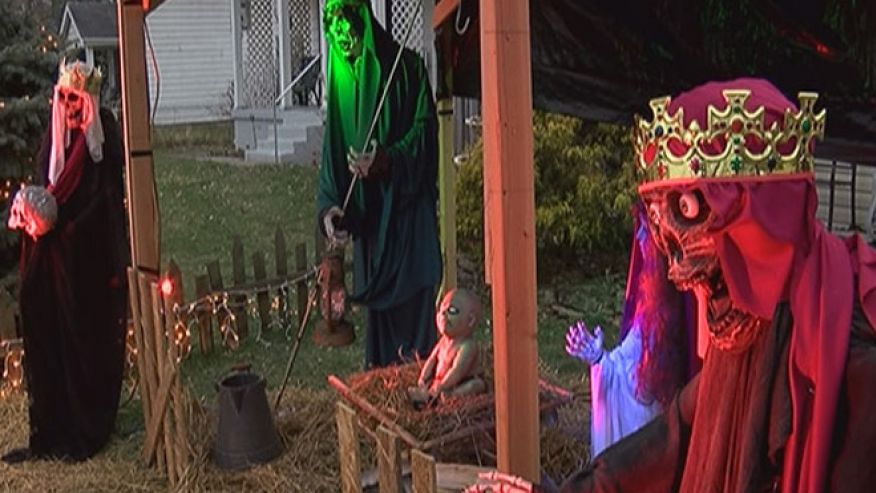
Sycamore Township, which is just outside Cincinnati, has responded to complaints by neighbors by applying various ordinances against Dixon’s unusual Nativity scene that he constructed in his front yard. It features life-size figures portraying Joseph and Mary as the walking dead, and a zombie baby Jesus, who has pale skin and pure white eyes. Here, here’s a close-up of Zombie Baby Jesus:

Zombie-nativity-scene

Awwwww!

Dixon suspects that the township laws, which prohibit structures in the front or the side yard of a residence that occupy more than 35 percent of its total area, and require that the primary structure must be 3 feet from the street and 6 feet from the dwelling, are really being selectively enforced against him because his holiday display offends some people….well, almost everyone. I suspect this as well.

Poor Jason says he doesn’t mean any harm: he’s just doing the best he can to celebrate the birth of baby Jesus. “I wanted a Nativity and I worked with what I had,”  says Dixon, who manages a nearby haunted house called “The 13 Rooms of Doom.” He says his First Amendment rights are being infringed.

“I’ve lived here for 15 years and I’ve never had a violation of any kind,” Dixon said. “It’s a holiday decoration. I know if it was a real pretty Nativity scene they wouldn’t be saying anything.”

I’ll agree with that too. Continue reading

Remembering Christmas Music

nativity

It is slowly dawning on me that Christmas music, one of the annual joys of my childhood and perhaps yours, is in a perilous state, both culturally and aesthetically. The best of the songs musically are religious in nature, which means that schools won’t pass them along to their charges as happened routinely when I was a child, and even playing them on the radio is likely to be regarded as a religious statement. I just loved the music, as I think most kids would if they ever got the chance before they were brainwashed into believing the ancient songs were subversive.

A full court cultural press is underway to make those songs as rarely heard outside of church as hymns, and I don’t see the trend as reversible. One obvious bar to a comeback: current pop stars don’t have the pipes to sing most of them without causing a sound pollution emergency. Or, if one of the few singers who could actually hit the notes dared to cover a carol like “O Holy Night,” he or she would feel required to apply flourishes of the sort that make every rendition of “The Star Spangled Banner” at a major sports event an invitation to PTSD.

Even for the more secular Christmas repertoire, the clock is running out. The most listenable versions, and the definitive ones in most cases, are by performers of the past who are not just dead, but also long forgotten by the current culture. An hour of classic Christmas recordings on the radio is now a reminder of how old I am and close to joining great singers like Bing Crosby, Judy Garland, Andy Williams, Nat King Cole, Jo Stafford, Burl Ives, Gene Autry, Frank Sinatra, Dean Martin, Elvis—dead, dead, dead. I guess Brenda Lee is still alive, so “Rockin’ Around The Christmas Tree” is a little less depressing, but it’s a minor classic at best. It’s gotten so bad that when I hear “The Little Drummer Boy,” I find myself wondering if the whole Harry Simeone Chorale is dead too—Harry died in 2005, and the recording is 56 years old, after all.

Meanwhile, our post-modern culture is sneering at the whole idea of Christmas songs, and Christmas itself. Most modern Christmas songs either are making fun of Christmas, about sex, or just lousy. The tradition is being undermined in more creative ways, too: this week I watched a 2012 straight-to-video movie called “12 Disasters of Christmas,” based on the loopy premise that “The Twelve Days of Christmas” was really a coded recipe for stopping the 2012 apocalypse predicted by the Mayan calendar. “The Mayans knew that the knowledge would have to be preserved for centuries, so they devised a song that would carry the secret and would be passed on and learned by children for generations,” explains the old codger who’s figured it all out. (But why would they choose such a monotonous and stupid song?) Come on, guess: How does the “Chosen One” stop the end of the world? [Answer below.]*

The movie is on to something, though. The Christmas songs that have the best chance of persevering though this age of  cynicism and cultural illiteracy may be those that either tell a story  or that have an interesting one related to their creation. The simple and beautiful tune of “Silent Night,” for example, as one of those films they used to show in school assemblies every year before some anti-religious hysteric sued, was composed for guitar in response to a Christmas Eve crisis for a small church in the Austrian alps in 1818: the church organ wasn’t working.  I have found that Irving Berlin’s “White Christmas”  affects me far more deeply since I learned that the Berlins’ infant son died on Christmas day, and that while his children celebrated Christmas as a cultural holiday, Berlin and his wife did not. They spent each Christmas after their son’s death in mourning. The song is a wistful remembrance of a happier time that the composer will never experience again.

Maybe another Christmas song will persevere if its origins are remembered; I was reminded of its history this week as a result of the thaw in U.S. relations with Cuba. Though my wife hates it, the song is one of my favorites, perhaps because it brings back warm memories: I watched the song’s first national broadcast with my sister and parents, and the Marshalls bought the recording the next day.

It was 1962. Noel Regney and Gloria Shayne were a husband and wife songwriting team of modest success. They were saddened by the lack of any spiritual content in popular Christmas songs then; imagine what they would think today.

Like all Americans, they were petrified during the thirteen days of the Cuban Missile Crisis, when the world stood on the brink of nuclear annihilation. As the crisis intensified, Regney found himself inspired to write down a simple poem with a Christmas theme. (Later, the couple would say that neither of them could ever sing the song through, because of the strong emotions it recalled.) When the nation could finally take a deep breath of relief as the threat ended,  Gloria devised a melody for her husband’s words, though he had always been the composer when he and wife wrote songs together.

The result of this unique variation on their collaboration was recorded before the end of 1962, but it wasn’t until the following year, when Bing Crosby sang the team’s creation live on ABC’s  “Hollywood Palace,”  that it became widely known. The song written during the Cuban Missile Crisis became a best-seller, Crosby’s last hit Christmas record, and also the last popular Christmas song to have a religious theme.

It was, and remains, a prayer for peace.

____________________________

* By finding and wearing FIVE GOLDEN RINGS, of course!