The Seventh Annual Ethics Alarms Awards: The Best of Ethics 2015, Part I

Sweet Briar montage

Welcome to the Seventh Annual Ethics Alarms Awards, our blog’s retrospective of the best and worst in ethics over the past year, 2015.

It was a rotten year in ethics again, it’s fair to say, and Ethics Alarms, which by its nature and mission must concentrate on episodes that have lessons to convey and cautionary tales to consider probably made it seem even more rotten that it was. Even with that admission, I didn’t come close to covering the field. My scouts, who I will honor anon, sent me many more wonderfully disturbing news stories than I could post on, and there were many more beyond them. I did not write about the drug company CEO, for example, who suddenly raised the price of an anti-AIDS drug to obscene levels, in part, it seems, to keep an investment fraud scheme afloat. (He’ll get his prize anyway.)

What was really best about 2o15 on Ethics Alarms was the commentary. I always envisioned the site as a cyber-symposium where interested, articulate and analytical readers could discuss current events and issues in an ethics context. Every year since the blog was launched has brought us closer to that goal. Commenters come and go, unfortunately (I take it personally when they go, which is silly), but the quality of commentary continues to be outstanding. It is also gratifying to check posts from 2010 and see such stalwarts who check in still, like Tim Levier, Neil Dorr, Julian Hung, Michael R, and King Kool.  There are a few blogs that have as consistently substantive, passionate and informative commenters as Ethics Alarms, but not many. Very frequently the comments materially enhance and expand on the original post. That was my hope and objective. Thank you.

The Best of Ethics 2015 is going to be a bit more self-congratulatory this year, beginning with the very first category. Among other virtues, this approach has the advantage of closing the gap in volume between the Best and the Worst, which last year was depressing. I’m also going to post the awards in more installments, to help me get them out faster. With that said….

Here are the 2015 Ethics Alarms Awards

For the Best in Ethics:

Most Encouraging Sign That Enough People Pay Attention For Ethics Alarms To Occasionally Have Some Impact…

The Sweet Briar College Rescue. In March, I read the shocking story of how Sweet Briar College, a remarkable and storied all-women’s college in Virginia, had been closed by a craven and duplicitous board that never informed alums or students that such action was imminent. I responded with a tough post titled “The Sweet Briar Betrayal,” and some passionate alumnae determined to fight for the school’s survival used it to inform others about the issues involved and to build support. Through the ensuing months before the school’s ultimate reversal of the closing and the triumph of its supporters, I was honored to exchange many e-mails with Sweet Briar grads, and gratified by their insistence that Ethics Alarms played a significant role in turning the tide. You can follow the saga in my posts, here.

Ethics Heroes Of The Year

Dog Train

Eugene and Corky Bostick, Dog Train Proprietors. OK, maybe this is just my favorite Ethics Hero story of the year, about two retired seniors who decided to adopt old  dogs abandoned on their property to die, and came up with the wacky idea of giving them regular rides on a ‘dog train” of their own design.

Ethical Mayor Of The Year

Thomas F. Williams. When the Ferguson-driven attacks on police as racist killers was at its peak (though it’s not far from that peak now) the mayor of Norwood, Ohio, Thomas F. Williams, did exactly the opposite of New York Mayor Bill de Blasio in response to activist attacks on the integrity of his police department. He released a letter supporting his police department without qualification. At the time, I criticized him for his simultaneously attacking activists as “race-baiters.” In the perspective of the year past, I hereby withdraw that criticism.

Most Ethical Celebrity

Actor Tom Selleck. In a terrible year for this category, Selleck wins for bravely pushing his TV show “Blue Bloods” into politically incorrect territory, examining issues like racial profiling and police shootings with surprising even-handedness. The show also has maintained its openly Catholic, pro-religion perspective. Yes, this is a redundant award, as “Blue Bloods” is also a winner, but the alternative in this horrific year when an unethical celebrity is threatening to be a major party’s nominee for the presidency is not to give the award at all.

Most Ethical Talk Show Host

Stephen Colbert, who, while maintaining most of his progressive bias from his previous Comedy Central show as the successor to David Letterman, set a high standard of fairness and civility, notably when he admonished his knee-jerk liberal audience for booing  Senator Ted Cruz

Sportsman of the Year

CC Sabathia

New York Yankee pitcher C.C. Sabathia, who courageously checked himself into rehab for alcohol abuse just as baseball’s play-offs were beginning, saying in part,

“Being an adult means being accountable. Being a baseball player means that others look up to you. I want my kids — and others who may have become fans of mine over the years — to know that I am not too big of a man to ask for help. I want to hold my head up high, have a full heart and be the type of person again that I can be proud of. And that’s exactly what I am going to do.”

Runner-up: MLB Commissioner Rob Manfred, who dismissed the ethically-addled arguments of Pete Rose fans to reject his appeal to be have his lifetime ban for gambling lifted.  For those who wonder why football never seems to figure in this category: You’ve got to be kidding.

Ethics Movie of the Year

SpotlightTIFF2015

“Spotlight”

Runner-up: “Concussion”

Most Ethical Corporation

Tesla Motors, the anti-GM, which recalled all of its models with a particular seatbelt because one belt had failed and they couldn’t determine why. Continue reading

The Starbucks Stupid Red Cups Uproar Is Trivial, But The Growing Cultural Insanity That Caused It Is Not

STARBUCKS-cups

On one level, the angry protests by some evangelicals and others regarding Starbucks’ eschewing the placement of snowmen, Christmas tree ornaments, reindeer and whatever other holiday kitsch they have festooned their coffee cups with in past years is too stupid to waste time discussing. Here, read all about it if you have a strong stomach. It appears to be yet another of those issues that deserves the George S. Kaufman rebuke. [ “Mr. Fisher, on Mount Wilson there is a telescope that can magnify the most distant stars to twenty-four times the magnification of any previous telescope. This remarkable instrument was unsurpassed in the world of astronomy until the development and construction of the Mount Palomar telescope. The Mount Palomar telescope is an even more remarkable instrument of magnification. Owing to advances and improvements in optical technology, it is capable of magnifying the stars to four times the magnification and resolution of the Mount Wilson telescope.Mr. Fisher, if you could somehow put the Mount Wilson telescope inside the Mount Palomar telescope, you still wouldn’t be able to see my interest in your problem.”]

Yet the fact that not just a few recently escaped inmates of a mental institution would make an issue of the design of Starbucks coffee cups, but lots of people, is significant. Continue reading

Clarence Darrow, in 1926, On Why Black Lives Matter

The all white Detroit jury that acquitted Dr. Sweet.

The all white Detroit jury that acquitted Dr. Sweet.

When I referred to Clarence Darrow’s support for terrorist John Brown in the previous post, I reviewed other references to the great trial lawyer that have appeared here. (As you may know, I authored a one-man play about Darrow, still performed to legal groups by actor (and my friend) Paul Morella, and with historian Ed Larson compiled selections from Darrow’s writings, court appearances and speeches, The Essential Words and Writings of Clarence Darrow.) I have also posted on his famous Leopold and Loeb argument against capital punishment, but I was shocked to find out that I never posted any part of his closing argument in the murder trial of Dr. Sweet.  I need to remedy that omission now. That courtroom oratory is not only the best of Darrow’s closing arguments, but also the most relevant to current events. It is a masterpiece, and  also astonishingly prescient and wise.

In 1925, Dr. Henry Ossian Sweet, a black man, moved his family into a house in a previously segregated section of Detroit. Mobs of whites gathered outside the house with torches, clubs and guns the first two nights of their residence, as police stood by passively. On the second night, a gunshot coming from the house killed one of the demonstrators, and all 11 residents of the home, including Dr. Sweet, were charged with murder. The National Association for the Advancement of Colored People hired Clarence Darrow to handle the defense.

There were two trials, the first ending in a hung jury. In the second, Darrow performed a seven hour closing argument, aspects of which have inspired homages in “To Kill A Mockingbird” and “A Time to Kill.” Despite the all-white jury, Dr. Sweet was acquitted, and the charges against the others were dropped. Darrow isn’t a legend for nothing.

I have left out the parts of the closing argument that recount the testimony and the facts of the case: you can read about the trials on Doug Linder’s excellent website, and you can read Darrow’s whole closing here. This redacted version focuses on Darrow comments about race and race relations. It is longer than the version we used in the play, but this is the version I would have used if audiences could tolerate a three hour one man show.

I continue to believe that this was the high point of Darrow’s incredible career, and also one of the most impressive—and gutsy—speeches in our history. Only Clarence Darrow would challenge an all-white jury like this in 1925. It is also unbearably moving. Paul, when he performs the selection, ends with tears streaming down his face, as Darrow did. You might too. Try reading it aloud to your kid. Or to yourself.

This post also relates to another recent post, the one about jury nullification. That is really what Darrow is arguing here, in the context of confronting racial injustice and bigotry for the survival of the nation and society. The white victim of the shooting was shot in the back. Darrow, at one point, calls it murder himself. Nonetheless, he argues that acquitting Sweet and his family is the right thing to do, whatever the law says.

Here is my abridged version of the epic closing argument made by Clarence Darrow, May 11, 1926, in defense of Dr. Sweet and his family.

Continue reading

Ethics Hero, Maybe For The Ages: The Center for Medical Progress

As I said with the release of the first surreptitious “sting video” of Planned Parenthood released under auspices of the anti-abortion group, the Center for Medical Progress, such videos are, in principle, unethical. However, while the unethical should be used in pursuit of a greater good only with great reluctance, moral certainty and a minimum of harm, there are instances when utilitarianism must apply.

This is one of them.

In the case of abortion, the prospect of saving the lives of millions of unborn is certainly worth the incursion on the ethical values of honesty and respect for privacy implicated by these videos. Indeed, it is worth a great deal more. With the seventh video, released yesterday, the conclusion is unavoidable that we, the public, the nation, and humanity, owe a debt of gratitude to the Center for taking radical action to force  confrontation with the reality of abortion so that there can be a real, open and honest debate  that doesn’t duck the central issue. That issue  is not women’s control over their lives, but the ethics of killing innocent human beings to achieve it.

The latest video, like the earlier ones, compels any fair, emotionally functioning and rational observer to accept the brutality and near complete callousness towards human life that the abortion machine creates and requires. In this respect the seven videos—with more to come— are abortion’s equivalent of “Uncle Tom’s Cabin,” forcing genteel, moral, good people by their own confident assessment to confront the horrors that have been occurring under their noses with their passive approval. Because they chose not to think about what abortion really involved, just as so many Americans had no idea what  slavery was like until Harriet Beecher Stowe forced them to consider it as more than an abstraction, abortion advocates, passive and active, have an ethical obligation to watch these videos. Those who refuse are admitting that they are incapable of letting facts disturb their ideologies. Continue reading

Musings On The Clarence Thomas Affair and Insideous, Unavoidable, Rationalization Eleven

If you are good enough and valuable enough, do you deserve one of these?

If you are good enough and valuable enough, do you deserve one of these?

A recent—and off-topic—comment caused me to begin thinking about “The King’s Pass,” #11 on the Ethics Alarms Rationalization hit parade,and perhaps the most perplexing of them all. The commenter referenced the 2010 discovery that Supreme Court Justice Clarence Thomas had inexplicably neglected to mention his activist wife’s annual income on his annual financial disclosure filings, meaning that he had filed a false affidavit and violated the law. Thomas claimed that he had made a careless mistake—for five years—and the matter was allowed to drop except for the angry agitating of the Anti-Clarence Thomas Furies, who are constantly searching for any way to get a conservative black justice off the Supreme Court short of assassination.

The episode had left a bad taste in my mouth, and I was happy to be reminded of it, bad mouth tastes being essential to triggering ethics alarms. I went back to read my post on the matter, and sure enough, I had followed the principle of rejecting The King’s Pass, and asserted that Thomas should be punished appropriately and formally…but that really ducked the question. Lawyers have lost their licenses to practice for single episodes of swearing to false information when it was far more obvious that a mistake had been made than in Thomas’s case, as when a hapless Maryland lawyer carelessly signed a legal document that had misrecorded  his address. The logic of this no-tolerance ruling was that a lawyer, above all people, should never swear to a falsehood, and that doing so, even once, was a serious breach of duty calling into question his fitness to practice law. I think the penalty for this particular act was excessive—it is cited locally as a cautionary tale—but I agree with its underlying principle, which should apply with even more vigor when the lawyer in question is a judge, and not merely a judge, but a Supreme Court Justice.
Continue reading

Ethics Observations On The Latrez Cummings Sentence

"I understand, son. We've all been at that awkward, "just want to beat the old white guy to death" age...."

“I understand, son. We’ve all been at that awkward, “just want to beat the old white guy to death” age….”

Detroit Third Judicial Circuit Judge James Callahan sentenced 19-year-old gang member Latrez Cummings to six months in jail for his participation in the mob beating of Steve Utash, a 54-year-old white man who jumped out of his car to assist a 10-year-old African-American boy after his pick-up truck hit the child. Cummings and at least 20 others on the scene attacked Utash and beat him severely, leaving him with permanent brain damage.

Judge Callahan told Cummings that the lack of a father was what led him to his current plight. “That’s all you have needed in your life, a father, someone to discipline you, someone to beat the hell out of you when you made a mistake,” Callahan lectured Cummings. “Without the guidance of a father, being 19 years of age, I can understand how some of these problems existed in the past.” The judge added that Cummings has suffered without “somebody to beat the hell out of you when you made a mistake.”  With the further rationalization, “We’ve all been 19 years of age, ” Callahan handed down the six month sentence, to be followed by probation.

The prosecutor, to her credit, went nuts. Said Assistant Wayne County Prosecutor Lisa Lindsey: Continue reading

Is It Ethical For A Criminal Defendant To Take Acting Lessons Before Testifying?

Actors make great witnesses. Especially in movies...

Actors make great witnesses. Especially in movies…(and if you don’t know who this is and in what film classic, you have some cultural literacy to catch up on…)

This is a trial development I have never encountered before. Blogger Janni Allen, a former columnist for the South African Sunday Times, claims that a famous South African actor told her that he coached Oscar Pistorius before his histrionic testimony in court regarding the death of his girlfriend. Prosecutors have charged the famous “Blade Runner” with murder; he claims it was an accident. In his appearance on the stand, Pistorius wept and appeared overcome with grief and emotion.

For the sake of the discussion, let’s assume that Allen is correct, and that Pistorius took acting lessons. Is there anything unethical about a criminal defendant or anyone else who has to testify in court taking acting lessons in anticipation of the experience? Is there anything unethical about a lawyer directing a client or a witness to take acting lessons in advance of a court appearance?

I don’t think they are difficult questions. The answers are “No,” and “No.” Continue reading

Lawyer Daniel Muessig’s Clever, Effective, Legally Ethical And Thoroughly Despicable Ad

Just as I’ve been desperately trying to explain that lawyers do not represent bad people because they like them or want to loose them upon the world,  here comes innovative Pittsburgh lawyer Daniel Muessig, whose clever TV ad proclaims that this is exactly what he wants to do. Here it is:

Is this an ethical ad? According to the Pennsylvania Rules of Professional Conduct, it is within the conduct permitted by the state’s legal ethics rules. The ad isn’t misleading. It doesn’t make promises the lawyer cannot keep. It doesn’t represent dramatic recreations as fact, or use broad metaphors and exaggerations. (Lawyer ads are held to a standard of literalness that presumes the public has never see any other kinds of advertising in their entire lives.) Once upon a time the various state bar advertising regulations included prohibitions on “undignified” communications, or those that undermined public trust in the profession, but those days are long past: the standards were necessarily vague, and breached free speech principles.

So we have this: a lawyer who appeals to his future criminal clients by saying that he thinks like a criminal, believes laws are arbitrary, that other lawyers will “blow them off” and that he visits jails frequently because that’s where his friends are. He attacks his own colleagues and profession, denigrates the rule of law he is sworn to uphold, and seeks the trust of criminals not because of his duty as a professional, but because he’s just like them. Muessig is willing to undermine the law-abiding public’s belief in the justice system and the reputation of his profession and his colleagues in order to acquire clients. I’m sure his strategy will work, too. Continue reading

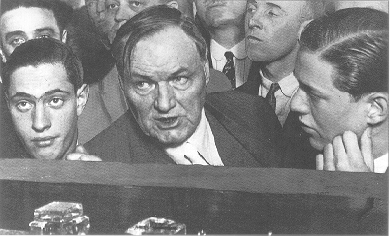
Perspective: The Trial of Nathan Leopold and Richard Loeb (1924), Clarence Darrow’s Closing Argument, And Judge Caverly’s Sentence

Darrow and his clients

Darrow and his clients

I just commented, on the controversial post here about Judge Boyd and the media frenzy regarding the “affluenza” defense offered by Ethan Couch’s lawyers, that the fact that so many of the comments, many of them angry, focused on the fact that a spoiled, rich kid got a break, or, as they used to say in the old days, mercy, that I began thinking about the famous Leopold and Loeb murder trial.   In 2011, I  posted a shortened version of Clarence Darrow’s famous closing argument in that trial, one of my favorite of all courtroom speeches, and it seems appropriate to do so again. It is far from a perfect parallel, but any excuse to revisit Darrow at his best is a good one.

 Nathan Leopold and Richard Loeb were, like Ethan Couch, young, rich and spoiled; they also were Jewish and gay. Their crime was  far worse than Crouch’s: they planned and executed the murder of a child just for the fun or it, and to show that they could outsmart authorities. (Ironically, they were arrested almost immediately). The two teenagers were charged with the premeditated murder of fourteen year-old Bobby Franks. Both defendants were brilliant students (Leopold, the youngest graduate in the history of the University of Chicago; Loeb, the youngest graduate of the University of Michigan),  and the sons of wealthy and successful Chicago businessmen. Neither showed any remorse for their terrible crime. There is no question that had they been poor, they would have been sentenced to die, and would have been hanged. Their parents, however, could afford to hire Clarence Darrow, a foe of capital punishment who had never had a single one of his often guilty clients executed. They got their money’s worth.

His summation on August 22, 1924, remains perhaps the most persuasive and eloquent argument against capital punishment ever made in a court or anywhere else.  It is also an argument for mercy, and especially mercy for the young. The plea worked: Judge John L. Caverly spared Leopold and Loeb, and he sentenced them to life imprisonment without parole—under the circumstances and in those days of rough justice, a gift. In his sentencing statement, which is posted here after Darrow’s summation, Caverly did not indicate that he was swayed by Darrow’s eloquence or reasoning. Caverly based his sentence on the ages of the defendants. Darrow was counting on this particular vulnerability of Caverly, who had helped establish juvenile justice courts in Chicago. Later, Nathan Leopold suggested that he and Dickie Loeb might have gotten the same result if they had simply submitted their birth certificates into evidence.

I doubt that he would have bet his life on it. The pressure on Caverly to hang these two despicable sociopaths was overwhelming, and having Clarence Darrow put his decision in such heroic terms had to steel his nerve, if it needed steeling. Still, as with Judge Boyd in the Couch case, there is no way to be sure that he would not have spared Leopold and Loeb anyway. Also as in Ethan Couch’s case, critics said this was disparate justice, bought and paid for.

This is a condensed version of Darrow’s closing,  edited for The Essential Words and Writings of Clarence Darrow, (2007),  that I co-edited with historian Ed Larson.  Here is one of the great orators of the 20th Century, one of the great progressive thinkers in our history, and the greatest trial lawyer who ever lived, arguing for the life of two murderers and for the soul of our civilization. I do not share Darrow’s absolute rejection of the death penalty, but I always do for a few hours, at least, after reading this. Continue reading

Ethics Quote Of The Month: Dr. Jonathan Gruber

“We currently have a highly discriminatory system where if you’re sick, if you’ve been sick or [if] you’re going to get sick, you cannot get health insurance. The only way to end that discriminatory system is to bring everyone into the system and pay one fair price. That means that the genetic winners, the lottery winners who’ve been paying an artificially low price because of this discrimination now will have to pay more in return. And that, by my estimate, is about four million people. In return, we’ll have a fixed system where over 30 million people will now for the first time be able to access fairly price and guaranteed health insurance.”

—– Dr. Jonathan Gruber of MIT, an economics professor who is among the designers of the Affordable Care Act, a.k.a Obamacare. He was interviewed by NBC’s Chuck Todd regarding the troubled law’s problems.

lottery

Could it be that the act of getting involved with this administration turns even non-politicians into deceivers and liars? For an economist to talk so deceitfully and manipulatively is distressing. He, of all people, certainly knows how insurance works, and has to work. The insurance company accepts, in essence, wagers from its insured, in the form of premiums, that they will “win” by incurring health care costs that require more funds more than the accumulated “wagers.” The insurance company gambles that it will “win” by the insured remaining relatively healthy, so that the premiums (and whatever investment income they generate) exceed what the company has to pay in medical costs for that individual. The only way a company can keep providing insurance is to win more bets than it loses.

Saying that an insurance company is “discriminating” (in the unjust and biased sense) when it refuses to  accept a wager that is virtually certain to win is like saying that a poker player is engaging in discriminatory conduct by refusing to play with a new player who brings a royal flush to the table with him. It is not discrimination to refuse to lose money, and Gruber knows it. But  like an expert liar, as I must presume he is, he plants a false definition of discrimination at the beginning of his discussion and then treats it as an agreed-upon description of what is occurring. Not selling something to a customer who can’t afford a fair price is not discrimination, and refusing to gamble with someone who is assured of winning is also not discrimination. But discrimination is something that everyone regards as wrong, unfair, and unlawful, so that is how the lawful operation of insurance companies is framed by this clever, learned, dishonest man.

I no longer trust Dr. Gruber, nor should you.

His statement is of additional interest, however, because it starkly defines the unique Progressive definition of “fairness,” by his repeated use of lottery imagery to describe the fact that some people, through no fault of their own, have fewer advantages than others, while those others, often through no virtue of their own, have more resources and opportunities. Progressives regard this as inherently wrong and unfair, and so unfair that it must be remedied by obtrusive government interference. The rest of America regards this as “life.” Continue reading