Morning Ethics Warm-Up, 4/6/2018: The Good, The Bad, And The Ugly

Gooooood Morning!

1. From the Moral Luck files:

What you just saw is a bald eagle landing on Seattle Mariners starter James Paxton’s shoulder during the National Anthem before yesterday’s Mariners-Twins game.  Here’s a closer look…

The eagle got confused: it is supposed to go to his trainer, in one of the more spectacular Anthem displays that has ever been devised: I’ve seen this performance several times.  After the game, Paxton was asked why he didn’t try to escape. His answer:

“I’m not gonna outrun an eagle, so just thought, we’ll see what happens.”

Heck, he had already endured the horror of Dessa’s incredibly off-key rendition of “The Star Spangled Banner,” what’s a mere bald eagle attack? Seriously, Paxton’s quote is an ethics guide: Don’t panic, don’t act on emotion, assess the situation, see what happens, and act accordingly. Of course, the fact that this strategy worked out well helps: if the eagle had ripped his eyes out, everyone would be saying Paxton was an idiot not to run.

How I would have loved to see this happen to Colin Kaepernick!

2. How the President gets himself into ethics trouble. I just watched a clip of Trump speaking yesterday about California’s sanctuary cities. “The thing is that these cities are protecting bad people,” he said, with emphasis. Naturally, this will be characterized as racism. It’s not racism, however. The statement is just overly simplistic, and exacerbated in its inflammatory elements by the President’s rudimentary vocabulary, in which the only operable adjectives appear to be great, bad, horrible, wonderful, terrible, sad, and a few more. It is impossible to communicate about complex issues competently and fairly with such meager tools. Illegal immigrants have broken our laws and willfully so. That is not good, but it does not make all of them bad people….though many are. Continue reading

Review: Ethics Alarms Concepts And Special Terms

Recently updating the Ethics Alarms list of concepts and frequently used terms reminded me that I had been meaning to post them for review and assistance to those relatively new here. Of course, the link has always been right there at the top of the home page, but I have this sneaking suspicion that it isn’t visited very often.  Here, then, is the up-to-date list.

CONCEPTS

Non-Ethical Considerations: Defined above, non-ethical considerations are important because they are often the powerful impediments to ethical conduct, and the cause of many conflicts of interest. Non-ethical considerations are many and diverse, and include:

  • The need and desire for shelter, health, wealth, fame, security, self-esteem, reputation, power, professional advancement, comfort, love, sex, praise, credit, appreciation, affection, or satisfaction
  • The desire for the health, comfort, safety, welfare and happiness for one’s family, loved ones, friends, colleagues, an co-workers
  • The pursuit of vengeance or retribution
  • Hunger, lust, pain, ambition, prejudice, bias, hatred, laziness, fatigue, disgust, anger, fear
  • …and many more

Ethical Dilemma: This is an ethical problem in which the ethical choice involves ignoring a powerful non-ethical consideration. Do the right thing, but lose your job, a friend, a lover, or an opportunity for advancement. A non-ethical consideration can be powerful and important enough to justify choosing it over the strict ethical action.

Ethical Conflict: When two ethical principles demand opposite results in the same situation, this is an ethical conflict. Solving ethical conflicts may require establishing a hierarchy or priority of ethical principles, or examining the situation through another ethical system.

Ethical Gray Area: Gray areas are situations and problems that don’t fit neatly into any existing mode of ethical analysis. In some cases, there may even be a dispute regarding whether ethics is involved.

Reciprocity: The ethical system embodied by The Golden Rule, and given slightly different form in other religions and philosophies. It is a straight-forward way of judging conduct affecting others by putting oneself in the position of those affected. Reciprocity should always be available in any ethical analysis, but it is frequently too simple to be helpful in complex ethical situations with multiple competing interests.

Absolutism: Absolutist systems do not permit any exception to certain ethical principles. The champion of all absolutists, philosopher Immanuel Kant, declared that the ethical act was one that the actor was willing to have stand as a universal principle.

One principle of absolutism is that human beings can never be harmed for any objective, no matter how otherwise worthwhile. Absolutism has the advantage of making tough ethical calls seem easy, and the disadvantage of making debate impossible. One sees absolutism reflected today in the controversies over war, torture, abortion, cloning, and capital punishment.

Utilitarianism: Utilitarianism accepts the existence of ethical conflicts and the legitimacy of some ethical dilemmas, and proposes ethical analysis based on the question, “Which act will result in the greatest good for the greatest number of people?’ It entails the balancing of greater and lesser goods, and is useful for unraveling complex ethical problems. Its drawback, or trap, is that utilitarianism can slide into “The ends justify the means” without some application of absolutist and reciprocity principles.

Consequentialism: In formal ethics, utilitarian schools of philosophy are sometimes lumped together as “consequentialism,” in that the ethical decision-making is based on seeking the best result. Here we just uses the above term, utilitarianism.  Consequentialsm, in contrast, is the flawed belief that the rightness or wrongness, or even wisdom, of chosen conduct is measures by its actual results rather than its intended results. If “if all worked out for the best,” in other words, the conduct that created the desirable result most have been ethical, whatever its intent or however the conduct was determined to be necessary or desirable. This is a fallacy.

Cognitive Dissonance:
Cognitive dissonance is a psychological phenomenon first identified by Leon Festinger. It occurs when there is a discrepancy between what a person believes, knows and values, and persuasive information that calls these into question. The discrepancy causes psychological discomfort, and the mind adjusts to reduce the discrepancy. In ethics, cognitive dissonance is important in its ability to alter values, such as when an admired celebrity embraces behavior that his or her admirers deplore. Their dissonance will often result in changing their attitudes toward the behavior. Dissonance also leads to rationalizations of unethical conduct, as when the appeal and potential benefits of a large amount of money makes unethical actions to acquire it seem less objectionable than if they were applied to smaller amounts.

Moral Luck: The common situation where an unethical act is only discovered, noticed, or deemed worthy of condemnation due to unpredictable occurrences that come as a result of the act or that affect its consequences. Moral luck is the difference, for example, between two mildly intoxicated drivers, one of whom arrives home without incident, while the other has an unwary child dash in front of his automobile, leading to a fatal accident that he couldn’t have avoided if completely sober. Yet the unlucky driver will be a pariah in the community, while the more fortunate driver goes on with his life.

SPECIAL TERMS USED ON ETHICS ALARMS

Continue reading

Morning Ethics Warm-Up, 4/1/2018: The Easter-April Fools Edition [UPDATED]

Happy Easter, or April Fools Day,

…whichever you chose, or both.

[My family celebrated Greek Easter (next Sunday, this year), or not, depending on how Greek my mother was feeling. The whole thing left me thoroughly confused. And why no Greek April Fool’s?]

1 Hey, it’s only the Pope carelessly allowing centuries of Catholic teachings to be declared, if informally, null and void. What’s everyone so upset about? Recipe for a fiasco:

  • The Pope inexplicably has a meeting with a 93-year-old atheist reporter, Eugenio Scalfari, who has reported on the alleged contents of their private meetings before.
  • Scalfari has admitted “on more than one occasion” that he doesn’t take notes or record his conversations with the Pope.
  • The Pope either opines, or doesn’t, or sort of does depending on your interpretation, and if you are an atheist confirmation bias comes into play, opine that Hell doesn’t exist, saying, according to his pal, “Hell does not exist…The disappearance of sinful souls exists.”
  • Scalfari, presumably without permission or consent, but he’s a journalist, so he’s going to report the news, and the Pope saying that all that stuff in the Bible about Satan is a lot of hooey is, you have to admit, news (although who knows if Matt Pearce would report it as news; I guess it would depend on whether he wanted the public to know there was no Hell, right?), naturally lets the world know that the Pope doesn’t believe what his predecessors and follower have been using to scare the Hell out of sinners all this time.
  • The Vatican issued a statement saying:

“What is reported by the author in today’s article is the fruit of his reconstruction, in which the precise words uttered by the Pope are not cited. No quotations in the aforementioned article, then, should be considered as a faithful transcription of the words of the Holy Father.”

That’s called “spin.” Why do we trust these people?

2. Why is NPR taxpayer-funded again? This “correction” actually appeared in the NPR story about the Pope’s Hell problems:

Correction March 30, 2018: An earlier version of this post incorrectly described Easter as “the day celebrating the idea that Jesus did not die and go to hell or purgatory or anywhere at all, but rather arose into heaven.”

Competence? Editors? Basic education? Respect for people’s faith? Knowing something about the predominant religion ins the nation you are reporting on? Hello? Continue reading

Ethics Warm-Up, Valentines Day, 2018: Of Mummies, Mockingbirds, Hunchbacks, And Sperms….

Happy Valentines Day!

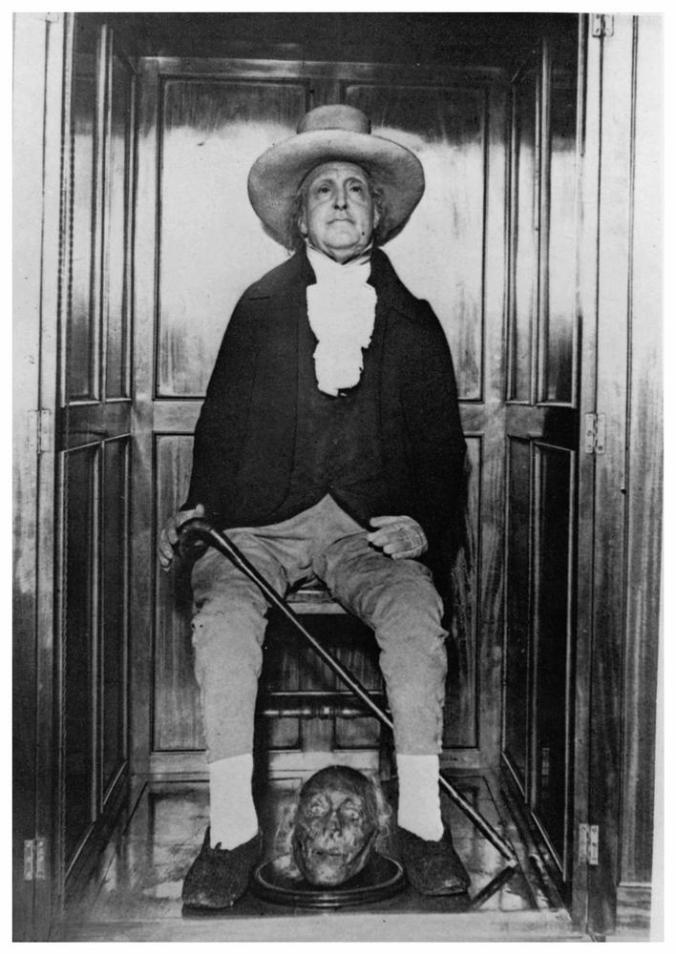
1 Jeremy gets a vacation! As some of you may know, philosopher Jeremy Bentham, John Stuart Mill’s mentor and the founder of utilitarianism, has been stuffed and kept in a glass case at the College of London since his death in 1832 as a condition of his will. I’m not kidding! (A photo has appeared periodically in the Ethics Alarms header from the blog’s first day.) Here he is…

That’s Jeremy’s real head on the floor: the one on top of the stuffed body around his skeleton is wax. Jeremy still attends all meetings of the school’s board, wearing his own clothes.  Now he’s visiting the U.S., something he always wanted to do when he was alive.

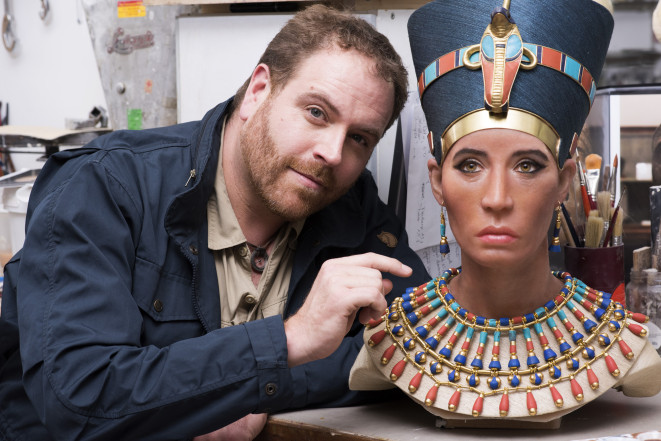
2. The message is increasingly clear: everything is racist. Got it, thanks! Working from her mummy, scientists from the University of Bristol reconstructed the face of 3,400-year-old queen Nefertiti, King Tut’s mother, using 3D imaging technology. The process required more than 500 hours. Nefertiti was Egypt’s queen alongside Pharaoh Akhenaten from 1353 to 1336 BC. Heeeeeeere’s  NEFI!

Now the project is under attack on social media because the reconstructed Nefertiti face isn’t dark enough, not that anyone has a clue regarding how dark or light anyone who lived over 3000 years ago was.

This is the kind of gratuitous race-baiting that causes well-deserved backlash.  It’s also redolent of an old whitewashing theme, dating back to the “Cleopatra was black” and “Jesus was black” claims of activists in the 1970s.

3. Segue Alert! And speaking of stupid whitewashing controversies, the cancellation of that high school production of “The Hunchback of Notre Dame” because the student cast as the gypsy ingenue Esmeralda was “too white” provoked a backlash….from Nazis.

Naturally, this means that the race-based attack on the innocent student cast because she was the most qualified to play the part was justified, thanks to the trampoline effect when a bad idea is attacked by even worse extremists.  (Don’t make me put the cognitive dissonance scale up twice in one day.) The New York Times reports that the students who intimidated school administrators into cancelling the show “are now besieged by an online mob targeting them with threats and racial epithets after the incident was reported in right-wing publications like Breitbart News, then spread to the neo-Nazi site The Daily Stormer. Via Facebook, the students received pictures of themselves with swastikas plastered on their faces. One parent had what was thought to be her home address (it wasn’t) posted online with a comment seeming to encourage harassment: “Do your thing social media.” Another parent received a profane email, assailing her for embracing “anti-white racism,” adding: “I feel sorry for your brainwashed child.” The way this phenomenon works is that now, when someone legitimately objects to the unethical handling of this episode by the school, they can be portrayed as agreeing with white supremacists.

We saw this effect in full bloom in Charlottesville. Tearing down statues of Robert E. Lee is a form of historical airbrushing and censorship, and principled, objective critics (like me) condemned the statue-toppling mania. Then the alt-right and the white nationalists marched against the removal of a Lee statue, and suddenly if you objected to a memorial to a major figure in American history and a bona fide military hero whose life is a wealth of lessons for all of us, it meant you were siding with racists.  President Trump was effectively trapped by this Catch-22. Continue reading

Sex! Denial! Confirmation Bias! Media Obama Protection! Betrayal! Assholes! Hannity! It’s “Spermgate,” The Ethics Controversy That Has Everything!

Is this a stupid story? It is worthy of Ethics Alarms’ time and attention? That’s a legitimate question well down the list of issues raised by “Spermgate”—my name for it, and I hope nobody else’s, because it is intentionally silly—regarding whether President Obama’s official portrait contains an intentional representation of a sperm cell, a trademark of the artist, Kehinde Wiley.

But to prematurely answer that question, yes, story is worthy of Ethics Alarms’ time and attention, because the related issues it cracks open for examination are more important than the specific story itself.

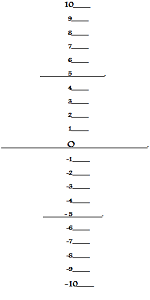
I was going to title this story “Stop making me defend Sean Hannity.” Hannity, whom I regard as a blight on multiple landscapes, including national ethics standards, was among the first to assert that the portrait of Obama included a sperm on his face. I heard about this third hand, and immediately concluded that this was just one more anti-Obama Hannity fantasy. And there we have it: bias, one of the themes of this whole episode. I don’t trust Sean Hannity, I don’t respect him, and I question his integrity and motives. As with all bias, the Cognitive Dissonance Scale immediately took over. Here it is again…

Hannity is down around  -10. For me, if he declared that chocolate wonderful, and chocolate was at +7 on my scale, his endorse ment would yank it down into negative territory. So I didn’t even bother to check out Hannity’s claims—after all, he’ll claim anything to embarrass Democrats.

Then I stumbled across a mocking piece in the Daily Kos, full of mockery regarding Hannity’s crazy claim and launching the (pretty funny) gag, “Oh the #spermhannity.” The article began with the assumption that Hannity’s claim was res ipsa loquitur ridiculous, and signature significance for an right wing idiot. I accepted this analysis, even though I have about tyhe same level of bias reagrding the Daily Kos that I do regarding Hannity. It seemed as if Hannity himself had doubts, because after the barrage of abuse and ridicule, he deleted his tweet and the article on his website about the  “inappropriate sexual innuendo” and the hidden image of sperm in the portrait. I was prepared to leave it at that, but decided to follow up this link on the Kos post:

“If you’re hoping for more explanation than that, you will not find it in the article, which is still available to read via cache. It moves on from there to note that the artist once sardonically used the phrase “kill whitey” in New York magazine profile, which at least has the virtue of being true, unlike the claim that he put sperm in his painting of Barack Obama, which is objectively not true.”

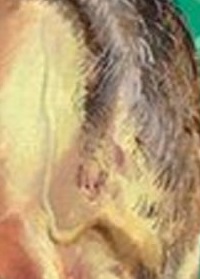
Through that link, I eventually found the close-up section of the portrait pictured above. Here is the portion of it at issue:

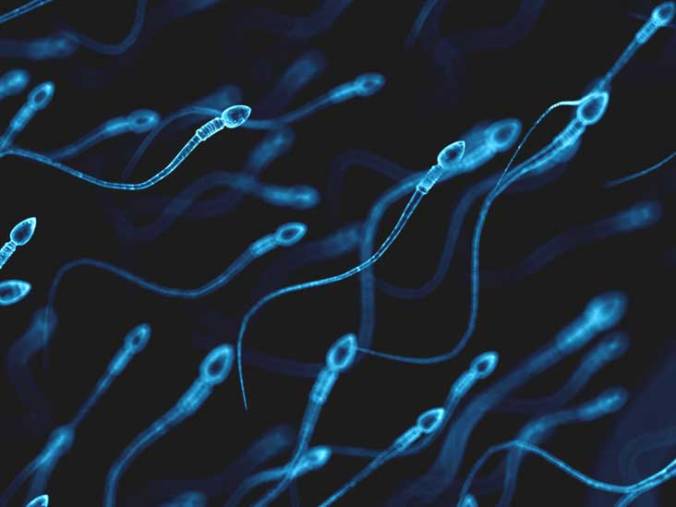
Anyone who says that it is objectively untrue that the section doesn’t include what might have been an intentional representation of a sperm is either lying or is in the throes of crippling confirmation bias and denial.  Of course that could be a sperm. Here are sperms…

Here’s that vein in Obama’s head again…

Continue reading

Why Aren’t Feminists In The U.S. Supporting The Cause Of Iranian Women In The Current Protests?

Excellent question, don’t you think?

Writes Sarah Rumpf, at the conservative blog Red State,

“Liberal feminist groups in America have been busy this year, knitting pink hats with cat ears, organizing marches, dressing up like characters from The Handmaid’s Tale, and tweeting their #Resistance panic that the Trump administration will soon chain all of us ladies in the kitchen, barefoot and pregnant, where we’ll be forced to make sandwiches and watch Archie Bunker…you’d think that a story about women who are actually facing systemic gender-based oppression would be an obvious rallying cry.

Nah.

Conservative author Christina Sommers tweeted,

“Women in Iran are valiantly protesting genuine oppression. So far the silence of major feminist groups in USA is deafening. Where are you @NationalNOW, @AAUW @nwlc @MomsRising?

Where indeed. Nor have Hollywood celebrity feminists like Madonna, Meryl Streep, Ashley Judd, Lena Dunham, Alyssa Milano, et al. mentioned the Iranian protests. The Democratic party feminists among their elected officials have similarly been silent. Why? From an ethics perspective, it seems like a serious breach of integrity.

I see the following possible explanations:

  • Cognitive dissonance. The feminists are more dedicated to opposing President Trump than they are supporting women’s rights abroad. Trump has been vocal in support of the Iranian protests.

That means the protests are bad.

  •  Pro Obama denial. President Obama let the 2009 protest, and by extension any chance of liberty for Iranian women, come and go without his support or endorsement in a cold display of real politick at its worst.

Obama’s ex-staff and supporters are twisting themselves into pretzels to insist that this wasn’t the mistake—and betrayal of principle–that it was.

  • Apathy. They don’t care about Iranian women.

They care about abortion.

  • Selective multiculturalism: Muslims can do no wrong is the progressive party line, and U.S. feminists don’t have the courage of integrity to break from it.

Did I miss one?


Morning Ethics Warm-Up, 12/11/2017: Boston, Racism, Morality And The Media’s Continuing Conspiracy

Good Morning!

1 That’s my town! Spotlight, the Boston Globe investigative team that was the focus of the Academy Award-winning film about its crucial role in exposing the  Catholic Church’s child-molestation scandal, has published the results of an investigation into racism in Boston. Nobody who lives in Boston or did for any length of time (like me) can find that the conclusion of the Spotlight team qualifies as news: Boston is an overwhelmingly white city—the whitest of all the major metropolitan areas—which may have softened its traditional hostility to African Americans, but that so far hasn’t changed the impression among its black residents that they are outsiders, and tolerated rather than welcome.

I love Boston, and would move back there in a heartbeat if it didn’t mean uprooting my life in unpleasant ways. The report, however, is depressing, for that ironic feature of the city was a blight on it when I lived there, and decades have failed to change it significantly.

2. Not “Morality Alarms”. Let me stick this in quickly.

A commenter on the most recent Comment of the Day on the Masterpiece Cakeshop controversy sent in a defense of the baker’s conduct based on Scripture. I stated,

I dismiss this argument out of hand.

2000 year old biases are now called ignorance. They can be justified as of their time, but pretending nothing has changed since then is indefensible and willfully obtuse. The taboos against homosexuality were a matter of common sense when procreation was essential to a tribe’s survival. Before there was psychological research and knowledge of brain chemistry, ignorance about homosexuality was excusable, and even natural. 2000 years is a long time. There is no excuse for pretending that it isn’t, that human beings haven’t learned, that knowledge hasn’t expanded, and that ancient texts are not often dangerously and cruelly out of date.

In two follow-up comments I wrote, stitching them together,

That’s not reasoning or argument, and this blog is about ethics (what’s right?) not morality (what does God say is right?)…At some point discrimination and prejudice is still discrimination and prejudice. “The Bible says I should be prejudiced” is better, sort of, than “I just hate these people,” but it also is a cover.

Needless to say, an argument that relies entirely on the Bible is just an appeal to authority. That’s not a reasoned argument, but a declaration. Nor is it possible to argue with God, who works in mysterious ways, meaning that “but that makes no sense!” doesn’t work.

This isn’t a morality blog, and never has been. Simple as that. Continue reading

Unethical Quote Of The Month: George Takei

That tweet—cynical, desperate, pathetic, ridiculous, hilarious—by the minor “Star Trek” supporting actor turned gay rights warrior turned pop celebrity pitch man turned Kevin Spacey—has been taken down, but it’ s too late. Poor George Takei has set a new mark for complex and creative virtue-signaling as an incompetent crisis management tactic. It’s interesting that this relatively new art form has become so popular for riders on the Harvey Weinstein Ethics Train Wreck, because it has backfired every time.

It’s gratifying that these Hollywood types are beginning to grasp the cognitive dissonance scale, but the damn thing can’t work miracles.

First Harvey announced that he was going to go after the NRA as he sort of apologized for assaulting, abusing, intimidating and raping actresses, because Weinstein gambled that this would make Hollywood say, “Oh,  you’re a good guy then! We’ll ignore the rapes, as long as your enemy is our enemy.” I can see how he may have thought this would work; after all, it had worked with Democratic politicians his whole career. When Kevin Spacey’s protective Wall of Silence  was starting to crumble, he tried the “I’m gay! Love me!” version of this tactic, figuring that he would more than double his support in the show business community. This did not go well.

Takei had come out long ago, so he couldn’t try that, and he hadn’t been giving millions to the Democratic Party, so a pledge to destroy Ted Cruz or Roy Moore or some conservative organization that he thought people hated more than they have problems with gay sexual predators wasn’t likely to work. What do do? Wait…wait! People blame the Russians for electing Trump! I can’t say I’m going to go after Russia, but I can say that Russia’s going after ME! Sure, that can work! I’ll blame the whole Scott Brunton “Sulu molested me” accusation on Russian bots! Then I’ll take a heroic stand, explain the Putin’s out to get me because I called him out on Russia’s anti-gay policies and proclaim that I won’t be silenced! It’s perfect!”

Uh…no. Continue reading

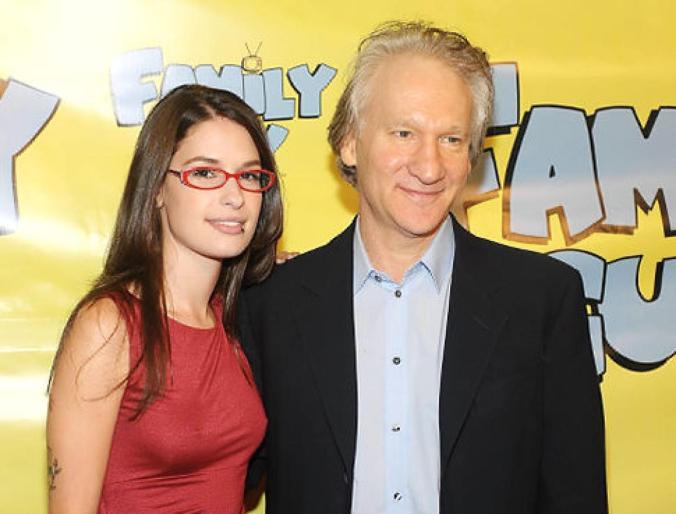
Ethics Dunce: Bill Maher, As Usual

Bill Maher, the star of HBO’s “Real Time,” was hosting comedian Joy Behar of “The View” to talk about her new book when they got on the subject of Bill O’Reilly and his  $32 million settlement of a single sexual harassment claim.

Maher observed that many of the recent powerful men of Hollywood accused of sexual abuse always seem to be married.  Behar expressed puzzlement regarding why that was.

Now, I could answer that question for Joy, as could anyone else smarter than she is, which is to say, almost anyone. Joy, you will recall, earlier this month excused sexual harassment by progressives like Weinstein over harassers like Bill O’Reilly because, she said, at least the liberals weren’t hypocrites. (She didn’t explain the pro-feminist/misogyny contradiction, but then Joy is, as I just noted, an idiot.)

Rich and powerful men are almost always older, usually middle-aged, in Hollywood, and everywhere else for that matter. See, Joy, it takes a while to become rich and famous. Nobody heard of you when you were 25 either, and let me tell you, I was much happier then.

The older a man is, the more likely he is to be rich and powerful—sexual harassment doesn’t require power, but power inequity helps—and also he is more likely to be married, especially in Hollywood, where executives  start wondering whether you are gay if you aren’t married and 40. Not that they care if you are gay—after all, more than 50% of Hollywood men probably are— but they care if the public cares, because then you won’t be as marhetable as a romantic lead. Thus even gay middle aged men are usually married by the time they are powers in Hollywood. This has been true since the 1920s.

Another reason is that it takes a while to accumulate hundreds of victims, as in the case of  James Toback.

Maher, however, had a different, if predictable, answer:

“Because they have shitty sex lives.”

Oh, was that a joke, Bill? Hilarious! Except Bill wasn’t joking. He’s a well-documented misogynist, not that this would stop a hypocritical feminist dimwit like Behar from sucking up to him since he is on the right side of history, and Maher has always made it clear that he thinks marriage is for chumps. Maher defended Bill Clinton’s sexual harassing/assaulting ways by arguing that he “earned it,” and has extolled his own lifestyle as a play-the-field, aging bachelor like Sam Malone on “Cheers” as Man Heaven. It should surprise no one that Bill  believes that if married women were good little submissive spouses and eagerly cheered while their fat, disgusting husbands masturbated in front of them like Weinstein or humped their leg like James Toback, men wouldn’t have to force young women looking for jobs to do it instead. Continue reading

Rudy Huxtable Lets Desperate Dad Use Her As A Stage Prop

Bill Cosby’s sexual assault trial began yesterday in Norristown, Pennsylvania,  but Bill’s enabling and complicit wife didn’t appear with him. Smart move by defense counsel: Camille Cosby’s almost certain knowledge of her husband/meal ticket’s infidelity and worse makes the pair seem like a couple of monsters, and the jury would be conflicted seeing Mrs. Cosby  sitting in court as women described being drugged and assaulted by Funny Bill while her husband’s defense was not “I didn’t do it” but “it was consensual.”  Still, having Cosby  entering the Montgomery County courtroom without family present would send the message that he was being shunned by those who know him best. What to do?

Eureka! Have the accused serial sexually predator accompanied by a member of the family the public knows and loves best, his TV family from “The Cosby Show! Perfect! It sends the message that he is still supported and loved by those who know him. It proves that he has not been abandoned and shunned. Best of all, such an entrance makes Cosby appear to be the nice, ethical, fatherly Bill Cosby everyone thinks they know, the one who raised four adorable girls and who had a beautiful feminist wife, a noble and moral man who would never, never do the things that over 50 women say he did to them, the money-grubbing sluts.

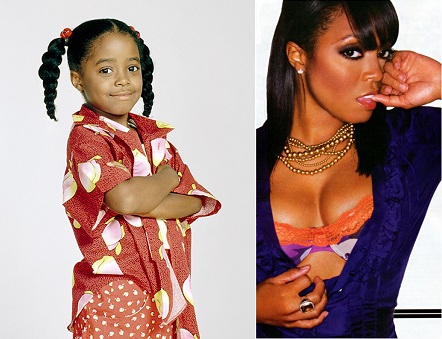
So instead of his real-life wife, Cosby was guided into the courtroom  by former television daughter Keishia Knight Pulliam, who played the cute little one, adorable Rudy, from 1984 to 1992. Pulliam agreed to be a prop, in other words, a prop designed to help implant reasonable doubt in a case where reasonable doubt will be hard to come by. Bias and cognitive dissonance helps, though. Rudy is there to help “Dad” by nourishing bias as a jury considers Andrea Constand’s lon-standing accusation that Cosby drugged and molester her.

Of Knight Pulliam’s presence, Cosby’s spokesperson Andrew Wyatt said: “She’s not here to proclaim guilt or innocence. She’s here to finally hear the truth for herself in the courtroom. She wants people to stop listening to the sensationalism and come hear the truth.” Nonsense. If Pulliam wanted to do just that, she could have arrived at the courtroom like anyone else, and sat quietly among the spectators. Instead, she was playing a role calculated to make it harder for a jury to see through Cosby’s celebrity and public persona. She knew it, too.

Why would an alleged feminist ally herself with a sexual predator and against so many women? Well, it can’t hurt Pulliam’s career any, since she barely has a career. She has been languishing in post-child star Hell for sometime now, going the “She’s all grown up and she’s bad’ route that worked out so well for Lindsay Lohan; the Cosby trial gig—no, I don’t think its unfair to ask if she was paid—at least reminds people that Rudy is 38 and still around. Maybe a reality show producer is watching.

Last year, Pulliam had Amber Rose on her podcast “Kandidly Keshia”I’m sure you never miss it-to promote Rose’s “Slut Walk” event designed to end slut-shaming. When he mentioned Cosby, she responded,

“I feel you, and everyone’s entitled to their opinion, but we still live in a country where you’re innocent till proven guilty. And I understand everything that’s happened, and me being a feminist and believing women—no means no and I get that—but, just so you know, I did work with him for a really long time. I love him dearly still and that isn’t the man that I know.”

Translation: My mind’s made up, don’t confuse me with facts. Maybe this statement led to the phone call from Cosby’s lawyer. Continue reading