Morning Ethics Warm-Up, 5/24/2018: ‘Can’t We All Get Along? Nah…’ Edition

Good morning!

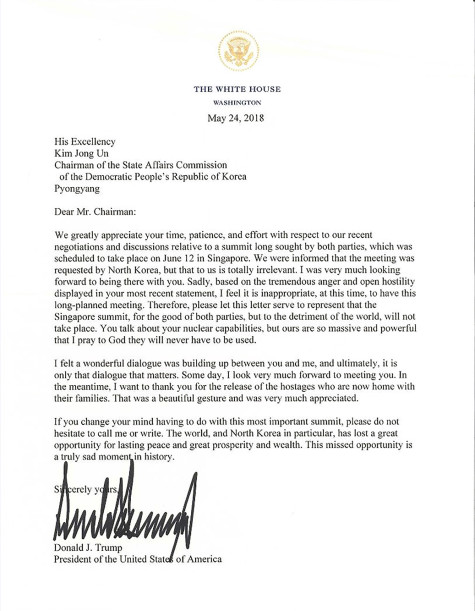
1. What? Negotiation competence? Boy, we haven’t seen THAT for a while. President Trump just pulled out of the scheduled summit with North Korea, a public lesson in Negotiation 101. If only Barack Obama had taken the Art of the Deal seminar before capitulating to Cuba and Iran. the letter the current elected President just sent to North Korea could not be more obvious in its devices, but I guarantee you that my negotiations professor at law school, Dean Adrian Fisher, one of the negotiators of the SALT treaty, would have approved. Here’s the letter, released this morning.

This is another ethics test, by the way. Take note of who criticizes the President for this, for they  will be revealing themselves as either reflex-Trrump haters or the kind of people used car dealers love to see walking in the door.
2. “A Nation of Assholes” update. It is now beyond dispute that the concept was right but that I badly misjudged the population that I thought would be primarily affected. My theory in the 2015 essay was that that having an ethics-challenged boor like Donald Trump as President would degrade the ethical standards of the public through the “rotting fish head” process: people follow the leader. Well, that has happened too, but the worst asshole transformation has beset progressives and “the resistance.,” as their behavior gets worse by the hour. Continue reading

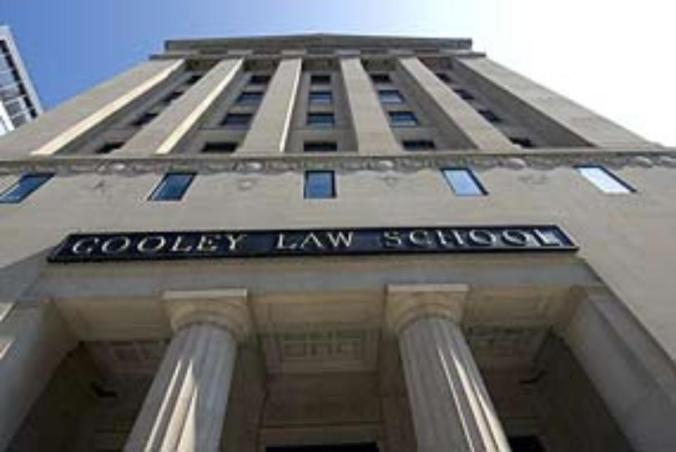
No, Thomas M. Cooley Law School Did Not Make Michael Cohen A Bad Lawyer, And The Fact That Cohen Got His JD There Does Not Mean It’s A Lousy Law School

Ugh. I don’t want to argue that Cooley isn’t a lousy law school, mind you, although I don’t have anything but anecdotal data of the matters, and I certainly don’t want to defend Cohan, whom I fingered as a lousy lawyer way back in 2015. ( What A Surprise: Donald Trump Has An Unethical Lawyer!). 

No, this post is about how incompetent journalists are, how they are too frequently devoid of basic reasoning and research skills, and how, particularly when they deal with legal matters, their ignorance is frequently embarrassing while it actively misleads the public.

Politico’s Phillip Shenon, who, not surprisingly, is not a lawyer, figures he can smear three parties via guilt by association with one brush in  “Trump’s Lawyer Went to the Worst Law School in America.”  But graduates of every law school succeed and fail, and while the law schools like to take credit for them, there is every reason to believe that those grads would have succeeded or failed had they gone to better law schools, or worse ones. One graduate’s misadventures prove absolutely nothing.

Roy Cohn, who  served as Senator Joe McCarthy’s chief counsel during the infamous Army–McCarthy hearings and was later disbarred, graduated from Columbia Law School. If he had graduated from Thomas M. Cooley Law School, Shenon no doubt would have thought Cohn’s alma mater was significant, but, of course, it would be a cheap shot at McCarthy and Cohn. If Cohen had gone to Columbia, Shenon could write a piece titled “Trump’s Lawyer Went to the Same Law School As Roy Cohn.”

Bill Lerach, disbarred in the class action law suit scandal involving his law firm, was considered a champion of abused investors and a social justice crusader, until he was exposed and sent to prison. He went to the University of Pittsburgh’s law school. Did that school make him do what he did? If he had gone to Harvard, or Cooley, would he have practiced law any differently?

Let’s look at Richard Nixon’s lawyers. John Erlichmann, send to prison and disbarred, went to Stanford Law School.  John Mitchell, also locked up, also disbarred, graduated from Fordham Law. John Dean, who was sent to prison and disbarred, got his law degree at Georgetown. Speaking of Georgetown, Stephen Glass, the disgraced journalist deemed possessed of so wretched character that California declared that he can never be a lawyer and have a chance to screw up like Michael Cohen, attended t Georgetown Law Center, which, as I have written about here, has a law professor who was previously a bank robber. Thomas Cooley Law School never sank that low.  Until recently, GULC also had an adjunct ethics prof who turned out to be a meth dealer. That guy, Jack Vitayanon, got his degree at Columbia Law School, just like Roy Cohn. What a coincidence! Or is it….?

As you may know, I also got my law degree at Georgetown, so if I go rogue, you know who to blame. Wait, maybe you don’t. The one to blame will be ME. Continue reading

Morning Ethics Warm-Up, 4/26/18: Sorry Trump-a-Phobics, It’s A President Trump Morning!

Good Morning!

1. Wake up with President Trump! By sheer chance, I surfed by Fox and Friends just as the three goofs (or two goofs and a random blonde from the stable in a tight party dress) on the sofa were having a spontaneous phone interview with President Trump, just like in the good old days in 2015, when CNN and NBC let the crazy old reality star and eccentric real estate mogul blather on while they smirked and nodded because it was great for ratings and  might even saddle the evil Republican Party with a Presidential candidate that Hillary Clinton could squash like a bug, finally leading to the Great Progressive Awakening in America, with open borders, no more guns, free college, a ban on fossil fuel, and Harvey Weinstein as a White House regular.

Observations:

  • Say what you will about Trump, this was just after 8 AM, I could hardly utter a coherent sentence, and the President was sounding like Harold Hill doing “Trouble in River City.” Either he had 20 cups of coffee or was hooked up to an electric generator.  I have a lot of energy, but Trump is older than I am, and he was energetic, engaged, and, for him, articulate.
  • His performance this morning highlights how disgusting the “Trump has dementia, let’s use the 25th Amendment to get rid of him” plot was, with the news media in full complicity. It made it hard for me to focus on what the President was saying on Fox, frankly. That particular post-election, anti-democratic attack—it was Ethics Alarms’ Plan E on the alphabetical list of “the resistance’s” ongoing efforts to overturn the election, if you recall—makes me furious every time I think about it.
  • Nevertheless, I will never get used to having a President who talks like he does.  It isn’t statesman-speak, or even demagoguery. It’s pure salesman patter, again, like Harold Hill,  or any infomercial spokesman. It’s almost hypnotic. What Trump-Whisperer Scott Adams would say, indeed has said many times, is that this is a talent and a skill, and we aren’t going to see it become commonplace among Presidents because most people just can’t do it well. No, it’s not Presidential, and will never be. But it works.
  • I also realized, once again, how much class bigotry is involved in the extreme hostility to President Trump from the “elites,” and yes, I count myself in that group. Never mind what schools Trump went to: he’s Fred Trump’s son, and unlike the Kennedy boys, never polished off the rough spots passed along to him through his humble, street-smart, back-alley forebears. I just watched the film of “My Fair Lady” again after many years, and found myself thinking about Henry Higgins’ theories while I was listening to Trump: if he spoke like Barack Obama, how differently would the news media and his adversaries treat him? Yet how many of his supporters would then regard him as just another one of “them”?

Why can’t the English teach their children how to speak?
This verbal class distinction, by now
Should be antique
If you spoke as she does, sir
Instead of the way you do
Why, you might be selling flowers, too!

An Englishman’s way of speaking absolutely classifies him
The moment he talks he makes some other Englishman despise him! Continue reading

Morning Ethics Warm-Up, 2/9/2018: Post 2016 Election Ethics Train Wreck Update Edition. Sorry.


Good Morning.

I don’t say “I told you so” as often as I could or would like to. One continuing theme at Ethics Alarms since the 2016 election that drove progressives mad has been the accusation leveled at me that I have been under-emphasizing the existentially perilous character and conduct of the President while concentrating too much on the conduct of his critics. My answer has been that I believe that the reaction of progressives, Democrats and the news media to President Trump’s election has been, by far, the most disturbing ethics story of the past year, and in historical context one of the most serious and dangerous periods in U.S. history. That conclusion has been reinforced as the year progressed. I was and am right.

None of that makes the ethical conduct of the Trump Presidency any better than it is; as I made clear in last year’s ethics audit,  he has largely behaved as I expected he would when I declared him, over and over again, unfit and unqualified. However, if our institutions and the public’s trust in them remain as strong as they have through-out U.S. history, a single odd-ball President, even for two terms, will not do irreparable damage. What the resistance and its allies in the Democratic Party and the news media are doing, however, threatens to wreck many of those institutions and tear down public trust to a point of no return. That’s my professional assessment. It is not one based on partisan politics or ideology, but on American history, cultural history, and ethics.

1 Fake news and fake history. I knew it was manufactured nonsense when my Facebook friends, Democrats, pundits and the mainstream news media began once again screaming “Fascist!” and claiming that the President’s expressed desire for a major military parade was a terrifying departure from American tradition. I knew a little research would prove it so, but then, I thought, surely some news source would have the integrity to do its job, and some “nationally recognized historian,” like go-to Democratic shills like CNN’s Douglas Brinkley, would set the record straight. Why should I have to do the work for free that these people are paid handsome fees to do, and have a duty to do besides?

Yet few corrections from these supposedly objective sources were registered while Rep. Adam Smith (D-CA) said, “A military parade of this kind would also be a departure from the values of our constitutional democracy,” and Rep, Ted Lieu (D-CA) sneered, “Because authoritarian regimes like Russia and North Korea hold massive military parades does not mean that we must as well. Politico headlined, “Trump’s Military Parade Draws Bipartisan Rebuke.” The Washington Post told readers,  “Military Parades Are About Ego and Power. Of Course Trump Wants One.”  Normally reasonable bloggers were similarly triggered, like Prof. Jonathan Turley, who wrote, “The United States has long rejected the holding of military parades featuring tanks, missiles and other heavy weapons as a symbol of authoritarian regimes like the Soviet Union, North Korea and other countries.”

I guess this depends on what one’s definition of “long” is. Such parades have been out of style since the Vietnam War caused much of the public and the political class to turn against the military, though politicians still give deceit-laden lip-service to “supporting the troops,” just not what they do. Military parades featuring heavy weaponry were not uncommon between the end of the Civil War in 1865 through 1961 during the peak of the Cold War, when it was arguably strategically beneficial to remind the USSR that if it was going to bury us, there would be a fight.  Many of these parades, in 1919, 1942, 1946, 1953, 1957, 1961, and as recently as 1991, featured tanks, missiles, and sometimes many thousands of troops  Let’s see: that’s Presidents Wilson, Roosevelt, Truman, Eisenhower, Kennedy, and George H.W. Bush…Hitlers all. That there is Chuck Schumer, a leader of the party having the vapors over the President’s suggestion, saying this: Continue reading

Comment Of The Day: “Trevor Noah’s Critics”

Bravo: a  deft,  quirky and thought-provoking comment about “how difficult writing and reading is and how easy misunderstandings are born”—and my own careless—or not!—phrasing was the writing at issue.

Here is Zanshin’s Comment of the Day on the post, Trevor Noah’s Critics:

Jack,

In the sentence,

version 1. We should respect consistent standards and integrity instead of hypocrisy, not treat them like they are qualifications for sainthood.

I guess you meant expect instead of respect.

version 2: We should expect consistent standards and integrity instead of hypocrisy, not treat them like they are qualifications for sainthood.

And even then, I, with English as a second language, would read ‘ should expect’ firstly as “To consider likely or certain” but given the current climate that is not a given anymore. Therefore, to emphasize the (intended?) meaning of ‘expect’ as “To consider obligatory; require” the following sentence would have been clearer to me,

version 3:We should demand consistent standards and integrity instead of hypocrisy, not treat them like they are qualifications for sainthood.

Flash of insight: By pondering your sentence and rewriting it I realized that your sentence is fine but that I bracketed the sentence in a wrong way; which is made possible given the complexity of two polarities involved in this sentence:

a. consistent standards and integrity versus hypocrisy
b. [treat them with] respect versus treat them like they are qualifications for sainthood

Lets name the different parts of the sentence,

A: [should respect
B: consistent standards and integrity
C: hypocrisy
D: treat them like they are qualifications for sainthood

The bracketing I now think you meant is: { A { B_C } } versus { D }

The bracketing I understood first was: { A { B } versus { C } } versus { D }

But in bracketing the sentence in my way, ‘respect’ felt awkward once reading part D. That’s when I backtracked to A and thought-up ‘expect’. while thinking, “Just another typo by Jack and/or wrongly suggested/inserted word by the word processor.” Continue reading

The Unprepared Judicial Nominee [Updated]


Matthew S.] Petersen, a lawyer serving on the Federal Election Commission, was one of five President Trump judicial nominees to be questioned by the Senate Judiciary Committee last week. Senator John N. Kennedy, a Republican from Louisiana, subjected Petersen to questions regarding basic litigation law, such as the Daubert standard, which has to do with qualifying expert witness testimony, the definition of a motion in limine, and several other bits of information a junior litigator would have to have in his memory banks. The potential judge told the Senator that he had never tried a case or argued a motion in court. He said he last read the Federal Rules of evidence in law school. “I understand that the path that many successful district court judges have taken has been a different one than I’ve taken,” Petersen said.

Naturally, being a Trump nominee, Petersen is being widely mocked in the news media and by Democrats. Some legal experts have been more sympathetic, like Judge Wayne R. Andersen, who was a federal judge in the Northern District of Illinois for nearly 20 years. He told reporters  that there was a continuing debate within the legal profession about the qualifications required of a trial judge, saying, “Anyone who steps to the federal bench lacks a huge amount of federal experience necessary to do the job,” and that Senator Kennedy’s questions, while fair, “would eliminate 80 percent of the nation’s lawyers and many of the most talented lawyers.”

Lawyer/Blogger John Hinderaker wrote in part,

The lawyers who have the most thorough understanding of substantive areas of the law–real estate, taxes, corporate governance and so on–are generally not litigators. Do we really want to say that all of these non-litigators–the majority of lawyers–are unfit to be trial judges?…does it mean that one of my non-litigator partners would be disqualified from such an appointment, no matter how good a lawyer he or she might be? I don’t think so.

… Newly-appointed judges attend “judge school,” where they are taught the finer points of the rules of evidence….Most lawyers who are appointed to the bench in both federal and state courts have backgrounds in litigation. No doubt that is appropriate. However, it is by no means rare for non-litigator lawyers to be appointed, or win election, to the bench. In my opinion, that is a good thing. I don’t see why a minority of lawyers–litigators–should have a monopoly on the bench. I don’t know whether Matthew Petersen will make a good judge or not. But in my view, he doesn’t deserve to be ridiculed because his highly-successful law career has been conducted outside of the courtroom.

I agree; he shouldn’t be ridiculed for that. Continue reading

Comment Of The Day: “Comment Of The Day: “The Popeye,” From The Ethics Alarms Ethics Estoppel Files: … And My Epiphany About Investigative Reporting'”


Arthur in Maine, who has kindly featured me on his radio show and actually given me sufficient time to explain things without being cut off, submitted the following discourse focusing on my embarrassingly slow-to-form realization that all investigative reporting into political matters had to be considered as manipulated to serve some political agenda by the news organization.

I’ll have some observations at the end, but first, here is AIM’s Comment of the Day on Comment Of The Day: ‘“The Popeye,” From The Ethics Alarms Ethics Estoppel Files: I Can Say The Republican Party Is Rotting…”, And My Epiphany About Investigative Reporting:

…Why are any of you – including Jack – surprised? Media is, first and foremost, a BUSINESS. It doesn’t sell news – it provides news as a mechanism for generating advertising (in the case of NPR, underwriting and/or listener) support.

The United States is one of the only so-called free nations that embraces the concept of objective media. In fact, the whole concept started in this nation – with Joseph Pulitzer (recognize the name?). In other words, the concept of objective media is an American conceit.

Pulitzer’s drive towards so-called “objective” media certainly raised standards, but it wasn’t due to the noble idea that newspapers – pretty much the only game in town at his time – should be objective. Pulitzer was the visionary who recognized that the way news was being reported was scaring off the advertisers, and the advertisers were way more important than the folks who plunked down a penny or two to buy a copy at the news stand.

American media at the dawn of the 20th century wasn’t dissimilar to the way it is today – and much like it has ALWAYS been in nations in which the media isn’t state-controlled. It’s rambunctious. It’s partisan. It wears its beliefs on its sleeve – both with regard to what it covers and the way it covers it. Continue reading

Comment of the Day: “‘White Christmas’ Ethics Addendum: Battlefield Incompetence, Insubordination And More In The Holiday Classic”

To kick off the Not-Too-Early-To-Play-Christmas-Music Season, here is a Comment of the Day that adds another chapter to the Ethics Alarms commentary on “White Christmas,” the Bing Crosby-Danny Kaye musical film that is one of the five or six most resilient of the Christmas classics. The initial ethics analysis is here.

The post that spawned the latest take was a rare guest essay by Ethics Alarms veteran texagg04.

Now comes new commenter SykesFive to provide insight into the pivotal character of General Waverly, played by Dean Jagger. Among other things, he argues that one reason the general was so beloved was that he was poor general, treating the lives of his men as more important than his mission.

Here is his Comment of the Day on tex’s post, “White Christmas” Ethics Addendum: Battlefield Incompetence, Insubordination And More In The Holiday Classic:

I have a somewhat different take on this. I sometimes think I am the only person who thinks so much about the Waverly character.

As the scene opens, Major General Waverly is being relieved for frankly the only reason American unit commanders were relieved during the war: he didn’t take the objectives. That is failure. It could be lack of aggression or poor coordination or anything else, but ultimately it is failure and the commanding officer will pay the price. He will be shuffled off to a rear area command, or maybe just left to bum around the theater, and be out of the Army by the end of 1945 because his record will be so tarnished. He will be lucky not to revert to his prewar rank.

Waverly’s age suggests he was a company-grade officer during WWI and may or may not have seen combat during that conflict’s closing weeks, then spent decades idling in the interwar army. Apart from whatever happened in 1918, Waverly has no more combat experience than anyone else in the division. He is not an experienced commander by any measure. He had the right credentials–a few articles in service journals, no serious problems on his posts, and of course a West Point Ring–but had never really been tested as a field-grade officer. Again this is a common profile.This is a very common profile for WWII US Army division commanders.

So in 1940, let’s say Colonel Waverly seemed like a likely candidate for command of an infantry division in the expanding army. He did well enough with some trial commands–all during stateside training and expansion–and was promoted to one and then two stars. He seemed competent enough when the 151st Division was formed and went through let’s say nearly two years of intensive training in Texas or California or wherever. And so the division was sent to Europe in let’s say August 1944, then spent a couple months languishing in Normandy or the Pas de Calais region, during which time Waverly was a friendly presence at other officers’ headquarters as well as around his division. Bear in mind that at this point, and really for the whole war after the breakout from Normandy, the limit on American frontline strength was providing fuel and artillery shells. There were more men and tanks than could be sustained at the front. Continue reading

KABOOM! Roy Moore’s Lawyer Just Made My Head Explode. Or As He Would Say, Just Made My Head Exploded

I hate early morning head explosions. Among other reasons, those bits of skull and brain ruin the taste of my coffee.

No, I don’t blame Trent Garman for representing a vile creepazoid like Roy Moore. Creepazoids have rights too, and should have access to trustworthy and competent counsel. My problem with Garman arises from those last four words. Lawyers as untrustworthy and incompetent as Garman, in my opinion (don’t sue me, Trent, it’s just my opinion that you’re an idiot; I can’t prove it, but I do think you did), shouldn’t be representing clients. Garman, in truth, needs to go back to the sixth grade.

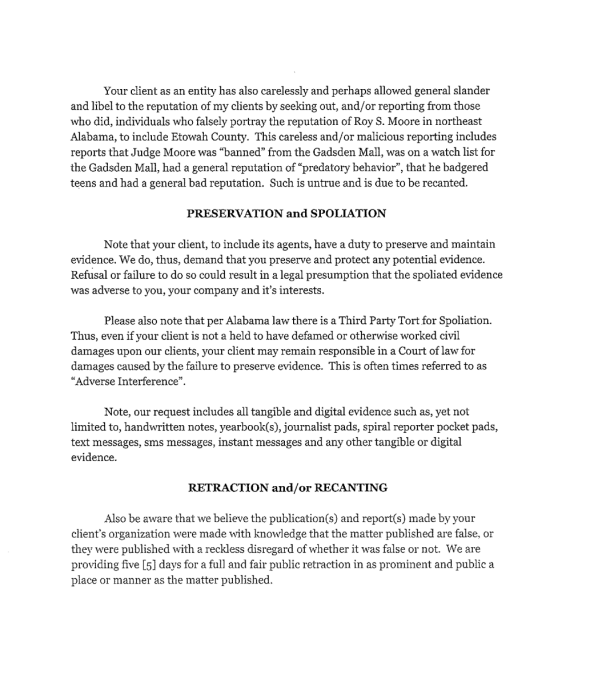
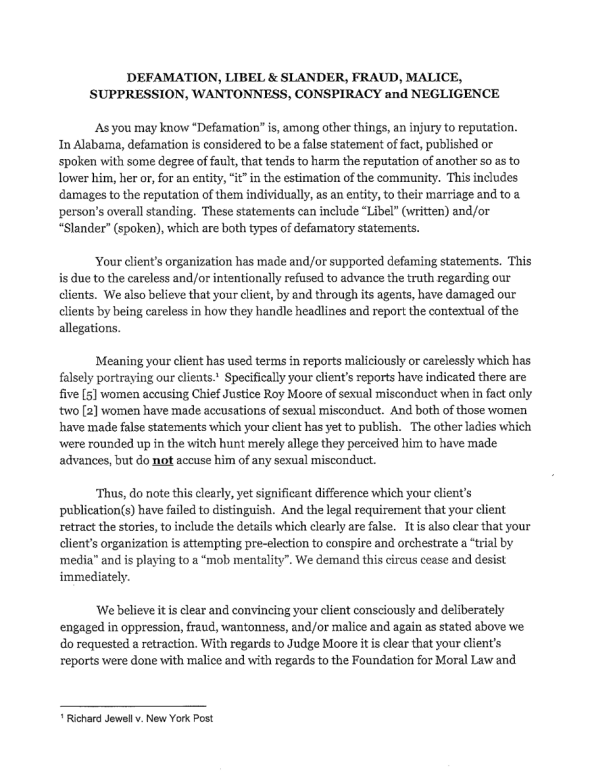
Here is the letter Garman authored on Moore’s behalf. I’ll follow it with the stuff that blew my head; you don’t have to read the whole thing unless you’re into inflicting pain on yourself, like that albino monk in “The Da Vinci Code.”

If you do read the letter, you will note that Attorney Garman never learned that the possessive “its” has no apostrophe, and that he writes English like it is a second, and perhaps third, language. Here are the best, as in worst, examples of his professional writing:

 Your client’s organization has made and/or supported defaming statements. This is due to the careless and/or intentionally refused to advance the truth regarding our clients. We also believe that your client, by and through its agents, have damaged our clients by being careless in how they handle headlines and report the contextual of the allegations.

The second statement  actually says “This is due to the careless and/or intentionally refused to advance the truth regarding our clients.” Diagram that for me. That head-scratcher is followed by “We also believe that your client, by and through its agents, have damaged our clients by being careless in how they handle headlines and report the contextual of the allegations.”This isn’t even the worst example of Authentic Frontier Gibberish in the letter. This is:

Thus, do you know this clearly, yet significant difference which your client’s publication(s) have failed to distinguish. And the legal requirement that your client retract the stories, to include the details which clearly are false.

I can’t even decide what to bold on that one.

Disturbingly, we learn in Trent’s biography that he earned a Masters in Theology from Regent University and  translated two books of the Bible from Greek.  I can just imagine what that translation was like.

I’m not nit-picking a blog comment or a hasty tweet. Roy Moore is fighting for his professional life and reputation, and this is the best legal representation he can find? That letter is a professional product. Garrman is obligated to be competent and diligent, not to send the message far and wide that the former judge thinks that this is persuasive logic and deft prose. Do they not proofread at Garman & Liddon? Do they know what proof-reading is? Do they know what syntax, punctuation and grammar are? Coherence? Professionalism?

Shame on the Troy University and Birmingham School of Law for graduating this careless, inarticulate boob. Heck, no high school should graduate someone who can’t write a letter better than that. Shame on his high school too. Shame on his the Alabama Bar for giving him a license.(I would use words other than “shame,” just to reliev the monotony , but as I’m sure you understand, my vocabulary is affected when my brains are on the ceiling…)

The legal field’s dirty little secret is that lawyers who can’t write or articulate a coherent argument are not as rare as they should be, and they should be extinct.  Nonetheless they get fees from innocent clients who assume that these hacks are smart and skilled because they call themselves lawyers.

But Roy Moore called himself a judge, didn’t he?

Hmmmm…

Maybe this is what George Will calls “condign justice.”

______________________

Pointer: Red Ipsa Loquitur


The Tragedy Of Shahid and Aasia, Or “Murder Isn’t For Idiots”

From Pakistan comes this story, which alternatively sounds like a Coen Brothers black comedy or that lost Shakespeare tragedy, “Shahid and Aasia.”

Aasia Bibi, 21, lived in the small village of Alipur. She was in love with a young man, Shahid Lashari, but her Muslim parents forced her to marry another man of their choosing. After the marriage, Aasia continued to see her lover secretly, and they decided on a desperate plot. Shaid procured some poison, and the bride put it her husband’s milk.

Unexpectedly, he refused to drink it. Maybe it tasted funny: this is what any good “How to Poison Your Spouse” book would have explained. Milk is a really bad drink to poison. Then Aasia left the poisoned milk lying around, and her enterprising mother-in-law used  it to make a traditional yogurt-based drink and served it to 27 members of her extended family.

Wait: how much milk did Aasia expect her husband to drink?  Was she married to the Pakistani Paul Bunyan? Assuming he wasn’t twenty feet tall like Paul, the term “overkill” comes to mind, and appropriately so, for “Oopsie!” does not begin to express the magnitude of her mistake. All of 27 people who drank the yogurt—see, yogurt always tastes like its poisoned— passed out and were rushed to the hospital.  Seventeen of them died. Aasia’s husband, however, remains hale and hearty.

Observations:

1 I liked “Romeo and Juliet” better.

2. Moral luck is a bitch. Still, if you poison food and leave it around, you are asking for random bad things to happen. Usually it isn’t this many or this bad, but you never know. Continue reading