The Difference Between Legal Ethics and Ethics: A Son Takes Sides

“You’re doing WHAT???????”

Nevada lawyer Mark Liapis decided to represent a man sued for divorce by his longtime spouse. The spouse petitioned the court to have him barred from the case, and the court agreed: Mark was, after all, representing his father against his own mother.

Ick. Continue reading

Unethical Quote of the Month: Howard Kurtz

“Brinkley’s book will undoubtedly tarnish the Cronkite legacy. But my admiration for the man is only partly diminished. Perhaps it is too easy to judge him by today’s standards, any more than we should condemn Thomas Jefferson for owning slaves. Perhaps he simply reflected his times, when some journalists and politicians quietly collaborated, when conflicts of interest were routinely tolerated, when a powerful media establishment could sweep its embarrassments under the rug. Cronkite thrived as television came of age, always protecting what we would now call his brand. That’s just the way it was.”

—-CNN good journalism watchdog Howard Kurtz, closing his review of the new Douglas Brinkley biography of Walter Cronkite, which shows that the legendary paragon of broadcast journalism was biased, often dishonest, and frequently conflicted.

No, no, no, no.

And that’s the way it wasn’t…

The “things were different then” excuse won’t fly as a defense of Cronkite, and shame on Howard Kurtz, who is supposed to stand for ethical journalism, for trying to rationalize the obvious conclusion demanded by Brinkley’s biography. That conclusion is that there was no Golden Age of TV journalism, and that rampant liberal bias infected the nightly broadcasts then as now, but we were too trusting and unsophisticated to realize it. Kurtz spends an entire book review extracting information Brinkley uncovered that proves Walter Cronkite’s image as an objective, incorruptible truth-teller was a lie, and then attempts to make the case that we shouldn’t judge him harshly.

Why? Because he was one of Kurtz’s heroes? Perry Mason made me want to be a lawyer, and it wasn’t until I became one that I realized that the fictional defense attorney was the sleaziest criminal lawyer this side “The Practice.” Tarnished heroes are part of growing up, Howard. Don’t pretend that journalistic ethics were different then…journalism schools were teaching objectivity, transparency, fairness, honesty and avoidance of conflicts of interest when Walter was saying “And that’s the way it is!” in a high soprano. Yet Brinkley shows that he… Continue reading

So Wrong It Defies Belief: The Green Bay Police Heist

Maybe the public and the media are finally waking up to the astoundingly un-American abuse of power that are the  civil forfeiture laws,  which allow property and cash to be seized as helping to facilitate a crime, and later are divvied up between the police and the state. There are some promising signs. Libertarians like Radley Balko have been trying to ring the ethics alarms on this horrendous example of government misconduct for years, and the Institute for Justice continues its lonely battle to defeat the most egregious offenses, but George Will just used the trumpet of his weekly column to expose the Caswell family motel scandal, which Ethics Alarms discussed in February here. Now comes a tale of civil forfeiture from Wisconsin that is so brazen that it defies belief, and also compels the following question:

How can this happen  in America? Also this one: If the government will use its power to steal money and property from law-abiding citizens, and no effort is made on the part of national government leaders to do anything to stop it, how can at least 50% of the American public continue to advocate giving more power and money to a government that obviously cannot be trusted with either?

The first question is frightening in its implications.

The second is a mystery, on par with “What happened to the Mary Celeste?” Continue reading

Ethics Dunces: 29 Wisconsin Judges

Yes the gavel's fuzzy, but then so is the judgment of the person on the other end of it.

There is something seriously wrong with the ethical culture of the judiciary in Wisconsin. I suppose this was already obvious, as it is definitely a bad sign when two members of the state Supreme Court accused each other of physical attacks. Nonetheless, the news that 29 of Wisconsin’s sitting judges placed their names on the recall petition for Gov. Scott Walker would seem to settle any remaining doubts.

Is doing this a strict, slam-dunk, violation of the Wisconsin Code of Judicial conduct? No, probably not. It is in a gray area of the Code. Judicial ethics codes prohibit judges from becoming involved in political contests, but a recall petition a judge signs as a private individual (Personally and professionally, I don’t think it is possible for a judge to sign a petition as “a private individual”) don’t fit neatly into the definition of political activity. Other states, such as New York and New Mexico, have allowed judges to sign nominating petitions for candidates on the theory that it is the equivalent of voting, the right to which judges do not give up by ascending the bench.

Still, the judicial codes don’t exactly give a ringing endorsement to this kind of activity, and I would say the better interpretation is that the ethical rules preclude it. The ABA’s Model Judicial Code, for example, says… Continue reading

Now THAT’s a Conflict of Interest!

"How do you plead, Judge Ballentine?" "I'm innocent, Judge Ballentine!" "I find you credible. Case dismissed, Judge Balentine! See you in the mirror!"

Judge Kelly S. Ballentine, a Pennsylvania district court judge, apparently avoided paying $268.50 in parking tickets by dismissing  her own cases.  Two of the three tickets issued to her were for overtime parking, and the other was for an expired registration. She has been charged with tampering with public records, obstructing the administration of law and participating in activities that are prohibited due to a conflict of interest.

Yes, I’d say that was a fair assessment of the situation.

Ethics Alarms thanks the ABA Journal for the story.

The Civil Forfeiture Outrage: American Government At Its Worst, So Naturally We Ignore It

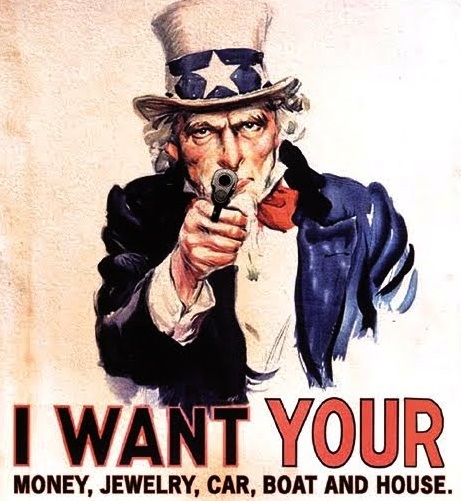
Do progressives and conservatives have the courage to confront the illusion-shattering outrage of civil asset forfeiture in America? Not so far they haven’t. That shouldn’t be too surprising.

There are some things our governments do that are so frightening, wrong and un-American that we tend to look right by them—ignore them, pretend they aren’t happening, focus on other things—because their implications are too confounding to deal with. For fans of big government, who look to central authority to micro-manage our economy, distribute our resources, protect us from every threat and isolate us from the consequences (and often the benefits) of human nature, the fact that government power corrupts as surely as any power is an inconvenient (and undeniable) truth that threatens the foundation of their ideology. How irrational is it to place more responsibility on the government if we can’t trust the government, because we can’t trust the inevitably flawed and conflicted individuals who run it?

The willful blindness is no less insidious with conservatives, whose core belief is the inherent goodness of the American system and way of life, as defined by our founding documents. Accepting that the largest and oldest democracy on earth sometimes targets and plots against law-abiding citizens means accepting the possibility that the system itself doesn’t work, and that its supposedly sacred ideals—life, liberty, and the pursuit of happiness—are a cynical lie. Aiding and abetting the blindness is the traditional media, which is substantially populated by self-important, inadequately-educated, ethically-shaky pseudo-professionals who believe their duty to objectively tell the public what it needs to know should be tempered by what they believe will persuade members of the public to adopt the “right” views, and, of course, by what will pull their attention away from the competition. Better to have features about Michelle Obama’s healthy eating crusade than to tell Americans about government wrong-doing, especially when the journalists support the party in power.

As a result of this toxic mix of bias, self-interest, self-delusion and incompetence, many of the most illuminating examples of how far America can go wrong can take a long, long time to enter into public consciousness. A recent example is insider trading by members of Congress, which had been well-documented for a decade before a “60 Minutes” report combined with the Occupy protest visibility and the widespread distrust of Wall Street suddenly made it a significant public concern. But other equally important issues, like the abuse of U.S. convicts, including the tolerance of prison rape, haven’t broken through the willful blindness yet.

Neither has civil asset forfeiture, despite the efforts of libertarian activists, publications like Reason, websites like Popehat, and organizations like ACLU and  The Institute for Justice, a libertarian, human rights public interest law firm that I have been negligent in not plugging earlier. (I apologize.) Right now, the Institute is going to court in a Massachusetts civil forfeiture case, United States v. 434 Main Street, Tewksbury, Mass, that serves as an excellent introduction to the sinister nature of this institutionalized abuse of power. Here’s the story, from the Institute’s website: Continue reading

Freddie Mac’s Conflict of Interest and the Betrayal Of The American Homeowner

Possible, but expensive.

Though the political implications of this disturbing story, which broke today on NPR, are wide-ranging, this isn’t a political blog.  I will avoid the temptation  to wade into them. That’s fine: the ethical implications are bad enough.

Freddie Mac, the taxpayer-owned mortgage giant, has been doing a Goldman Sachs, betting against the very homeowners it is pledged to serve by making multi-billion-dollar investments that will profit Freddie Mac only if homeowners can’t get out of  expensive mortgages with interest rates well above current rates. Of course, Freddie Mac’s job is supposedly to do the opposite…to help homeowners find cheaper, fairer mortgages. And we were told, by the Obama Administration, that this what it was working to do.

This is called a conflict of interest. And since Freddie Mac, along with its cousin Fannie Mae, is owned by U.S. taxpayers, this is also a massive breach of trust by the Federal government. Freddie and Fannie were bailed out in 2008. The companies insure most home loans in the United States, making banks able to lend at lower risk, and the companies’ rules determine whether homeowners can get refinanced and on what terms. Now we know that Freddie Mac, at least, profits when they fail.  Continue reading

Philidelphia’s Conflicted, Shameless, Greedy—But Law-Abiding!— City Council

In the City of Brotherly Love, why shouldn't the City Council show a little love to itself--and its members' bank accounts?

Philadelphia, a city that like all cities these days is reeling under budget deficits, contemplating harsh cuts in city services and programs and raising taxes, is receiving a cruel lesson in the limits of public-mindedness by elected officials when the price is right.

Philadelphia City Councilwoman Marian Tasco retired yesterday, collected $478,057 in pension payments, and then plans to return to work after she is sworn-in on Monday to serve her seventh term. Register of Wills Ronald Donatucci retired Dec. 23 and will also return to work on Monday. He collected $366,797.

Why are they doing this? Because they can. Because it’s a lot of money. Because nobody can stop them. In Tasco’s case, because her irresponsible, disengaged, foolish constituency voted her into office despite ample warning that this is what she had planned. Continue reading

TV Payola and the Shameless Alison Rhodes

" 'Conflict of interest?' What's that?"

She’s not the only one, apparently. But consumer product reviewer Alison Rhodes (“The Safety Mom”), a frequent guest on national, syndicated and local TV shows, not only reviews products whose manufacturers have paid her to mention them, she is unapologetic about it.

Today’s Washington Post reveals that Rhodes, who can be seen on such shows as “Regis and Kelly”, “Today” and “Good Morning America!” as well as local news outlets around the country, raved on the air about a home electronic monitor and a backpack with a built-in alarm known as the iSafe bag without telling either viewers or producers that she had accepted payola from their makers. Rhodes, however, shrugs off the issue. She tells the Post that she doesn’t see any problem, because “I’m not going to take on any engagement with a client unless I believe in their product.”  Amazing. Meanwhile, the news programs the Post interviewed claim that they had no inkling that Rhodes was plugging the product of a client.

This brazen deception of the public is inexcusable, but the shamelessness—or ignorance— of Rhodes and the negligence of those who give her exposure are worse. Continue reading

Now THIS Is What They Used To Call “Appearance of Impropriety”…

"So, Miss Scarlet!! At last you confess your guilt in this heinous crime! Now that that's over with, would you care to join me for dinner tonight?"

The prohibition against attorneys engaging in conduct that creates “the appearance of impropriety” was eliminated from the legal ethics rules (though not the judicial ethics rules) a long time ago, almost 30 years.  Periodically a case will arise in which its absence is felt. The nice thing about the appearance of impropriety category is that it was flexible enough to use to sanction lawyers who figured out ways to make the profession look slimy without running squarely afoul of other rules…like  San Diego prosecutor Ernie Marugg.

Marugg, it is alleged, used his defendants list as his little black book…seeking romantic relationships with the women he prosecuted after their trials were over. His habit was investigated one, but no specific ethical violation could be found. What would it be? Was he too easy on the women he was duty bound to prosecute zealously? One woman who pleaded guilty when Marugg prosecuted her  is now suing him, claiming that his personal  interest in her  caused him to be biased against her. Huh? How does that work? “You always hurt the one you love,” as the old song says? Continue reading