Cold Monday Morning Ethics Warm-Up, 12/10/18: You’ve Got Ethics To Keep You Warm!

Brrrrr!

Maybe this will help...

1. Starting with the important stuff: Baseball’s badly-named Today’s Game Era Committee announced that long-time right-fielder/designated hitter Harold Baines and towering closer Lee Smith had been voted into the Major League Baseball Hall of Fame. Smith, who retired as the all-time saves leader and is now third behind two Hall of Famers, was a defensible pick, but not Baines. The Committee’s job is to look back on players who were rejected in the regular Hall of Fame voting process and see if some of them fell through the cracks who were Hall caliber. There are only 16 members of the committee, and an ex-player needs 12 votes to enter Cooperstown. The sixteen members included at least four with strong ties to Baines, and they  presumably argued eight more members into letting him squeak by.  Bias made them stupid. Those four, which included Baines’ former manager and the owner of the Chicago White Sox, which retired his number, should have had to recuse themselves because of conflicts of interest.

Baines led the league in an offensive category, once, when he had the best slugging percentage in the American League. He never finished high in the Most Valuable Player voting. Most of the players who compare most closely to him are not in the Hall. The big thing Baines had going for his candidacy as a very good but not great player was that everybody liked him. He’s sort of the opposite of Curt Schilling, who is clearly Hall-worthy but whom most sportswriters hate—too religious, too conservative, too mouthy.

Now the argument for admitting other good but not great players will be, “But he was better than Harold Baines!” This is how conflicts of interest undermine the integrity of institutions.

2. When Naked Teachers have no excuses.  The Naked Teacher Principle holds that when a teacher allows a nude photo of herself or himself to circulate on the web where it can be seen by students, that teacher cannot complain when and if it leads to their dismissal.  A teacher really can’t complain if she sends the photo to a student intentionally, which is what Ramsey Bearse, 28, a former Miss Kentucky now teaching at Andrew Jackson Middle School in Cross Lanes, West Virginia, did with a 15-year-old former student , according to the sheriff’s office. She faces four felony counts of distributing or displaying obscene matter to a minor.

3. Pondering whether to include an open Ethics Alarms forum as a regular feature. Many of the blogs I frequent for story ideas do this late at night. Ethics Alarms has done it once when I was forced to be away from a keyboard for most of the day, and I was impressed with the results. Those forums on the other blogs often devolve into silliness, bad jokes, memes and worse, and I would insist that an “open forum” on Ethics Alarms be restricted to raising and discussing ethics and ethical topics. Continue reading

The “White Christmas” Ethics Guide (REVISED And UPDATED)

I’m looking at some holiday movies to add to the Ethics Alarms library of annotated classics—no, ethics and “A Christmas Story” are irrelevant, it being a child’s remembrance and hardly literal–but I might as well begin with  revising and revisiting the “White Christmas” guide, which first appeared in 2012. 

I still like the film—my wife hates it—being a fan of all four stars, especially Bing and Danny, as well as the director, Michael Curtiz.  I do like it a bit less each time I see it, mostly from an ethics perspective, and the successive revisions reflect that.

I still get misty when the old general, played by Dean Jagger, gets saluted by his reunited army unit, which has gathered at his struggling, snowless, Vermont inn on Christmas Eve to remind him that he is still remembered and loved. Nonetheless, “White Christmas” is by far the strangest of the Christmas movies, and also the most unethical. Though everything works out in the end, the characters in the sloppy plot spend the whole movie lying, extorting, betraying, manipulating and generally mistreating each other, always with no recriminations at all, and usually with no consequences either.

In his addendum last year to my original post, Michael West found the film foundering from the second the opening credits ended. He began with the script for the opening scenes—General Waverly* is played by Dean Jagger; Captain Bob Wallace is Bing Crosby, and Private Phil Davis is Danny Kaye:

Opening Scene in the Jeep as they hear the Entertainment show.

GEN CARLTON (To Adjutant): What’s this all about, Captain?

ADJUTANT: A little entertainment for the men, sir. Tonight’s Christmas Eve.

GEN CARLTON: These men are moving up tonight, General Waverly. They should be lined up for full inspection!

GEN WAVERLY (To Carlton): You’re absolutely right. (To Adjutant): There’s no Christmas in the Army, Captain.

ADJUTANT: Yes, sir.

GEN WAVERLY (To Carlton): There’s always a slip-up or two during a change in command. The men get a little loose. But I know I’m leaving them in good hands.

GEN CARLTON: (To Waverly): Thank you, General. (To Driver): Sergeant, take me to headquarters immediately! We’ll have those men turned out on the double!

The Sergeant looks at General Waverly.

GEN WAVERLY: Goodbye, Sergeant. Take the short cut.

SERGEANT: Yes, sir!

The jeep pulls off and makes a half circle. The Adjutant makes a gesture, as if to stop it. Waverly stops him. The Adjutant turns to him.

ADJUTANT: That’s not the way back to headquarters!

GEN WAVERLY: Joe, you know that, and I know that, but the new General doesn’t know it. Or he won’t for about an hour and a half.

ADJUTANT: That Sergeant’ll be a private tomorrow!

GEN WAVERLY: Yes… isn’t he lucky?

SCENE CHANGE TO ENTERTAINMENT SITE:

CAPTAIN BOB WALLACE and PRIVATE PHILIP DAVIS are doing a number on stage to entertain a mass of 200 or so soldiers. GENERAL AND ADJUTANT just starting to take seats, off to one side where they are not noticed by the performers. ABOUT 6 SOLDIERS seated in audience. They look off, see General, start to rise. The General notices them – motions for them to sit down again, indicating he doesn’t want attention called to himself. Captain Wallace sings “White Christmas”.

CPT WALLACE: Well that just about wraps it up, fellas. It’s certainly too bad General Waverly couldn’t be here for this little yuletide clambake ’cause we really had a slam bang finished cooked up for him. I guess by now you know the Old Man’s being replaced by a new Commanding General fresh out of the Pentagon…it’s not a very nice Christmas present for a division like us that’s moving up. The Old Man’s moving toward the rear. That’s a direction he’s never taken in his entire life. Well all I can say is we owe an awful lot to General Waverly and to the way…

GEN WAVERLY: ATTENTION!

Every man is at attention and every head has turned to where General Waverly has taken up a position near the front of the platform.

GEN WAVERLY: Captain Wallace, who’s responsible for holding a show in this advanced area?

CPT WALLACE: Well sir as a matter of fact it was…

PVT DAVIS: …me Sir! It was my idea sir. Uh, I mean when you gotta entertainer sir of the caliber of Captain Wallace, sir…I mean sir…it’s Christmas Eve, sir. And well, sir, I mean that if you were in New York, Sir, you’d have to pay six sixty or even eight eighty to hear a great singer like Captain Wallace, sir.

GEN WAVERLY: I’m well aware of Captain Wallace’s capabilities. Who are you?

PVT DAVIS: Er…Phillip Davis, sir. Private First Class, sir.

GEN WAVERLY: Well, at ease, Davis.

DAVIS: Yes, Sir!

WAVERLY: I said, At Ease!

DAVIS: Oh, uh, Yes, sir, thank you sir.

WAVERLY: This division is now under the command of General Harold G. Carlton, and I don’t want anyone to forget it — not that he’ll let you. He’s tough — just what this sloppy outfit needs. He’ll have you standing inspection night and day — you may even learn how to march. And if you don’t give him everything you got, I may come back and fight for the enemy. Merry Christmas!

ASSEMBLED MEN: Merry Christmas!

GEN WAVERLY: Well, I guess, all I can say is, how much I…what a fine outfit…How am I going… (to Wallace) don’t just stand there, how am I going to get off…?

CPT WALLACE: We happen to have a slam-bang finish…He turns to the musicians, gives the downbeat.

They play “THE OLD MAN,” which is sung by the entire outfit.

ARTY FALLS IN VICINITY…Soldiers crouch…then finish singing.

GENERAL AND ADJUTANT DEPART.

MORE ARTY FALLS, ON SITE…Men scatter. Captain Wallace and Private Davis try to get men to cover. Private Davis man handles the Captain to cover as a wall collapses where he had just been standing.

For starters, we see a mass of soldiers in an open air situation within effective range of enemy artillery fire. A single well-placed artillery round could eliminate approximately 200 soldiers — more than an entire World War 2 Infantry Company (whose authorized strength is about 190-195 men; but given this stage of the war and attrition, this could easily be 2-3 companies of EXPERIENCED soldiers). Someone in the chain of command KNOWS this to be true and authorized this gathering despite the obvious danger. We know for certain that the Adjutant knows what the gathering is, as he answers in line #2 precisely what is going on. But an Adjutant has no command authority, so someone else authorized the gathering. We have to assume General Waverly didn’t know until the Adjutant answered General Carlton’s inquiry based on General Waverly’s later questioning of Captain Wallace. We can’t ever be sure who actually made the decision to have the entertainment occur at that location since Private Wallace, breaking an incredible number of military bearing protocols, interrupts a Captain, to answer a General. This Private, Private Davis, accepts all responsibility for the decision to expose upwards of 2 companies-worth of men to devastating artillery fire.

This information leaves us with two options: Either it really was Private Davis’s idea to have the venue at that location, in which case, Private Davis’s commanding officer and the various commanding officers AND EVERYONE ELSE in their chain of command are colossally INEPT for agreeing to the idea. The second option is that Captain Wallace DID indeed make the decision to have the venue at that site, and now he’s standing there like a lump allowing a subordinate to cut him off mid-sentence, a military no-no, and then allowing the subordinate to take the heat of any potential censure that was forthcoming. Of course, since he’s a Private trying to cover for his boss, he’ll say anything, so I won’t even ding him for the horrible excuse that 200 men should be exposed to German artillery fire because CPT Wallace is a famous singer – we all know it’s worth dying to hear Bing sing…

But of course, even General Waverly doesn’t seem to mind that 200 of his soldiers are idling around with a population density rivaling that of Bombay, just one artillery strike away from having more in common with mist than with humanity. When HE discovered what was going on by the Adjutant’s answer in line #2, he should have immediately ordered the soldiers disperse and had about two dozen commissioned officers who had every ability to stop the farce standing in his headquarters receiving the most royal dressing down of their careers and maybe a few firings.

What possibly does General Waverly think outweighs the need to disperse a mass of soldiers within effective range of artillery? Why, a Christmas music concert of course! It is Christmas Eve, after all!  Now, the Army does a really good job bending over backwards for the morale, welfare, and recreation of soldiers, much more than was ever considered a military precedent. BUT, we learn from the dialogue, the entire division is on orders to “move up tonight.” This somewhat vague description could range anywhere from simply occupying a section of the line to relieve a unit coming back or it could mean they are initiating a major offensive operation. We learn, however, that this movement, whatever it is, is occurring in mere hours. Having experienced large movements of soldiers myself, I know that if a Division is stepping off in a few hours, the men down to the platoon level are ALREADY in their assembly areas doing final preparations. This is apparent to the new commander, General Carlton, who is astonished that the men aren’t doing their final checks of equipment and gear.

Which leads us to the next bit: General Waverly is none too concerned about the unjustifiable exposure he’s tolerating of his…well, now General Carlton’s men…as we know Waverly has just been replaced by General Carlton, who, trope-tastically, we learn is one of those wretched new leaders who is probably horribly incompetent. The movie lets us know early on that he’s a despicable piss-and-vinegar type when he is mad that the men are having Christmas entertainment. Never mind that we now know that Carlton is severely concerned about a huge mass of men within artillery range open and exposed as well as not anywhere near where they ought to be to initiate movement of the entire Division.

The movie also lets us know he’s a jerk because it pushes the whole “fresh out of ________” trope. The usual way this plays out is the “fresh out of West Point” or “fresh out of ROTC” smear applied to new Lieutenants who assume Platoon Leadership with little to no actual experience. Unfortunately, this doesn’t exactly play out on the General level. Yes, the General ranks expanded rapidly during World War II, but an individual didn’t become one by being a complete buffoon (and yes there are always exceptions — but General Carlton, who seems to have a sense of urgency that no one in Waverly’s sphere of influence seems to possess, does not seem to be the exception).

Never mind, we’ll go on with the traditional “smearing of the new guy who replaces the beloved experienced leader.” In the original script I copied and analyzed, the dialogue was OVERTLY insubordinate and actively undermining of the men’s confidence in their new commander. In the corrected dialogue, though cleaned up a lot, there are still hints of undermining the new guy’s authority before he even makes a decision as the commander. There’s General Waverly’s smart-ass “There’s no Christmas in the Army” jab as a response to Carlton’s concern about the location and timing of the entertainment event — which he says “knowingly” to the Adjutant, who, we must remind ourselves no longer works for the Waverly but for Carlton.

There is the extra-rotten move when Carlton, recognizing the imminent danger as well as the horrifying breach of schedule in implementing the plan of operations, indicates he plans to move to Headquarters immediately to begin rectifying the situation and is undermined either by the Sergeant driving Carlton or by General Waverly himself. The driver decides to undermine Carlton’s ability to fix the problem by taking an extra long route back to headquarters. Between a driver and a singing-private, this division is apparently full of the lowest-ranking guys thinking they know best when to leave a behind-the-schedule division exposed to enemy fire just so they can catch a few tunes from Bing. The only other possible explanation is that General Waverly, himself, with a nod-nod wink-wink, authorized the driver to follow the reckless plan to take an hour-and-a-half detour, which we assume will require another hour-and-a-half correction before Carlton can get to Headquarters. Just as with the Adjutant before, let’s again consider that this driver no longer works for Waverly, but for Carlton The Sergeant is being openly insubordinate.

Even if Waverly was not responsible for the three-hour diversion, he immediately became complicit when the Adjutant, in an apparent realization who his new boss is (Carlton), moved to correct the driver but was stopped  from doing so.by General Waverly

The last bit of insubordination and undermining  the chain of command comes from the subtle digs Captain Wallace makes during his speech. His “Fresh out of the Pentagon” disdain undermines faith that Carlton may be a good commander, followed by the snide “not a nice Christmas present” for the division is enough to get any soldier censured. Soldiers and peers WILL whisper about their leaders, but an open act of insubordination like that? Stamped out like a spark in a dry forest… I won’t even address the fact that it’s a COMMISSIONED OFFICER making the openly insubordinate comments and a CAPTAIN no less. He would be dismissed and transferred immediately.

But hey, I suppose Waverly recognized all their rotten conduct when he feebly tried to make things right by saying “hey guys, he’s a good commander, never mind all the stuff we said before and our attitudes we displayed before!” A few moments later, just to do Carlton some justice, the artillery shelling arrives.

Then the movie moves into its funny guilt extortion phase. Army private Phil Davis (Danny Kaye) rescues his smooth-singing captain, Bob Wallace (Bing Crosby) from being crushed by a falling wall in a World War II bombing raid, and injures his arm in the process. (It’s not a plot feature, but the battlefield set for the entire opening sequence is itself unethically unprofessional by being chintzy even by musical standards: it looks like they are filming a skit for a Bob Hope Christmas Special.  I thought it was lousy when I saw it as a kid. Michael Curtiz deserved better; the man directed “Casablanca.” Show some respect.) Phil then uses Wallace’s debt of gratitude to coerce him into accepting the aspiring comic as a partner in Wallace’s already successful civilian act. This is obviously unfair and exploitative, but Bing accepts the ploy with good spirits, and the next we see  the new team of Wallace and Davis knocking ’em dead and rising in the ranks of stage stars.

The act looks terrible. Bing was never much of a dancer, a game hoofer at best, and you don’t feature the greatest voice in the history of American popular music by having him sing exclusively duets. Nevertheless, all we see of the team’s rise is both of them singing and corny dancing inferior to what Bing did with Bob Hope in the “Road” movies.

Never mind. They have a show on Broadway, and as a favor to a mutual army buddy, they agree to watch the boonies nightclub act of “The Haynes Sisters” (Rosemary Clooney as Betty, and Vera-Ellen, of wasp-waist fame, as kid sister Judy. Did you know that in the “Sisters” number, Clooney sang both parts? ). Bing is immediately smitten with older sister Rosemary, but there is a tiff over the fact that younger sister Judy fooled them into seeing their act: she, not her brother, had sent the letter asking for a “favor.”

This is the first revealed of many lies woven into the script. This one is a double beach of ethics: Judy uses her brother’s name and contacts without his permission or knowledge, and lures Wallace and Davis to the night club under false pretenses.

Bing dismisses Judy’s cheat by noting that everyone “has an angle” in show business, so he’s not angry. Rosemary is, though, and reprimands Bing for being cynical. That’s right: Vera/Judy uses their brother’s name to trick two Broadway stars into watching their little act, and Rosemary/ Betty is annoyed because Bing/Bob (Bing’s bandleader, look-alike, sound-alike brother was also named Bob) shrugs off the lie as show business as usual. True, Betty is technically correct to flag the Everybody Does It rationalization, but shouldn’t she be grateful that Bob isn’t reaming out the Haynes sisters and leaving the club in a huff? OK, nice and uncynical is better than nice and cynical, but Bob is still giving her and Judy a break. As the beneficiary on Judy’s angle, Betty is ethically estopped from complaining that Bing/Bob’s reaction was “I don’t expect any better.” I can, she can’t. He should expect better: accepting unethical conduct allows it to thrive.

As we soon find out, however, Betty often flies off the handle.

Continue reading

Sick-Bed Ethics Warm-Up, 11/14/18: Ethics Among the Sneezes [UPDATED]

Good whatever it is….

1. Bottom line” Don’t trust Facebook. From the Times: “Facebook failed to closely monitor device makers after granting them access to the personal data of hundreds of millions of people, according to a previously unreported disclosure to Congress last month.” Surprised? As with Google promising moths ago that it was no longer reading our mail, then admitting months later that it had resumed the practice, the big tech companies have proven repeatedly that that we cannot believe what they say, or their motives, or their pledges of good will and public service. More from the Times story:

Facebook’s loose oversight of the partnerships was detected by the company’s government-approved privacy monitor in 2013. But it was never revealed to Facebook users, most of whom had not explicitly given the company permission to share their information. Details of those oversight practices were revealed in a letter Facebook sent last month to Senator Ron Wyden, the Oregon Democrat, a privacy advocate and frequent critic of the social media giant.

In the letter, a copy of which Mr. Wyden provided to The New York Times, Facebook wrote that by early 2013 it had entered into data-sharing agreements with seven device makers to provide what it called the “Facebook experience” — custom-built software, typically, that gave those manufacturers’ customers access to Facebook on their phones. Those partnerships, some of which date to at least 2010, fall under a consent decree with the Federal Trade Commission drafted in 2011 and intended to oversee the company’s privacy practices.

Read the whole thing. I just assume that anything I put on Facebook, regardless of the alleged settings,will be sold to or otherwise obtained by potentially malign entities.

2. Just what we need now, a rogue First Lady. First Lady Melania Trump publicly called for the President’s deputy national security adviser, Mira Ricardel, to be fired.  In a word, well, two: Shut up. The felicitous circumstance of marrying someone who is later elected President of the United States confers no expertise or authority. The position of First Lady has no Constitutionally recognized duties, nor does it carry any real power. There is nothing anyone can do to diminish the influence and spouse may have with the President behind closed doors—and that is a problem—but she or the inevitable he must not confuse, confound or otherwise seek to influence affairs of state with public comments and opinions. Why Melania wants Ricardel fired is irrelevant. It’s none of her business.

I just want to point out that I sneezed six times while typing those last four words. Applause, please. Continue reading

Morning Ethics Warm-Up, 11/1/2018: Battling Toddlers, Racist Lemons, And Justices In Love

Welcome November!

1. Warm-Up musings…I suspect that the Warm-Up format costs the blog traffic, potentially a lot of traffic. If each was broken into components and posted individually, there would be a lot more clicks. Of course, I wouldn’t have time to post each separately—I estimate that a single post adds 15 to 20 minutes to the process—and there would be fewer issues covered. Capturing more of the events and issues that get into my files is one of the main reasons I started this. A better blog but less appreciated? Nah, I’m not going to measure success by traffic, as tempting as it is. I resist click-bait—there are topics that guarantee flood of comments—and don’t resist posting analysis that I know will cost me followers: I literally watch the numbers go down. And, of course, there are once regular readers who have fled because I have been consistent in my approach to the Trump Presidency, and regard his treatment by the “resistance,” Democrats, progressives and the news media as a national ethics catastrophe, irrespective of his own neon flaws. They fled, in part, though they will not admit it, because they simply could not muster valid arguments for why this President did not deserve the same presumptions of good will, good effort and public loyalty as every other President, traditional benefits that are essential to the office working and the nation thriving. What they represented as arguments were really presumptions of guilt and the byproduct of hateful group-think magnified by confirmation bias. I hope they eventually get well, and that when they do they aren’t too remorseful for being appropriated by an angry mob.

In the subsequent items, I’ll briefly explain why they are here rather than in a full post.

2. Unethical quote of the week: Don Lemon. Again. Earlier, Lemon said on his CNN platform,

“We have to stop demonizing people and realize the biggest terror threat in this country is white men, most of them radicalized to the right, and we have to start doing something about them. There is no travel ban on them. There is no ban — you know, they had the Muslim ban. There is no white-guy ban. So what do we do about that?”

Like so much Lemon says, this was incoherent, biased, and intellectually lazy. He said to stop demonizing people, and demonized a gender and race in the same sentence. “Start doing something” is typical political humming: do what, exactly? Lock them up? What? Any fool can say “Do something!”, and Lemon is just the fool to say it.  The travel restrictions are a non-sequitur, the kind of lame-brained argument that social media advances in memes and “likes.” Those restrictions involve non-citizens and their ability to immigrate. It was not based on race or ethnicity, but nation of origin. It’s an ignorant and misleading statement. “There is no white-guy ban. So what do we do about that?” is flat out racist, and intended to be—unless Lemon can’t speak clearly, which you would assume is a job requirement. A responsible news organization would have fired him, but he’s black and gay, so that’s not going to happen.

Then he came back and said this:

“Earlier this week, I made some comments about that in a conversation with Chris [Cuomo]. I said that the biggest terror threat in this country comes from radicals on the far right, primarily white men. That angered some people. But let’s put emotion aside and look at the cold hard facts. The evidence is overwhelming.”

Continue reading

The Astounding, Clueless, Unethical And Doomed Hiring Of Brodie Van Wagenen

‘Conflicts of interest? I have no idea what you mean…’

Disclaimer: This is NOT a baseball ethics post. This is a business ethics post about a major ethics issue,  and the business happens to be a major league baseball team.

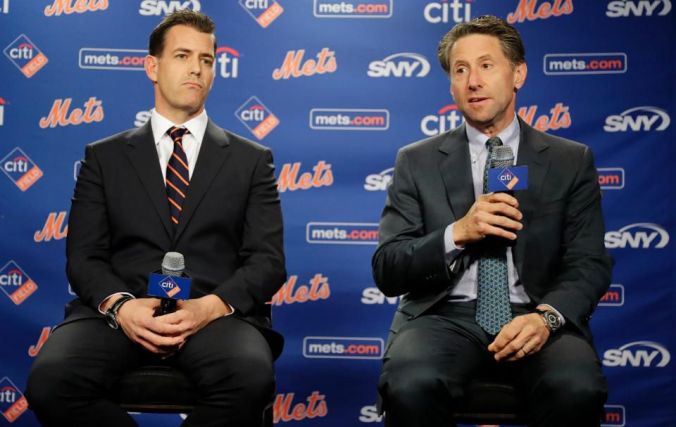
This week the New York Mets stunned the baseball world by hiring Brodie Van Wagenen—that’s him on the left—as its new general manager.

He is not only being hired to manage the business of a major league baseball team without having ever worked for a baseball organization in any capacity. That would be strange enough. He is also a player agent who has been the representative of several key players currently under contract to the Mets, meaning that he acted for them in negotiating against the team he now heads.Van Wagenen made $25 million in commissions last year on player contracts.

Anyone whose ethics alarms weren’t set ringing like the bells during the Great Chicago Fire by the Mets decision doesn’t understand what a conflict of interest is. Guess who this category includes. Yup: Van Wagenen and the New York Mets.

In a press conference at Citi Field, Mets executives were asked about the conflicts issue, which should have been predictable, mandating a careful, thorough answer.  As a player agent for Creative Artists Agency (Van Wagenen has divested himself of all shares in the company and future commissions…at least he figured out that much) Van Wageman’s responsibility was to negotiate the most lucrative contracts for his clients. As the a general manager for the New York Mets, his responsibility is to build a successful team within its resources, regardless of the best interests of his former clients, the players he worked with over the past 18 years. When the “C” word was raised bu reporters,  Mets President Fred Wilpon interrupted before Van Wagenen could answer  and said that he had spoken with the commissioner’s office and Major League Players Association chief Tony Clark, adding, “We have provisions in Brodie’s contract to deal with any conflicts of interest.”

Oh! Well never mind then! The contract deals with it, and the Mets have spoken to people! All taken care of!

Neither Wilpon nor Van Wagenen would say what those provisions were, but I guarantee this as an ethics specialist: the only provision that could effectively deal with Van Wagenen’s conflicts would be “Van Wagenen can’t be the Mets general manager.” Continue reading

Morning Ethics Warm-Up, 10/29/2018: Codes, Cars, Carter And The Caravan

Boy, this really IS a good morning!

(The warm-up may rely a bit more on links and quotes than usual…as Bob Cratchit tells Scrooge, “I was making rather merry yesterday.”)

1. Breaking News: Jimmy Carter is right! Former President Jimmy Carter, now 94, has injected himself into the Georgia governor’s race by asking Republican candidate Brian Kemp to resign as secretary of state. Carter’s argument is that there is an appearance of impropriety in his being officially responsible for an election in which he is a candidate, and that his resignation is essential  to preserve public confidence in the outcome of Kemp’s race against Democrat Stacey Abrams. Carter’s made the request in an Oct. 22 letter .

“One of the key requirements for a fair and trusted process is that there be a nonbiased supervision of the electoral process,” Carter wrote, explaining that stepping aside “would be a sign that you recognize the importance of this key democratic principle and want to ensure the confidence of our citizens in the outcome.”

When he’s right, he’s right. Kemp should resign, and his lamer than lame rationalization for not doing so, that it isn’t really he who supervises the election but his staff, would be sufficient reason not to vote for him in the gubernatorial election.

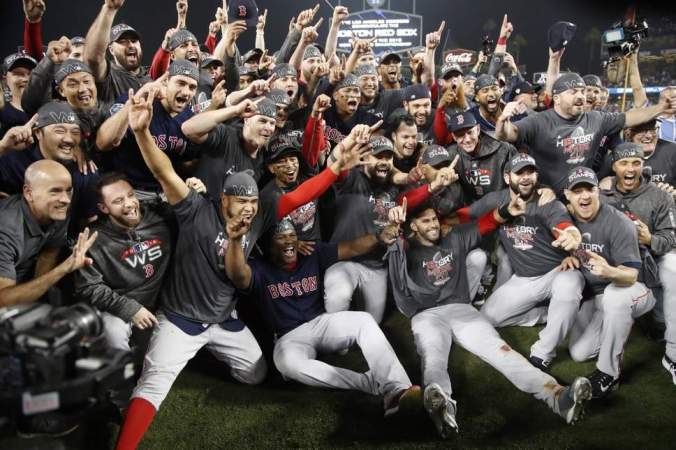
2. Ethics Dunce: Red Sox owner John Henry. You would think the progressive owner of the Boston Globe could restrain himself from blatant virtue-signaling while his team was celebrating its historic season and World Series victory, but no. Henry saluted his team for being “diverse” in his post-game remarks. Nobody sane cares how diverse, whatever that means (Where were the women, John? Where were the Asians? The differently-abled? Muslims? LGBT representatives?), a pro sports team is as long as it wins, and if it doesn’t win, its check-offs on an EEOC form won’t make it any better or its losing more palatable. The 2018 Red Sox were assembled according to the skills and talents of its personnel, with race and ethnicity a non-factor. What mattered is that the team’s manager (he’s Puerto Rican, and I don’t care) proved himself a natural leader who created a selfless, courageous, professional culture on his team, none of whom mentioned race, religion or creed all season, and properly so.

The compulsion to spurt progressive cant at every opportunity is pathological. Continue reading

Morning Ethics Warm-Up, 10/1/2018: Of Boies, Drunks And Maryland…

Welcome, October!

In vaudeville terms, ethically speaking, this is like following a dog act…

1.  More on the strange legal ethics of David Boies. I am currently teaching the David Boies-Harvey Weinstein-New York Times fiasco as a main feature of all of my legal ethics seminars. (You can read the original post here) To its credit, the Times recently did a feature on Boies including his side of the story, which is, I found, not very mitigating. It also had this passage:

For his part, Mr. Weinstein showered Mr. Boies with invitations for opening-night parties and celebrity-studded charity events. The Weinstein Company put one of Mr. Boies’s daughters in the hit 2012 film “Silver Linings Playbook,” and also distributed a movie she produced, “Jane Got a Gun.” Along with the son of one of his law partners, Mr. Boies formed a film production company, which invested $5 million each in two Weinstein films, “Gold” and “The Upside,” both flops.

These entanglements may have colored Mr. Boies’s objectivity and judgment about Mr. Weinstein. But they weren’t, in the legal sense, a conflict of interest. They more closely aligned Mr. Boies’s interest with his client’s, which as far as the bar is concerned is a good thing.

I don’t know what bar the Times is talking about, because a lawyer “aligning” aclient’s interests with a client is not “a good thing,” but a condition that interferes with a lawyer’s independence and objectivity. It creates a personal conflict of interest that not only has to be waived by the client, but which the lawyer must reasonably believe will not affect his representation.

This comments to ABA Model Rule 1.8 make it very clear that significant gifts to clients (in this I would include gifts and benefits to family members) are ethically perilous at best:

Gifts to Lawyers

[6] A lawyer may accept a gift from a client, if the transaction meets general standards of fairness. For example, a simple gift such as a present given at a holiday or as a token of appreciation is permitted. If a client offers the lawyer a more substantial gift, paragraph (c) does not prohibit the lawyer from accepting it, although such a gift may be voidable by the client under the doctrine of undue influence, which treats client gifts as presumptively fraudulent. In any event, due to concerns about overreaching and imposition on clients, a lawyer may not suggest that a substantial gift be made to the lawyer or for the lawyer’s benefit, except where the lawyer is related to the client as set forth in paragraph (c).

Why don’t bars just declare lawyers accepting significant gifts and favors from clients as inherent conflicts of interest that reek of the appearance of impropriety?

The answer is that lawyers like getting gifts from rich clients, and lawyer associations tend not to interfere with things lawyers like to do. Continue reading

Unethical Quote Of The Week, Cross-Filed to “The Brett Kavanaugh Nomination Ethics Train Wreck,” “Nah, There’s No Mainstream Media Bias,” AND “Bias Makes You Stupid”: ABC Correspondent Terry Moran

“Overturning Roe vs. Wade by an all-male majority, two of whom have had credible accusations of sexual misconduct lodged against them, would not be a legitimate action.”

—–ABC correspondent Terry Moran, on an ABC news broadcast, as he discussed what would happen to the nation’s highest court if the Senate confirms Supreme Court nominee Brett Kavanaugh,

It doesn’t get much worse than this. The statement is irresponsible, unfair, ignorant, partisan, incompetent, inflammatory and untrue. It involves multiple distortions of law and fact. It is an opinion presented as fact by an individual lacking the credentials or authority to issue such an opinion. It also encourages defiance of lawful authority.

Moran is a journalist, trained as a journalist and as nothing but a journalist. His current role at ABC is as a foreign correspondent. He is no lawyer, and apparently has no idea what a conflict of interest is. For him to use his air time to make such a pronouncement, sure to be sucked up by the eager, empty brain cells of social media junkies everywhere, is an abuse of his position and influence. That is, however, what he and his colleagues increasingly call “journalism” in 2018. It isn’t journalism, not the ethical kind. It is propaganda, and worse.

For the sake of brevity, since these are major misrepresentations that could each be the subject of scholarly essays, allow me to just bullet point them:

  • More fake news, Future and Psychic News Division. Why is Moran talking about Roe v. Wade being overturned? There is no case before the Supreme Court that would do that. There is no pending case in the system that would lead to that. None of the sitting justices or Kavanaugh have argued that Roe should be overturned, and the conservative justices have all declared their fealty to the concept of stare decisus, in which established SCOTUS decisions are regarded as settled law except in extraordinary circumstances.

For a broadcast journalist to discuss a remote hypothetical—and it is remote by definition, since none of the conditions necessary for it to occur appear to exits—is brazen fear-mongering and misleading the public.

  • More fake news, Future and Psychic News Division, Part II.  Then Moran forsees what individual Justices will decide in this imaginary case that hasn’t been argued, or briefed. In this he reduces the Supreme Court, which analyzes difficult questions of law, to a group of agenda-driven knee-jerk hacks, which they are not.

Journalists like Moran are the agenda-driven knee-jerk hacks, and at least in his case, are unable to imagine anyone else treating important controversies objectively

  • Gender stereotyping. There is no justification for assuming that a male justice would automatically vote to overturn Roe, and the assumption is historically ignorant. After all, an all-male SCOTUS majority established Roe.

Moran also assumes that no woman on the Court would vote with the male members even if the particular facts and law related to the imaginary, hypothetical future case that may never exist required an honest, objective female Justice to do so. This is  simple-minded, biased thinking that reduces both genders to their lowest common denominators.

  • The misleading word, “credible.” “Credible” means “capable of being believed” by itself. I could state here that I am five foot three inches tall and once worked as Latin tutor to make extra money in school. Those are both credible claims: there’s nothing that makes them unbelievable. They are also untrue. Being credible is not the test for whether any statement of evidence should be believed, and in any dispute, such statements must be considered in the context of other evidence. Brett Kavanaugh’s denial is also credible, except to those who have a vested interest in disbelieving it.

In this nation, and in any just society, we do not make judgments about people based on “credible accusations.” The accusations must be corroborated and substantiated to some extent. Dr. Ford named witnesses, and none of them have confirmed her story. That does not make her accusation incredible, but no conclusions can be drawn from it either.

  • There’s no conflict of interest. I don’t know what tortured definition of conflict of interest Moran thinks he knows, but whatever it is, it doesn’t exist in law or ethics. I’m assuming that a conflict is what he thinks would undermine the legitimacy of his imaginary, future hypothetical SCOTUS decision. If mere gender created a conflict, then neither women nor men could consider abortion cases. Blacks couldn’t rule on civil rights cases. Motherhood, fatherhood, whether a judge had an abortion or chose not to have one, these at most create biases, not conflicts, which occur when a judge’s current tangible, real life, current interests will be affected by a decision he or she is obligated to make. Judges are pledged to ignore their biases, not to never have them. All human beings have biases; judges are professionally trained and obligated to do a better job than the rest of us recognizing them and overcoming them.

Continue reading

And The ACLU Takes A First Class Seat On The Brett Kavanaugh Ethics Train Wreck. Of Course It Has. (The ABA Stayed In Coach)

The American Civil Liberty Union has decided to make an “exception” to its supposedly unshakable policy of being non-partisan and non-political—Oh,  the pop-up fundraising appeal the group is currently showing on its website says to contribute to “stop Trump’s attack on civil liberties.” Then it vanishes, with the permanent text on the site staying abstract and without any overtly partisan slant.  Nice. And dishonest!—and announced its opposition to Kavanaugh’s confirmation.

This should not have surprised anyone, because the ACLU has become a sham organization, claiming to be non-partisan and apolitical while every day making it increasingly obvious that it, like so many organizations that take that pose (including virtually all of the mainstream news media), it is a fully committed ally of the Democratic Party. Nonetheless, there is always hope that at crucial moments in the nation’s history, organizations will find their soul, their guys and their principles before they seep away.

For this we need look no farther than The American Bar Association, another “non-partisan” group that habitually endorses Democratic Party agenda items that should not concern it at all. Its membership is overwhelmingly Democratic, and being that this entire section of the political spectrum is in the process of being ethically corrupted, many members, including members of its governing body, were prepared to turn on Brett Kanavaugh, a judge the organization had rated as very qualified for the Supreme Court, and recommend his rejection as a consequence of unsubstantiated, last minute allegations of sexual misconduct by an accuser dredging up dim memories from more than three decades ago. As a lesser tactic, many were in favor of bolstering the Democratic Party’s disingenuous call for an open ended FBI investigation, not because it is likely to clarify anything, but because it will accomplishe the Party’s stated objective since before Dr. Ford was persuaded, or pushed, to play the part of Anita Hill in this adaptation of “The Clarence Thomas Hearings.” They want to delay until after the November elections.

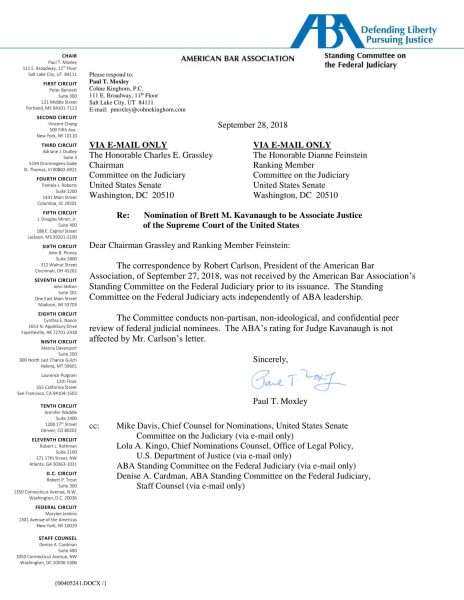
Thus it was that Robert Carlson, the latest Democratic Party contributor to lead the organization, wrote this letter on ABA letterhead, falsely stating that he was speaking for the ABA itself:

“The American Bar Association urges the United States Senate Judiciary Committee (and, as appropriate, the full Senate) to conduct a confirmation vote on Judge Kavanaugh’s nomination to the Supreme Court of the United States only after an appropriate background check into the allegations made by Professor Ford and others is completed by the Federal Bureau of Investigation.”

Rather than allow him to hijack its process and integrity, the ABA sent this letter to the Judiciary Committee, clarifying that Carlson was speaking for himself only:

Of course, if it were really a non-partisan, non-ideological organization, the ABA would be in the process of removing Carlson from office. In every organization, falsely using one’s post to imply organizational support of a personal view is a firing offense. Instead, the ABA took the face-saving measure of posting Carlson’s misleading letter (lawyers are prohibited from engaging in misleading conduct) under a link saying, “ABA President Calls For…” THAT’S deceit (lawyers are prohibited from engaging in deceit). Most readers will not notice the material distinction between the President of the ABA’s position and the official ABA position, and that’s just the way the association wants it.

Well, it’s not exactly integrity, but it’s a lot closer than what the ACLU has become. Continue reading

Oh, Fine: I Knew Wikipedia Was Untrustworthy, And Now I Find Out It’s Partisan Too….

If the mainstream media, social media, and the most accessed encyclopedia won’t tell the truth without trying to manipulate it, what chance do we have?

Yesterday I again tip-toed into the realm of government lawyer ethics for a CLE seminar. As I did last week, I attempted to mention the most important government lawyer issues raised by the events of the past year without triggering partisan zealots and the anti-Trump deranged. I also noted that being a partisan zealot or anti-Trump deranged qualifies as a potential conflict of interest for a government lawyer, interfering with his or her ability to be objective, independent, competent, loyal and zealous. I did not say, but could have, as proven by Sally Yates. I know from past experience that this particular—100% accurate—observation is inviting a fight.

However, I did feel it necessary to discuss Bruce Ohr, the Justice Department official who is at the center of several Mueller investigation controversies. I am not yet prepared to weigh in on Orr, except to note this, as I did yesterday: The fact that Ohr served as the Justice Department contact for Christopher Steele, the former MI6 agent commissioned to author the dubious Trump–Russia dossier that was used as the primary justification for the FISA warrants permitting surveillance of the Trump campaign, while Ohr’s wife, Nellie Ohr, worked for Fusion GPS, the opposition research firm that prepared the dossier under a contract with the Democratic National Committee and the Hillary Clinton campaign (but I repeat myself), was a blatant conflict of interest, and arguably (and I’ll argue it) an unwaivable one. It also violates the ethics requirement that all government employees must follow to avoid the appearance of impropriety. (Pretty much the entire Mueller investigation has breached that. )

In the course of trying to confirm the basic facts of Ohr’s conduct, I consulted Wikipedia. Where else do you go these days for a dispassionate up-to-date recitation of facts without spin? Not  the New York Times. Not Fox News. As Frankie Pentangeli says to Michael Corleone, “Your father did business with Hyman Roth; your father respected Hyman Roth; but your father never trusted Hyman Roth.” That pretty much describes my relationship to Wikipedia. I don’t trust it. I frequently find errors in entries; I know people who have Wikipedia pages who are about as deserving of them, or less, than my Jack Russell Terrier; and I have never forgotten how my father spend hours correcting a wildly inaccurate Wikipedia article about a World War II battle that he was deeply involved in and wrote about in his book only to have his work rejected because Wikipedia does not accept, it said, “first hand accounts.” Wikipedia is a classic example of an imperfect resource that is both essential and hopelessly flawed by its very nature. Continue reading