On “Chappaquiddick” And My Multiple “KABOOMS!” As I Watched It.

I finally saw “Chappaquiddick” after delaying the ordeal as long as I could. It isn’t an ethics movie; nor is it the unethical movie I feared that it might be. What “Chappaquiddick” is a very discouraging movie, one that depressed me greatly. It is telling that the Kennedy Legacy Collective didn’t swoop down and try to kill the film, as it is devastating in it depiction of the late Senator. I can only assume that increased focus on what really happened in, say, a libel trial would only affirm the portrayals, and do more damage than a little-seen film alone.

Of course, the movie is open to attack by Kennedy defenders on the grounds that it speculates what Ted Kennedy was thinking, as well as on  the conversations that went on behind closed doors. Nonetheless, the bare fact that Senator Kennedy waited 10 full hours before reporting the accident that killed Mary Jo Kopechne to police has been damning enough since that summer day in 1969 without further elaboration. The cover story—no, we can’t prove it was a cover story, but it was a cover story—that Ted was dazed and in shock from a concussion and wandered around aimlessly, explaining his actions—was never credible, certainly not at my Arlington, Massachusetts home.

I experienced the film this week as a simultaneous flashback and a series of head explosions. I had forgotten the ridiculous neck brace Kennedy wore to Mary Jo’s funeral (but not before or after it); the film states that it was a prop, and I remember that this was the consensus at the time. My biggest head explosion? It was probably the statement of the Martha’s Vineyard judge who gifted Kennedy with the shortest sentence possible for the lesser offense the Senator agreed to plead to, which was leaving the scene of an accident. Kennedy got a two months suspended sentence, and the judge said that he would be “punished enough.” (If you are unfamiliar withe my opinion of THAT rationalization, you can check out this post from 5 years ago; I have another one somewhere about a father who let his baby die in a hot, locked car, and both people involved in those tragedies were less despicable than Ted Kennedy.) Punished enough? The judge presumably meant that Teddy would take a big hit to his White House aspirations, poor guy.

You know, I’d say that every citizen locked up for negligent homicide, which is the real crime Kennedy was guilty of, can kiss their Presidential aspirations good-bye.

KABOOM #2 was the film’s version of first thing out of Kennedy’s mouth when he began explaining the fateful night’s events to cousin and family lawyer Joe Gargan: “I’m never going to be President.” I can’t find substantiation for this; the line isn’t in the version of the screenplay on the web. The subsequent conferences with Kennedy advisors and fixers, however, showed callousness that was not much worse. The film took a lot of its facts from “Senatorial Privilege” by Leo Damore, which was written from interviews with Kennedy friends and relatives, including Gargan.  Kennedy  made over 30 phone calls from the hotel payphone, none of which involved rescuing Mary Jo.   His driving license had been expired for 6-months, so Kennedy’s fixers pulled the right strings and the DMV issued him a new license on that Sunday, before he surrendered to police.

My head blasted the third time watching the recreation of Ted’s nationally televised speech, written by Kennedy wordsmith Ted Sorensen. This is the real version; the movie shortens it quite a bit…

My fellow citizens:

I have requested this opportunity to talk to the people of Massachusetts about the tragedy which happened last Friday evening. This morning I entered a plea of guilty to the charge of leaving the scene of an accident. Prior to my appearance in court it would have been [im]proper for me to comment on these matters. But tonight I am free to tell you what happened and to say what it means to me.

On the weekend of July 18th, I was on Martha’s Vineyard Island participating with my nephew, Joe Kennedy — as for thirty years my family has participated — in the annual Edgartown Sailing Regatta. Only reasons of health prevented my wife from accompanying me.

On Chappaquiddick Island, off Martha’s Vineyard, I attended, on Friday evening, July 18th, a cook-out I had encouraged and helped sponsor for a devoted group of Kennedy campaign secretaries. When I left the party, around 11:15pm, I was accompanied by one of these girls, Miss Mary Jo Kopechne. Mary Jo was one of the most devoted members of the staff of Senator Robert Kennedy. She worked for him for four years and was broken up over his death. For this reason, and because she was such a gentle, kind, and idealistic person, all of us tried to help her feel that she still had a home with the Kennedy family.There is no truth, no truth whatever, to the widely circulated suspicions of immoral conduct that have been leveled at my behavior and hers regarding that evening. There has never been a private relationship between us of any kind. I know of nothing in Mary Jo’s conduct on that or any other occasion — and the same is true of the other girls at that party — that would lend any substance to such ugly speculation about their character. Nor was I driving under the influence of liquor.

Little over one mile away, the car that I was driving on an unlit road went off a narrow bridge which had no guard rails and was built on a left angle to the road. The car overturned in a deep pond and immediately filled with water. I remember thinking as the cold water rushed in around my head that I was for certain drowning. Then water entered my lungs and I actual felt the sensation of drowning. But somehow I struggled to the surface alive.

I made immediate and repeated efforts to save Mary Jo by diving into the strong and murky current, but succeeded only in increasing my state of utter exhaustion and alarm. My conduct and conversations during the next several hours, to the extent that I can remember them, make no sense to me at all.

Although my doctors informed me that I suffered a cerebral concussion, as well as shock, I do not seek to escape responsibility for my actions by placing the blame either on the physical and emotional trauma brought on by the accident, or on anyone else.

I regard as indefensible the fact that I did not report the accident to the police immediately.

Instead of looking directly for a telephone after lying exhausted in the grass for an undetermined time, I walked back to the cottage where the party was being held and requested the help of two friends, my cousin, Joseph Gargan and Phil Markham, and directed them to return immediately to the scene with me — this was sometime after midnight — in order to undertake a new effort to dive down and locate Miss Kopechne. Their strenuous efforts, undertaken at some risk to their own lives, also proved futile.

All kinds of scrambled thoughts — all of them confused, some of them irrational, many of them which I cannot recall, and some of which I would not have seriously entertained under normal circumstances — went through my mind during this period. They were reflected in the various inexplicable, inconsistent, and inconclusive things I said and did, including such questions as whether the girl might still be alive somewhere out of that immediate area, whether some awful curse did actually hang over all the Kennedys, whether there was some justifiable reason for me to doubt what had happened and to delay my report, whether somehow the awful weight of this incredible incident might in some way pass from my shoulders. I was overcome, I’m frank to say, by a jumble of emotions: grief, fear, doubt, exhaustion, panic, confusion, and shock.

Instructing Gargan and Markham not to alarm Mary Jo’s friends that night, I had them take me to the ferry crossing. The ferry having shut down for the night, I suddenly jumped into the water and impulsively swam across, nearly drowning once again in the effort, and returned to my hotel about 2:00am — and collapsed in my room. I remember going out at one point and saying something to the room clerk.

In the morning, with my mind somewhat more lucid, I made an effort to call a family legal advisor, Burke Marshall, from a public telephone on the Chappaquiddick side of the ferry and then belatedly reported the accident to the Martha[‘s] Vineyard police.

Today, as I mentioned, I felt morally obligated to plead guilty to the charge of leaving the scene of an accident. No words on my part can possibly express the terrible pain and suffering I feel over this tragic incident. This last week has been an agonizing one for me and for the members of my family. And the grief we feel over the loss of a wonderful friend will remain with us the rest of our lives.

These events, the publicity, innuendo, and whispers which have surrounded them and my admission of guilt this morning raises the question in my mind of whether my standing among the people of my State has been so impaired that I should resign my seat in the United States Senate. If at any time the citizens of Massachusetts should lack confidence in their Senator’s character, or his ability — with or without justification — he could not in my opinion adequately perform his duties and should not continue in office.

The people of this State, the State which sent John Quincy Adams, and Daniel Webster, and Charles Sumner, and Henry Cabot Lodge, and John Kennedy to the United States Senate are entitled to representation in that body by men who inspire their utmost confidence. For this reason, I would understand full well why some might think it right for me to resign. For me, this will be a difficult decision to make.

It has been seven years since my first election to the Senate. You and I share many memories — some of them have been glorious, some have been very sad. The opportunity to work with you and serve Massachusetts has made my life worthwhile.

And so I ask you tonight, the people of Massachusetts, to think this through with me. In facing this decision, I seek your advice and opinion. In making it, I seek your prayers — for this is a decision that I will have finally to make on my own.

It has been written:

“A man does what he must — in spite of personal consequences, in spite of obstacles, and dangers, and pressures — and that is the basis of all human morality……whatever may be the sacrifices he faces, if he follows his conscience — the loss of his friends, his fortune, his contentment, even the esteem of his fellow man — each man must decide for himself the course he will follow. The stories of the past courage cannot supply courage itself. For this, each man must look into his own soul.”

I pray that I can have the courage to make the right decision. Whatever is decided, whatever the future holds for me, I hope that I shall have — be able to put this most recent tragedy behind me and make some further contribution to our state and mankind — whether it be in public or private life.

Thank you and good night.

I had forgotten that Kennedy never apologized to the Kopechnes for getting their daughter killed. But he did use the recently departed Mary Jo as a convenient device to signal his virtue, standing up for her reputation, while being mostly concerned about his own. The poetic quote was a a typical Sorensen touch, and laying it on a bit thick: a Churchillian passage of dubious provenance that sainted brother Jack had used in his Pulitzer Prize-winning “Profiles in Courage”—which was, after all, written by Ted Sorensen.

The final series of head explosions occurred at the end, as the film showed archival footage of Massachusetts voters, Kennedy worshipers, most of them, talking about how “anyone can make a mistake” and what good things Ted and his dead brothers had done in the past, and how sure, they would vote for him again.

Of course, they did.

The modern progressive movement in the Democratic Party was substantially built on the career of this weak, corrupt man, the product of the triumph of nepotism, mythology, celebrity, money and privilege over merit and justice.

And people deny that there could have been any bias, political manipulation and corruption in the investigation of Hillary Clinton’s private server.

Kaboom.

Morning Ethics Warm-Up, 7/2/2018: Bad Neighbors And Bad Journalism

Good Morning…

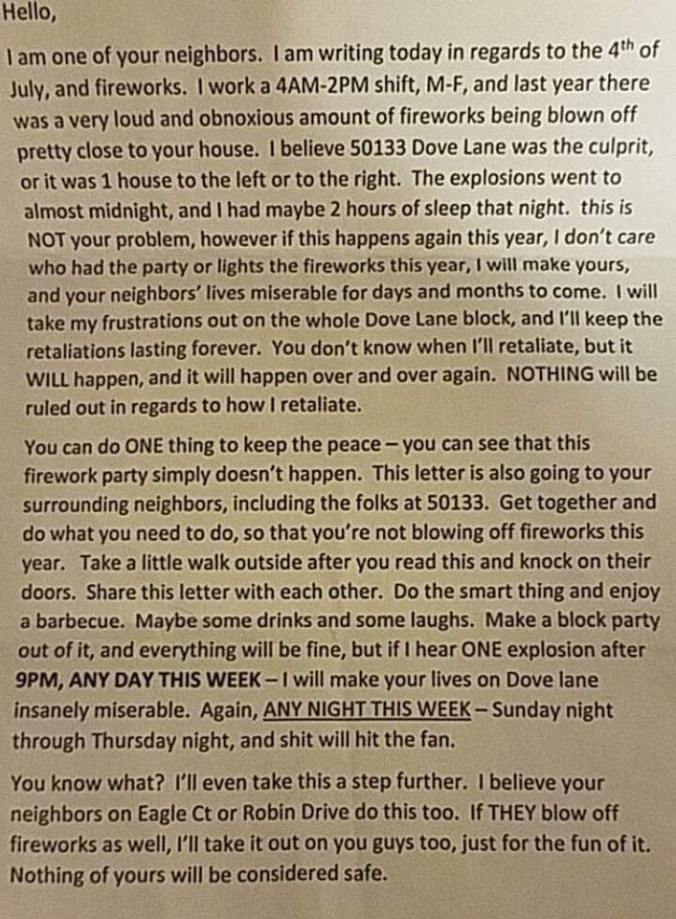
1. Ah, now THAT’S the ol’ Spirit of 1776!  In a subdivision near Sterling Heights in Chesterfield, Michigan,  a resident sent an anonymous letter to other residents, threatening  to take dire measures against them if they set off fireworks after 9 PM  this week. Here’s the letter…

Yikes.

I’m presuming that the real spirit of 1776 still breathes deeply in this nation, and that the reaction of the recipients of that letter will be to make certain that the noisiest fireworks possible are exploding every second during the time they are permitted to be by law, from the start of the week to the end. The neighbor is a coward, a jerk and a bully, and his bluff must be called as a matter of justice and honor. (Pointer: HLN)

2. Nah, the mainstream news media isn’t biased! In an absolutely correct and justified editorial note, Fox News’ Chris Wallace excoriated media outlets on “Fox News Sunday” for attempting to connect President Donald Trump to the newsroom shooting at Capital Gazette in Maryland. (This will, of course, be called an example of Fox News pro-Trump toadying by those same media outlets.) This was indeed one of the most transparent recent episodes of fake news peddling by CNN, Reuters and others in the mainstream media, who worked hard to make the case that the killer of five was motivated by the President’s repeated accusation that the media is “the enemy of the people.” We now know that the shooter swore that he would kill the Capital Gazette writer whom he targeted in the attack years ago, when everyone assumed that Hillary was going to be the next President. Continue reading

Morning Ethics Warm-Up, 3/15/2018: The Last Of Hillary, More NCAA Enabling, And Hoping For The End Of “Pride” In Student Ignorance

Good Morning!

1 To be crystal clear about the student walk-outs:

a) The only reason schools are tolerating them is because a majority of teachers and administrators share the anti-gun agenda the protests represent. Ethics Foul. Educators’ political views should be irrelevant to how they do their job, which is to educate students, not encourage them to skip class.

b) The students who walk out should be disciplined, and the reason they walked out should be neither a mitigation nor an enhancer. If they want to engage in civil disobedience, fine: its a grand old tradition, for causes noble and dumb alike.

c) The news media hyping the protests is unconscionable, and just another example of journalists taking sides rather than reporting.

d) Anyone who says in public that they are “proud” of these children should be fitted with a dunce cap and have it super-glued to their heads. Proud of what? That they have allowed themselves to be used as puppets, pawns and human shields by cynical politicians and activists? That they have failed to make a single valid or persuasive argument in over a month, while polluting the discussion with statistical falsehoods, blame-shifting, name-calling and demonization? That they are reveling in and parading their lack of intellectual honesty and critical thinking skills?

e) The walk-outs and protests are not merely sort of like, but exactly the same, as the “screaming at the sky” demonstrations. Those was embarrassing, and so are the wlak-outs. In particular, educators should be embarrassed. This is the level of critical thinking they are training our young to master.

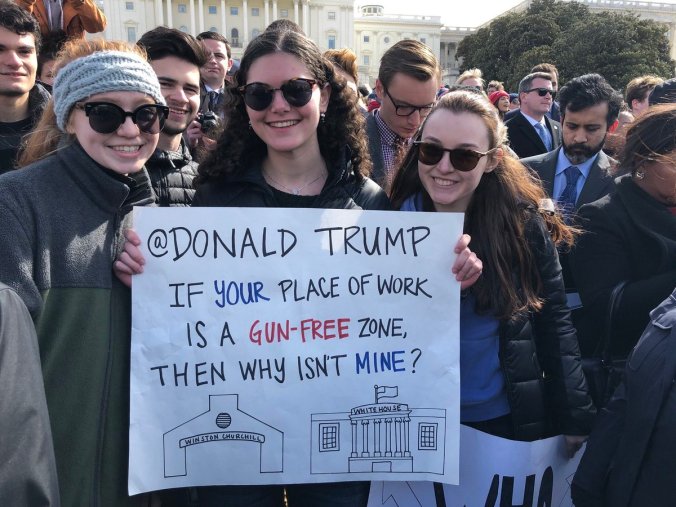
f) This idiotic sign, on display in my area yesterday, nicely sums up the level of seriousness, common sense and acumen the anti-gun students have displayed so far:

2.  I’m going to try to make this the last time I pay any attention to what Hillary Clinton says. I really am. During that infamous interview the India Today Conclave  over the weekend, the one where she again implied that anyone who voted for President Trump was a bigot or a moron, Clinton made another statement that raised metaphorical eyebrows She was asked why she thought most white women voted for Trump, and said, Continue reading

Afternoon Ethics Cool-Down, 2/28/18: Honors, Bribes, Blackmail, And “Ugh!”

Good Afternoon.

Actually, that’s dishonest: it’s been a terrible day, morn to now.. A catalogue retailer took an email address my wife sent them a year ago and  bombarded her account with hundreds of promotional messages yesterday, crashing her email. Then her efforts to fix the problem resulted in a Proethics system email crash that I have been trying to address for the past five hours. I finally decided to get something productive done, so I’m getting up this post while talking to my tech people. UPDATE: They just gave up.

1 Trump Tweets. Ugh. The President criticizing his own Cabinet member, in this case Jeff Sessions, in public via tweet, is horrific leadership and management practice. If I were Sessions, I would resign, It is disrespectful, disloyal, undermines morale on the President’s team, and is just plain stupid. I don’t understand how Trump had any success at all treating employees and subordinates like this. While we’re on this perpetual subject. the fact that the President would say out loud that he would have rushed the Parkland shooter without a weapon is just more evidence of a) a flat learning curve b) the lack of the usual filters from brain to mouth and c) the unethical tendency of third parties to critique the actions of others in rescue situations. No question: the resource officer who was required by policy, assignment and duty to try to intervene in the shooting deserves all the criticism he has been getting, and is accountable. But the President of the United States announcing that he is Batman is something else entirely.

My objections to the non-stop personal ridicule of our elected leader stands, but he also has a duty, as the steward of the Office, not to make himself look ridiculous.

2. An unethical boycott tactic, but I repeat myself.  The anti-gun zealots have decided to attack a free and constitutionally protected Bill of Rights advocacy group as part of the news media-assisted effort to demonize the NRA as being somehow responsible for a school shooting that none of the proposed “common sense gun reforms” would have prevented. Now the Second Amendment-gutting crowd  is using the boycott, a particularly odious weapon favored by progressives, which depends on the venality and spinelessness of corporate executives to constrict free speech. Delta Airlines announced it was ending a promotional discount with the National Rifle Association after threats and a social media campaign, then tried the weaselly explanation that its decision to stop offering discounted fares to the N.R.A. “reflects the airline’s neutral status in the current national debate over gun control amid recent school shootings.”
Continue reading

Morning Ethics Warm-Up, 2/20/18: Cheaters And Useful Idiots

Good Morning!

1. A Whistle-blowing dilemma.The Ethicist in the New York Times Magazine is no fun anymore, now that a competent, real ethicist is answering queries rather than the previous motley assortment of Hollywood screenwriters and others of dubious qualifications. Even when I disagree with

  • “Given how little cheating is caught, reporting them would have meant that they paid a penalty that lots of others ought to — but won’t — pay.” Ugh! A Barry Bonds excuse! So because all guilty parties aren’t apprehended, everyone should get away with wrongdoing?
  • “Because many people in your generation don’t take cheating very seriously, your friends would most likely have ended up focusing on the unfairness of being singled out, not on their wrongdoing.” That’s their problem. The attitude the Ethicist identifies is 39. The Pioneer’s Lament, or “Why should I be the first?” He’s correct that this will be the likely attitude of the busted cheaters, but since when did how wrongdoers rationalize their wrongdoing become mitigation?
  • “The intervention you were considering was likely, therefore, to be very costly to you.” Yes, doing the right thing often is.
  • “The burden of dealing with cheating in your school shouldn’t fall on you.” Boy, I really hate this one. It’s #18. Hamm’s Excuse: “It wasn’t my fault.”

This popular rationalization confuses blame with responsibility. Carried to it worst extreme, Hamm’s Excuse would eliminate all charity and much heroism, since it stands for the proposition that human beings are only responsible for alleviating problems that they were personally responsible for. In fact, the opposite is the case: human beings are responsible for each other, and the ethical obligation to help someone, even at personal cost, arises with the opportunity to do so, not with blame for causing the original problem. When those who have caused injustice or calamity either cannot, will not or do not step up to address the wrongs their actions have caused (as is too often the case), the responsibility passes to whichever of us has the opportunity and the means to make things right, or at least better.

This rationalization is named after American gymnast Paul Hamm, who adamantly refused to voluntarily surrender the Olympic gold metal he admittedly had been awarded because of an official scoring error. His justification for this consisted of repeating that it was the erring officials, not him, who were responsible for the fact that the real winner of the competition was relegated to a bronze medal when he really deserved the gold. The ethical rule to counter Hamm’s Excuse is a simple one: if there is a wrong and you are in a position to fix it, fix it.

Appiah doesn’t feel the full force of my fury because the case involves middle-school, and the questioner is a child. This is what makes it a toss-up. If this were college or grad school, I think reporting cheaters is mandatory. Appiah also says that he doesn’t care for honor codes because they are usually not followed.

Maybe I was wrong about him… Continue reading

Morning Ethics Warm-Up, 1/25/2018: Special “Was That Wrong? Should I Have Not Done That? I Gotta Plead Ignorance On This Thing Because If Anyone Had Said Anything To Me At All When I First Started Here That That Sort Of Thing Was Frowned Upon…” Edition*

Good morning, all.

Let’s get warmed up…

1  Social media censorship. Tom Champlin, who owns the libertarian news aggregator The Liberty Review and runs its associated Facebook page was banned from Facebook for 30 days under its “community standards” for posting this:

Facebook prohibits posts that promote harmful conduct, eating disorders and suicide, but no one but an idiot–is the Facebook community made up of idiots?—would misinterpret the meaning of that meme. It’s a political statement, and if it really violates Facebook’s “community standards,” then Facebook is demanding ideological conformity in its already largely mindless left-wing echo chamber. Either enough Facebook users who believe in free speech make a stink over this kind of attempted regulation of public opinion to force Facebook (and Twitter, and Google) to cut it out, or the open expression of ideas in social media will be doomed.

I suggest every Facebook user post this meme, not to chide Obamacare, but to show support for freedom of expression, and contempt for Facebook’s attempt to strangle it. Of course Facebook, as a private business, can ban what it wants. That doesn’t mean abusing its power and influence is any less dangerous or despicable.

I just posted this item, with the meme, to my Facebook page. I’ll be interest to see a) if I get banned, even with the above preface, and 2) how many of my knee-jerk progressive friends have the integrity to post the meme themselves.

2.  Predators who don’t get it, Part 1. Like many others, I wondered if the NPR banishment of Garrison Keillor and the deposit of his iconic “Prairie Home Companion” radio show  in the Void of Shame was just witch hunt mania. Keillor dismissed it as the result of a single ex-employee making a late fuss over an accidental laying on of hands. Finally, after being attacked by Keillor fans for Frankening him unjustly, Minnesota Public Television, which was the NPR station that investigated the plummy humorist, decided that it had to go public with the real story. Yesterday it posted a statement that said in part…

When Minnesota Public Radio abruptly severed ties with Garrison Keillor in November, the sole explanation offered by the company was “inappropriate behavior” with a female colleague.

For his part, the creator and longtime host of A Prairie Home Companion described his offense as nothing more than having placed his hand on a woman’s back to console her. An investigation by MPR News, however, has learned of a years-long pattern of behavior that left several women who worked for Keillor feeling mistreated, sexualized or belittled. None of those incidents figure in the “inappropriate behavior” cited by MPR when it severed business ties. Nor do they have anything to do with Keillor’s story about putting a hand on a woman’s back:

  • In 2009, a subordinate who was romantically involved with Keillor received a check for $16,000 from his production company and was asked to sign a confidentiality agreement which, among other things, barred her from ever divulging personal or confidential details about him or his companies. She declined to sign the agreement, and never cashed the check.

• In 2012, Keillor wrote and publicly posted in his bookstore an off-color limerick about a young woman who worked there and the effect she had on his state of arousal.

• A producer fired from The Writer’s Almanac in 1998 sued MPR, alleging age and sex discrimination, saying Keillor habitually bullied and humiliated her and ultimately replaced her with a younger woman.

• A 21-year-old college student received an email in 2001 in which Keillor, then her writing instructor at the University of Minnesota, revealed his “intense attraction” to her.

MPR News has interviewed more than 60 people who worked with or crossed professional paths with Keillor. Most spoke on the condition of anonymity because they still work in the industry or feared repercussions from Keillor or his attorneys…

Is it possible that Keillor really believes that he never did anything wrong? Yes, it’s very possible, and this Ethics Alarms post from yesterday in all likelihood applies to Keillor, another weird, homely guy that learned early in life that show business was a great way to attract women. Continue reading

Re Met Conductor James Levine: I Know, I Know, “The King’s Pass”…But What’s The Matter With People?

The Harvey Weinstein Ethics Train Wreck took a cultural turn and visited the New York Metropolitan Opera yesterday. James Levine, the Met’s legendary conductor for four decades, allegedly molested a teenager in the 1980’s. The allegations were described in a police report that was filed in 2016. A man stated that he met Levine as a 15 year-old child when Levine was a conductor at the Ravinia Music Festival in Illinois. Beginning the next year, when Levine was 42 and the boy was 16, the conductor  touched the teenager’s genitalia and masturbated in his presence. The sexual relations involved hundreds of incidents and lasted for years, according to the allegations. Levine also served as a mentor to the teenager, wrote a college recommendation essay, and gave him tens of thousands of dollars of cash.  The man says he is straight and that  he was “confused and paralyzed” by Levine’s actions.

Now the Met says it is investigating. But I have more…

Today I attended a performance of an opera, and by chance happened to chat with one of the opera company’s board members. I asked him if he had heard about Levine. He said he didn’t know what I was talking about. After I summarized the story above, he said (I’m paraphrasing):

“I hadn’t heard about that, but it’s no surprise. I performed in the Met  chorus in the Eighties and Nineties when I lived in New York. Everyone knew that Levine fooled around with teenaged boys. I’m pretty sure the Met paid off some of them.”

After I heard this–at the time, there was only one man making one accusation—it was reported that the Met suspended Levine, because three more men came forward saying that they had been abused by the conductor as teens. Continue reading

It’s Thanksgiving, And Time For The Complete “It’s A Wonderful Life” Ethics Guide [Updated And With A New Introduction For 2017 ]


Last year (to the day) when I posted the Ethics Alarms ethics guide to Frank Capra’s 1946 masterpiece “It’s A Wonderful Life,” one of the great ethics movies of all time, as this blog’s official welcome to the holiday season, I wrote, “I suspect we need it more in 2016 than usual.”  As it turned out, we need it even more in 2017.

Multiple forces have been hard at work for a full year now, roiling the nation, painting the future as dire and the present as unbearable, trying to divide us and even to encourage discord and conflict during this special time when we are supposed to remember what is most important in life. In case you have been infected, it’s not politics and not partisan agendas, but love, family, community, kindness, and friends. The simple message of Frank Capra’s masterpiece—it has aged far better than his other films, including, and maybe especially, “Mister Smith Goes To Washington”—that no one is a failure who has friends, is vital to recall when so many are rejecting friends because they don’t conform to some ideological talking point. This is madness, and watching and heeding “It’s A Wonderful Life” is a better remedy than Thorazine.

Senate Minority Leader Chuck Schumer actually told his Twitter followers this week to bring a chart prepared by a  think tank to attack the Republican tax plan during Thanksgiving dinner. This is part of the effort to politicize everything in our lives, by zealots who value power over humanity, country, and spirituality. They belong with Mr. Potter, not George and Clarence.

I need this movie more in 2017 than usual for other reasons. It has been a year in which I have lost many peers and cherished friends, and listened to too many of the living bemoan the passage of time and looming mortality.  I don’t think like that—a lifetime gift from my brave and fatalist father—but I can’t pretend that the game clock isn’t running out, or not face the fact that I have not sunk anywhere near the baskets I could have and should have. Fortunately, what I wrote in an earlier year introducing this post still resonates…

Everyone’s life does touch many others, and everyone has played a part in the chaotic ordering of random occurrences for good. Think about the children who have been born because you somehow were involved in the chain of events that linked their parents. And if you can’t think of something in your life that has a positive impact on someone–although there has to have been one, and probably many—then do something now. It doesn’t take much; sometimes a smile and a kind word is enough. Remembering the lessons of “It’s a Wonderful Life” really can make life more wonderful, and not just for you.

Have a terrific Thanksgiving, everyone.

And here we go:

1. “If It’s About Ethics, God Must Be Involved”

The movie begins in heaven, represented by twinkling stars. There is no way around this, as divine intervention is at the core of the fantasy. Heaven and angels were big in Hollywood in the Forties. The framing of the tale seems to advance the anti-ethical idea, central to many religions, that good behavior on earth will be rewarded in the hereafter, bolstering the theory that without God and eternal rewards, doing good is pointless.

Yet in the end, it is an ethics movie, not a religious one. George lives an ethical live, not out of any religious conviction, but because step by step, crisis after crisis, he chooses to place the welfare of others, especially his community and family, above his own needs and desires. No reward is promised to him, and he momentarily forgets why we act ethically, until he is reminded. Living ethically is its own reward.

We are introduced to George Bailey, who, we are told, is in trouble and has prayed for help. One has to wonder about people like George, who resort to prayer as a last resort, but they don’t seem to hold it against him in Heaven. The heavenly authorities assign an Angel 2nd Class, Clarence Oddbody, to handle the case..He is, we learn later, something of a second rate angel as well as a 2nd Class one, so it is interesting that whether or not George is in fact saved will be entrusted to less than Heaven’s best. Some lack of commitment, there— perhaps because George has not been “a praying man.” This will teach him—sub-par service!

2. Extra Credit for Moral Luck

George’s first ethical act is saving his brother, Harry, from drowning, an early exhibition of courage, caring and sacrifice. The sacrifice part is that the childhood episode costs George the hearing in one ear. He doesn’t really deserve extra credit for this, as it was not a conscious trade of his hearing for Harry’s young life, but he gets it anyway, just as soldiers who are wounded in battle receive more admiration and accolades than those who are not. Yet this is only moral luck. A wounded hero is no more heroic than a unwounded one, and may be less competent as well as less lucky.

3.  The Confusing Drug Store Incident

George Bailey’s next ethical act is when he saves the life of another child by not delivering a bottle of pills that had been inadvertently poisoned by his boss, the druggist, Mr. Gower. This is nothing to get too excited over, really—if George had knowingly delivered poisoned pills, he would have been more guilty than the druggist, who was only careless. What do we call someone who intentionally delivers poison that he knows will be mistaken for medication? A murderer, that’s what.  We’re supposed to admire George for not committing murder.

Mr. Gower, at worst, would be guilty of negligent homicide. George saves him from that fate when he saves the child, but if he really wanted to show exemplary ethics, he should have reported the incident to authorities. Mr. Gower is not a trustworthy pharmacist—he was also the beneficiary of moral luck. He poisoned a child’s pills through inattentiveness. If his customers knew that, would they keep getting their drugs from him? Should they? A professional whose errors are potentially deadly must not dare the fates by working when his or her faculties are impaired by illness, sleeplessness or, in Gower’s case, grief and alcohol.

4. The Uncle Billy Problem

As George grows up, we see that he is loyal and respectful to his father. That’s admirable. What is not admirable is that George’s father, who has fiduciary duties as the head of a Building and Loan, has placed his brother Billy in a position of responsibility. As we soon learn, Billy is a souse, a fool and an incompetent. This is a breach of fiscal and business ethics by the elder Bailey, and one that George engages in as well, to his eventual sorrow.

5. George’s Speech

Continue reading

The IRS Scandal: “I’m Sorry!” Is Not Enough, But That’s Apparently All Our Battered Democracy Will Get


I’ve been holding a draft of this post for two weeks until I calmed down. You should read the first version.

The Treasury Department  agreed to  a “very substantial” settlement covering damages to hundreds of tea party groups following a class-action lawsuit over the obstructive, discriminatory IRS scrutiny they received when applying for tax-exempt status leading up to the 2012 election. According to court documents,  the IRS admitted wrongdoing and apologized for its conduct. The IRS stated,

“The IRS admits that its treatment of Plaintiffs during the tax-exempt determination process, including screening their applications based on their names or policy positions, subjecting those applications to heightened scrutiny and inordinate delays, and demanding some Plaintiffs’ information that TITA determined was unnecessary to the agency’s determination of their tax-exempt status, was wrong. For such treatment, the IRS expresses its sincere apology.”

That’s nice. Isn’t that nice?

The department did not disclose the amount of money handed out to over 400 organizations: “The [Internal Revenue Service]’s use of these criteria as a basis for heightened scrutiny was wrong and should never have occurred,” Attorney General Sessions said in a statement.  “It is improper for the IRS to single out groups for different treatment based on their names or ideological positions.”

Ya think?

The scandal began in 2013, when an IRS official admitted the agency had been aggressively scrutinizing groups with names such as “Tea Party” and “Patriots.” It later emerged that some liberal groups had been targeted, too, but in less aggressive ways and although in far smaller numbers. I hate to be suspicious, but if a Democratic administration’s tax agency agency in advance of an election wanted to hobble Republican and conservative groups, picking out some progressive groups to harass would be the smart move. In “Jack Reacher,” a sniper who wants to kill one target shoots five, so it looks like a random mass shooting. Same theory.

The IRS accelerated its special treatment of conservative groups around 2010, as the election approached, and Tea Party applications for tax-exempt status surged. Some court decisions had eased the rules for tax-exempt groups to participate in politics. Something had to be done, and some obama loyalists in the IRS apparently decided to do it. Or it was all one big misunderstanding.

After the scandal broke, there was a mass exodus from the IRS’s management. Conservative groups sued. Congressional Republicans launched  years of hearings, amid allegations the Obama White House had ordered the targeting. It was a futile effort. In earlier administrations, the news media would have been asking questions. A non-political Justice Department would have investigated hard, but Obama’s Justice Department was entirely constructed to protect the President and Democratic interests. The situation screamed for a Special Counsel. This wasn’t a matter of speculation: Something was rotten in Washington, D.C. A supposedly apolitical agency of the US Government, in advance of a national election with a Democratic President in office, used its power to interfere with the rights of conservatives to organize and participate in the democratic process. If the IRS employees involved were sufficiently partisan—and they were–no explicit orders from the White House were necessary. They knew what to do. Continue reading

Ethics Dunce: Donna Brazile, But Not For The All The Obvious Reasons…

“Now, it’s my understanding that as a CNN contributor, you won’t make me follow any of that ethics crap, right, Jake?”

In her new book, “Hacks: The Insider Story of the Break-ins and Breakdowns That Put Donald Trump in the White House,” Suddenly Ethical Donna Brazile takes a moment  to slam Jake Tapper because he harshly criticized her after a leak reveealed that she had used her CNN position to procure debate question and pass them along under the table to Hillary. (Of course, if Clinton had any integrity, she would have refused—what am I SAYING?).

She wrote,

“The next day, even Jake Tapper took a swing at me, calling me unethical and ‘journalistically horrifying’ during a radio interview with WMAL even though I worked for CNN as a commentator not a journalist.When I called him on this, he did not apologize. His attack on me was really about him. He wrote in an email, ‘I don’t know what happened here except it undermines the integrity of my work and CNN … you have to know how betrayed we all feel.”

OH! Donna was a contributor, not a journalist! That changes everything! So as an individual who was contributing to a journalism product, as well as paid to do so, and being relied upon by journalists in a journalism-supplying entity to inform their audience honestly regarding what journalism covers by definition, Brazile as a paid contributor should not have been expected  not required to tell the truth, be fair, maintain standards of integrity, state her biases and conflicts up front, or indeed engage in ethical conduct at all!

Is that the new definition of what “contributor” means? Boy, I think CNN needs to clarify this; I always assumed that if a network employed a “contributor,” that individual was being presented as someone who would be held to the same standards of professionalism as other on-screen employees. Continue reading