The Wrestler, the Girl, and Cultural Confusion

"Wanna wrestle?"

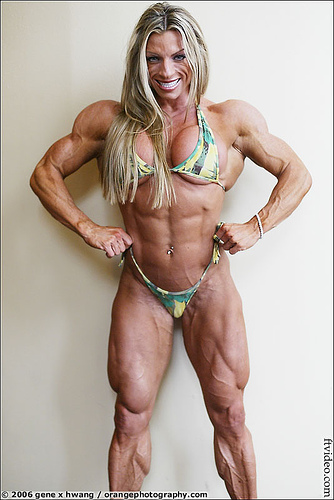
Sixteen-year-old high school sophomore wrestler Joel Northrup forfeited his match against a fourteen-year-old wrestler with two X chromosomes, Cassy Herkelman, at the Iowa state wrestling championships, saying that “As a matter of conscience and my faith I do not believe that it is appropriate for a boy to engage a girl in this manner.” Obviously Herkelman didn’t require protection from anyone or anything. She was her district’s 112-pound champion wrestler, and she won the Iowa championship for her class as well.  Cassie had won 20 of 33 matches, all against male wrestlers, on her way to the state championship. Maybe Northrup didn’t want to risk being ridiculed for losing to a girl; maybe he was uncomfortable with the sexual overtones of an inter-gender contest. All we can do is assess his conduct by taking him at his word: he believes a young man wrestling a young woman is morally wrong, and was willing to forfeit a match he might have won. Joel was, after all, the fifth-ranked wrestler in the state at 112 pounds, and had a 35-4 record.

Was his decision admirable, or sexist? Was it gentlemanly, or demeaning? Continue reading

“The Strange Case of the Threatening Hypothetical”, Continued: The Verdict Is In!

The Victim

Lawrence Connell, the Widener School of Law criminal law professor placed on administrative leave for using the school Dean in a “violent scenario” to illustrate legal principles to his class, has given a revealing and clarifying interview to the National Association of Scholars website.

This section is most relevant to his current plight, and the fairness of complaints leveled against him by some of his students. It’s also about one of my favorite topics in criminal law, attempt law, which has a significant ethical component, as you will see. But the main point of interest is that includes one of the supposedly racist, sexist, threatening hypotheticals he used.

Q: Can you give me an example of a hypothetical you might have used in class, to which the students who complained might have been referring? Can you describe the context in which you would have used it? Continue reading

Unethically Leaked Unethical Manuscript Shows That Sarah Palin Is Unethical

The Anchorage Daily News has obtained a leaked (read: stolen) manuscript of an unpublished book detailing a close former aide to Sarah Palin’s discovery of the Republican star’s many character flaws. Among other items, the book suggests that she knowingly violated federal election laws.

Now what? Let’s run down the ethical docket: Continue reading

Good-bye and Good Riddance to Bush’s Unethical “Conscience Clause”

The Obama Administration has deep-sixed a controversial Bush Administration rule that permitted a wide variety of health care workers to  refuse to administer treatments they found morally repugnant, what the Bush administration termed workers’ “right of conscience.”

Hospitals and clinics faced a loss of federal funds if they failed to uphold the rule, which itself was ethically repugnant. Kudos, thanks and hosannas to President Obama for getting rid of the Federal variety; some states, regrettably, still have them.

The American Medical Association’s position on the matter, embodied in a resolution passed by its membership, is clear and well-reasoned. Its reasoning applies to health care workers though the specific subject of the resolution was pharmacist conscience clauses.

The AMA’s resolution, “Preserving Patients’ Ability To Have Legally Valid Prescriptions Filled,” states: Continue reading

The Strange Case of the Threatening Hypothetical

Lawrence Connell, a tenured associate professor at Widener University School of Law in Delaware, is fond of using famous or familiar people in the hypotheticals he presents to his criminal law class.  One of his imaginary scenarios involved him as a murderer, and the school’s Dean as his victim. Now he is on administrative leave from the school, as administrators investigate  him for using “violent scenarios” that some students complained violated the school’s discrimination and harassment codes.

Widener University spokesman Dan Hanson, meanwhile, has declined to provide more details on the matter, but insists that Widener is committed to academic freedom.

Right. Continue reading

Alcoholics Anonymous and Ethics

With all the alcoholics in my life, and there are and have been many (some of whom I undoubtedly never knew qualified), today was the first time I ever actually attended a meeting of Alcoholics Anonymous. Indeed, before yesterday I didn’t know I could attend. Many groups have periodic “open” meetings, however, to which friends and family members of alcoholics as well as “anyone interested in learning about alcoholism” are invited. I know a lot about alcoholism, learned the hard way. Now I know more. More important than that, I realize that Alcoholics Anonymous has a great deal to teach everyone…not just about alcoholism, but about ethics. Continue reading

Ethics Scoreboard Flashback: “Death on Everest”, a Real Life “What Would You Do?”

[ The discussion in the earlier post today regarding ABC’s revolting “What Would You Do?” convinced me that I should re-post this essay about a real-life “What Would You Do?”tragedy, which originally appeared on The Ethics Scoreboard in 2006.  Entitled “Death on Everest,” It has been lightly edited to bring it up to date.]

As 34-year-old mountaineer David Sharp lay near death on Mount Everest, over 40 other climbers trudged past him on their march to the peak. All had oxygen with them, and a few even stopped briefly to give Sharp a few breaths. But still they climbed on, and Sharp perished. His demise on May 15, 2006 has gone into ethics lore alongside the infamous death of Kitty Genovese on March 13, 1964. Genovese was murdered outside her apartment building in Queens while thirty-eight neighbors watched and did nothing.
The two incidents stem from very different causes, however. While Genovese’s death was fueled by urban fear and apathy, a mass failure of courage and the willingness to assume responsibility in a crisis, Sharp was the victim of that universal ethics-suppressant, the powerful non-ethical consideration. Continue reading

ABC News’ Unethical, Dishonest and Biased “What Would You Do?”

ABC’s News’ periodic segment “What Would You Do?” is public opinion manipulation crossed with bad social behavior research, seeking the entertainment value of hidden camera shows. The segments stage outrageous public scenarios—a caretaker mistreating a wheelchair-bound senior, for example, to see how bystanders will react. Any potential benefit of the segments—might they encourage people to consider intervening when they see blatantly unethical  behavior?—is swallowed whole by the more likely negative results. One is that the existence of a hidden camera show that stages such charades creates inevitable cynicism and skepticism. Most witnesses to crimes and other shocking public conduct have enough mental and social hurdles to clear before they can reach the decision to take action without ABC News giving them another. The thought “I wonder if this is fake?” may be just enough to still someone’s ethics alarms and cause them to discount the duties of rescue and confrontation. Indeed, several of the scenarios stages for the show have been unconvincing. “What Would You Do?” also provides a convenient rationalization for those who are inclined to ignore fellow human beings in peril: “This must be set-up.”

In addition, “What Would You Do?” often carries a more sinister feature, courtesy of the biased journalists at ABC. Sometimes the simulated conduct appears to be designed to portray the worst of human values, with the clear implication that such conduct is common in America. And sometimes, like last week, this is driven by a political agenda. Continue reading

Latest Political Correctness Bullying Victim: Kenneth Cole

If you can’t make a silly joke on Twitter, that on-line  jungle of the trivial, incoherent, moronic, witty and self-promotional 140 word blurb, where can you make it? Designer Kenneth Cold sent out a tongue-in-cheek bit of satirical self-promotion, tweeting:

“Millions are in uproar in #Cairo. Rumor is they heard our new spring collection is now available online at http://bit.ly/KCairo -KC.”

Horrors. Continue reading

Frivolous Charge of the Month (Runner-Up): Redskins Owner and Ethics Dunce, Dan Snyder

Most NFL fans know that Washington Redskins owner Dan Snyder is the most hapless, inept, and narcissistic team owner in the league, spending millions upon millions of dollars on the once successful franchise while meddling in team affairs and ending up with a squad that seems to get worse every season. Few knew how petty and mean he was, however, until he was angered by an alternative media publication that published a reporter’s withering, exhaustive article last year, entitled “The Cranky Redskins Fan’s Guide to Dan Snyder”, cataloging the full range of Snyder’s non-feasance, misfeasance, malfeasance, and plain old bone-headedness over his career. Snyder’s lawsuit, filed this week in New York, claims that the article contained “numerous outrageous, false and defamatory statements of and concerning” Snyder. “Simply put,” it says, “no reasonable person would accept the publication of these types of false, malicious, and/or defamatory statements about them or their spouses. Nor would any reasonable person tolerate an anti-Semitic caricature of himself or herself prominently displayed on the front pages of a newspaper containing false and malicious allegations.”

The lawsuit is ridiculous on many levels, but mostly because it is a classic frivolous action. Continue reading