Mrs. Q, who is keeping Ethics Alarms current on the oppressive politically correct environment slowly poisoning Portland, Oragon, was moved to issue another report in reponse to the Ethics Alarms post about a virtue-signalling sign popping up live wild-flowers on yards across America here is her Comment of the Day on the post, “Why That “We’re Glad You’re Our Neighbor” Sign Is Unethical (As Well As Obnoxious)”…(I’ll be back at the end.)
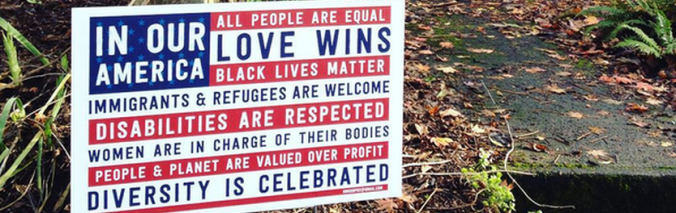
This yard sign is just about everywhere in the city including businesses, churches, schools, and city offices.
This one is also popular. I love how the “Science is real” part is in green.
Black Lives Matters signs often accompany the 2 above. Also on businesses, schools, etc.
This one is mostly on businesses/community centers but some residents have this sign taped to their living room windows.
What’s most interesting is that all the problems this town suddenly has with “hate” came after the anti-Trumpers started putting these signs up. I told a (former) friend that I thought these signs were virtue signaling and devisive and smug I didn’t appreciate that every day everywhere an average citizen can’t take a walk or go to the gym without knowing the political opinions of the home/business/agency owners.
She promptly quoted Eleanor Roosevelt’s “No one can make you feel inferior” mantra. Funny enough she’s white, I’m not, and instead of actually listening to me, you know as a special downtrodden minority, she dismissed my concerns altogether about how such signs may negatively affect a community (and then she cut me out of her life. Yep, so tolerant). Continue reading →
Once again, a Hollywood film has political correctness furies attacking its casting. This time, it’s the sci-fi “Ghost in the Shell,” starring Scarlett Johansson.
The sad fact is, movie makers can’t win. If a black actor isn’t cast to play a white character in the source material, Hollywood is engaging in bias by eschewing “non-traditional casting,” which is necessary to remedy de facto segregation and prejudice in movies. If Charlton Heston is cast as a Mexican, as in “Touch of Evil,” it’s “whitewashing”—prejudicial and racist casting of whites to play non-whites. Of course, when Morgan Freeman, an African American, is cast to play a dark skinned Semitic character in “Ben Hur,” nobody calls that “blackwashing,” for there is no such thing as blackwashing. Casting Denzel Washington as a white character from “The Pelican Brief”: great! Who doesn’t like Denzel? Casting Denzel as the white hero of “The Magnificent Seven” in the remake, when the white hero was non-traditionally cast with the sort-of Eurasian Yul Brenner in the original, was also great, because—who doesn’t like Denzel? Casting Andy Garcia, a Cuban-American, as member of the Italian Corleone family in “Godfather III” was also fine and dandy, but not the casting of sort-of Eurasion Brenner as the King of Siam in “The King and I,” (even though he won the Tony and the Academy Award for an iconic performance)—, especially with all those great Thai musical comedy stars available. So that was–what, “sort-of-whitewashing”?
All right: how about a musical conceived with the novel conceit of having the Founding Fathers played by young black and Hispanic performers? Is that non-traditional casting? Minority-washing? Is it racist to stay with the original (brilliant) concept and tell white actors they can’t audition to be Hamilton, Jefferson, and Aaron Burr? Of course it’s not racist. After all, those actors are white. Screw ’em.
Are you seeing a theme here? Neither am I. What matters in casting a play, film or writing an adaptation is whether the final result works: How well do the actors play their roles? Is it entertaining? Does it make money?
Now the casting of Johansson as an originally Japanese character in a Japanese manga comic and animated film is being attacked as racist. Whitewashing, you know. No, in fact the words applicable here are “adaptations,” “movies,” “cultural cross-pollination” and “commerce.” In this case, not always, but in this case, the accusation of “whitewashing” is pure race-baiting.
More than forty years ago, the real life German prison camp escape engineered by captured WWII British fliers was made into the film “The Great Escape.” Brits were annoyed as production got underway, however, by the presence of heroic American prisoners in the cast, the characters played by U.S. stars James Garner and Steve McQueen. This was, British critics and veterans said, an outrage: Americans had nothing to do with the real escape. The answer by the producers contained three segments:
1. We own the film rights, and can do whatever we think will make the best movie.
2. The film is fictionalized, and makes no representations to the contrary.
3. Garner and McQueen will ensure that the film makes a profit in the U.S, plus they are both great and entertaining young stars.
Good justifications all. “The Great Escape,” as we now know, is a classic, still honored the real event, and made lots of money. Somehow, British self-esteem recovered.
The Brits also didn’t complain when Japan’s great film auteur director, Akira Kurasawa, made an all-Japanese cast adaptation of “King Lear,” which is about a Celtic king. Wasn’t this–what, “yellow-washing”? Don’t be silly: all good stories can be told in myriad ways, in many cultural contexts. “Ghost in the Shell” is a science fiction fantasy. It is not about real people, and the characters were Japanese because the author and intended audience were Japanese—you know, like the original “King Lear” was in Elizabethan English.
“Ghost in the Shell” director Rupert Sanders cast Johansson as the cyborg assassin named Motoko Kusanagi in the original and renamed the character “Mira Killian.” It is the “Who doesn’t like Denzel?” non-traditional casting principle, except the even more understandable “Who doesn’t like Scarlet, especially when she looks naked for much of the movie?” variation. The perambulations of critics trying to find something racist about the most obvious box office casting choice imaginable border on hilarious. At some point, actress Johansson decided it was more lucrative and fun being the next female action movie star than starring in solemn costume drama bombs like “The Girl With The Pearl Earring” and “The Other Boleyn Girl.” Since then, she has been rising as a bankable star in blockbusters like “The Avenger” films and “Lucy.” Quick: name another hot (I mean, of course, popular and bankable) female action star?
It’s a bit early for Halloween costume controversies , but the outrage machine is ever vigilant, and has provided a provocative ethics quiz, though not a difficult one if one isn’t the Headless Horseman.
Disney released a Halloween costume for kids that will allow tykes to dress up as the Polynesian demi-god Maui, a character in its new animated movie “Moana.” This is classic Disney cross-marketing, what Wells Fargo would call “cross-selling,” and what Elizabeth Warren would call “evil,” because it makes money for a big corporation. The difference is that Disney allows customers to actually purchase such products intentionally, while Wells Fargo charges customers for products without their knowing it.
Wait, how did I get off on Wells Fargo and Warren? Right: the next post. Sorry.
Back to Maui: The costume features a body-suit with thin brown material covered by traditional Polynesian tattoos, as well as a grass skirt and a plastic bone necklace. As soon as it was released on the web, the costume was attacked as racist (it’s the equivalent of blackface, critics say) and an example of cultural appropriation. Marama Fox, co-leader of New Zealand’s Maori Party, said that selling the costume is “no different to putting the image of one of our ancestors on a shower curtain or a beer bottle” while Pasifika news site Samoa Planet described the release as “cultural appropriation at its most offensive worst”. The New Zealand Human Rights Commission issued a statement calling on Disney to “listen to the views of the communities and people whose cultures their movie is based upon.“ Translation:“Bend to our will, or else.”
Activist Chelsie Haunani Fairchild argued on Facebook that Disney was encouraging a children to wear “the skin of another race.”
“Polyface is Disney’s new version of blackface. Let’s call it like it is, people,” Fairchild argued in a video.
Oh, let’s!
Your Ethics Alarms (Ridiculously Early Halloween) Ethics Quiz of the Dayis this:
Is there anything genuinely unethical about making, advertising, selling or wearing the Maui costume?
Actually, they didn’t make Clemson grovel, Clemson chose to grovel rather than teaching the proper lesson, which is that when you live in this melting pot culture, every thing it has belongs to you, and everything you bring to the pot belongs to it. Clemson’ ethical and responsible response to two students who were “offended” by “Mexican Food Night” and students wearing sombreros should have been “Oh, grow up!”
Clemson Dining’s “Maximum Mexican” night is a regular event popular among students. However, when two students took to Twitter to protest that the “#CulturallyInsensitive” food fest was offensive, Clemson officials rushed to apologize. The university also has a Irish-themed night for St. Patrick’s Day, but it might survive because the Irish missed their opportunity to become political correctness bullies and dictators.
Another student objected to the wearing of sombreros, saying, “Our culture isn’t a costume and we will not be mocked!” Once again, the correct response from the University was “shut up, you’re embarrassing yourself, and if you can’t understand this country better than that, then you really should do some nation shopping. ” Continue reading →


 Ethics Alarms