Perspective: The Trial of Nathan Leopold and Richard Loeb (1924), Clarence Darrow’s Closing Argument, And Judge Caverly’s Sentence

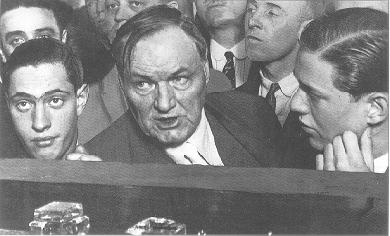
Darrow and his clients

Darrow and his clients

I just commented, on the controversial post here about Judge Boyd and the media frenzy regarding the “affluenza” defense offered by Ethan Couch’s lawyers, that the fact that so many of the comments, many of them angry, focused on the fact that a spoiled, rich kid got a break, or, as they used to say in the old days, mercy, that I began thinking about the famous Leopold and Loeb murder trial.   In 2011, I  posted a shortened version of Clarence Darrow’s famous closing argument in that trial, one of my favorite of all courtroom speeches, and it seems appropriate to do so again. It is far from a perfect parallel, but any excuse to revisit Darrow at his best is a good one.

 Nathan Leopold and Richard Loeb were, like Ethan Couch, young, rich and spoiled; they also were Jewish and gay. Their crime was  far worse than Crouch’s: they planned and executed the murder of a child just for the fun or it, and to show that they could outsmart authorities. (Ironically, they were arrested almost immediately). The two teenagers were charged with the premeditated murder of fourteen year-old Bobby Franks. Both defendants were brilliant students (Leopold, the youngest graduate in the history of the University of Chicago; Loeb, the youngest graduate of the University of Michigan),  and the sons of wealthy and successful Chicago businessmen. Neither showed any remorse for their terrible crime. There is no question that had they been poor, they would have been sentenced to die, and would have been hanged. Their parents, however, could afford to hire Clarence Darrow, a foe of capital punishment who had never had a single one of his often guilty clients executed. They got their money’s worth.

His summation on August 22, 1924, remains perhaps the most persuasive and eloquent argument against capital punishment ever made in a court or anywhere else.  It is also an argument for mercy, and especially mercy for the young. The plea worked: Judge John L. Caverly spared Leopold and Loeb, and he sentenced them to life imprisonment without parole—under the circumstances and in those days of rough justice, a gift. In his sentencing statement, which is posted here after Darrow’s summation, Caverly did not indicate that he was swayed by Darrow’s eloquence or reasoning. Caverly based his sentence on the ages of the defendants. Darrow was counting on this particular vulnerability of Caverly, who had helped establish juvenile justice courts in Chicago. Later, Nathan Leopold suggested that he and Dickie Loeb might have gotten the same result if they had simply submitted their birth certificates into evidence.

I doubt that he would have bet his life on it. The pressure on Caverly to hang these two despicable sociopaths was overwhelming, and having Clarence Darrow put his decision in such heroic terms had to steel his nerve, if it needed steeling. Still, as with Judge Boyd in the Couch case, there is no way to be sure that he would not have spared Leopold and Loeb anyway. Also as in Ethan Couch’s case, critics said this was disparate justice, bought and paid for.

This is a condensed version of Darrow’s closing,  edited for The Essential Words and Writings of Clarence Darrow, (2007),  that I co-edited with historian Ed Larson.  Here is one of the great orators of the 20th Century, one of the great progressive thinkers in our history, and the greatest trial lawyer who ever lived, arguing for the life of two murderers and for the soul of our civilization. I do not share Darrow’s absolute rejection of the death penalty, but I always do for a few hours, at least, after reading this. Continue reading

“Baghdad Bob” Dionne’s Orwellian Flackery

Baghdad Bob

There was a time long ago when columnist E.J. Dionne Jr. was legitimately regarded as the liberal twin of uber-consvervative Charles Krauthammer, a persuasive, analytical, fair, ideologically consistent political commentator. Somewhere along the line Dionne decided to recast his role as a full-time flack for the Democratic Party. His cheerleading became shrill and increasingly dishonest, often to the point of ridiculousness: James Taranto of the Wall Street Journal now regularly refers to Dionne as “Baghdad Bob,” after Saddam Hussein’s ridiculous Information Minister during the Iraq invasion, who issued straight-faced  on-air declarations that the Americans were being thrashed even as world viewers could see convincing contrary evidence in news reports, and Iraqi citizens could see the truth out their windows.

I now ignore Dionne, because he has no credibility at all. His readers must consist almost entirely of close-minded partisans on the left seeking comfort food, close-minded partisans of the right seeking an injection of adrenaline, and unsuspecting, trusting readers who don’t realizethat they are being misled. Having just finished posting here about Connecticut lawmakers passing a ban on the death penalty that is as cowardly as it is incoherent, my early morning head nearly exploded to see the headline on Dionnes’ column this morning about the same law. The headline?

“Connecticut’s Courage” Continue reading

Ethics Quote of the Month: Clarence Darrow’s Closing Argument in the Trial of Nathan Leopold and Richard Loeb (1924)

When capital punishment is in the news, it's time to listen to Clarence Darrow.

I know I have previously quoted portions of Clarence Darrow’s famous courtroom plea for mercy in the “thrill killing” murder trial of teenagers Nathan Leopold and Richard Loeb. It can never be read too many times, however, and is an essential backdrop to any discussion of capital punishment. Darrow, who hated the death penalty and defended over a hundred clients facing it, never lost a capital punishment case. This, however, was the only time he articulated why he believed that capital punishment was wrong. 

Nathan Leopold and Richard Loeb were charged with the murder of fourteen year-old Bobby Franks. Both defendants were brilliant students (Leopold, the youngest graduate in the history of the University of Chicago; Loeb, the youngest graduate of the University of Michigan), Jewish and the sons of wealthy and successful Chicago businessmen. Neither showed any remorse for their act, which had been coldly undertaken as a demonstration of their superior intellects. Darrow was hired by the Leopold and Loeb families to keep their sons from dying on the gallows, and he decided to plead their case directly to the judge.

His summation on August 22, 1924, remains perhaps the most persuasive and eloquent argument against capital punishment ever made in court or anywhere else. And it worked: Judge Caverly spared Leopold and Loeb, and they were sentenced to life imprisonment. This is a somewhat shortened version, edited for The Essential Words and Writings of Clarence Darrow, a 2007 paperback compiled by historian Ed Larson with some help from me. Here is one of the great orators of the 20th Century, one of the great progressive thinkers in our history, and the greatest trial lawyer who ever lived, arguing for the life of two murderers and for the soul of our civilization. I do not share Darrow’s absolute rejection of the death penalty, but I wouldn’t want to have to argue against him either. Continue reading

Perry, Insomnia, Leadership, and the Death Penalty

When should a leader lose sleep over a decision?

A lot of ink has been spilled over NBC’s Brian Williams’ question to Rick Perry regarding the death penalty, the Republican candidates debate audience’s strange reaction to it, and Perry’s response. Conservatives see Williams’ question—“Your state has executed 234 death row inmates, more than any other governor in modern times. Have you struggled to sleep at night with the idea that any one of those might have been innocent?”—as a loaded query by a biased questioner who is pressing the progressive anti-death penalty agenda. Liberals see Perry’s answer as proof-positive that he is an unthinking, unfeeling, blood-thirsty monster. Continue reading

The Ethics of Stopping the Condemned From Accepting Death

In Oregon, a judge has granted death row inmate Gary Haugen’s motion to dismiss his lawyers after they persisted in taking measures to block his execution. They had declared he was not mentally competent to waive his appeals and allow his own state-decreed death to proceed.

Leave it to lawyers to be convinced that they know what’s best, even when it involves someone else’s wishes about his own life and death.

Is the condemend prisoner who approves of his own excecution insane, or courageous?

In an attorney-client relationship, the lawyer is ethically bound to do what the client wants as long as it is legal and within the bounds of the ethical constraints on the lawyer. A lawyer can render advice and should; a lawyer can explain the legal consequences of a course of action. But substituting the attorney’s judgment for that of the client is taboo…except, all too often, in cases like this one, in which a death row inmate decides that letting justice take its course and accepting the state’s death decree is preferable to rotting in prison.  Continue reading

Illinois’s Death Penalty Ban: Defensible Decision, Indefensible Reasoning

Justice.

Illinois Gov. Pat Quinn  signed legislation abolishing capital punishment in the state and commuted the sentences of the 15 inmates still on death row to life in prison without parole.

I disagree with the decision, and have stated my reasons for not abolishing the death penalty here and here. Never mind: this is a topic on which ethical and reasonable people can disagree with honor. But if one is going to abolish an important law enforcement tool, the official justification for it ought to be coherent and persuasive, and not just facile rhetoric. That, unfortunately, is what Gov. Quinn gave us.

Here is the relevant segment of Quinn’s statement after signing the bill into law during a private ceremony: Continue reading

Deceit and Dishonesty in the Capital Punishment Debate

Those who oppose the death penalty on moral grounds, fervently believing that the taking of human life is always wrong, also believe, it seems, that lesser sins are legitimate tools if they can save even one condemned prisoner. The misconduct of choice seems to be intellectual dishonesty, and there have recently been some  obvious displays of it. Whether you believe such tactics are justifiable or not, there is no question that they muddle the capital punishment debate. Continue reading

Ethics Tip To President Obama Regarding the Mohammed Trial: Please Shut Up!

This is something of an addendum to the previous post, which should probably be read first.

Politico reports that in response to a question from NBC’s Chuck Todd about those who find it offensive that Khalid Sheikh Mohammed, the terrorist mastermind, will receive  the same rights accorded to U.S. citizens when they are charged with a crime, President Obama said,

“I don’t think it will be offensive at all when he’s convicted and when the death penalty is applied to him.”  Continue reading

The Death Penalty At Its Best

Virginia executed the D.C. Sniper tonight, and I am not sorry. Apparently not very many others are either: in stark contrast to past executions, like that of Gary Gilmore, anti-death penalty protests regarding the execution of John Muhammad have been minimal.

A responsible society is obligated to have a death penalty to set an appropriate upper limit for state imposed punishment. Without such a ceiling, the punishment for every other crime must be ratcheted down, and this tends to lower the penalty for capital crimes as well. The Lockerbie Bomber would never have been released after a short prison term in the U.S., as he was by Scotland; in all likelihood, he would have been executed. As with Ted Bundy, Timothy McVeigh, and Muhammad, it would have been a case of the punishment fitting the crime. Continue reading