Leadership Trust: Is This Finally The Public’s Tipping Point On President Obama?

giant-jengaTipping points are events that establish major shifts in public attitudes and the culture, and what determines a tipping point varies from circumstance to circumstance. When the switch is flipped on public trust, a leader is done for, at least in a democracy. This is why, in a parliamentary system,  prime ministers call for elections at such times, or even resign. It’s a tradition the U.S. might do well to consider.

The tipping point on the George W. Bush presidency was glaringly obvious: it was the botched handling of Hurricane Katrina, even though that particular fiasco was mostly an example of effective  blame-shifting by New Orleans mayor Ray Nagin. Bush had already accumulated many legitimate reasons to doubt him, but the traditional American eagerness to like and trust whoever holds the same job as Washington, Lincoln and FDR had kept his presidency afloat…until it drowned in Katrina. All was downhill from there.

Interestingly, nobody at the time argued that Americans should support the lousy response to Katrina because not doing so would cripple the Bush presidency going forward. But I digress..

Now it appears that the Obama proposal/decision/ argument—who knows what it really is?—to engage in a limited missile attack on Syria may be the public tipping point on Obama’s leadership, the moment when the veils fall and the nation reluctantly but decisively admits that the man it elected—twice—as its leader cannot be trusted. If so, it is remarkable this took so long, testimony to how much we all wanted our first African-American President to succeed. The tipping point for me was years ago. Following the Bush experience, I thought that the bungled government handling of the Gulf oil spill would clinch it, but no. Then came the Benghazi mess, with an ambassador and other Americans murdered without any decisive response other than deceptive spin and obfuscation to avoid electoral consequences—the I.R.S. tea party harassment (still being investigated, and looking worse all the time)—the NSA revelations, and the growing evidence that while the Affordable Care Act may not be the cataclysmic socialist disaster conservatives claim it is, it is also far from what the President promised. No tipping point though, until Syria, and the consequences flowing directly from the President’s undisciplined off-the-cuff rhetoric—a constantly repeated flaw in his leadership style.

Now, as tipping points do, this current controversy is resuscitating all of the past incidents, and serving as the catalyst for a reappraisal of Obama’s leadership. The looming conclusion is that he cannot be trusted.

Occasionally am beaten to the punch by a pundit or blogger who delivers an essay that says exactly what I was preparing to write, even as I was almost finished writing it. Such a pundit is Forbes contributor Merrill Mathews, who delivered an article on that publication’s website over the weekend, titled “What Happens When You Can’t Believe A Thing The President Says?” (My title was going to be “When Trust Is Gone”).

Some key quotes from the article: Continue reading

“Don’t Worry! We’ve Got Your Back!” Markey’s Indefensible Cowardice and Cillizza’s Inexcusable Bias

Some Senators are Red, and some are Blue. Then there's Ed Markey...

Some Senators are Red, and some are Blue. Then there’s Ed Markey…

Massachusetts Senator Ed Markey, who is at least temporarily filling John Kerry’s seat in the U.S. Senate, listened to the testimony and questioning regarding President Obama’s embarrassing plan to attack Syria just enough to kill a few people and be annoying (to prove he really, really meant what he said about that red  line), and then cast his vote on the Senate Foreign Relations Committee’s compromise resolution approving the attack as “present.” Why? Well…

1. He’s a long-time Democratic loyalist from the House, and would no more oppose a Democratic president than fly…

2. He’s from peacenik Massachusetts (just like me!), and he knows that in the only state to give George McGovern its electoral votes, voting to drop missiles on foreign land that haven’t attacked us first is very unpopular, and…

3. He’s a lily-livered coward and a disgrace to his state.

Markey is also a liar, as his ridiculous “explanation” for his abdication of responsibility shows: Continue reading

Case Study In How Bias Rots Integrity: Washington Post Columnist Harold Meyerson

You see, Harold, this is your brain on bias. Yes, I know it looks yummy...

You see, Harold, this is your integrity on bias. Yes, I know it looks yummy…

Back in the run-up to the Iraq invasion, I exchanged some e-mails with Harold Meyerson, the left-est of the Post’s op-ed liberals. He had been condemning the Bush administration’s decision to go to war against Iraq—we were technically still at war with Iraq, since no peace terms had ever been agreed upon from the previous war, and Saddam was blatantly violating the terms of a cease-fire, but never mind—saying, among other things, that this was the first time in American history that the nation had embarked on a “war of choice” rather than necessity. This was a popular, and ignorant, “talking point” used by the anti-war critics at the time, and I was thoroughly sick of it being shouted in CNN debates without any objective participant protesting that it was a lie. I pointed out to the columnist that this was historical fantasy clothed as fact, and that he owed his readers better.

Most U.S. wars have been “wars of choice,” I wrote, and presumably Meyerson knew this. Arguably only the War of 1812, World War II and Afghanistan didn’t fit that description. The Revolution wasn’t a “war of choice”? Of course it was….most of the country would have been happy to stay subjects of the Crown. The Mexican War was not merely a “war of choice” but a war of “let’s trump up a reason to take away all this land belonging to Mexico” war.  Lincoln certainly didn’t have to oppose the secession of the Southern states and start the Civil War; indeed, the best Constitutional analysis is that he was acting beyond his authority to do so.The Spanish-American War? World War 1? Korea? Vietnam? Granada? Desert Storm? What country was Meyerson talking about?

To my surprise, Meyerson replied, politely and, I thought, a bit sheepishly. Yes, he said, of course you are right, but this war is more of a war of choice than those were. Translation:I oppose this war, and the party of this President, so I’ll say whatever is necessary to get people to agree with me, and I’ll convince myself in the process.” I’ve never taken a Meyerson column seriously since. His reasoning process, like so many on the ends of either side of the political spectrum, is to frame reality in the way that most comfortably supports his ideological objective, and then to allow that warped reality to become part of his own world view. I think this kind of thought process by confirmation bias should disqualify any infected media pundits from commentary, as much as habitual dishonesty, dementia or insanity.

Today, Meyerson once again shows how his biases rot his reasoning and integrity. Continue reading

A Handbook For Manipulation and Deceit, Rationalizations Included

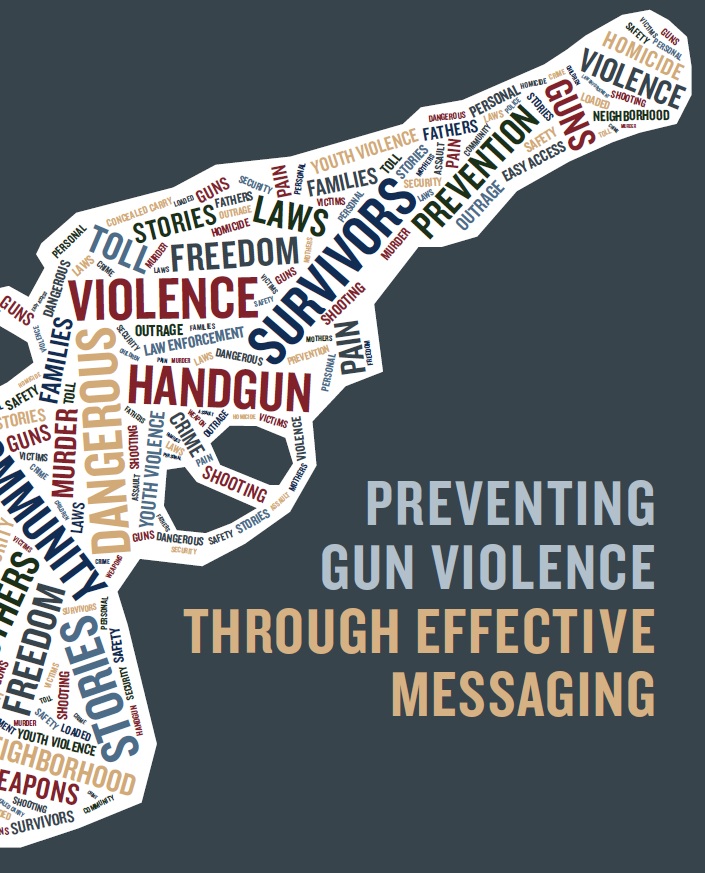
PreventingGunViolence

This wasn’t considered newsworthy by the mainstream media, and that alone is worthy of some pondering: a 70-plus page how-to guide titled “Preventing Gun Violence Through Effective Messaging” has surfaced, produced last year by the Washington, D.C.-based firm of Greenberg Quinlan Rosner.* The guide is a political strategy lesson for anti-gun advocacy, and its favored tactics involve emphasizing emotional hot-buttons over rational discourse and informative debate. The manual was produced, it appears, for the Seattle-based Washington Alliance for Gun Responsibility (WAGR) before the Sandy Hook tragedy, but its advice tracks in every way with the approach employed by Democrats, including President Obama, during the disgraceful rush to exploit public horror over the shooting in an effort to pass strong anti-gun measures in the states and nationally.

Of course this is newsworthy. The public is the target of manipulation, deception and persuasion tactics that are designed to provoke half-baked opinions and positions based on emotion rather than rational analysis. If the public recognizes such tactics as the cynical ploys they are, such tactics will not be as effective. Such tactics shouldn’t be effective, and should be employed by honest, ethical advocates on any side of any issue. The mainstream media chose not to publicize the manual because 1) most reporters agree with the manual’s objective, and 2) the mainstream media eagerly facilitated the unethical methods recommended, and will probably continue to do so.

“The debate over gun violence in America is periodically punctuated by high-profile gun violence incidents including Columbine, Virginia Tech, Tucson, the Trayvon Martin killing, Aurora, and Oak Creek,” the guide points out. “When an incident such as these attracts sustained media attention, it creates a unique climate for our communications efforts.”  Early on, the document it makes it clear that the “communication efforts” must always concentrate on stirring up emotions, not relying on facts or engaging in substantive debate. “A high-profile gun violence incident temporarily draws more people into the conversation about gun violence. We should rely on emotionally powerful language, feelings and images to bring home the terrible impact of gun violence.”

For example,  the guide addresses Stand Your Ground laws and advises substituting pejorative (and misleading) descriptions like  “Shoot First” and “Kill at Will,” asserting that these terms are “more accurate and persuasive.” At every turn, the guide cautions against getting bogged down in potentially nuanced statistics and facts, and urges anti-gun advocates to overwhelm any efforts at balancing or considering pros and cons with talking points based on  emotion salted with one-sided, group-tested statistics and generalities...”The core frame should be personal and emotional—centered on ‘people’ and not on facts, laws, or legislation.”  The top things to remember, cautions the guide,

#1: ALWAYS START WITH THE PAIN AND ANGUISH THAT GUN VIOLENCE BRINGS INTO PEOPLE’S LIVES

#2: USE STATISTICS TO REINFORCE AN EMOTIONAL ARGUMENT, NOT TO REPLACE IT.

Recommended phrases to use in forums and interviews include,

  • “It breaks my heart that every day in our country (state or city) children wake up worried and frightened about getting shot.”
  • “Just imagine the pain that a mother or father feels when their young child is gunned down.”
  • ” The real outrage – the thing that makes this violence so unforgivable – is that we know how to stop it and we’re not getting it done”

To the authors of the guide, effective persuasion “means emphasizing emotion over policy prescriptions, keeping our facts and our case simple and direct, and avoiding arguments that leave people thinking they don’t know enough about the topic to weigh in.”

That’s right, keep them ignorant and thinking that they aren’t. It’s the American way.

The guide is professional and well-thought out. It is certainly a useful document for any advocate to study before going on a talk show, or before drafting remarks at a rally, and it is obvious that this is exactly what such advocates do, if not with this document, then with similar ones. It is creepy to read line after line that is immediately recognizable as an endlessly repeated “talking point” during the Trayvon Martin uproar and the Sandy Hook aftermath. The manual also could grow cynicism on a rock. There is nothing honest or genuine about the political and policy-making process that the guide presupposes and attempts to control. There is nothing productive either. The objective is only to win—to get a desired policy initiative past the stage where public support is important and into the back rooms where the deals can be cut . You know that there was an equivalent document during the Affordable Health Care Act. These are blueprints for rushing policies into law, not for educating the public or fairly exploring complex issues before taking giant leaps of faith. They are, in short, instruction books on how to exploit the ignorance of the American people and distort the democratic process.

This is a bi-partisan practice, of course. The only difference between this guide and those produced by conservative consultants is that if one of those was found, the mainstream media would have reported it, Media Matters would have announced that it was a smoking gun document showing how evil Republicans corrupt America with their lies, and on MSNBC, Lawrence O’Donnell would have smirked over it for a week.

The number of rationalizations at the ready, therefore, begin powerfully with “Everybody does it” (#1 on the Rationalizations list). So is, as a direct result, #2, “They’re just as bad” and #7, “Tit for tat,” Such a document and the politics behind it also invokes #3, Consequentialism, and #4, Marion Barry’s favorite, “If it’s legal, it’s ethical.”  It employs # 11, the Dissonance Drag, since the reason it will be deemed acceptable by anti-gun types is because they happen to like the people using the strategy; if the same document outlined the NRA’s approach, they would sincerely and passionately feel it was despicable.

It is the very embodiment of The Saint’s Excuse (#12), otherwise known as “It’s for a good cause,” as well as #13, Self-Validating Virtue. #17,  Hamm’s Excuse or “It wasn’t my fault,” is one of the predictable responses to criticism: “Hey, this is how the game is played. We didn’t make these rules; this has been going on for decades. Don’t blame us!”  My least favorite rationalization of all, #22, Comparative Virtue,  “There are worse things,” is also in play; so is “We have no choice” (because the evil NRA keeps buying legislators and rational debate doesn’t work!), # 24#27, “These are not ordinary times!” is a natural, of course.  So is #30, The Troublesome Luxury, usually expressed as “Ethics is a luxury we can’t afford right now!”

Politics being politics, it’s perfect for #31, The Unethical Role Model, as in “Thomas Jefferson/Abe Lincoln/ Jack Kennedy would have done the same thing.” Heck…A new book suggests Jesus might have done the same thing!

Fourteen out of thirty-two possible rationalizations is an impressive arsenal, all right, but they are still rationalizations for what is a Machiavellian, “the ends justifies the means,” “by any means necessary,” unethical strategy that intentionally aims at the weaknesses of democracy and exploits them through the cynical use of psychology, manipulation, and deceit. Yeah, I know, it works, just as so many methods used by governments and interest groups to deceive the public and warp their perceptions have worked and work still.

That’s not really working, though, is it now? Causing a system designed to involve an informed and rational citizenry  to malfunction by exploiting laziness, ignorance and hysteria isn’t working, just because it succeeds. In fact, such tactics result in the kind of politics and government we have right now.

That is called, not working, but failing.

* According to the guide, Quinlan was part of “a team of communicators” with “decades of experience advising organizations on message development and strategic communications.” Other members of this team were Frank O’Brien, creative director and founder of OMP, another Washington, D.C.-based firm, and Jeff Neffinger and Matthew Kohut at KNP Communications, also headquartered in Washington, D.C. Among GQR’s clients are the Mayors Against Illegal Guns, the Joyce Foundation, several state education associations, Defenders of Wildlife, National Public Radio and the Sierra Club. Among OMP’s clients are Planned Parenthood of America and the Natural Resources Defense Council.

_______________________________________

Sources: WSJ, Washington Examiner, Examiner

Virginia Governor Bob McDonnell On How To Sound Like A Crook

Why is this man smiling?

Why is this man smiling?

I posted earlier on the blatant violation of basic conflict of interest principles (not to mention de facto bribery) by Virginia Governor Bob McDonnell (R). Following increased criticism and talk of forcing him to resign, McDonnell announced on his weekly radio show (“Ask the Unethical Governor,” or something like that) that he was returning the many gifts and repaying the loans that came to him and members of his family from Star Scientific chief executive Jonnie William.

His comments read like a primer on how to sound like a slippery and dishonest politician, which, it seems clear, he is. Here are  some highlights, with my comments in bold: Continue reading

Ethically Depressing Quote Of The Week: NBC News

“It’s unclear if his latest admission will hurt his standing with voters.”

—-NBC News, after revealing on its website that New York City mayoral candidate Anthony Weiner, who resigned from Congress in 2011 amid a sexting scandal, admitted today that there were more episodes like the one that forced his resignation.  He issued the statement after a gossip website published an interview with an anonymous woman who claimed she had a six-month online relationship with him that continued after his earlier online activities were, uh, exposed.

The once and future studmuffin...

The once and future studmuffin…”Mayor Studmuffin?” Really, New York?

Weiner’s  statement was Clintonian with heavy dash of weasel, saying,

“I said that other texts and photos were likely to come out, and today they have. As I have said in the past, these things that I did were wrong and hurtful to my wife and caused us to go through challenges in our marriage that extended past my resignation from Congress. While some things that have been posted today are true and some are not, there is no question that what I did was wrong. This behavior is behind me.”

Note: Weiner also said the behavior was behind him when he resigned. (Actually, based on the photos, the behavior is clearly in front of him.) Given his talent for Clintonesque  deceit, perhaps he means that all past behavior is behind him, since he’s talking in the present, and only future internet flashing is ahead of him.

Whatever. Continue reading

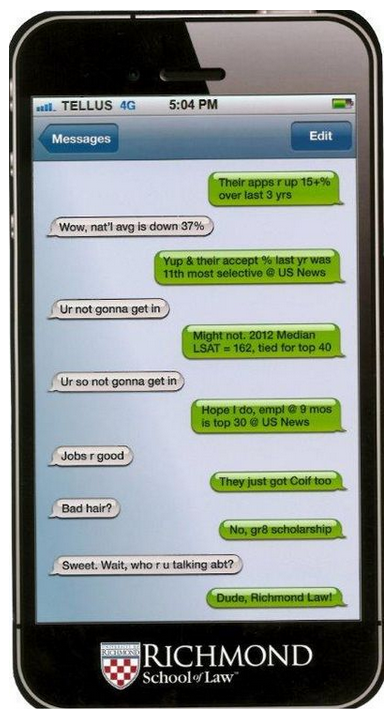
Ethics Quiz! Richmond Law School’s “Cool” Ad: Lame, Deceitful…Or Just Advertising?

Richmond ad Richmond-Law-ad

So, what do you think? Such esteemed legal commentators as TaxProf Blog and Above the Law have mocked and condemned the above Richmond Law School ad directed at law school applicants deciding where to plant their hopes. “The clubhouse leader for the lamest law school ad of 2013” snarked the former. “Calling it “lame” or “uncool” or “hackneyed” or any of the other words in the English language that denote a distinct inability to appear genuine or interesting doesn’t do the ad justice,” declared the latter. Then there is the little matter of puffery, which usually means deceit, spin, or exaggeration, except that in advertising such lies (for that is what they are) are mostly accepted as part of standard practice. That employment within nine months stat cited is dubious in the judgment of those who feel only legal jobs should count–apparently Richmond Law includes jobs where a JD is considered an asset, but the graduates are not working as lawyers. (On the other hand, almost every  job I’ve had since I graduated from laws school has been in the “JD advantage” category, and I’m satisfied with the results.) Continue reading

Slate Gives Us A Lovely Example Of Deceit

Deceit_Cvr_CMYK

Thanks, Slate!

A lot of people have trouble with the concept of deceit, which is the intentional use of apparently true statements to deceive. Now I have a wonderful example to give them, thanks to Slate’s use of the most sneaky of lies as its recent contribution to the Post Sandy Hook Ethics Train Wreck, Media Anti-gun Propaganda Division.

Slate compiled a list it called “How Many People Have Been Killed By Guns Since Newtown,” and illustrated it with an “infographic.” The list was widely used in the current “those crazy Republican gun nuts have blood on their hands” campaign led by the President, the Vice President, Mayor Bloomberg and others.  The list is unreliable, however, as an advocacy device, since one of the names it includes is Boston Marathon terrorist Tamerlan Tsarnaev, killed in a shootout with police. How many other gun casualties are on the list that are perfectly justified, legally and ethically, unless one is an anti-gum absolutist who thinks neither the police nor other law enforcement should have access to firearms either? Quite a few, it turns out.

The only explanation for including Tsarnaev (and the others) is to mislead the public and inflame fear and passion by maximizing the raw number of names on the “shooting death list.” Yes, this is literally an accurate (I guess) list of every gun death since Newtown, but if the purpose of the list is to dramatize the need for anti-gun measures in the wake of the Sandy Hood shooting, why is a Boston Marathon child-killer on the list? What does his death have to do with the defeat of gun-control legislation in the Newtown aftermath, or the Newtown massacre generally? Nothing…except that it inflates the number, to be used in fear-mongering and misrepresentation. And that is exactly how Slate’s list is being used…as if it didn’t know. Those defeated, Newtown-inspired anti-gun measures would not have have saved the terrorist, nor does anyone sane wish they could have. Continue reading

The NSA Scandal: And THIS Is Why We Can’t Trust The Government

Businessman Crossing Fingers

From Tuesday’s House Intelligence Committee hearings on the NSA domestic spying issues:

Rep. Mike Rogers, R-Mich., Chairman: “Does the NSA have the ability to listen to Americans’ phone calls or read their emails under these two programs?”

NSA Director General Keith Alexander: “No, we do not have that authority.”

That’s right. Alexander not only didn’t answer the question that was asked: he answered a different one, with a “no,” that would make the casual listener believe that the answer to the question that was asked was also “no.”

Meanwhile, neither Rogers nor anyone else on the committee stopped him, corrected him or  asked again whether he had the ability, not the authority, to “listen to Americans’ phone calls or read their emails under these two programs.”

I have the ability to throttle my neighbor to death with a bat, but not the authority. I have the ability to have wild tempestuous adulterous affairs, but not the authority.

The fact that the head of the NSA would pull a verbal sleight of hand like this before Congress is proof, in my mind, that transparency in this administration is neither its intent or manner. Its intent and manner is deception and obfuscation.

The fact that Congress, even when such a ploy is pulled before its eyes on national television, is either so complicit or so dim-witted that it doesn’t insist on candor on behalf of the American public it purports to represent is, one way or the other, disheartening and disgraceful.

_________________________

Pointer: Shep Smith

Facts: International Business Times

Ethics Quote of The Week: Washington Post Blogger Jennifer Rubin

“How about this for a new communications plan: No one investigates themselves. No one take the Fifth. No executive privilege is asserted to protect anyone in the White House from testifying. Everyone tells the truth. And Holder goes. Otherwise it just looks like more spin and more prevarication from a White House determined to do everything but tell the truth, the whole truth and nothing but the truth.”

—-Washington Post conservative blogger Jennifer Rubin, discussing the Obama Administration’s defensive and evasive posture in response to the various scandals within.

Good sign!

Good sign!

I was torn about how best to raise the issue of why Eric Holder’s removal as Attorney General is an ethical imperative. Labeling President Obama an Ethics Dunce in his ridiculous decision to leave the investigation of Holder’s conduct in the various news media investigations to the Justice Department itself was fair, but obvious. Noting the apparent dishonesty of Holder’s denial to Congress that he was involved in the surveillance of James Rosen—

“In regard to potential prosecution of the press for the disclosure of material — this is not something I’ve ever been involved in, heard of, or would think would be wise policy.”

—-seemed too easy, and I also do get tired of the word-parsing employed by the seemingly impenetrable Obama defenders here, for which this would be blood in the water. Continue reading