How the Lack of Ethics Cripples Democracy, Reason #2: Corporate Executive Greed


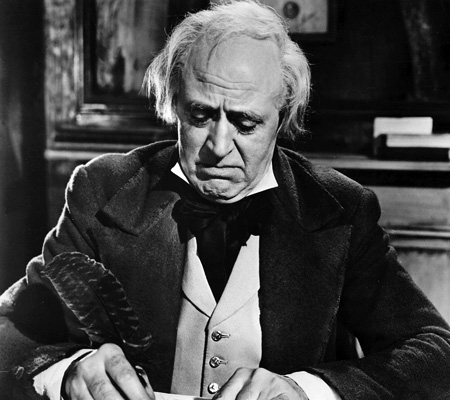
"Let's see...that's one schilling for Cratchet, 280 for me..."

The average compensation for chief executives of the 500 largest U.S. corporations is going up again.

According to Governance Metrics International, the average compensation for the CEOs, including salary, bonus and benefits plus the exercise of stock options, the vesting of stock grants and retirement benefits, was just under $12 million in 2010, up 18 percent from 2009. As Washington Post business writer Steve Pearlstein observes in his column this week, if you believe this is justified by market forces and common sense, “then you must also believe two things: First, that none of these guys would do the same job for a nickel less. Second, that the value of the chief executive went up 18 percent last year while the value of average workers in their companies changed very little.”  “And,” concludes Pearlstein, “if you believe that, you are a fool and an ideal candidate for an open seat on an S&P company board of directors.” Continue reading
Unethical Quote of the Week: U.S. Secretary of State Hillary Clinton

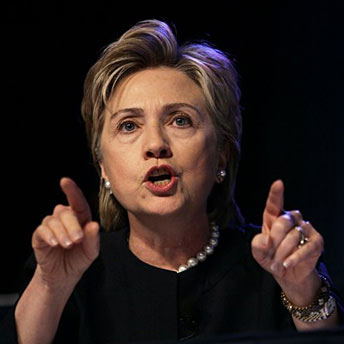
Hillary said something unethical? I'm shocked! Shocked!

“But the bottom line is, whose side are you on? Are you on Qadhafi’s side or are you on the side of the aspirations of the Libyan people and the international coalition that has been created to support them? For the Obama Administration, the answer to that question is very easy.”

—–Obama Administration Secretary of State Hillary Clinton, responding in a press conference to Congressional objections that the U.S. continued participation in attacks on Libya violates the War Powers Resolution—which it undoubtedly does.

Most of the objections to Sec. Clinton’s comments focus on her apparent hypocrisy; after all, this is the same woman who as a U.S. Senator in 2003 objected to “are you with us or against us” rhetoric from the Bush Administration regarding the Iraq war by saying,  “I am sick and tired of people who say that if you debate and you disagree with this administration somehow you’re not patriotic. We should stand up and say we are Americans and we have a right to debate and disagree with any administration.” But this isn’t necessarily hypocrisy: Hillary has a right to change her mind. What is unethical about her statement on Libya is that it is manipulative, unfair and dishonest. Continue reading

Sorrell v. IMS Health: Legal, Ethical, and Unjust

The case of Sorrell v. IMS Health, which the Supreme Court decided yesterday, sharply focuses the philosophical disagreement over the role of the courts in public policy. The legal question was rather straightforward; the ethical issues are complex. Is it the Court’s duty to make bad—but constitutional— laws work, or is its duty to follow the laws, and leave it to the legislature to fix their flaws?

This was a case about incompetent  lawmaking. Gladys Mensing and Julie Demahy had sued Pliva and other generic drug manufacturers in  Louisiana and Minnesota over the labels for metoclopramide, the generic version of Reglan. The drug, used to treat acid reflux, had caused them to develop a neurological movement disorder called tardive dyskinesia. None of the generic drug’s manufacturers and distributors included warnings on the labels about the danger of extended use of the medication, even though the risk was known to them. Neither did the manufacturers of the brand-name drug. The problem was that the state statutes required generic drug manufacturers to included warnings about dangerous side effects, while federal regulations required generic drugs to carry the exact same label information as their brand name equivalent.  Continue reading

Ten Lessons from the “Dog Wars” Debate

Wait! Calm down! This is a CARTOON dog.

The “Dog Wars” Android phone app is apparently down for the count, the victim of too many complaints, threats and accusations that it was evil and irresponsible and promotes real, live dog-fighting, even though almost nobody sane makes similar claims about other video games. As with the subject of most posts on Ethics Alarms, however, the ethics issue lingers on, whether or not the specific incident that sparked the commentary has been resolved.

The comments, often passionate, that this post elicited have been fascinating, and had much to teach, even when the comments themselves were dubious. Here are ten lessons from the debate over the game and the Ethics Alarms commentary about it.

1. Ethics alarms aren’t always right. So many comments about “Dog Wars”, here and around the web, consist of various versions of, “That’s just wrong!” Well, why is it “just wrong”? Continue reading

Would It Be Ethical To Prohibit Civicly Ignorant Citizens From Voting?

CNN columnist L.Z. Granderson made the argument in a recent website post that it would be reasonable to deny the right to vote to ignorant Americans who cannot name the three branches of government and who have nary a clue about the issues facing the country .

Granderson could have saved some time by simply writing the undoubted truth that American policies, progress and choices of leaders and are greatly handicapped by the fact that lazy, uninformed, blissfully ignorant boobs warp our democratic process….and have almost from the beginning. But so what? What can be done about it? There is one thing for certain: taking away the right to vote based on someone’s subjective formula for measuring “ignorance” isn’t among the realistic—or ethical—solutions. Continue reading

Are Citizens of Warring Nations “Innocent”?

No.

“Innocent” and “civilians” apparently go together like a horse and carriage, if one is to believe the cliché used with increasing regularity by journalists, bloggers and even elected officials. The instance that finally provoked me to write about the irresponsible acceptance of this falsehood was the gratuitous appropriation of it by a sportswriter, who, if I understand him correctly, feels the United States has no standing to object to baseball star Barry Bonds’ lying and cheating because it dropped atom bombs on “innocent civilians” in Hiroshima and Nagasaki. (The sportswriter neglects to mention that these act occurred during wartime; perhaps he doesn’t know.) The exoneration of civilian citizens for the acts of their governments is a relatively new phenomenon, one happily endorsed by the habitually politically correct. It is untrue, and it is time to blow the whistle. Ethics foul. Continue reading

Exceptionalism and the United States of America’s Grand Ethical Dilemma

Today’s morning headlines were full of violence in Syria, Bahrain, Libya, and the threat of new conflict in Egypt, as popular uprisings against entrenched dictatorships continue to grow. As the U.S. tries to somehow avoid a lead role in the international intervention in Libya, the question looms regarding its responsibility to other nations whose people yearn to be free—or at least freer. As important as what America ultimately decides to do will be for the futures of these nations, the U.S. economy, and foreign relations, something far more important is at stake. These difficult choices once again challenge the United States to affirm or reject its ideals, the very essence of what has made America what it is.

We have come to these crossroads four times before. Continue reading

Comment of the Day: “Ethics Carnage in Wisconsin: The Ethics Grades So Far”

Commenter Glenn Logan argues that President Obama’s C- Ethics Grade in the post is too high. Here is his Comment of the Day, on the post “Ethics Carnage in Wisconsin: The Ethics Grades So Far.”

“I think that Obama is getting grade inflation here. Obama was elected to lead all Americans, not just unions.

“While Walker’s position and comments may be imperfect, and Obama is certainly within his rights to disagree, it is his duty to all Americans to at least take the other side into account. Presidents who are entirely partisan are poor presidents, and in this instance, a C- is unfairly high.

“Combine that with his pronouncement to Republicans after he was elected that “Elections have consequences, and I won,” and in my view, you have an ethics train wreck.  This is as two-faced and unfair as it is possible to be, and dispatching his political organization to inject an even more partisan impact into the problem and the best grade I could give him is a D-.”

Ethics Carnage in Wisconsin: The Ethics Grades So Far

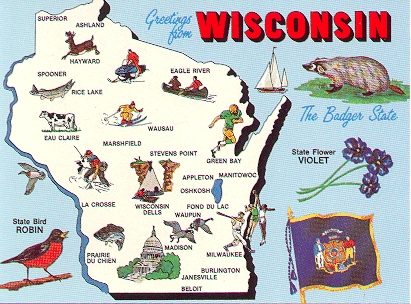
The battleground

The story to date: Wisconsin’s Republican Gov. Scott Walker announced a budget-repair measure to address  looming budget deficits (in a state with a balanced budget mandate in its constitution) by requiring state employees to contribute a larger proportion of their pensions and health care plans, and  restricting their long-standing  collective bargaining rights. Wisconsin’s deficit is projected at $30 million for the remainder of the 2011, with a shortfall of $1.5 billion projected for next year. In response to Walker’s announcement and the near certainty of his plan being passed by the Republican dominated state legislature, 14 Democratic legislators fled the state to prevent a quorum and block a vote, teachers left their classes to protest in Madison, where they were joined by thousands of pro-union protesters, many of whom were organized and bused in by Organizing for America, a White House operated political group.

Let’s try to separate the ethics wheat from the chaff—amazingly, there is actually some wheat–and get an early line on the heroes, dunces, villains, and the rest as the Wisconsin budget battle threatens to become a full-fledged Ethics Train Wreck. Continue reading

Egypt Ethics: Integrity Deficit on the Right

It has been fascinating and troubling listening to conservative radio talk-show host Mark Levin lambast fellow conservatives who have been siding with the revolutionaries trying to end the 30 year rule of Hosni Mubarak in Egypt. Levin argues that such support is foolish and ignorant, because there is no way for the United States to be sure that the resulting new government, even if it is more democratic than the current one (hardly a difficult bar to clear), wouldn’t be worse for the interests of the United States. Continue reading