…but he felt really guilty about it, so that’s OK.
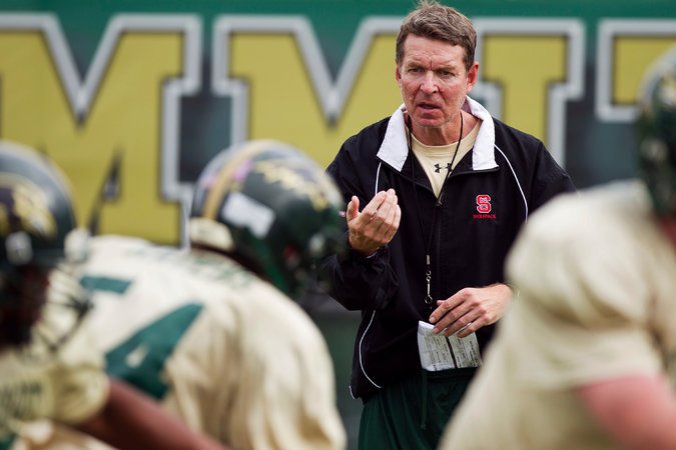
The New York Times had a very strange sports story yesterday. Its subject was the late Don Horton, a prominent assistant coach at Boston College and North Carolina State for nearly 20 years who was diagnosed with Parkinson’s disease but was also experiencing symptoms linked to chronic traumatic encephalopathy, or C.T.E., a degenerative brain disease caused by repeated hits to the head strongly linked to football. The sensitive reporter, Bill Pennington asks,
“Was his deteriorating health, Horton wondered, a consequence of his many years as a football lineman?” Even worse, he worried, was he responsible for exposing hundreds of players to the kind of head trauma now impairing his life? After all, as he had recruited and encouraged scores of athletes to play major college football….There was only one way to be sure if he had C.T.E. His brain would have to be examined post-mortem, the only way to confirm the disease since there is no reliable test for the living. At first Horton balked, but as his cognitive difficulties intensified, he relented and even insisted that the findings of his brain examination be made public.”
The Times article makes this sound like a noble and brave resolution of his crisis of conscience. It was not, however. Having his brain dissected after his death was no sacrifice at all; Horton would be dead, of course. In the meantime, Horton, despite his symptoms and his wife’s investigation into them, continued sending young men out to get their brains beat in.
We learn,
In 2009, seven years before Horton died, [Horton’s wife] called Chris Nowinski, a co-founder and the chief executive of the Concussion Legacy Foundation, and told him that she thought her husband had C.T.E. She also raised her suspicions with Horton’s doctors, but they said that, even if true, it would not change the course of his treatment.
Horton continued his duties at North Carolina State.
“He never missed a day of work and still produced great offensive linemen,” said Jason Swepson, an assistant coach at North Carolina State at the time. “You could see him struggling sometimes, but he never opened up about it because, I think, he didn’t want to feel like he was letting the group down.”
At home, however, Horton’s illness was leading to a variety of changes, physically and philosophically. His daughters, Libby, 14, and Hadley, 9, had begun playing soccer, but Horton pointedly refused to allow them to head the ball in games or in practices, aware that some studies had linked heading to brain injury.
“Don told them, ‘If I ever see you head the ball, I’ll run onto the field and yank you off myself,’” Maura said.
Although Horton kept his misgivings about football’s potential consequences within his household, he talked about it regularly.
“Don would ask, ‘Are we just carrying this cycle on?’” Maura Horton said. “That was a question I couldn’t answer. But it’s definitely the right question to ask.”
It’s not just the right question to ask, it was a question with an obvious answer, and both Hortons knew it. YES he was just carrying the cycle on. YES, he was continuing to coach college players when he had first-hand, personal knowledge of the horrible fate in store for some or many of them as a result, and said nothing. “Was he responsible for exposing hundreds of players to the kind of head trauma now impairing his life?” If he refused to let his daughters head the ball while playing soccer, we know he was responsible, and so did Coach Horton. Was he in denial? Was he willing to let his player risk crippling cognitive impairment because he wouldn’t and couldn’t give up the only job he knew? Why does the Times suggest that there was any question about his culpability or breach of duty?







 Ethics Alarms
First time commenter Aleksei!
A sample:
The challenge was issued on November 3rd, and my intention was to publish the winner on the 6th, two days before the election. There were not many entries, in part because Aleksei’s analysis was so quickly posted and thorough. In the frantic run-up to the election, including my own resolution of the many conflicts the choice represented for me professionally and personally, I just forgot to publish Aleksei’s work, and then moved on to other issues in the election.
I apologize to Aleksei and Ethics Alarms readers.
It certainly is weird to read the article and the analysis now. It was written only two weeks ago, but it feels like a lifetime ago. The election was the ultimate rebuttal of the essay’s argument—if Hillary really was “so widely loved,” she’d be President today—and the kind of mindless worship and relentless denial the piece displays was a large factor in her defeat. It is bracing to read this in light of the efforts by the Clinton team, Democrats, and various pundits to absolve Clinton and the party from all accountability for the most stunning upset in presidential election history. Hillary blames the loss, predictably, on James Comey, which is like blaming the loss of your license for speeding on traffic cops. On MSNBC on this week, former Clinton campaign communications director Jess McIntosh put the blame on white women with “internalized misogyny,” who couldn’t bring themselves to vote to elect the first woman president. Then there was the narrative that Trump’s win was based on massive support for “Misogyny, Racism and Xenophobia”—good names for triplets, now that I think about it. Slate’s star race-baiter, Jamelle Bouie, wrote that there is “no such thing as a good Trump voter.” To paraphrase the hysterical woman who gives “The Birds” its funniest moment, Bouie thinks everyone who didn’t vote for this beloved woman is “Evil! Evil!”
I don’t necessarily agree with all the analysis of the winning submission, but he was willing to slog through the Atlantic’s disingenuous mess, and Ethics Alarms is grateful.
Here then, late, is the winner of the first Ethics Alarms Readers Challenge:
Continue reading →