Ethics Alarms Recap: A Long Weekend of Ethics

If the long Presidents Day weekend took you hither and yon and away from ethical dilemmas and controversies, welcome back! Here is what went on here in a lively three days:

The Broadcast Media’s Golden Rule: “Do Unto Others What You Will Use Cronyism To Stop Others From Doing Unto You”

Two Denver TV stations are feuding, and why? Because one of them refused to allow the other to suppress news footage that was embarrassing to a news anchor.

On February 8, KUSA-Channel 9 news anchor Kyle Dyer was interviewing the owner of Max, an 85-pound Argentine Mastiff, and the firefighter who had rescued the dog from an icy pond. I saw the video. Dyer had me wincing throughout the interview, showing herself to be the most dangerous kind of dog lover, someone who is fond of animals but naive and ignorant about their behavior.  She kept rubbing the dog’s ears and face during the interview, and the mastiff was obviously stoic but stressed by the strange environment, the cameras, and this women talking and running her hands all over him.  Mastiffs are gentle dogs, but very shy;  it was clear to me that Dyer was not according sufficient respect and caution to a powerful creature. As the interview ended, she suddenly moved in to kiss the dog on the muzzle, and the dog reacted defensively, biting her on the face and taking off part of her lip. She was seriously injured, and she had to have 75 stitches. Continue reading

Please Kill My Dog

“The Ethicist,” whom I have not harassed for a while, a.k.a Ariel Kaminer, handles this week an odd query from a woman who has been asked by an elderly friend to pledge to euthanize her dog after she dies. Kaminer, as she often does, makes the issue more complicated than it is and muddles things by implying some kind of inconsistency on the part of pet owners who find the request unethical but who will dine on cooked animal flesh this evening. She even had to consult Peter Singer, the controversial Princeton ethicist, about whether an animal has a “right to life.”

Every living thing has a right to life, and also a right to live, which is why eating other animals as humans have evolved to do is not incontrovertibly  unethical. Killing an animal just because you can, or because it makes you happy, or because you have convinced yourself that it wants to die when in fact it doesn’t, however, is incontrovertibly unethical. Continue reading

Affronts to Animal Dignity

"Boy, will you look at those idiots watching this? Where is their sense of dignity?"

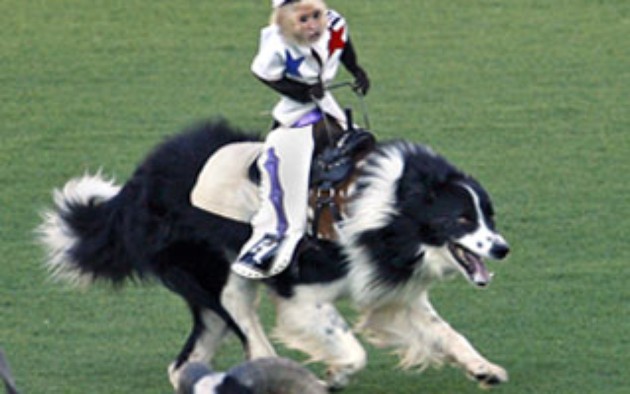
The Washington Post recently published a photo of an oddball attraction at a minor league baseball game in Harrisburg, PA. A capuchin monkey, garbed in jockey attire, was riding a border collie—really, really stupid, though “really stupid” is the frequent standard of minor league baseball promotions generally. This means that when a club executive suggests, “Hey, howzabout we have some monkeys riding on dogs, like in little saddles?” and the response from the management team is, “That’s really stupid, Ed,” he’ll say, “Great! Then it’s a go!”

I found the picture rather grotesque, but it never occurred to me that the gimmick was unethical. Oh, I assumed that PETA would find it unethical, but PETA believes it’s unethical that animals aren’t allowed to vote.  Several indignant readers wrote to the Post, however, protesting that the photo was “offensive” because it celebrated unethical conduct, the conduct being, apparently,“insulting the natural identity of these animals.” “Monkeys riding boarder collies is just wrong,” wrote one of the outraged. Continue reading

An Appropriate Limit on the First Amendment Right To Be A Total Jerk

"Pardon? I'm not sure I understood that last remark."

If you peruse the various debates on Ethics Alarms, you will note that every time someone writes or says something cruel, dishonest or uncivil that appropriately brings down criticism or worse on the miscreant’s noggin, he and his defenders  will argue that the First Amendment should render them immune from the consequences of their words. This is not what the First Amendment is about, however. It is about the government not being able to punish them for what they say, with some exceptions. Even then, it is possible to be so inarticulate in your jerkish expression that your utterances are beyond even that constitutional protection.

For example, when you bark like a dog.

Or to be more accurate, when you set out to tease and annoy a police dog by barking. Mason, Ohio has an  ordinance making it a crime to “willfully and maliciously taunt, torment, [or] tease … any dog used by the Police Department in the performance of the functions or duties of such Department.” That’s exactly what Mason Police Officer Brad Walker found a drunken Ryan Stephens doing to Timber, a K-9 German Shepard behind a screen in his police cruiser. Continue reading

Comment of the Day: “Murder House Ethics and the Validity of Feelings”

"Oh THAT! You would have cared about THAT?"

Tgt, the ghosts of whose earlier argument in series of comments haunted me prompted a revisit to the issue of murder houses and a seller’s obligation to reveal their history to potential buyers, came back with this Comment of the Day, thought-provoking, as usual:

“…I still want to know the line that determines what ethically does and does not need to be disclosed. It was never settled. This post generally boils down to another emotional appeal that something should be done in some cases. I want to know which cases and why those. Otherwise, my argument holds fast. I don’t see multiple murders (the latest clearly having nothing to do with the earlier ones) as being any more relevant than one murder.

“I also believe Jack misrepresented my position on emotion in general. Us rational humanists still mourn our dead, though we try to celebrate their lives more than anything else. While humans are not special in the concept of the Universe, we understand that we are special to ourselves and in our relations with other people. Humanism is about celebrating human life and relationships.

“As for death specifically, I see no need of a grave or burial rites. A dead body is just decomposing flesh. It does not need to be prayed for and cleansed. The person though, the lasting effects they have had on others, the memories of them – these are all important. I cried when a somewhat distant high school friend died in a freak accident at 17. I sent his family flowers on the anniversary of his death for the next 2 years. Why? Because it let his family know that he wasn’t forgotten, that he made an impact on other lives. It let them knew that people cared… people they only knew by name. I cherish the cards they sent in response. Continue reading

Murder House Ethics and the Validity of Feelings

We last visited the issue of the ethical selling of murder houses in February, when  the Jon Benet Ramsey house went on sale. I opined that even though Colorado doesn’t have a legal requirement that a seller must reveal the history of the house as long as it has no structural implications, there is an ethical obligation to let prospective buyers know about house-related events that might cause them to reconsider their decision to buy it:

“The truth is still this: there is something about the $2,300,000 house that makes it undesirable to a lot of prospects, and that means that even if the law doesn’t require the seller to tell interested house-hunters the story of the little dead girl in the basement, fairness and the Golden Rule do.”

The debate over this issue was unexpectedly intense. Ethics Alarms’ resident rational humanist “tgt” objected strenuously, writing,

“I don’t see how you can avoid the slippery slope question. Your basis is 50% of the population having a desire. Is that the cutoff? I think over 50% of people would prefer to live in a house where there hasn’t been child abuse. Go back a few years, and I bet a significant portion of the population would prefer to live in a house that had never had black occupants. Back in today’s world, more than 50% of the population doesn’t want to live in a haunted house. If a previous tenant thought the house was haunted, does the complete nonexistence of ghosts make not mentioning this a material representation? If an event is uncommon, does a realtor need to take a poll before deciding what is material and what isn’t?”

Karl Penny, however, bolstered my position:

“…the question is, does the realtor have an ethical obligation to fully reveal the history of this house. Well, the funny thing about behaving ethically is, it often requires us to act in ways that are not in our own immediate best interest… this may give a potential buyer a leverage point to negotiate a lower price for the house, to the detriment of the realtor, who could end up taking a lower commission as a result. No surprise, then, that the realtor would love to find a reason not to opt for full disclosure. But, if that realtor successfully conceals the house’s history from an actual buyer, one who would not have bought had they known otherwise? The realtor had a simple, human duty to disclose, even if it cost him money (and, yes, even if it cost me money, were I the realtor)….Jack’s right: this is Golden Rule time. If I am willing to treat with someone else in a way that I would not want anyone to treat with me, is that logically consistent (much less ethically consistent)? And would any of us want to live in the resulting society should everyone behave in that fashion?”

Now another house with a Hitchcock-worthy past is on the market: 9337 Columbia Boulevard in Silver Spring, Maryland, a state that also doesn’t require its realtors to disclose when a house has been the scene of a murder…or, in this case, three murders in the last decade. Continue reading

Lying to Dogs

Could you lie to this dog?

I am looking at a box of “premium dog treats” that my sister gave Rugby, my Jack Russell Terrier. (All right, she gave the stuff to me to give to Rugby.) The box says that they are “ridiculously delicious.” I have just offered him one of the “natural wellness nuggets” because we are temporarily out of regular dog biscuits and he is clamoring for his afternoon snack, driving me crazy in the process. You don’t want to be in the room when a Jack Russell clamors.

He refuses to touch it. In the past, he has spat them out; occasionally he will throw them around the house like an Olympic discus thrower would do if he had no arms and could only use his mouth. Clearly, Rugby doesn’t believe the damn things are edible. Continue reading

PETA’s Definition of Being Ethical to Animals: Kill Them

Good...play dead, and maybe PETA will leave you alone...

I have long believed that PETA, the Norfolk, Virginia-based “People for the Ethical Treatment of Animals,” not only gave ethics a bad name, but also people, and you might as well throw in pita bread while you’re at it. This conviction was partially based on such stunts as PETA’s using Michelle Obama in ads without her permission and offering to pay Octomom money to put a billboard on her lawn comparing herself to an overly fecund pet.

Then there is PETA’s fondness for killing puppies and kittens. Continue reading

The Westminster Dog Show and the Benign Lie

Tonight is the finale of the Westminster Dog Show. The show is always entertaining if you are dog lover and educational whether you are or not—what the heck is a Plott?–but it is also a strange epitome of what human beings will accept as fair and reasonable because of tradition alone. The pretense that the judging at this stage of the show, after the best of the individual breeds have been selected, is anything but deluded arbitrariness presented as scientific expertise is astounding, because so many intelligent people not only accept it, but accept it with good humor and certitude.

A Scottish Deerhound

The American Kennel Club has exacting standards for each breed, and its judges are well-trained and knowledgeable to be sure. The Group competitions and climactic Best of Show determination, however, are blatant exercises in the suspension of disbelief. It is a true apples vs. oranges extravaganza that the owners, crowd and commentators treat with the solemnity of a major Supreme Court ruling, yet has no more real meaning than a series of coin flips. Last night, for example, a Scottish deerhound, one of my favorite breeds, won the Hound Group. This meant that the Group’s judge determined, in a matter of minutes, that the winning deerhound was a better deerhound than the best long-haired dachshund was a long-haired dachshund. How? What does that even mean? Continue reading