Gee, Who Could Have Ever Predicted That Marijuana Use Would Become a Problem? Me, For One…

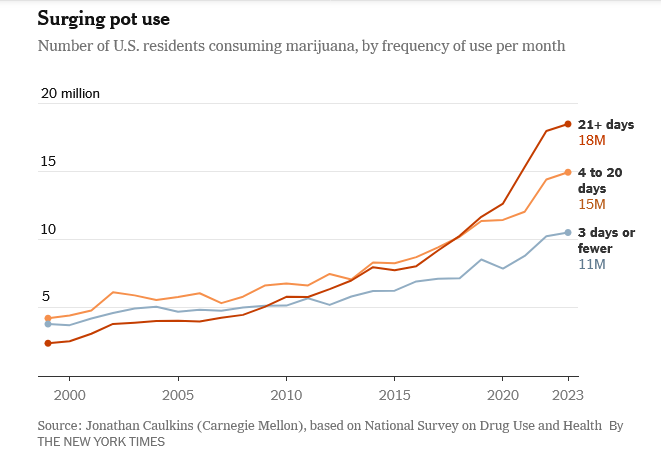
I really try not to get emotional over ethics stories, but the current Editorial Board declaration in the New York Times headlined, “It’s Time for America to Admit That It Has a Marijuana Problem” makes me want to run screaming naked into Route 395.

The U.S. had a marijuana problem a half century ago, when an earlier wave of The Great Stupid washed over the land and all manner of important lessons a healthy and functioning society needed to remember and institutionalize were deliberately tossed away because a lot of passionate, anti-establishment assholes were sure that they knew better than anyone “over 30.” I fought this destructive development from college, when I watched one of my room mates suffer short term memory loss from getting stoned morning and night; in law school, when the student running my lightboard for a production of “Iolanthe” erased all the light cues that we had taken six hours to set up because he was higher than the moons of Jupiter, all the way onto this blog. I put up with the mockery of classmates and dorm mates over the fact that I would not “try” pot (“It’s illegal” wasn’t a winning argument, so I settled on “It’s stupid and destructive.”). I drew a line in the sand with my addiction-prone wife, a former pot-head who was already an alcoholic. My fellow lawyers quickly learned not to get stoned around me because they knew I regarded buying and selling pot when it was illegal grounds for reporting them to bar authorities and respected my integrity enough to have reasonable doubts that I might not pretend that I didn’t know what I knew.

I carried the battle onto Ethics Alarms as the relentless pro-stoner propaganda was heading to victory, resulting in the legalization of the drug, the inevitable result of which the assholes who edit the New York Times have the gall now to tell us “Oopsie!” about after being a significant part of the mob mentality that inflicted it on the public, probably forever.

Back in 2011, I drafted a post that I never finished titled, “To My Friends the Pot-Heads: I Know. I’ve Heard It All Before.” It began:

“I take a deep breath every time I feel it necessary to wade into the morass of the Big Ethical Controversies, because I know it invites long and fruitless debates with entrenched culture warriors with agendas, ossified opinions, and contempt for anyone who disagrees with them. War, abortion, religion, prostitution, drugs, torture, gay marriage…there are a lot of them, and all are marked by a large mass of people who have decided that they are right about the issue, and anyone disagreeing with them is stupid, evil, biased, or all three. Contrary to what a goodly proportion of commenters here will write whichever position I take, I approach all of these issues and others exactly the same way. I look at the differing opinions on the matter from respectable sources, examine the research, if it is relevant, examine lessons of history and the signals from American culture, consider personal experience if any, and apply various ethical systems to an analysis. No ethical system works equally well on all problems, and while I generally dislike absolutist reasoning and prefer a utilitarian approach, sometimes this will vary according to a hierarchy of ethical priorities as I understand and align them. Am I always right? Of course not. In many of these issues, there is no right, or right is so unsatisfactory—due to the unpleasant encroachment of reality— that I understand and respect the refusal of some to accept it. There are some of these mega-issues where I am particularly confident of my position, usually because I have never heard a persuasive argument on the other side that wasn’t built on rationalizations or abstract principles divorced from real world considerations. My conviction that same-sex marriage should be a basic human right is in this category. So is my opposition, on ethical grounds, for legalizing recreational drugs.”

Instead of finishing and posting that essay, I posted this one, which used as a departure point a Sunday ABC News “Great Debate” on hot-point issues of the period featuring conservatives Rep. Paul Ryan and columnist George Will against Democratic and gay Congressman Barney Frank and Clinton’s former communist Labor Secretary Robert Reich. [Looking back, it is interesting how all four of these men went on to show their dearth of character and integrity. Ryan proved to be a spineless weenie, rising to Speaker of the House but never having the guts to fight for the conservative principles he supposedly championed. Frank never accepted responsibility for the 2008 crash his insistence on loosening mortgage lending practices helped seed, preferring to blame Bush because he knew the biased news media would back him up. Will disgraced himself by abandoning the principles he built his career on in order to register his disgust that a vulgarian like Donald Trump would dare to become President. Reich was already a far left demagogue, so at least his later conduct wasn’t a departure. I wrote in part,

Picking My Way Through Alex Berenson’s Ethics Minefield

Alex Berenson is one of the former Axis journalists (Matt Taibbi is another) whose conscience and cerebrum just couldn’t take the lies and craziness of the Left any more and went rogue. He’s done yeoman work for Truth, Justice and the American Way on Twitter/X and on his substack. Berenson’s latest post there gives readers a glimpse into his ethical orientation, and it’s nothing if not thought-provoking.

Berenson makes statements that make me wonder if he’s worth paying attention to at all, however. A prime one is this: “I am pro-choice, though I find abortion personally abhorrent…Those are medical decisions, and they are governed by a principle of near-absolute autonomy.”

Why does he find abortion “abhorent”? Presumably it is because abortion most frequently involves the killing of a nascent human being who would have a shot at a long, exciting, productive and possibly consequential life were it not for another individual, his or her mother, deciding that her life would be easier if this separate individual’s existence were sacrificed.

Continue reading

Ethics Quiz: Maryland’s Mass Pot Pardon

This is an ethics quiz because I recognize that I am irretrievably biased on the question of marijuana (no, I really don’t care that I’m supposed to call it “cannabis” now: bite me), which I believe should continue to be illegal, though I am under no illusions that this metaphorical horse has left the barn for good.

Maryland’s governor Wes Moore signed an executive order yesterday that pardons more than 175,000 convicted drug-abusers whose crimes were related to marijuana use. Moore said he did this “with deep pride and soberness.”

Yes, he’s proud to announce that Maryland doesn’t think violating laws is anything anyone should be ashamed of.

“Today is about equity; it is about racial justice,” Anthony Brown, Maryland’s attorney general, said. “While the order applies to all who meet its criteria, the impact is a triumphant victory for African Americans and other Marylanders of color who were disproportionately arrested, convicted and sentenced for actions yesterday that are lawful today.” This is because a disproportionate number of blacks broke the pot laws. This in turn acculturated many of them into breaking other laws with impunity as well. The progressive rule is that if laws are violated by larger numbers of a minority group than their demographic presence in the population would predict, it is discriminatory to enforce those laws.

I wonder who thought up that dodge? Whoever he or she is, it’s brilliant.

Your Ethics Alarms Ethics Quiz of the Day is…

Is the Maryland pardon fair and responsible?

Continue reading

“Gee, What A Surprise: Pot Isn’t Good For Teenagers”…The Sequel

In the same vein as the rueful post from two days ago, Ethics Alarms offers this excerpt from today’s Sunday Times without further comment, because none should be necessary…

Continue reading

Gee, Who Would Have Predicted That Legalizing Pot Would Put Children At Risk?

Sorry, I have no sympathy, zero, zilch, nada, for any parents and grandparents of the rebellious toking generation who are horrified at the effect widespread pot legalization is having on the young. Any idiot could have and should have predicted it. For example, I predicted it when I was 18, and being prodded, mocked, urged and wheedled (perhaps that should be “weedled”) into taking “just one puff” almost every day in college. (It was also against the law, which stodgy old me took too seriously, I was lectured, by a lot of students who went to law school.)

Here is how the New York Times’ “Kids Buying Weed From Bodegas Wasn’t in the ‘Legal Weed’ Plan” begins…

Not long ago, a mother in Westchester learned from her teenage son that he and his friends had gone to a nearby bodega and bought weed. She understood — they were kids, stifled and robbed by the pandemic of so many opportunities for indulging the secretive rituals of adolescence…

But it was deeply troubling to her that a store was selling weed to kids — New York State’s decriminalization statute makes it illegal to sell to anyone under 21 — so she embarked on an investigation. Predictably, when she confronted the bodega owners, they denied that they were distributing to anyone underage, so her next stop was a visit to the local police precinct, where she did not encounter the sense of urgency she had hoped for.

The cops greeted her with a kind of smug indifference, she said, an affect of I told you so, suggesting that liberals were now faced with the downstream impact of values that law enforcement had always disdained. Mothers in earthy, expensive footwear from the River Towns to Park Slope had supported the legalization of marijuana on the grounds that it needlessly funneled so many young Black and brown men into the criminal justice system. But now it was ubiquitous, and in the worst case scenarios possibly laced with fentanyl, and all too easy for their children to access. The bodega, in this instance, was a short distance from the local high school.

Continue reading

Ethics Observations On Biden’s Mass Marijuana Pardon

The pardon is irresponsible, cynical and unethical. It is also transparent: like the college loan forgiveness stunt (which is unconstitutional and a good bet to be knocked down), this is another sop to the Democratic base showing that Biden is keeping his promises made on the 2020 campaign trail. If it does serious damage to the Rule of Law, society, cultural ethics and developing young brains, hey, it’s worth it. Maybe getting more pot-heads to vote will keep the Democrats in power.

The pardon certainly doesn’t reflect any deeply-held convictions by the President, who doesn’t have such convictions. (This is a man who, please note, says he is a devout Roman Catholic who believes that the unborn are human lives from conception, but who champions abortion.) Biden opposed pot legalization until he became the Democratic nominee for president in 2020. Integrity? What’s integrity?

The pardon is guaranteed to lead to an increase in crime. The people with federal convictions for marijuana possession who Biden pardoned broke the law because they felt like it. They don’t respect the law, and Biden’s move endorses that disrespect. Such law-breakers will break other laws, and probably have.

Continue reading

I Lost On This Issue, But I Was Right

The New York Times tells us today, “Psychosis, Addiction, Chronic Vomiting: As Weed Becomes More Potent, Teens Are Getting Sick.”

Gee.

Who could have predicted such a thing?

Some of the more intense discussions on Ethics Alarms, primarily with libertarians, arose from the unshakable position here that the government’s capitulation to marijuana legalization efforts would accomplish nothing but short and long-term damage to vulnerable populations, the young, and the nation generally. I saw the writing on the cultural wall long ago, when arrogant elites in entertainment, politics, journalism and other spheres declared pot “cool,” and my college associates began seeking to sit around bleary-eyed and moronic to actually having interesting discussions and doing things.

Continue reading

Saturday Ethics Booster, 8/7/2021: Looking For A Hero…

I hate to inflict that song on you (the singer/composer was the late Jess Cain, once the most popular disc jockey in Boston) but I have limited options. The 2021 Red Sox, who were sailing all season to what looked like a certain play-off slot , are suddenly in freefall,  with the hitters not hitting and the pitchers not pitching. They face a double-header today, and a double loss would be disastrous. After the 1967 Red Sox “Impossible Dream” season, the best summer of my life, when a team of virtual kids won the closest pennant race in baseball history by a single game after finishing in a tie for last place the year before, WHDH, which then carried Boston’s games, put out the cheesy but wonderful commemorative album above, containing clips from broadcasts of the most memorable games and Cain’s song, tied together by Sox play-by-play announcer Ken Coleman reciting one of the worst pieces of doggerel ever heard by human ears. At one point, Ken recounted a desperate point in the team’s underdog quest, and, having set up the rhyme with “zero,’ intoned, “We have to have a hero.” Cue the Yaz song!

I’ve been thinking about the need for a hero, indeed more than one, quite a bit lately, in matters more consequential than the Red Sox season (well, for normal people anyway.) The Sox sure need one today. If he shows up, maybe it will be an omen…

Incidentally, Yaz deserved the song. Modern metrics show that his Triple Crown, Gold Glove, MVP 1967 season was the second best of all time. (Babe Ruth had #1, naturally.) Anyone who followed that 1967 season knew it before the numbers were crunched.

1. More free speech threats in the Biden Era, but Donald Trump was a threat to democracyThe Baltimore Symphony fired Emily Skala, 59, the orchestra’s principal flutist for more than three decades, because she shared social media posts expressing doubt on the efficacy of vaccines and facemasks. Fellow musicians, audience members and donors complained, so it was bye-bye Emily. Skala, no weenie she, will challenge her dismissal, and accuses the orchestra of creating a hostile environment where she was being attacked for expressing unpopular views. I’d say that is likely. Musicians as a group are about as progressive and open to conservative views as college professors.

Skala angered many of her colleagues for sharing posts questioning the results of the 2020 presidential election—Oooh, can’t have that! She was also criticized for saying that black families needed to do more to support their children’s classical music studies. Wow, this woman is a veritable Nazi! Amusingly, the New York Times cites as among the examples of social media “disinformation” that got her fired were “false theories suggesting that the coronavirus was created in a laboratory in North Carolina” and posts “raising concerns about the safety of vaccines.”

That’s funny: it wasn’t too long ago that suggesting that the virus originated in a Wuhan lab was considered disinformation. And didn’t Joe Biden and other prominent Democrats raise “concerns” about any vaccine produced under the Trump Administration?

I’m just spitballing here, but if only we had some heroic organization that defended free speech, regardless of what side of the political spectrum it came from. It could call itself…let’s see…the National Civil Liberty Protection Alliance, or something like that…

2. Believe it or not, this Russian lawsuit isn’t frivolous, just mind-meltingly stupid. Thanks to Curmie for passing along the saga of Ksenia Ovchinnikova, an Orthodox Christian in Omsk, Russia, who is suing McDonald’s on the theory that its ads made burgers seem so yummy and irresistible that they made her break her fast for Lent in 2019 after years of successfully avoiding meat. She wants 1,000 rubles ($14) as damages for “sustained moral damage.”

The reason this isn’t frivolous (at least not in the US) is because a lawsuit clears the bar if it seeks a new interpretation of existing law, no matter how wacky. Of course, a heroic lawyer would tell the woman, no matter what she offered to pay, “You’re out of your mind, and I’d rather eat my foot than disgrace my profession by taking such a ridiculous case. By the way, would you like this  corndog?” Continue reading

Friday Late Morning Ethics Warm-Up, 7/30/2021: Pot, Bribes, “Advocacy Journalism,” Baseball’s Domestic Abuse Policy, And How Did A Woman Win The Gold In The Men’s Decathlon?

White rabbit 2

I often check multiple websites to see what of ethics significance occurred on given dates. This July 30 isn’t a major ethics day, though the fiasco that resulted in 1864 when the serially incompetent Union General Ambrose Burnside made his third major blunder of the Civil War in the Battle of the Crater carries a crucial leadership lesson that apparently is impossible to learn: don’t give incompetent leaders second (or third) chances to lead.

However, on one of the sites, “This Day in History,” the headline on a note reads, “1976: Caitlyn Jenner wins Olympic decathlon.” That may be politically correct, but it’s cowardly (would the trans activist mob pounce if the event was stated straight?) and absurd on its face. Bruce Jenner won the Olympic decathlon, and it was a men’s event. Caitlyn was, as far as we know, not even a twinkle in his eye. Bruce fathered children after winning the gold; the event and the other events in his life when he was a he were not magically altered by his later transgender journey, like “Back to the Future.”

1. “Nah, there’s no mainstream media bias” note of the day. Frequent commenter and invaluable tipster Steve Witherspoon sent me a link to a Jonathan Turley column I had missed. The law professor covers a lot of issues we have discussed here as he notes that “Professional ethics, it seems, has become entirely impressionistic in the age of advocacy journalism.”

It seems? There is no question about it. Turley also points out the hypocrisy of the Times with several examples, writing, “If none of this makes sense to you, that is because it does not have to make sense. Starting with the [Senator Tom] Cotton scandal, the New York Times cut its mooring cables with traditional journalist values. It embraced figures like Nikole Hannah-Jones who have championed advocacy journalism.” He also notes that “while the Times has embraced advocacy journalism, its has not updated its guidelines which state that “Our journalists should be especially mindful of appearing to take sides on issues that The Times is seeking to cover objectively.”

Read it all, and I recommend sending it to any friend or relative who calls assertions that the news media is a left-wing propaganda machine at this point “conservative disinformation.”

Continue reading

Gee. What A Surprise. Pot Damages Brains.

Have you ever had the experience of knowing immediately and without question that something was wrong, and have everyone around you argue, and smirk, and yell, and posture, and insult, and mock, and still know you are right, and then be ignored only to have the fact show you were right all along, as you knew you would be?

That’s been my experience with marijuana. At this point, I’m no longer angry about it, frustrated or even sad. I’m resigned. I’m not accepting, because that’s not how I’m wired. This isn’t even the only issue like this: I will not be surprised when in future years there will be other cultural suicidal decisions that I (and many others) warned about and tried to explain why they were utterly, stupidly, indefensibly wrong. We may just open the borders. We may gut the First Amendment, or try to ban guns. We may swallow the poison pill of socialism, or worse. I won’t be surprised. I have learned that the entropy of society drifts toward idiocy, ignorance and self-destruction. I know I am lucky that I was born quite a bit smarter than  my typical fellow citizen, but they are not lucky that they so, so overwhelm me and people like me when it comes to guiding our cultural ship.

The New York Times article, authored by Kenneth L. Davis, the president and chief executive of the Mount Sinai Health System and Mary Jeanne Kreek,  head of the Laboratory of the Biology of Addictive Diseases at Rockefeller University, is titled “Marijuana Damages Young Brains.”

It essentially outlines a public health crisis, and more: it explains that we are not merely legaizing but preparing to market and promote a “recreational drug” that will make the public even dumber and less intellectually capable now than they already are. They write, Continue reading