Ethics Dunces, “What The Hell Is The Matter With You People?” Division: Everybody* On United’s Chicago-D.C. Flight Except Tahera Ahmad

taheraAhmad

Feared soda can hijacker Tahera Ahmad

I don’t understand how this episode could happen as it has been described. I am assuming for the purpose of the post that it did, and thus have almost nothing to add to the story other than to ask “What the hell is the matter with these people?”

Tahera Ahmad, an associate chaplain and director of interfaith engagement at Northwestern, described the alleged incident on Facebook while she was on the United flight from Chicago to Washington, D.C. Friday night.She wrote that she was in tears following an ugly episode that began with her request for a Diet Coke when the beverage service reached her row. The flight attendant had given her an opened can of Diet Coke. When Ahmad requested an unopened can, the flight attendant told her, “Well, I’m sorry. I just can’t give you an unopened can, so no Diet Coke for you.”

Then the same flight attendant gave another passenger an unopened can of beer. Ahmad said she asked why the man was given an unopened beverage can, but she was forbidden from having one. The flight attendant, according to Ahmad, replied, “We are unauthorized to give unopened cans to people, because they may use it as a weapon on the plane.”

Ahmad told the flight attendant she felt she was being discriminated against, and the flight attendant quickly grabbed the man’s beer can, opened it and said, “It’s so you don’t use it as a weapon.”  When Ahmad asked for support from other passengers,  a man sitting in an aisle across from her said, “You Muslim, you need to shut the fuck up,” Ahmad said.

“What?” a shocked Ahmad said. The passenger looked her in the face and said, “Yes you know you would use it as a weapon, so shut the fuck up.” “Some people just shook their heads in dismay,” Ahmad wrote on Facebook. But nobody rose to her defense.

After the flight, the attendant and the pilot apologized to her, and  United issued a lame mea culpa. It doesn’t matter. Everybody on the plane except for Tahera Ahmad should hang their heads in shame.

What the hell is United (or whoever made the “unopened can” policy, if there really is such a deranged policy) thinking? A can of soda is a weapon? There must be hundreds of things in carry-on luggage that would make a more plausible weapon than a soda can. Like pens. Like laptops. Like powercords. Like dop kits. Like electric razors.

Like fists and feet. Ridiculous.

Gee, I always thought they opened those cans to be nice…

What the hell was the flight attendant thinking? Making that excuse to Ahmad, and then handing a male passenger an unopened can right in front of  her? What an obvious insult! Continue reading
Ethics Quiz: Once Again, Bystander Ethics, The Duty To Rescue, And The Imperiled Child

clarkkentThe free-range kids debate already raised this issue, and now my colleague and friend Michael Messer, the talented and versatile musician/singer/ actor who teams with me in the ProEthics musical legal ethics programs Ethics Rock, Ethics Rock Extreme, and Ethics Jamboree, just posted about his traumatic experience on Facebook, writing,

“I’m standing in Central Park and witnessed a tourist father grab his (approx 5 year old) child by the arm and shake him… The. open palm smack his child in the head. Hard. Twice. I screamed to him, from about 50 feet, where I witnessed it: “HEY!!! YOU DON’T HIT HIM” he looked up, startled to be called out, and waved me off to mind my business. “YOU DO NOT HIT A CHILD IN THE HEAD”, I repeated, at the top of my lungs, hoping to attract attention. The kid cried and then got himself together and went off to play. No one else in Sheeps Meadow saw or took notice. For about 5 minutes after I kept my eyes on him so he knew he was now being watched. What is the role of a bystander in this situation?”

Your Ethics Alarms Ethics Quiz for the day is…

What is the role of a bystander in this situation?

The answer is simple, really—its that oft-repeated Ethics Alarms mantra, “FIX THE PROBLEM,” at least as much as you can. Do something. Mike did the right thing, from a distance: show the abuser he’s being observed, protest, shame him. If one can, if one has the ability, the skill and the timely reaction and the child looks to be in genuine danger, intervene physically.

The latter course, however, carries risks, and also may be precluded by the natural reflex most humans have when they observe something unexpected and shocking. I discussed this issue when Penn State assistant coach Mike McQueary was being pilloried in some publications for not immediately charging into the Penn State showers and stopping sexual predator Jerry Sandusky from sexually abusing a boy: Continue reading

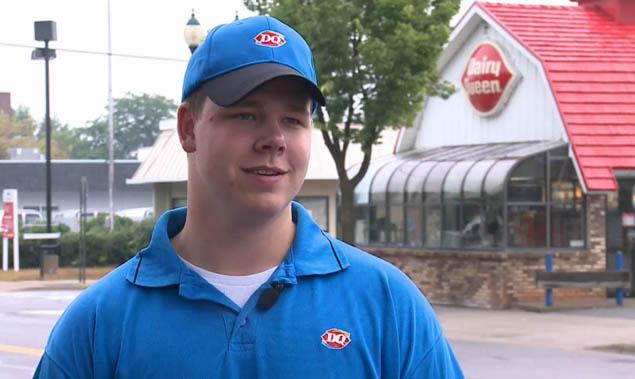
Ethics Hero: Minneapolis Dairy Queen Manager Joey Prusak

"Good job, Joey!You made Dairy Queen proud and brought honor to the store, Here's 40 dollars."

“Good job, Joey!You made Dairy Queen proud and brought honor to the store, Here’s 40 dollars.”

It’s a simple story, trivial in a way, but with an important ethics lesson.

Joey Prusak, the 19-year-old store manager at a suburban Minneapolis Dairy Queen, watched as a female customer with a heart of ice saw a vision-impaired man drop a $20 bill, picked it up, and instead of returning the money to the unaware customer, slipped it into her own purse. When the certifiably awful woman got up to the counter to order, Prusak told her what he had seen and demanded that she return the bill as a condition of service. The woman, as one might expect from someone who would take money under such circumstances, refused, so Prusek reimbursed the visually impaired customer with $20 of his own.

A customer who saw the incident e-mailed Dairy Queen in praise, and now Prusak has become something of a folk hero.

The important ethics lesson is “Fix the problem.” If you are in a position to right a wrong or prevent one, it has become your obligation to do it. Don’t adopt  any of many rationalizations available to persuade you to do nothing— “It’s not my job,” “Mind your own business,” “Who am I to judge?”, “It’s not my fault”, “What if I’m wrong?”—or, in a case like this one, manufacture excuses for the vile miscreant who took the money—–“Maybe she’s desperate,” “Finders keepers”-–and just act. Fix the problem. Continue reading

Hate Thy Neighbor: the Cranston Ethics Train Wreck

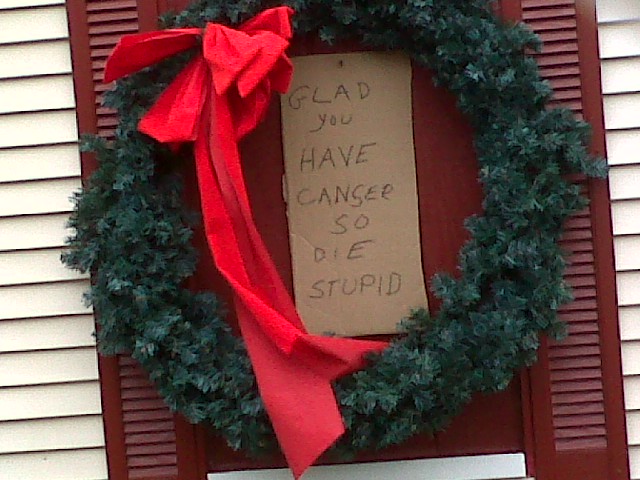
Cranston, Rhode Island resident Edward Jimmis, it is fair to say, is an idiot.

That’s okay. There are a lot of idiots, and they do very well. Many of them, perhaps a majority, are even in Congress. Now, when the constituents of a Congressional districts represented by an idiot get tired of the idiocy, they have a very effective remedy. They can vote the idiot out of office, and this is fair, ethical, and effective, though not exercised nearly as often as it should be. What is the ethical response, however, when you discover that your neighbor is not only an idiot, but an especially hateful and uncivil idiot? This is the challenge facing the neighbors of Edward Jimmis. They may not have the right answer. Continue reading