Tales From The Moral Luck Files: The Truck, The Ice, and the Hero

"I'm a hero!"

“Woo-Hoo! I’m a hero!”

A story from Manitoba, Canada raises the question, “Should someone get full credit for being a hero when he rescues the victim of his own poor judgment?”

A father on an ice fishing trip with his daughter drove his pick-up truck onto the ice of frozen Lake Manitoba, misestimating just how frozen it was. The truck broke through the ice, and he reportedly had to dive deep into the freezing water to rescue his daughter from an icy death. Is it heroism to repair the results of a near tragedy you caused yourself?

Let’s consider at a range of possible frozen ice scenarios:

1. You see someone else’s truck break through the ice, and rescue the occupants from drowning at great personal risk.

2.  You tell a driver that its safe to drive his truck onto the ice, and it breaks through because you were wrong. You rescue his daughter.

3.  You watch several trucks drive on the frozen lake without incident. You follow them, and your truck falls through the ice. You have to rescue your daughter.

4. You drive onto the ice without proper precautions, and after your truck falls through, you rescue your daughter.

5. A local citizen warns you about driving your truck on the ice, which he says is too thin. You do it anyway, and have to save your daughter.

6. The Homer Simpson scenario: You see a truck fall through the ice, and yet drive yours onto the ice anyway. You rescue Lisa. Continue reading
The Man On The Subway Tracks


Subway Headline

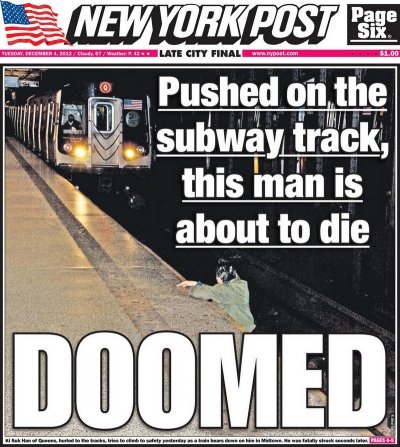
It is destined to become a classic case in photojournalism ethics. Someone pushed 58-year-old Ki Suk Han pushed onto a 49th Street station  subway track in New York City. R. Umar Abbasi,  a New York Post freelance photographer was  on the platform when it happened, and took a photo as the subway train bore down on the terrified man. He was killed, and the photo became a lurid, if dramatic, Post front page.

There have been many ethical questions raised about the incident. Let’s examine them.

Was it ethical for the New York Post run the photo?

This is the easiest of the issues: of course it was. The photo is dramatic, the incident was news, the paper had an exclusive, and readers were interested. The Post might have decided that it would be in better taste not to run the photo, and that decision might be praiseworthy. Still, there is no good argument to be made that such a photograph is outside the range of acceptable items for publication. By the ethical standards of 21st Century journalism, admittedly low, the Post’s call isn’t even close to the line. Objections to the photo on ethical grounds are pure “ick factor.” Continue reading

“I’m Warning You: If You Rescue That Drowning Man Over There, You’re Fired!”

“Not your concern…”

The brain-dead and ethics-empty conduct of Jeff Ellis Management, an Orlando, Florida-based company, in its recent firing of 21-year-old lifeguard Tomas Lopez is welcome in one respect, and one respect only. It helps explain the inhuman attitude of the two Brooklyn EMT’s who stood by and watched a woman die of a heart attack as they munched bagels. It begins to explain why two Seattle security guards stood by and allowed a woman to be nearly beaten to death while they looked on. It almost explains how a crowd of people on a California shore, including firefighters, stood by as a man named Raymond Zack took nearly an hour to drown himself. It might even provide some insight into the thought processes of Penn State assistant football coach Mike McQueery, who famously observed Jerry Sandusky as he engaged in a child rape but didn’t stop it. For one of the reasons so many Americans turn off their ethics alarms, reject their humanity and flunk their duty to rescue those in peril is that there are people like  Jeff Ellis, who deem human life less important than business, policy and profit, and who will punish any employee who doesn’t feel similarly and act accordingly.

The company fired Lopez after he pulled a struggling swimmer out of the ocean on Hallandale Beach in Broward County, saving his life. The rescue, you see, occurred 1,500 feet south of the firm’s contracted boundaries for lifeguard service.  Lopez was told that a swimmer was in peril off the neighboring beach, and ran to his rescue, leaving the “protected beach” area where his services had been contracted to serve. The near-drowning victim was swimming in the “unprotected area” without lifeguards, and there’s no point, the management company reasons, to hire it to provide lifeguards if the heroes like Lopez will dive in for free. Continue reading

Ethics Dunce: Safeway…Ethics Hero: Ryan Young. Justice? Waiting…

“You’re suspended, Kent.”

I’ve asked many times on Ethics Alarms why so many Americans stand by, inert and passive, when a fellow citizen is in peril.  Maybe the stunning ethics blindness exhibited by Safeway in a recent incident is part of the answer.

Ryan Young, who works in the meat department of a Safeway grocery store in Del Rey Oaks, California, was on the job when he witnessed a man beating a pregnant woman, apparently his girlfriend. Young told the man to stop, but he continued with his assault, shoving and kicking the her.  Young jumped over his counter, pushed him away, and ended the attack.

His reward was to be suspended without pay. Safeway has a policy that directs employees to summon security personnel and not to personally intervene when they see a crime or fight in progress. Even though police confirm that Young may have saved the woman and her unborn child from serious injury, the company is insisting that Young’s conduct warranted discipline, not praise. Continue reading

The Heroic Bird-Watchers and The Shame of the Star Princess

If Captain Stubing had been at the helm, a tragedy might have been averted.

Rescue is a frequent topic on Ethics Alarms, usually in a disturbing context. We all have a duty to rescue others in peril, but we should never underestimate the powerful forces that often work against that duty. Rescue can be dangerous or frightening, and often there are perplexing questions about when an individual has done enough to ensure a rescue, and what constitutes “enough,” especially if the rescue fails.

In March, the Star Princess—a luxury cruise ship operated by Carnival—was on a cruise around South America. Three of the passengers were bird-watchers, who eschewed shuffleboard and the other fun activities organized by whoever was the counterpart to Lauren Tewes on “The Love Boat” to use their binoculars and telescopes to spot seabirds from the ship’s decks.

It was March 10 when one of the bird-lovers, Jeff Gilligan from Portland, Oregon., saw a boat with a person standing up in it, waving a dark piece of cloth. The vessel was at least a mile away.  Another Oregon bird-watcher, Judy Meredith, told reporters that when she focused her lenses on the boat, it was clear to her that the man waving the cloth was trying to get the Star Princess’s attention, and that the boat was drifting, without an engine. She went inside to try to alert the crew about the situation. After she talked to one crew member, she says, he called the bridge and she talked him through what she and Gilligan had seen.”I was trying to have a sense or urgency in my voice — and tell them that the boat was in distress, and they were trying to get our attention.” Another crew member used Gilligan’s telescope to look at the drifting boat, and confirmed their assessment. The boat was drifting in the open seas and in peril. Gilligan said that at that point “We were a bit relieved because he had confirmed that he had seen what we were describing. We expected the ship to turn back or stop or something.” Continue reading

Ethics Dunce: Laurie Penny

Laurie Penny, in an alternate universe America where we don't bother about trivial things, like saving pompous, ungrateful British journalists.

Laurie Penny was the woman saved from being flattened by a New York cab this week by none other than Ryan Gosling, the dashing actor and and celebrity heart-throb who has already been honored here for his willingness to come to the rescue of others in peril. He pulled her back as the British journalist was about to step off the curb in Manhattan without looking, right in the path of a speeding vehicle.

The celebrity and gossip media went bonkers over this, as you might imagine. After all, a typical headline for this crude segment of the media is that Tia Tequila got a new tattoo or that a Kardashian broke a nail. Let’s see…what’s today’s buzz? Ex-child star Amanda Bynes was bailed out if jail following her DUI arrest, and Heidi Klum filed for divorce. But the attention being paid to Gosling’s good deed just annoys Penny, and, she says, is proof that America is trivial and misguided. In a piece authored for the gossip site Gawker, entitled, “Ryan Gosling Saved Me From a Speeding Car But There’s War In the Middle East So Everyone Calm Down,” Penny exposes herself as the kind of person Gosling might live to regret rescuing. Continue reading

A Facebook Suicide and the Duty To Rescue

One takeaway from Claire Lin's death: it's a good idea to have Facebook friends with character.

In Taiwan, a distraught young woman sent streaming photos* of her suicide attempt as she conversed with nine Facebook friends. Some urged her to stop, but none tried to contact police or rescue professionals as she asphyxiated herself with burning charcoal fumes. Yes, her attempt was successful. You can read the disturbing story of Claire Lin’s Facebook suicide here.

Would this happen in America? I wouldn’t be surprised. Sociologists are already weighing in with opinions about the isolation of social media and how the internet makes reality seem less real. I doubt that any of that was especially important in this incident. There have been so many other examples of people left to die with potential rescuers aplenty that were documented on Ethics Alarms and elsewhere, from the Mount Everest climbers who walked past their dying companion, to the more recent case of the Apple store employees who listened to a women get beaten to death in Maryland, that teach us that too many people have the natural inclination not to take affirmative action to help another in distress, and that the instinctive rescuers are the exception, not the rule.

Our culture should teach and reinforce the shared societal duty to come to the assistance of others in peril, but in fact it teaches the opposite. Most of us are told to mind our own business, to think of “Number One”, and  make reverse Golden Rule calculations to rationalize inaction (“He wouldn’t have lifted a finger to help me!”) We are taught to fear lawsuits, to wait for professionals (even if they aren’t coming), and to be fearful of making a bad situation worse. And, of course, we are conditioned to let the other person take the risk, so we can have our cake (not get involved) and eat it too ( see the situation resolved without anyone being harmed). And if we wait just a bit too long for that other person to do the right thing, we can always blame him (or her), saying, “I thought someone else would do it!” Continue reading

Letting Homes Burn in Obion County: Re-send the Memo

"I'll pay the $75 now."

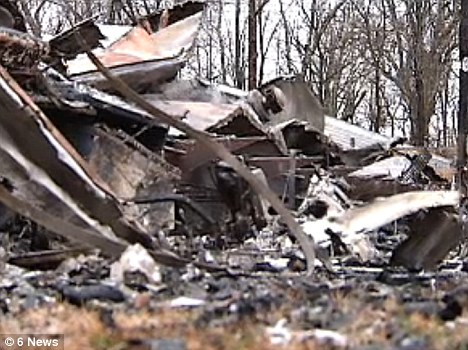
Just in time for Christmas, we have the heart-warming story—or just plain “warming”—of the South Fulton (Tennessee) Fire Department once again standing by as someone’s home burns down.  Ethics Alarms wrote about this  outfit doing the same thing in 2010, following Obion County policy: pay the yearly $75 fire department fee, or be prepared to put out your own damn fires.

In 2010, it was the home of a cheapskate named Gene Cranick, who, like the people who can afford health insurance but don’t buy it anyway, figured that his  community would still do the right thing if the worst happened, so he gambled to save the money.  The South Fulton Fire Department did the right thing, all right, at least according to Obion County officials. They let his house go up in flames.

This time, it was mobile home owner Vicky Bell whose dumb gamble backfired.  Continue reading

Judging McQueary: Child Rape Bystander Ethics

You have no excuses, Kal-El. But the rest...

“It was cowardly for a 6′4″ graduate assistant to witness the rape of a child by an older man and not only take no action to stop it but also not even call the police,” writes David French in the National Review.

He is, of course, referring to Mike McQueary, then a 28-year-old graduate student assistant coach for Joe Paterno at Penn State. Others have declared that it was an “absolute moral imperative” that McQueary physically intervene to stop the sexual assault.

It is interesting that the absolute moral imperative is nonetheless linked to qualifiers. French references McQueary’s size and the fact that the alleged assailant, Jerry Sandusky, is older. Some critics have focused on his gender. Still others, making the argument that McQueary failed to intervene because he didn’t take a child rape seriously enough, have suggested that he would have acted differently had Sandusky been beating, rather than raping the child. Of all the ethical debates surrounding the Penn State scandal, the question of how much scorn should be heaped on McQueary for not acting immediately to stop the rape in progress has been the most fascinating, and to my mind, the most disingenuous. It appears that every commentator, male or female, young or old, fat or fit, is convinced that would have charged in and battled the 57-year-old former wide-receiver, pummeling him into wet submission while the child escaped. Maybe. Studies and anecdotal evidence indicate that in fact, most people wouldn’t physically intervene. Perhaps sportswriters and op-ed writers are made of sterner stuff that the rest of the public.

Yes, that must be it.

None of this is to suggest that physically stopping a child rape in progress isn’t the right thing to do; it is. For his part, McQueary reputedly didn’t take any action to stop the assault,* which in order of effectiveness would be… Continue reading

Comment of the Day: “Mike McQueary and Me”

Some recent Ethics Alarms commenters

Joseph Edward bought me some time with this superb Comment of the Day, because I am writing a post on the same topic. Mike McQueary’s conduct in the locker room, when he allegedly witnesses Jerry Sandusky raping a boy,  has generated some of the most self-righteous and, I may say, annoying comments I’ve encountered on Ethics Alarms, characterizing my commentary (in “Mike McQueary and Me”) on why McQueary might have acted as he did with excusing his conduct. Most of these, I’m relatively certain, are motivated by those who want to shift responsibility for the Penn State debacle away from Joe Paterno.

One particularly persistent and vociferous commenter has decreed that it was an “absolute moral obligation” for McQueary to physically intervene to stop the assault he witnessed. Joseph touches on that dubious contention; I’ll have more to say about it soon. Meanwhile, here is his Comment of the Day, on “Mike McQueary and Me”: Continue reading