Morning Ethics Warm-Up, 2/3/18: On The Nunes Memo, The Times Flunks (Another) Integrity Check.

Cold Morning! I mean, Good Morning!

Anne Frank would still read The New York Times, I guess…

(Anne Frank belongs in the Ethics Alarms Heroes Hall of Honor. I will fix that with a post this month–she probably dies in February, 1945. Don’t let me forget.)

1 “But you know what I sometimes think? I think the world may be going through a phase… It’ll pass. – I still believe, in spite of everything, that people are really good at heart.” Or maybe not. I gathered up all my idealism and hope, and thought that maybe, just maybe, after the ugly and destructive lynch mob it has constituted for over a year to try to destroy the elected President, the mainstream news media, faced with incontrovertible evidence of frightening lawlessness and an attack on democracy by the previous administration in the midst of a Presidential campaign, would finally show some integrity and do its duty.

Then I read today’s New York Times.

The headline: GOP MEMO LEADS TO FRESH JOUSTING ON RUSSIA INQUIRY.

Unbelievable. That’s the news? That there is “fresh jousting”? The memo, as I accurately explained in the previous post, shows that the Obama administration’s Justice Department knowingly used opposition research, funded by Obama’s party and its Presidential candidate, that has substantially been discredited  by the FBI, the same agency that represented it to the court, as evidence justifying a FISA warrant against an American citizen and a member of the opposing party’s Presidential campaign and the Republican Presidential campaign itself.

I don’t see any mention of the Russian collusion investigation in that sentence, but that sentence still suggests a serious scandal involving abuse of civil rights and tampering with the election by law enforcement and a partisan Justice Department. If the so-called “newspaper of record” was objective and trustworthy, some version of that sentence would have been its headline, not an intentionally misleading headline stating that the “news” just is more political “jousting.”

Think about it: the Times is using a less interesting and provocative headline that the one that is justified by the facts. The only reason it would do this is misdirection born of a political agenda. No, Hanlon’s Razon does not apply here. This is not incompetence. This is malice.

2. “It’s really a wonder that I haven’t dropped all my ideals, because they seem so absurd and impossible to carry out. ” Then there the Times editorials. Two days ago, the Times editors wrote this:

“In a demonstration of unbridled self-interest and bottomless bad faith, the Trump White House and its Republican minions in Congress are on the cusp of releasing a “memo” that purports to document the biggest political scandal since Watergate. To pull it off, they are undermining the credibility of the law enforcement community that Republicans once defended so ardently, on the noble-sounding claim that the American public must know the truth.”

Again, unbelievable and yet too believable. Let’s parse this one:

“In a demonstration of unbridled self-interest and bottomless bad faith,”

The Times thinks it is bad faith to inform the American public of undeniable misconduct by the FBI and the Justice Department regarding civil rights and the Presidential election. Sure.

“…the Trump White House and its Republican minions in Congress are on the cusp of releasing a ‘memo'”

An ad hominem attack (“minions”), a partisan bias-based innuendo of dishonesty ( “purports to document”) and a dishonest use of scare quotes around “memo,” as if this wasn’t a memo. It is a memo.

“…the biggest political scandal since Watergate.”

A straw man trick, exploding an assertion into its most extreme form to knock it down. The facts are the facts, and how they are characterized by some is irrelevant to what the facts show. it may not be  “the biggest political scandal since Watergate” when a Democratic administration uses opposition research its party paid to have done to defeat a Republican Presidential candidate  to get court authorization to spy on that campaign during the campaign. You have to admit, though, that at least sounds a little like Watergate—Presidential campaign, administration interfering with the opposition campaign, dirt tricks, misuse of government power—no? Even a little bit like Watergate is bad enough, when government and law enforcement interference with Presidential campaigns is the issue.

“To pull it off, they are undermining the credibility of the law enforcement community that Republicans once defended so ardently, on the noble-sounding claim that the American public must know the truth.”

Pull what off? That’s another bit of rhetorical dishonesty implying wrongdoing by transparency, when  transparency is not wrongdoing unless it is illegal (Wikileaks, James Snowden). Then we have the cynical tack I just wrote about:

“The argument against the memo and the issues it raises, that the public revelations demoralizes our intelligence community and undermines the public’s support and trust is the same invalid logic being used to condemn criticism of the biased news media. If these institutions are not trustworthy and acting against the interests they are pledged to protect, then the public must know. If the conduct of the intelligence community shows that it isn’t trustworthy, there is nothing wrong, and everything right, about exposing it.”

How does the fact that the Republicans once defended the law enforcement community “ardently” change the appropriateness and necessity of  revealing wrongdoing they were not previously aware of? Finally, did I really read the New York Times editors mocking the proposition (“noble-sounding”) that “the American public must know the truth”?

What a disgraceful, shocking, self-indicting paragraph. Continue reading
Comment Of The Day: “Morning Ethics Warm-Up, 12/31/2017: The Too Many Year Ending Ethics Issues To Handle In One Day Edition”

JP’s Comment of the Day actually was sent in today, and so, despite the injustice of allowing him to jump in line (for there still are Comments of the Day from the Holiday Challenge of two days ago awaiting their honors), I’ve decided that this one should be published in close proximity to its target, which was #1 in today’s Warm-up, about Frank Bruni’s column,  “Higher Ed’s Low Moment, in the Times today. You should read Bruni’s column first to be fair to fine JP’s work, which is in the form of an open letter.

Here is JP’s epic Comment of the Day on the post,Morning Ethics Warm-Up, 12/31/2017: The Too Many Year Ending Ethics Issues To Handle In One Day Edition: 

Dear Mr. Bruni,

Thank you for that colorful article you posted in the NYT. As a college graduate from two universities (almost three), I can appreciate what you said regarding higher learning and its importance on the future of Americans (and in general the world). You see, I agree there is a lot that college has to teach us. Higher education should be focused, involve critical thinking, and provide much-needed life skills that are just not acquired at the at the high school level. While these could have been excellent points when defending the role of colleges and universities, you chose to skip right over them altogether. Instead, you chose to write about how people are wrong to not trust the system with not so subtle attacks on Trump, the Republicans, and the recent tax law.

I will give you some credit. You were able to point out some reasons why some of that trust is not there. You wrote, “I also hear more college presidents talking with more concern about their campuses’ images as enclaves of a distinctly illiberal liberalism. Especially ugly episodes this year at Middlebury College and The Evergreen State College fed that impression and, I think, increased many presidents’ resolve to do something about it.”

You also pay due attention to the much-noted lack of political diversity on campuses. However, it is clear from your article you believe these examples to be trivial based on your piece’s lack of focus, language used, and quick transitions.

With that in mind, let me ask you a question, Mr. Bruni:

Have you been hiding under a rock these last 10 years, or are you just so hidden in your elitist tower you can’t see Rome burning around you?

There are many good reasons that the public doesn’t trust college campus anymore. Follow me a little bit as I explore reasons.

The Teachers.

Just this past year alone we have witnessed a number of statements made by the professionals whose job it is to shape the minds of these students. These are the people who direct them, but with statements like the following, it is a wonder we haven’t had more students following the actual advice made by them (perhaps I don’t give these students enough credit on their critical thinking skills).

  • One professor at Montclair State University wished someone would shoot President Trump outright. He was later let go.
  • Another professor at Austin Community College said it was ok with him if Betsy DeVos was sexually assaulted. He later quit.
  • A University of Tampa Professor said Hurricane Harvey was “Instant Karma” for Texas because it was a red state. Nevermind that Houston, the heaviest area affected voted Democrat (moral luck) during the previous election, this professor had to get his two cents in. He was fired as well.
  • A Drexel professor said the shooting in Vegas this past year is what happens when white people don’t get what they want. His last day is officially today.

What is notable here is 70% of the staff tried to get his full reinstatement. This is somewhat bewildering because the professor is no stranger to racist tweets. writing last Christmas that the white genocide during the Haitian Revolution was a good thing. But of course if you here him, this was just a joke.

There are many more; this last is just icing on the cake:  A professor at California State University tweeted that Trump must be hanged. He later tweeted that “Justice = The execution of two Republicans for each deported immigrant.” This isn’t even retribution theology, it is just advocating for murder. He will be teaching again in the spring. Continue reading

Morning Ethics Warm-Up, 12/31/2017: The Too Many Year Ending Ethics Issues To Handle In One Day Edition

Happy New Year!

1 Arrgh! In an op-ed called “Higher Ed’s Low Moment, Farnk Bruni bemoans the fact that colleges “found themselves on the defensive.” Citing the Pew Center’s findings that I discussed here, he writes of declining opinions about the value of college,

“That’s not so surprising, given Americans’ intensifying resentment of anything that smacks of elitism and given Republicans’ attacks on science and intellectuals. As Ron Daniels, the president of Johns Hopkins University, recently told me, “Even if we were completely unblemished in the way in which we pursued our mission, it would be hard to imagine that in Trump’s America, we wouldn’t be targets for scorn.”

Incredible. (Or, as my late, schizophrenic cousin Trefon would say, “Umba!“, as in “Umbelieveable!” I always found that funny, and I would love to see his slang word enter the popular lexicon. Trefon was a great kid who had a short, empty life, and ended it by jumping off an overpass into an oncoming truck. It would be nice if he left some enduring contribution to the culture, even if it was a silly one.) No, the reason so many Americans no longer think college is a wonderful thing is that they can see and hear. Students aren’t being educated. Graduates have minimal knowledge of history, literature, government and culture. They can’t write, and they can’t argue. Their professors get on social media and issue things that would destroy trust in any institution that employed them.

The campuses are increasingly hostile to free speech, free thought, democracy, capitalism and the United States of America. None of these factors penetrate Bruni’s biases and conventional wisdom. He keeps repeating the mantra that caused me to resign from an education board many years ago: ” a college degree is one of the surest harbingers of higher earnings and better economic security.” That’s how college has been regarded as a reflex for a century now, and the policies that followed that starting point–a degree,  means jobs and money—have created the sick system in which students who are not qualified to attend college are accepted anyway, and tuition has soared to obscene level., all while the actual content of the curriculum and teaching have become an afterthought. It’s the diploma that matters!

No, it’s the education. Bruni says, ” [T]he continued competitiveness of the American economy depends on the skills of our work force, the intellectual nimbleness of our citizens, the boldness of our scientific research and the genius of our inventions. Our colleges and universities are central to that.”  If getting as many people diplomas as possible is the mission, however, seeking “intellectual nimbleness” is obviously an afterthought.

This emperor has no clothes, and hasn’t had for a long time. The disturbing development isn’t that so many conservatives have finally realized that the golden ideal of an American college education no longer comports with reality. It is that so many opinion makers and policy makers hold on to that ideal when it is so evidently false. If college degrees don’t prove that  graduates have core knowledge, writing and critical thinking skills, then they are  just high-priced tickets to be incompetent.

And they don’t. Continue reading

Unethical Quote Of The Month, And A Bonus Kaboom: The New York Times Editors

“But if your man is really innocent, what’s the worry?”

The New York Times in an editorial, “Fox News v. Robert Mueller”

Yes, the New York Times really printed that, under its banner.

Well,

KABOOM!

There goes my head.

As much as I have learned to distrust the objectivity and motives of the New York Times, I did not expect the traditionally liberal paper to make a sinister argument typically associated with totalitarian regimes. This is nothing but a  rephrasing of the traditional “nothing to hide” rationalization for obtrusive state surveillance, as well as illegal police searches and abusive prosecutorial methods.

“If you’ve got nothing to hide, you’ve got nothing to fear” is such a cliché of oppressive state action that it has its own Wikipedia entry. It is often attributed to Joseph Goebbels or “1984,” though there is no documentation for either. It was uttered by villain Pius Thicknesse in “Harry Potter and the Deathly Hallows”:

“As your new Minister for Magic, I promise to restore this temple of tolerance to its former glory. Therefore, beginning today, each employee will submit themselves… for evaluation. But know this: you have nothing to fear if you have nothing to hide.”

In the film version of the novel, the actor (Guy Henry) playing Pius was cast to evoke Goebbels. (above).

Progressive writer Upton Sinclair used an inverted version in 1918 in “The Profits of Religion: An Essay in Economic Interpretation” (1918):

“Not merely was my own mail opened, but the mail of all my relatives and friends—people residing in places as far apart as California and Florida. I recall the bland smile of a government official to whom I complained about this matter: ‘If you have nothing to hide you have nothing to fear.'”

The statement adopted by the Times editors as well as the attitude behind constitute a rejection of democratic values and an endorsement of state sponsored fear and subjugation of individual rights. “It you are innocent, why worry?” literally stands for the proposition that one is guilty until proven innocent, which is an accurate description of the position of the Times, the mainstream media and “the resistance” regarding the baseless allegation of  “collusion” with Russia to steal the election from Hillary Clinton. In the context of the editorial, which dismisses legitimate questions about the objectivity and conflicts of interest among Special Counsel Robert Mueller’s team, the argument is especially disingenuous. If one is innocent, one shouldn’t worry if a biased team of lawyers is trying to find a way to make you look guilty? Continue reading

Morning Ethics Warm-Up, 11/12/2017: Prisoners Behaving Badly, The Harvey Weinstein Ethics Train Wreck Picks Up The Brother Of “The Girl Next Door,” And The Attempted Coup Continues

Good Morning!

On the way to Boston soon for an in-and-out ethics seminar for young Massachusetts lawyers…

1 Why is the New York Times acting as if the 2016 campaign is still going on? Today’s Sunday Times includes a long scold from the Times editors urging the President to “please read the Constitution.” Then it reaches back all the way to 2015 for TrumpTweets that proposed or mused about Constitutionally impossible policy ideas. How does the Times know that the President’s Constitutional acumen hasn’t been enhanced since 2015? It doesn’t, of course. The criticism would be legitimate during a campaign, but a year after an election, it tells us only this: The New York Times is still in the mode it announced during the campaign. The existence of Donald Trump, in its view, justifies the suspension of journalism’s core principles. In the view of many of the Times’ voices on its op-ed page, his existence also justifies the suspension of the Constitution that the paper piously insists the President read. The Times editors have not told those who have claimed in its pages and from the floor of Congress that President Trump should be impeached based on no “high crimes and misdemaeanors” to read the Constitution. It didn’t tell Hillary Clinton to “read the constitution” when she advocated “the Australian approach” to gun control, or grandstanding Democrats in the House to ‘read the Constitution” when they behaved as if the right  of Due Process didn’t exist, so citizens arbitrarily placed on a no-fly list by the FBI could nonetheless be denied the right to own a gun. It didn’t tell “the resistance” to “read the Constitution” when it attempted to distort the operation of the Electoral College to undo the President’s election.

“He has showed disdain for the separation of powers by repeatedly attacking the federal judiciary and individual judges who have ruled against him.” the Times sniffs, but it did not tell Barack Obama to “read the Constitution” when he attacked the U.S. Supreme Court in a State of the Union address. Then the Times goes off into the hyper-partisan stratosphere, suggesting that its editors also need to “read the Constitution”:

He has abused the pardon power by granting his first, and so far only, pardon to a former sheriff who was found in contempt of a federal court for defying an order. And he has failed to take care that the laws are faithfully executed, whether by trying to sabotage the Affordable Care Act, leaving hundreds of critical executive branch positions vacant or threatening to prosecute his former political opponent.

The Constitution places no limits whatsoever on the pardon power; it is absolute, beyond appeal, and can’t be abused as a matter of Constitutional law. The Times’s definition of the duty to faithfully execute the laws is incomprehensible, since it did not object to Barack Obama circumventing crystal clear laws against illegal immigration by ordering them not to be enforced, or when the Obama administration refused to defend the Defense of Marriage Act while it was still a valid law signed by the previous Democratic President. The Constitution does not demand that the Federal government be a bloated, deficit-making bureaucracy; the President, not the Times, gets to decide what positions are “critical” in the Executive Branch. That’s in the Constitution. As for “threatening to prosecute his former political opponent.,” the President’s statements regarding Hillary Clinton can be and should be taken as questioning whether the Justice Department under Barack Obama was placing its thumb on the sales of justice for political purposes.

It is increasingly beyond argument that the mainstream news media, led by the Times, is trying to abuse its Constitutionally enshrined immunity from responsibility to engineer a virtual or actual coup. That is dangerous and unforgivable, as well as directly contrary to how the Founders wanted our democracy to operate.

2. I checked the news early this morning to learn the identity of the latest celebrity to have a finger pointed his way as a chorus shouts “HARASSER!” To my surprise and alarm, I discovered that the Harvey Weinstein Ethics Train Wreck had entered my world: jet-set hotelier André Balazs was accused by actor Jason Bateman’s wife of groping her crotch in 2014. André Balazs grew up across the street from my childhood home in Arlington, Massachusetts. His sister, Marianne, was a good friend and classmate all the way through high school. I knew André as Marianne’s annoying little brother.

It appears that the idea in Hollywood now is to accuse someone else before you or your significant other gets accused. This is because sexual harassment and misconduct has been an accepted part of power-player culture in Hollywood forever, even while the Left’s component of that culture proclaimed that the Right was wielding a “war on women.” The country should not forget how dishonest and hypocritical this was.

I never liked that kid…. Continue reading

Morning Ethics Warm-Up, 9/20/17: More Factchecker Spin, More Hillary (Unfortunately), And A Thank-You [UPDATED!]

Good Morning!

1 One comment thread over the last few days encompassed media fact-checkers and the consistent position here that they are intrinsically biased and untrustworthy. Law prof/blogger Jonathan Turley was so incensed (his term was “floored”) over one of the better factcheckers (Wapo’s Glenn Kessler) spinning for James Comey and against Trump press secretary Sarah Huckabee Sanders that he wrote a column for The Hill exposing it. (Hey! That’s MY job!) He writes on his blog about what prompted the column:

I have discussed previously how there has been a palpable bias in reporting on the Trump Administration. It is often that case that some journalists are not simply satisfied with disagreeing with the Administration. They sometimes take judgment calls or opinions and declare the Trump side to be simply factually incorrect. This relieves the need for readers to address the opposing view of controversies like the alleged misconduct of former FBI director James Comey. Those views are simply dismissed as untrue. This is a prime example.

The professor is right. It’s embarrassing. Read Turley’s whole piece, clearly prompted because Kessler refers to Turley’s repeated indictments of Comey (while saying that he does not believe Comey should actually be indicted). One respect in which the ever-polite and professorial Turley differs sharply from Ethics Alarms: he says that he has ” written for the Washington Post and [has] great respect for the publication. Indeed, I have objected to the attacks by President Donald Trump on the Post and the New York Times which remain two of our premiere journalistic organizations.”

Hmmm.

1) Turley obviously wants to keep writing for the Post, I guess, and 2) premiere members of a group that has become unprofessional and untrustworthy are still unprofessional and untrustworthy. Be that as it may, Turley concludes,

The Post concludes that the memos were, despite Comey’s denial, FBI material and that he violated FBI rules in removing and releasing such information. It also accepts that employees under Comey as director could well have been fired for such violations. It also agrees that the memos might have been either classified or privileged, even though there has been no final determination. Regardless, the Post awarded two Pinocchios for Sanders stating that Comey’s actions were “improper and likely could have been illegal.”

I have to give the Post two “Blue Fairies.” (I do not want to steal the Post’s Pinocchio signature motif so the Blue Fairy in the Disney story will do). After all, it was the Blue Fairy who said, “A lie keeps growing and growing until it’s as clear as the nose on your face.”

2. There are two items about Hillary Clinton in the Warm-Up today, because she is simultaneously a human ethics train wreck of a failed Presidential candidate, but also needs as little publicity for being so as possible. Continue reading

First Parmesan Cheese, An Now This: A Judge Bends Over Backwards To Let The New York Times Escape Its Abuse of Journalism Rights

Oh, we knew Palin had nothing to do with this wacko, but it sure felt good to stick it to her anyway…

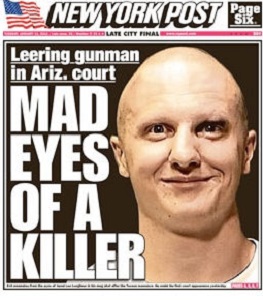
Federal judge Jed S. Rakoff  has dismissed Sarah Palin’s defamation lawsuit against The New York Times, ruling that she had failed to show that the Times  defamed her in its June editorial stating that she was responsible in part for the Tucson shooting of Rep. Gabrielle Giffords and others by the deranged Jared Loughner. Rakoff’s  ruling argued that the statements in the Times editorial were ambiguous (where have I heard this before?), and thus did not qualify as “provably false,” resulting in insufficient evidence that the Times had written the story with “actual malice.”

“[I]f political journalism is to achieve its constitutionally endorsed role of challenging the powerful, legal redress by a public figure must be limited to those cases where the public figure has a plausible factual basis for complaining that the mistake was made maliciously, that is, with knowledge it was false or with reckless disregard of its falsity,” Rakoff wrote.

Right. Except that to write what it did, the New York Times Editors had to be unaware of what the Times itself had reported regarding Palin’s alleged culpability for the shooting. The Times reported, in great detail at the time, that the claim that Palin’s website had inspired Loughner was completely without merit.

A newspaper’s editors impugning a public figure by blaming her for multiple murders and the attempted assassination of a Congresswoman without checking its own reporting doesn’t qualify as “reckless disregard of its falsity”? If that isn’t reckless disregard, what is? Continue reading

Morning Ethics Warm-Up: 7/23/17

Good Morning!

1. Not a single comment on yesterday’s sole warm-up topic, the propriety of complimenting someone’s physical appearance or features? That’s fascinating.

2. I had to wrestle my fingers to the ground yesterday to avoid writing a full post on this editorial by the New York Times editors. I know everyone is sick of Ethics Alarms pointing out the relentless, unprofessional anti-Trump bias in the news media, because I’m sick of  writing about it. This may have been a new low, however. In the wake of Sean Spicer’s resignation as White House press secretary, the Times unleashed the equivalent of a mean playground taunt.  To read it, one would never guess that the Times had ever experienced any other press secretaries, especially President Obama’s trio of Robert Gibbs, Jay Carney and Josh Earnest , who were uniformly dishonest with disgraceful regularity. Spicer was a “four Pinocchio” spokesman? The standrad term her for Obama’s press lackies was “paid liars,” and the description was fair. Yet the Times didn’t greet the news of any of their withdrawals for the post with “Nyah nyah nyah you suck!” editorials, because the New York Times accepted that President’s lies and deceptions as designed for the greater good.

Of course, it was exactly this unethical journalistic bias that caused Spicer to adopt the attitude that most prompted the Times to attack him personally on his way out the door. He believed that journalists who don’t behave like journalists need not he respected as journalists, and he was absolutely correct in this. Indeed, no newspaper that isn’t able to discern that an editorial like the one yesterday regrading Spicer makes it look like a partisan hackery shop should be respected at all. Spicer was a really bad spokesman—inarticulate, inept, dishonest and not very bright. Nonetheless, he was trying to do a difficult job, did his best, and was no more nor less awful at it than all but a few Presidential press secretaries over the last half century or so. Only Spicer, however, was deemed deserving of such insults at the end, not even Ron Ziegler, Nixon’s complicit press secretary who looked and sounded like a half-successful laboratory clone of his boss. That is because the Times’ editorial was personal, based on emotion and anger, and an ethics alarms void.

3. This story from Canada reads like it was designed to illustrate the folly of giving government more power over our lives rather than less. Continue reading

New York Times: ‘Now That The Supreme Court Has Ruled That Our Position Was Progressive Censorious Jack-Boot Political Correctness Enforcement, We Didn’t Mean It’


How can anyone take the New York Times seriously anymore as an objective source of commentary, reporting and analysis?

Here is a hilarious section from today’s editorial celebrating the Supreme Court’s unanimous decision in Matal v. Tam as a victory for free speech:

Writing for the majority, Justice Samuel Alito said the law violates a “bedrock First Amendment principle: Speech may not be banned on the ground that it expresses ideas that offend.” That’s the right call. The First Amendment bars the government from discriminating among speakers based on their viewpoints. In this case, the Trademark Office did that by blocking only registrations for trademarks it determined to have negative connotations. …The decision is likely to help the Washington Redskins, who lost their trademark protections in 2014 after years of complaints from Native American groups. At the time, this page supported the Trademark Office’s decision, and we still regard the Redskins name as offensive. Based on this case, however, we’ve since reconsidered our underlying position.

Really? When did the Times reconsider that “underlying position”? It reconsidered it only when the Supreme Court made it crystal clear that the government’s attempt to bully the Redskins into changing their name was a neon-bright, obvious First Amendment breach that any non-partisanship-addled person of moderate intelligence should be able to discern, thus constituting an embarrassment for a renowned First Amendment-protected entity—the Times—that couldn’t discern it, or that didn’t have the integrity to oppose its ideological allies by stating the inconvenient truth.

The Times endorsed the underlying position that the government could dictate what was “acceptable” speech because Harry Reid’s Democrats and the Obama Administration were doing the dictating on behalf of a core Democratic Party constituency and the progressives that constitute the Times’s readership.

What a cynical, biased, dishonest, corrupt and untrustworthy news source the New York Times has become.

Morning Ethics Warm-Up: 6/17/2017

1. If you haven’t yet read them, Steve-O-in NJ’s Comment of the Day on Chris’s brilliant Comment of the Day regarding ideological and partisan hate—plus Chris Bentley’s Comment of the Day on the same post, are all especially worth reading, not that all Comments of the Day by Ethics Alarms readers are not. I apologize for an unusually long intro to Steve’s post, but I had been holding on to a lot of related material from the day past on the topic, and it was either use them there or be redundant later. This meant putting Steve-O’s COTD after the jump, which is why I’m giving an extra plug to it now.

2. There were two significant criminal trial verdicts yesterday: the guilty verdict in the trial of  Michelle Carter, a Massachusetts woman charged with murder for using text messages to persuade her teenaged boyfriend to kill himself, and the acquittal of the Minnesota police officers who shot and killed black motorist Philandro Castile during a traffic stop. I’ll cover the Carter case later.

There were the obligatory riots after the verdict acquitting Jeronimo Yanez, the officer who fatally shot Castile in his car after he told the officer that he was carrying a legally registered firearm and then reached for his wallet to show the officer his license. This is just the latest cattle-car in the Ferguson Ethics Train Wreck, the familiar pattern of a badly-trained cop, a dubious police stop, poor judgment by a victim, and a needless death. I would compare it to the Tamir Rice shooting in Cleveland, where the officers involved weren’t even indicted.

Why in the world would a motorist tell a cop in that situation—Castile had been officially stopped for a broken tail light, but in reality because he was black, and the officers thought he resembled a suspect in a crime who was also black—that he had a gun? This could be interpreted as a threat, and obviously Yanez saw it as one. The verdict looks wrong at a gut level, but it is easy to see how the jurors were thinking: they placed themselves in the officer’s position. They would have been in fear of their lives, so they couldn’t find a way to pronounce Yanez a murderer for doing what they could see themselves doing under similar circumstances. This was a legitimate case for reasonable doubt under the law. Police officers, however, are supposed to be less likely to panic than a typical juror. Castile is dead because of incompetent police work, but the criminal laws don’t allow different standards to be applied  for different occupations, not should they. Continue reading