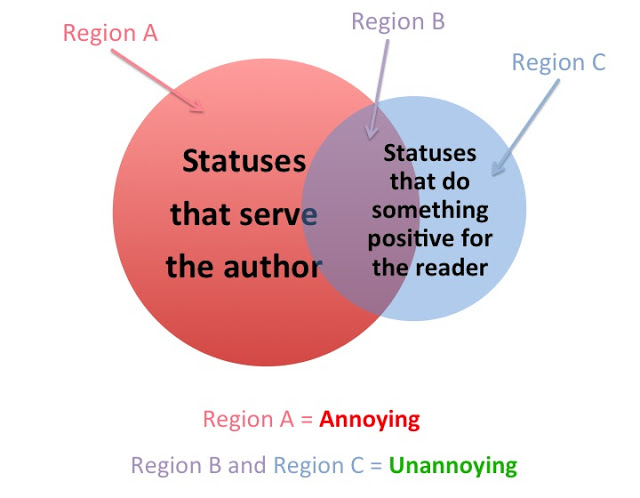
I’m grateful to JP for making the connection between the insulting, shaming marketing ploys I wrote about in the post and the similar techniques I see on Facebook. Not all of them involve virtue-signaling, as in the “Share this appeal for X charity and prove you care, or we’ll know you’re a cheap unfeeling bastard.” Just as bad are the “prove you’re really my friend by writing a sentence about where we met, because I’m going to unfriend everyone who doesn’t” posts. I’m not your validation monkey. Grow up.
A pretty good summary of obnoxious Facebook posts is this article, which observes,
Annoying statuses typically reek of one or more of these five motivations:
1) Image Crafting. The author wants to affect the way people think of her.
2) Narcissism. The author’s thoughts, opinions, and life philosophies matter. The author and the author’s life are interesting in and of themselves.
3) Attention Craving. The author wants attention.
4) Jealousy Inducing. The author wants to make people jealous of him or his life.
5) Loneliness. The author is feeling lonely and wants Facebook to make it better.
Notably absent from the piece is the obnoxious conduct my Facebook friends are addicted to: searching for and posting every anti-Trump news item or opinion piece they can find day after day.
Here is JP’s Comment of the Day on the post, “If You Present Me With Appeals Like This, You Will NEVER Have My Support”:
For a while now I have noticed that there is a trend (especially among evangelicals) to share religious or faith-based content on Facebook that state something like: “I bet this won’t even get one share,” or “Share if you like Jesus, skip if you want Satan to win.” As a Christian and a minister, 100% of the time I will not share it or like it at all. That does not make me a bad or callous person. As a human, I am emphatic and sympathetic about the plight of the sad kid in a third world country shown on the post. As a Christian, not only do I not want Satan to win, I know he has already lost. So what’s the problem? Why won’t I share?
Well, before I answer that, I want to back up here.
Why do people share things on Facebook? A survey done by the Fractl marketing agency said 48% of posts were done because others will find them interesting. 52% focused on things the posters were thinking or feeling. Only 11% of posts are intended to educate others (and we all know how well that is going). While it wasn’t mentioned in the survey, it was clear that 100% of posts were about the people themselves posting them. Therefore everything being stated by the person related to the person in some way. I don’t think that is a bad thing, in fact, I’m pretty sure that is Facebook’s sole purpose. So when a person shares that picture, in some way they are saying they themselves are Christian, or “hey this is an issue I care about!” However, I find this highly problematic.
The first way relates to the Blaze offer. One of the reasons this marketing campaign is so successful is because people are gullible, weak-minded, or proud. You challenge them on an issue that attacks them in someway, and they feel like they have to respond. It reminds me Marty McFly’s self-destructive flaw in the “Back to the Future ” movies. He couldn’t back down when someone called him “chicken.” It was Doc who had to tell Marty that if he didn’t learn to walk away, he was going to suffer the consequences. The second movie shows us the future where Marty’s life will be ruined after he gets in a car accident by accepting a drag race challenge after being called a chicken. This fate is erased in the third film after he finally learns to resist the trigger.
While I doubt any of our sharing or agreeing will have any lasting consequences (other than a flooded email box), I wonder if this pattern builds up to something bigger — (I know: slippery slope!). Continue reading



 Ethics Alarms