Comment Of The Day On Civility And Blog Moderation Ethics, By Ampersand

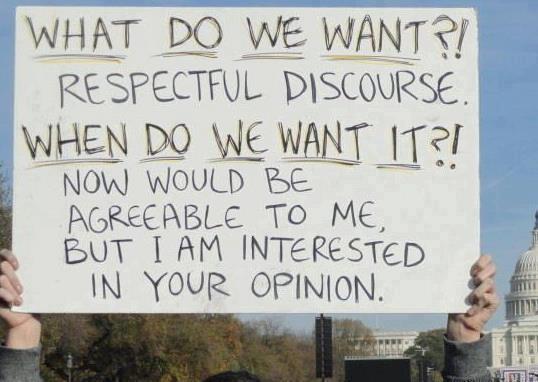
civility sign

It doesn’t really matter what post generated this Comment of the Day (it was the one about Melissa Harris-Perry’s second try at apologizing for inciting her guests to treat Mitt Romney’s adopted black grandchild as the human equivalent of spinach on a fashion model’s front teeth—further ethics developments: Mitt Romney was as gracious as one can be yesterday while accepting Harris-Perry’s mea culpa, and the clueless Alex Baldwin griped that she kept her MSNBC job by playing the weepy girl card, while he was sacked after his umpteenth public meltdown over a paparazzi), because it is off-topic. Ampersand, a.k.a. Barry Deutsch, and I have been fencing about the proper level of invective that should be permitted on blogs like Ethics Alarms and his blog, Alas!.

I take the topic very seriously, as does Barry, because we are both trying to build and maintain an enlightened and diverse community of serious readers and participants in ongoing discussion of serious topics. Barry’s blog is an ideological one; Ethics Alarms, despite being alternatively called on the carpet for being tilting either conservative or liberal, is not. Beyond question, from Barry’s own position on the ideological spectrum, this blog is well to his right. This particular exchange was prompted by complaints by some commenters that my moderation is too loose, that I should censor particular words or eject commenters here who engage in harsh personal denigration. I remain in flux on this problem.

It is true that I have moderated my moderation in recent months, though not as much as some people think. I still bar some commenters, and frequently refuse to accept comments that are nothing but name-calling, as well as those which are objectively moronic. But it is true that regular contributors here who have demonstrated serious intent and valid commentary acquire the privilege of going off the rails, civilly speaking, from time to time. I wish they wouldn’t do it, but despite my belief that civility is critical to societal harmony and professional conduct, I am persuaded that routinely filtering out the passion expressed by vulgarity (and worse) may go too far. I have also been influenced by the recent escalation of political correctness, especially in the media, epitomized when a CNN host announce that the verb “target” was no longer considered appropriate on TV—a threat, don’t you know.

Another factor in my thinking was Popular Science’s decision in September to ban online comments to its articles, rooted in its conclusion that research had proven that aggressively worded contrary opinions could be psychologically persuasive, and were thus “bad for science.” I don’t like the looks of that slippery slope at all.

  I explained my evolving thoughts on the issue in the earlier replies to Barry  and Beth, a commenter here and a personal friend, who has been the target of some of the least civil attacks.  I wrote in part… Continue reading

Dear Legal Profession: How Can We Respect And Trust You When You Police Yourself Like THIS?

Justice_broken3

I’ve been defending my profession a lot here lately, but I also recognize that there is a very good reason why such incidents as the surprisingly generous sentence in the “Affluenza” case and the drug court judge who suffered an alcoholic relapse on the bench are wrongly interpreted as proof of inequities and double standards in the legal system. The reason is that those who oversee the system do inexplicable things that appear to the outside world as not only a lack of integrity but also the apparent inability to realize how such conduct undermines the public trust.

Both of these recent news stories are cases in point:

I. The Imaginary Government Lawyer

In 2012, the Nebraska state supreme court disbarred lawyer David Walocha for not paying his bar dues and proceeding to practice law for 13 years with a suspended license. At the end of 2013, the District of Columbia Bar had to decide what to do with former Justice Department attorney Laura Heiser, who practiced 21 years with a suspended license in the District. What was her punishment? She received an informal admonition, which is the least severe form of disciplinary action.  Continue reading

Ethics Hero: Bill Clinton

Clinton and Bloom

A couple of initial observations on an ironic first Ethics Hero for 2014:

  • President Clinton has been an Ethics Hero before, despite the fact that it was his successful efforts at corrupting the nation’s ethics that led me to launch my first ethics website.
  • As always, when Bill does the right thing, it raises the classic ethics conundrum: did he do the right thing because it was right; did he do it because he knew someone had to do right and he wanted to be first; did he do it because he felt he had a duty to do right; did he do it because he wanted to be perceived as doing right; or did he do it to fool people into believing that he was the kind of person who just does the right thing?
  • Good luck, New York City! You are going to need it.

The speakers lined up for  Mayor Bill  de Blasio’s inauguration’s made one wonder if being rude, arrogant and confrontational is a mandatory qualification for being a New York progressive. Continue reading

Mark Clemishire And The One That Got Away

Big Fish

Letting a fish you’ve caught swim off to be hooked another day doesn’t exactly place you in the altruism big leagues with Oscar Schindler,  but one takes one’s ethical opportunities as they arrive. For Mark Clemishire, a fly fisherman from Skiatook, Oklahoma, this qualifies as exemplary ethics, and attention should be paid.

It was about a month ago that  Clemishire was plying his craft in Lake Taneycomo, Missouri, and after an epic battle, caught a monster rainbow trout he immediately dubbed Troutzilla. Measured at 31 inches long with a girth of 22 inches, Troutzilla almost certainly weighed more than 20 pounds, which easily surpassed the existing record for a rainbow trout. To get credit for his achievement, a big deal for a serious fly fisherman, Clemishire’s trout had to comply with Missouri Department of Conservation rules that required the catch to be weighed on department certified scales. But instead of etching his own name in the record books, embracing immortailty and a place in the Fly Fishermen’s Hall of Fame, if there is such a thing, Mark had some photos taken of him posing with his Catch of the Day, and let Troutzilla go free. Continue reading

The Fifth Annual Ethics Alarms Awards: The Best of Ethics 2013

Ethics Story 2013

I decided to start with the Best in Ethics this year, in contrast to other years, on the theory that it would get things off to a positive start in 2014. What it did, instead, was make me realize how negative Ethics Alarms was in 2013. Either there wasn’t much positive going on in ethics, or I wasn’t seeing it. My thanks to those of you who send me nominations for Ethics Heroes (and other stories); even when I don’t write about them, they are valuable. Please keep them coming. In the meantime, I pledge to try to keep the jaundice out of my eye in 2014. Things just can’t be as dire as they seemed last year.

Could they?

Here are the 2013 Ethics Alarms Awards for the Best in Ethics:

Most Important Ethical Act of the Year:

The U.S. Supreme Court declared the Defense of Marriage Act unconstitutional, paving the way for the universal legalization of gay marriage. Yes, it was a legal decision, but it was also based, as all such culturally important decisions are, on a societal recognition that what was once thought to be wrong and immoral was, in fact, not. This is ethics, an ongoing process of enlightenment and wisdom about what is right and wrong, and the U.S. Supreme Court did its part. Continue reading

What Do You Do With The Drunken Judge? Media Distortion And Judge Gisele Pollack

Broward County (Florida) Judge Gisele Pollack, a recovering alcoholic, showed all the signs of suffering a relapse during her session on the bench two weeks ago, when she abruptly ended the day’s proceedings after an hour and a half that featured the judge slurring her words and acting erratically. She presides over misdemeanor drug court, a program she established shortly after being elected as a county judge.  Her program offenders to have their charges dismissed and their drug records erased after six months of treatment.

After staying away from work for a day, Judge Pollack returned to the bench in the late afternoon, and presided over a courtroom packed with about a hundred drug offenders, along with  their friends and their families. The event marked the completion of rehab for dozens of offenders and the dismissal of their misdemeanor marijuana charges.“You’ve got to remain vigilant,” she told the graduates, emphasizing that they had to work hard to avoid relapses that would  place them back in front of her, and perhaps in jail.

After court, she acknowledged her own health crisis and announced that she was going into an outpatient rehab program. An attorney retained by the judge in the wake of her conduct attributed her relapse to personal issues, telling reporters that she has  “had some severe personal tragedy in her life. Her mother recently passed away, and they were very close. It’s been really devastating for her.” Apparently her son is also suffering from a serious illness. Broward Public Defender Howard Finkelstein, a longtime friend, told reporters, 

“If this causes the people to not have faith and not have trust in what goes on in that drug courtroom, then she will have to step aside,’ he said. ‘My hope is is people will wrap their ever-loving arms around Judge Pollack just as she has wrapped her arms around thousands of people.”

What’s going on here? I think it’s pretty obvious: a recovering alcoholic in a critical position of public trust suffered a relapse, as alcoholics are wont to do. If one is an alcoholic, this is a symptom of a very persistent, pernicious and incurable disease that kills many Americans every year, does horrific damage to families, businesses, governments and the economy, and that is incurable. Being an alcoholic is not an ethical violation for a judge or a lawyer, nor is having a relapse. Allowing that relapse to affect the competent performance of one’s duties, however, is an ethical violation that calls into question a legal professional’s ability to do her job. It could trigger professional sanctions; it certainly should trigger an official inquiry. A Florida judge appearing drunk on the bench, just once, is still a massive ethical breach. It arguably violates the first five Canons of Judicial Ethics a Florida judge is bound to follow… Continue reading

Integrity Surrender For The U.S. Marines

"Any of them are fine, really--all that matters is that they're female, right?"

“Any of them are fine, really–all that matters is that they’re female, right?”

Among the core values of the U.S. Marine Corps is Honor:

“Honor guides Marines to exemplify the ultimate in ethical and moral behavior; to never lie cheat or steal; to abide by an uncompromising code of integrity; respect human dignity; and respect others. The quality of maturity, dedication, trust and dependability commit Marines to act responsibly; to be accountable for their actions; to fulfill their obligations; and to hold others accountable for their actions. “

According to NPR, the USMC has quietly postponed the requirement for all its female recruits to be able to do three pull-ups. The standard, which was to go into effect on January 1, 2014 for all women in the Marines, just as it has long been the upper-body strength requirement for men, has put back at least a year for “further study.” Marine women have not yet had to meet the same upper-body strength test as males because they were not permitted onto the battlefield. Beginning in 2016,  in response to the calls of feminists and women’s rights advocates, females in the Marine Corps and Army will be able, well, allowed, to serve in infantry, armor and artillery units, where the lack of sufficient physical ability can cost lives and result in military failure.  Continue reading

Bob Newhart, Legatus And GLAAD: “What’s Going On Here?” Is Tricky To Answer

"Hey, Bob---What's going on here?"

“Hey, Bob—What’s going on here?”

The news item about comedian Bob Newhart cancelling an appearance for the Catholic executives networking group Legatus under pressure from GLAAD is fascinating.

From the perspective of Ethics Alarms, it illustrates a peculiar phenomenon I experience often, where a prominent story seems to have been designed by the Ethics Gods specifically to combine and coalesce several issues that have been discussed here recently. For Bob’s travails neatly touch on the issues of pro-gay  advocacy groups attempting to restrict expression they disagree with( The Phil Robertson-A&E Affair, Dec. 19), a comedian being pressured to alter the course of his comedy (Steve Martin’s Tweet Retreat, Dec. 23) and an entertainment figure being criticized for the activities of his audience (Mariah’s Dirty Money, Dec. 23). You would think I could analyze the Newhart controversy by just sticking my conclusions from those recent posts, plus some of the more illuminating reader comments, into my Ethics-O-Tron, and it would spit out the verdict promptly.

It doesn’t work that way, at least in this instance, and that prompts the other observation. In most ethics problems, the starting point is the question, “What’s going on here?”, which forces us to determine the factual and ethical context of the choices made by the participants. Here, the question can be framed  several diverging ways, leading to different assessments of the ethics involved. Thus, asking “What’s going on here?” in the Bob Newhart Episode, we might get: Continue reading

Want A Perfect Example Of “Deceit”? Here You Go:

"Believe me, once you get the hang of deceit, you'll wonder how you ever got through a day without it!"

“Believe me, once you get the hang of deceit, you’ll wonder how you ever got through a day without it!”

A substantial number of people don’t understand what “deceit” is, or think that what constitutes deceit isn’t a lie. Deceit, which I used to joke was the official language of Washington, D.C. until it was changed officially to Blatant Mendacity, is when a statement is literally true, but stated in such a way or in a context intended to make the reader or listener believe something that is not true at all. The fact that the statement may have been factual in a pure sense does not diminish its unethical character as a lie. Its intent is to deceive. It is a lie, just a particularly insidious one, aimed at the trusting, unwary, undiscerning and gullible.

I am always looking for a good example of this peculiar form of deception, and they don’t come much better than this.

Drexel University professor Robert Brulle performed a study he eventually called “Institutionalizing delay: foundation funding and the creation of U.S. climate change counter-movement organizations,”  and it was subsequently published  in Climatic Change. Brulle identified 91 organizations that oppose anti-climate change policies, and added up the annual operating budgets of these groups, many of which are active in many issues and that devote a small percentage of their funding to climate change matters at all. He then characterized the resulting total of about $900 million per year from 2003 to 2010 as representing the resources dedicated to blocking the regulation of greenhouse gas production. Brulle’s  study also treats foundation grants to these organizations if every dollar given is earmarked for climate policy opposition. Taking the hand-off from the study’s framing, The Guardian headlined its findings, “Conservative groups spend up to $1bn a year to fight action on climate change.” Notice the “up to,” which would apply if every cent given to organizations like the American Enterprise Institute, The Reason Foundation, The Cato Institute, The Heritage Foundation, the Hoover Institute, the Hudson Institute and many others were only expended or intended to be spent on anti-climate change position papers and advocacy. This isn’t just a gross exaggeration: it’s a lie, intended to be misleading. Continue reading

Jahi’s Plight: Why Death Panels Are Inevitable And Necessary If We Are Going To Pay For Each Other’s Health Care

death panels

Even while the Affordable Care Act debacle is mired in other problems, the “death panel” controversy lingers on, as conservatives exploit the public’s visceral reaction against an inevitable result of modern health care cost-sharing, and progressives dishonestly deny and ridicule the reality of that result, because it makes health care reform less attractive.

The case of Jahi McMath is instructive, if anyone bothers to consider its practical and ethical implications. Jahi, 13, underwent a tonsillectomy Dec. 9, and emerged from her post-op recovery legally dead, due to massive swelling in her brain. She was placed on a ventilator, and according to its policy, Children’s Hospital Oakland was preparing to take her off life support when the family strenuously objected. It petitioned a court to keep her technically alive so she could spend Christmas with them. An Alameda County judge Monday ordered hospital officials to keep Jahi on a ventilator until Dec. 30 while an independent neurologist reviews her case. Meanwhile, her mother told CNN and other local media that although she appreciates  the second opinion and court order, she will fight to keep her daughter on life-support as long as possible, saying,

“I’m her mother. I’m going to support her. It’s my job to do it. Any mother would do it. I just want her to have more time. There are so many stories of people waking up in her situation.” Continue reading