The High School Football Slaughter

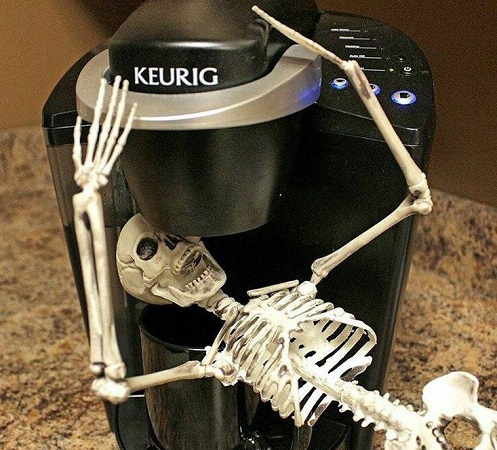
The winning team’s players weren’t really that much bigger; they just seemed that way.

The last time I wrote about the topic of high school football routs (I think) was here. In that post from 2013, I discussed a  “vengeful father who watched his son’s hapless football team get the just desserts of all hapless teams—losing badly” who filed a formal complaint accusing the winning team of “bullying.” The Aledo High School  (Fort Worth, Texas) should have “laid up, he claimed, and not doing so was poor sportsmanship.”

This guy apparently moved to Long Island, and bullied legislators there into adopting his concept of sportsmanship. Nassau County has a policy designed to prevent lopsided results in high school football games, decreeing that if a team wins a game by more than 42 points, the winning coach must explain to a special committee why such an outsize margin could not be avoided. If the coach is not sufficiently convincing, woe be unto him.

So when the  Plainedge Red Devils made a fourth-quarter touchdown against the previously unbeaten South Side Cyclones, making the final score 61-13, a 48 point margin, Plainedge coach Robert Shaver was called on the metaphorical carpet. His explanation wasn’t good enough, apparently, so he was given a one-game suspension.

From the Times account: Continue reading

“I’m Baaaack….” Ethics Catch-Up, 11/1/2019: And Answer, A Rebuke, And A Shock

Rolled back into Alexandria last night, having had an uproarious response from the New Jersey Bar to the special Halloween edition of “Ethics Rock Extreme in Asbury Park seven hours earlier.  The group of lawyers demolished all previous groups for sing-along enthusiasm and prowess in the finale, “The Ethics Man,” a parody of Billy Joel’s “Piano Man.” (My colleague, collaborator and friend Mike Messer gets credit for their verve, I think, for he was in top form, delivering the various songs in hilarious impressions of Joel, Paul Simon, Bob Dylan, Johnny Cash, John Fogarty, and Bobby Pickett imitating Boris Karloff. among others.

I couldn’t get up the energy after the four-hour drive to get a post up last night, so the Ethics Alarms commentariat ended up holding down the metaphorical fort here for all of Halloween. I haven’t had a chance to read all of the comments, but thank-you, everyone. There were even some baseball ethics posts!

Still, there are a lot of ethics issues languishing in my absence. I’m fried, and there are also paying ethics jobs to do and promised to keep, so be patient with me, please.

1. An ethics answer to an ethics question. One Forum comment I did see was this one, from Sarah B.

I have an ethics question. The set up is a bit long, so please bear with me.

Imagine a small town where one out of every nine people works for the same company. Now, this company hires predominantly men, not because it is sexist, but because the work and positions available are more likely to be applied for by men. 9 out of every ten employees are male. In addition, it pays well enough that if a married man were to work in a salaried position, he could make enough money that his wife could stay home with the children if the couple displayed only a modicum of frugality. Thus, most stay-at-home mothers in the community have a husband who works for the same employer, usually in different stages of the chain of command.

Now, imagine that there was a low level supervisor and one of his subordinates. They are of similar ages and have similar values. Their wives are of similar ages and find each other to be enjoyable company. Their children are of similar ages and like to play together. Also, no one else in the supervisor’s area is of a similar age, value system, or time in their families. (No kids or college age kids)

Is it unethical for these two families to hang out socially? What if it is just the wives and kids, not the husbands? What about kids birthday parties, as the kids are friends?

I have heard both sides of this argument played out in my town, but often with both sides using some set of rationalizations from our host’s list. I’d like to hear a more educated opinion here.

Continue reading

From The “Nah, There’s No Mainstream Media Bias!” Files: The Washington Post Plays Partisan Politics With A Headline, And Can’t Even Do It Competently

Once again I will begin by saying that those who deny the partisan bias in the mainstream media against President Trump (among other topics) deserve contempt, either for their lack of perception of the obvious, or for their atrocious citizenship. The last metaphorical rotten journalism gun choking the public with smoke was September’s effort by the New York Times and two of its reporters to continue the smearing of Justice Kavanaugh, a story quickly buried by the Ukraine phone call impeachment plot. (I know, I know, I never got my promised post up on Kavanaugh II. But I will, if it takes until December…) The latest, this time by the Washington Post, is pure res ipsa loquitur. Let me break it down:

I. From the New York Post:

A “high value” target believed to be ISIS leader Abu Bakr al-Baghdadi has died in a US raid in Syria Saturday, according to multiple news reports. Baghdadi was targeted in a strike by US Special Operations forces, three US officials told ABC News. One of those officials told ABC that it is believed the ISIS leader detonated a suicide vest as the ground raid was carried out in the northwestern city of Idlib. Defense Department officials told the White House Saturday it had “great confidence” that Baghdadi was killed in the raid, Newsweek reported, citing Army sources.

This is an undeniable achievement by U.S. forces of the type that the previous President claimed great credit for, and received from the news media without hesitation.

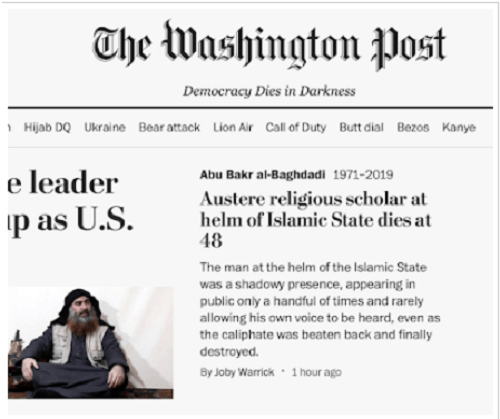
II. Reporting on the terrorist leader’s death, some headline writer at the Washington Post naively played it straight, as if the Post was a real, trustworthy news source. Referring to Al-Baghdadi as “Islamic State’s terrorist-in-Chief” in the obituary heading. Oooh, can’t have that! It will make casual readers assume that the Trump Administration did something praiseworthy!  So the foolishly objective headline writer was dispatched to the Kids Post section, and new headline was appended:

That means President Trump just killed a religious scholar! Oh, he may have been austere, but that’s no reason to kill him! Trump’s a monster!

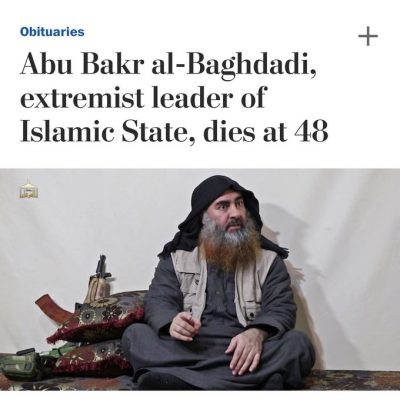
This was so misleading and blatantly absurd that it didn’t remain for more than a couple of hours. Ultimately the Post settled on…

That’s better, but it omits the little detail that the man was a terrorist, like, for example, Osama Bin Laden. The first headline was the right one; unfortunately, it might have benefited President Trump.

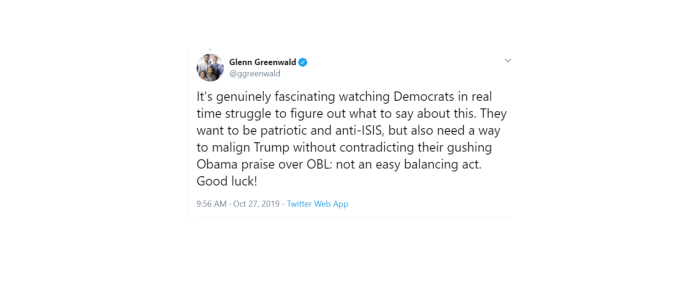
III.  The Post was caught red-handed. Tweeted muck-raking journalist Glenn Greenwald, no friend he either to the mainstream media or President Trump…

Democrats, Washington Post, mainstream media…Greenwald properly lumps them all together. Charles Glasser wrote, Continue reading

Catch-Up Ethics Warm-Up, 10/22/2019: Updates, Word Policing, And The World Series

Late start to the day…

…in part as a hangover from the lively Smithsonian Associates presentation on cross examination with my sister last night. The event was completely sold out, a first among my five Smithsonian programs, and it was an intense two hours, followed by lively questioning from some participants who stayed for nearly an hour to grill us.

1. Good ethics news follow-up: Marlon Anderson, the black security guard who was fired from Madison’s West High School last week for protesting being called “nigger” by  a student, thus triggering an unreasonable, brain-dead and indefensible “no-tolerance”  policy, is being reinstated.

Interim Superintendent Jane Belmore  rescinded the termination less than a week after Anderson was fired. The dismissal triggering intense criticism here and elsewhere, including a student walk-out.  One nice thing about incompetent bureaucracies is that their lazy, thoughtless, unethical actions seldom are accompanied by any real logic or conviction, so they will usually back down, following the path of least resistance.

Still, as Ethics Alarms has asked dozens of times, how can responsible parents trust educators whose judgment is so wretched?

I also want to note that most publications reporting on the story emulated the Wisconsin State Journal, which wrote, “A black security guard who was fired from Madison’s West High School last week for repeating a racial slur a student had hurled at him, in an attempt to correct the student, will get his job back.”

Gee, which racial slur? Isn’t the particular slur an essential part of this story? Was it “negro”? “Uncle Tom”? When is it ever competent journalism to withhold relevant information from readers? Is the theory that the mere word will upset some readers more than the tales of carnage the same publications include daily without censorship? Do we read stories that report, “Someone did something really terrible to 26 people in a church using a weapon of some kind”?

In this case, withholding the crucial word at issue supports the “logic” behind the no-tolerance policy that led to the whole fiasco.

2. In more news of progressive word-policing:  Massachusetts state Rep. Daniel HuntGuess what party he belongs to. Come on, guess!  Hey, you have a 50-50 chance of being right!—-has submitted a bill to the legislature that would criminalize use of the word “bitch.” There will be a hearing today on Beacon Hill. Of course the bill is unconstitutional, but why should we expect elected representatives to be able to figure that out?

Meanwhile, the Boston Herald, supposedly the city’s conservative paper (meaning it’s not as left-biased as the Boston Globe) didn’t dare publish the word, writing instead, “the B-word — the term for a female dog that is commonly used to slander women.”

Someone should  tell the Herald that calling a woman a “bitch,” no matter how unjustified, cannot possibly constitute slander. Continue reading

Once Again, The Unwarranted Presumption Of Racism

“What’s that kid doing up there?”

If something undesirable happens to an African American, the culture is pushing the norm that the misfortune ought to be presumed to be the result of racism until decisively proven otherwise. Similarly, if a white individual is responsible for a black citizen’s plight, deserved or not, the white individual’s motivations are also presumed to be based on racial animus.

Both presumptions are nothing less than sanctified bias and prejudice, as much so as racism itself.

A case study from Washington, D.C.:

About a hundred seventh and eighth-grade students from Shelton Intermediate School in Shelton, Connecticut were visiting the nation’s Capital last week. The group was supervised by twelve chaperones, and the itinerary included the usual museums, monuments and landmarks, including the newest attraction, the Smithsonian’s  African American Museum.

While touring the museum, a male student leaned over a balcony and drooled or spit down on the visitors below. His saliva struck one of them, and the victim was black.  As a result of the incident, the entire group was ejected from the museum. Continue reading

A Jury Gets An Unarmed Black Victim Cop Shooting Right, But The Reasons Why Are Significant

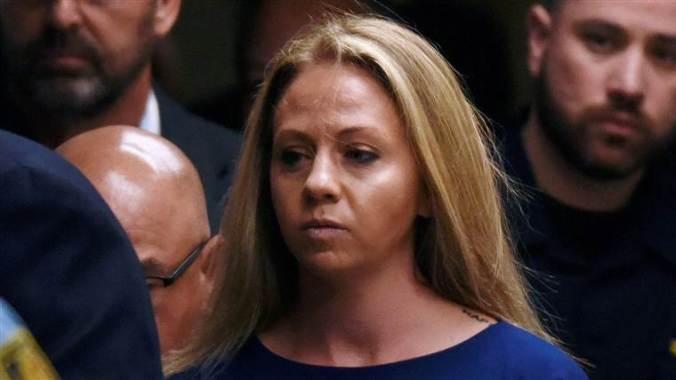
From the AP: “A white former Dallas police officer who said she fatally shot her unarmed, black neighbor after mistaking his apartment for her own was found guilty of murder on Tuesday. A jury reached the verdict in Amber Guyger’s high-profile trial for the killing of Botham Jean after six days of witness testimony but just a handful of hours of deliberation. Cheers erupted in the courthouse as the verdict was announced, and someone yelled “Thank you, Jesus!”

I am surprised at the murder verdict; I expected a manslaughter conviction, and thought that prosecutors may have over-charged.

Nonetheless, a guilty verdict was necessary. It must be remembered, however, that few of the factors typically present in cases where cops have been acquitted for shooting unarmed black citizens existed here. The victim, Botham Jean, did nothing to justify his shooting, indeed nothing to justify having a confrontation with police at all. He didn’t resist a lawful arrest or threaten the officer. Amber Guyger was absolutely and completely responsible for his death in every way. She may have thought her life was in danger, but she was ridiculously wrong, and even if Jean had threatened her, he had every right to do so. She was, to him, a home invader.

In such circumstances as these, none of the usual sympathy that juries have for police officers and their dangerous duties while protecting the public applies. Guyger wasn’t trying to protect the public; she wasn’t even on duty. A jury would naturally sympathize with the victim; if a confused cop could barge into his home and start shooting, it could happen to any juror. Did race play a part in the verdict? I hope not. Whatever the verdict was, there was no evidence to suggest that Jean was killed because of his race.

It will be interesting to see what sentence the jury recommends. I feel sorry for Guyger: she was badly trained, she may have been exhausted from an over-long shift, and there is no reason she wanted to kill Jean, or anyone. Yet with power comes responsibility, and with responsibility comes accountability.

I just re-read my post from a year ago about this case. You might want to read it again too. I’ve re-posted the whole essay below.

I could easily put this story in the Ethics Alarms Zugzwang file, because I see no analysis or result that won’t make the situation worse.

A white off-duty police officer named Amber R. Guyger  entered the apartment of  Botham Shem Jean, a 26 year old accountant, and fired her service weapon twice at him, killing the St. Lucia immigrant. She claims that she mistakenly entered the wrong apartment after returning home from her 14-hour shift and believed  Jean, who is black, was an intruder.

Indeed, her apartment was directly below his. She had inexplicably parked her car on the 4th floor, where Jean’s residence was, rather than the 3rd floor, where hers was. So far, there is no indication that the shooter and the victim knew each other. Guyger had a clean record. Other facts are in dispute. The officer told investigators the apartment door was  ajar and then fully opened when she inserted her computerized chip key. That seems possible but unlikely.  Lawyers for  Jean’s family say the door was closed. How could they possibly know that?  Guyger said in court documents that when she opened the door,  she saw shadows of someone she thought was a burglar, and shouted commands before shooting. Lawyers for Jean’s family have elicited testimony from neighbors that they heard someone banging on the door and shouting, “Let me in!” and “Open up!” before the gunshots.  Why would the officer do that if she didn’t know Jean, or if she thought it was her own apartment? They also said they then heard Jean, say, “Oh my God, why did you do that?”

Boy, that sounds like an awfully convenient exclamation to be remembering now, don’t you think? But who knows? Maybe it proves the two knew each other. (Why didn’t Jean say, “Who are you?”) Maybe it is another “Hands Up! Don’t shoot!” lie for cop-haters and race-baiters  to adopt as a rallying cry.

Surprise! Jean’s family is being represented by Benjamin Crump, the same lawyer who represented the relatives of Trayvon Martin and Michael Brown and managed to manipulate media accounts and public opinion into the narrative that those shootings were motivated by racial hate. If nothing else, Crump is diligent and zealous in creating an atmosphere that maximizes the opportunity for civil damages whether they are warranted or not.

Crump is referring to Jean’s death as an assassination. Of course it is! After all, Guyger’s a white cop, and they live to oppress, brutalize and kill unarmed black men for no reason whatsoever, except to protect white power in a racist nation. Dallas’s black citizens and white activists do not believe the officer’s story, because they presume racism. (Similar impulse: progressives and feminist believe Brett Kavanugh’s accuser, because they want to,)  Protesters chanted and disrupted a City Council meeting last week. There have been escalating  threats against the police. Officers say they believe Officer Guyger’s version of events, as weird and inexplicable as they are. The same bias is at work: they want to believe her.

Things don’t work when they are hemmed in by biases and agendas like this. Let’s say that an investigation yields no clarification. An innocent man was shot in his own home by a police officer who lived beneath him for no discernible reason, and the cop’s only explanation is that she was tired, confused, and made a mistake. What is the ethical course at that point?

There are a few easy calls. The police department has civil liability, and it is high time to put the same kind of limitations on police shifts that airline pilots must abide by. The accident, if it was an accident, may have been caused by unethical working conditions. It would also be sensible for apartment and condo complexes to be required to make all floors recognizably distinct. I have tried to enter the wrong hotel room, apartment, condo unit and dorm room at various times, in addition to walking into ladies rooms and the occasional closet. Luckily, I don’t carry a gun. However, my own experiences make me at least willing to consider that this might have been nothing but a terrible, tragic accident.

Obviously, Officer Guyger’s career is over no matter what the truth is, and should be. Thus I agree with the argument that she should be suspended without pay or simply fired. Off-duty cops are required to carry guns, and once a cop makes this kind of “mistake,” she can’t be trusted. I wouldn’t want her wandering around my neighborhood.

Beyond that, however, what is Dallas supposed to do? The race hucksters want to protest and exacerbate racial divisions. Guyger will be painted as a cold-blooded racist killer, and typical of all police. Any result that doesn’t have her sentenced to prison for a long time will be condemned as proof that the white fix is in. The city has a duty to prevent riots and deaths, but not to squelch protests, no matter how cynical and unfair. Should it indict and try Guyger for murder rather than manslaughter, knowing that over-charging could result in an acquittal?  This was Baltimore’s approach in the Freddie Gray case, and now police passivity has made the city a runner-up to Chicago as U.S. Murder Central. What if the investigation suggests that this was indeed an accident, and no more? Is it fair to try Guyger at all, then? Will jury members concede that she has lost her occupation and her reputation, and that imprisoning her is cruel—that she has suffered enough? Or will Guyger really stand trial not as an individual, but as a symbol of all cops who shot unarmed black men and escaped accountability?

Not only do I see no satisfactory ethical outcome, I can’t even decide what an ethical outcome would be.

I do know this, however. Bias not only makes us stupid, it makes fairness, justice and law enforcement impossible.
 

Sentencing Ethics: The Perplexing Relevance Of “Acquitted Conduct”

Senators Dick Durbin (D–Ill.) and Chuck Grassley (R–Iowa) introduced a bill this week that if passed and signed into law would  prohibit the use of so-called “acquitted conduct” at sentencing. What is acquitted conduct, you might ask? It is charges for which a defendant has been found not guilty that a sentencing judge nonetheless considers when sentencing that defendant for the crimes the jury says they did commit. This practice give prosecutors a special edge. Knowing that a judge may consider at sentencing every offense the prosecutor charges, a prosecutor can charge a defendant with an offense he knows he can prove beyond a reasonable doubt, and then charge more serious offenses that he probably can’t  prove. Even if jurors only reach a guilty verdict on the charges proved beyond a reasonable doubt, and refuse to convict on other charges, a judge can, and often does takes all the charges into consideration at sentencing.

“If any American is acquitted of charges by a jury of their peers, then some sentencing judge shouldn’t be able to find them guilty anyway and add to their punishment,” Grassley said in a statement released this week. “That’s not acceptable and it’s not American.” Under the law he is proposing with Senator Durbin, if a prosecutor charges you with five crimes, and the jury finds you not guilty of four of them, the judge who then sentences you should be able to consider only offense you were found guilty of.

What’s going on here? It is simply that the Federal sentencing rules currently allow a judge to consider crimes he or she believes the defendant is guilty of committing regardless of what the jury decided, just as a judge can take other factors into consideration. In such cases, a judge may use a preponderance of the evidence standard, not the criminal law standard of  beyond a reasonable doubt, to conclude that the jury was wrong and that a sentence should reflect conduct other than what the prosecution was able to prove to the jury’s satisfaction. Continue reading

Ethics Verdict: The Democrats Will Be 100% Responsible For The Damage The Impeachment Will Do To The nation.

Impeachment, though it is doomed to fail, will be terrible for the country in too many ways to count, and the Democratic Party, abetted by the mainstream news media, will be 100% responsible for the harm. Not 75%. Not 99%. 100%.

I know I’m going to have to write a lot in the coming months about this, and I’m already sick of it, but if progressives, the media and the Democrats had treated this President as every one of his predecessors had been treated, we would not be here. They all decided to actively search for a justification to remove this President from office without an election. The calls for impeachment and contrived legal excuses to remove him began before Trump even took office.

It is satisfying, I suppose, in a mordant way, that the Democrats somehow trapped themselves into using one of the lamest and least persuasive justifications for an impeachment inquiry imaginable, and will pay a steep, steep price for it. Even the fact that the party and the media will suffer greatly for their attack on democracy, however, does not sufficiently mitigate the damage they will have done to the nation. Continue reading

Saturday Night Ethics Fever, 9/21/2019: Crazy Stuff

1. A simple, factual, ethical rebuttal to Beto O’Rourke, who panders to the anti-gun Democratic base by saying that he’ll confiscate the weapons he thinks we don’t “need.” Lauren Boebert, who with her husband owns local restaurant Shooters Grill, where she and a lot of the staff  open carry a loaded firearm,  confronted  O’Rourke at a town hall in Aurora Colorado. “I was one of the gun-owning Americans who heard you speak regarding your ‘Hell yes, I’m going to take your AR-15s and AK-47s.’ Well, I’m here to say, ‘Hell no, you’re not!”

She was, of course, correct, just as Beto was grandstanding to the ignorant and fearful, in deliberate defiance of the Constitution.

To his credit, Beto tried to control the rabid anti-Second Amendment fanatics in his crowd  who tried to shout Boebert down, as she continued,  “We all have these stories. We all have the experiences. I was living in Aurora during Columbine. I had just recently moved when the Aurora shootings happened. Yet I have very close ties here. Yet all of those people were there defenseless.”

“They had no way to defend themselves against a crazed shooter, so I want to know how you intend to legislate the hearts of men and leave American citizens like myself, American mothers,” Boebert said. above the  abuse from the crowd. “I have four children. I’m 5 foot zero, one hundred pounds, and cannot really defend myself with a fist.”

Then she told a heckler near her that  she didn’t have her AR-15 with her, but  was carrying her Glock. “Well, you shouldn’t have that,” the man said.

Wrong again. It’s not his call, nor his business, whether she has a pistol or not.

2. From the wasteful and pointless protests files: “Hundreds of thousands” of 20-somethings and kids took part in a global protest against “inaction on climate change.” What do they know about climate change? Only what they have been told by agenda- driven activists, teachers and politicians, almost all of them without genuine scientific comprehension of the complexities, vagaries and uncertainty of the topic themselves. Are hundreds of thousands of people who don’t really know what they are talking about more persuasive than, say, one? Should they be?

No. Leading these innocents to believe otherwise is a cruel joke. Margot Guillen of Harvest Collegiate High School, told Yahoo News she was there to send a message, saying, “By protesting peacefully, it shows how committed our generation is to making a change and showing that we know what’s happening and we need to stop it.” They don’t know what’s happening, though, and they don’t know how to stop “it,” in part because they don’t know what “it” is, when “it” will occur, what the extent of “it” will be, and even whether “it,” whatever “it” is, will occur at all.

Good protest.

Typical. Continue reading

Ethics Quiz: The Declining Neighborhood Contractor

Two weeks ago, The Ethicist (that’s , the real ethicist who authors the New York Times Magazine’s advice column) was asked about the most ethical response to a true ethics conflict. A neighbor who frequently did contracting work in his neighborhood had recently  begun delivering shoddy work.

The inquirer writes, “He has made numerous mistakes, which have required fixes. He occasionally smells of alcohol and admits that he has “a beer” at lunch. Although he is on the job every day, he has not fulfilled the oversight component that we expect from a general contractor, and we have gradually taken over managing the project. “

The inquirer knows the man’s family, which has been going through a difficult period, “which may have impacted his mental health and drinking patterns.” Now he wonders where his loyalties and responsibilities lay. Does he have an obligation to alert neighbors, through a community consumer referral website, that their neighbor’s work is now unreliable? Or is the kind, compassionate action of trying to help the friend work through his current problems, while letting neighbors take their chances, despite the fact that everyone knows the inquirer has referred the contractor favorably in the past?

Appiah makes the predictable ethicist call that the duty to the many over-rides the duty to the one, especially since the inquirer has some responsibility for the community’s trusting the rapidly declining contractor. His advice asserts the equivalent of a duty to warn.

Your Ethics Quiz of the Day:

Is The Ethicist right?

Continue reading