The NFL’s Replacement Ref Dilemma

There are some things even football fans won’t stand for. I think.

It was Week #3 of the NFL season, and there is a growing consensus that the replacement referees, the consequence of the NFL’s labor dispute with its regular refs, are making, if not a mockery of the game, a mess of it. The ethics issue: at what point is the quality of the NFL’s product so compromised by sub-professional officiating that the league is cheating the public by presenting it at all?

Airlines don’t use replacement pilots when pilots go on strike; they wouldn’t dare. Chicago didn’t hire street mimes to stand in for the striking teachers. In the NFL’s case, it is making the calculation that football fans will put up with lousy officiating if the alternative is no games at all on Sunday. Meanwhile, the NFL still charges the same outrageous prices for its tickets and still collects full value in merchandising and TV revenue. Translation: It is getting full price for a less than complete product. Is that ethical? Continue reading

A Tale of Two Panders

I know. I’ve hated the pander-panda pun since Sen. Paul Tsongas called Bill Clinton a “pander bear” in 1992. But the newborn baby panda at the National Zoo died yesterday, there’s no way to write about it on an ethics blog, so this was the best I could do to register my condolences. Forgive me.

What would be the response of an objective and balanced news media—that is, one determined to treat both candidates equally unfairly—to  an Obama equivalent of the infamous Romney dismissal of “47%” of the electorate? We really can’t tell from the closest comparison, candidate Obama’s infamous and also surreptitiously taped 2008 comments in ultra-liberal San Francisco, condescendingly describing blue-collar Pennsylvanians who, he said, “get bitter, [and] cling to guns or religion or antipathy to people who aren’t like them or anti-immigrant sentiment or anti-trade sentiment as a way to explain their frustrations.”  That was while he was running against another media darling, Hillary Clinton, so it presumably got more play than it would have if he were facing a hated Republican.

Better intelligence comes from Jennifer Rubin’s criticism today of Obama’s answer to an interviewer on the Spanish language cable station Univision, who asked him what his greatest failure was. Why, failing to achieve comprehensive immigration reform, of course! (“This is a Hispanic channel, right?”)

Really?, wonders the conservative Rubin. How about… Continue reading

Ethics Heroes: Papa Roach

Ethics Alarms’ 2011 Commenter of the Year tgt, who found this story and passed it on, asks,

“How is a horrible stoner rock band more ethical than everyone in politics?”

It’s a great, if sorrowful, question.

A.V. Club has a feature (which could be called “Start a Feud”) in which it asks a rock performer what song he or she hates, and why.  Jenn Wasner, one half of the Baltimore indie-folk duo Wye Oak (“a blend of Southern culture and Northern sensibilities…”) submitted to this invitation to get in trouble, and fingered the song in the video above, “Scars,” by Papa Roach.

Criticizing the work of other artists in the same field is unprofessional at best, gratuitously unkind and disrespectful. Papa Roach’s members would have been within their rights to fire back something less than complimentary in defense, at very least the observation that ethical musicians don’t take gratuitous shots at one another. What the band did however, was this: it sent Wasner flowers. Wasner was convinced it was some kind of diabolical trap, and tweeted as much. The band tweeted back: Continue reading

The Part of Legal Ethics The Public Will Never, Ever Understand

Sen. Brown has the pulse of the public on this issue, and like the public, he’s ignorant.

Especially since politicians like Scott Brown keep making sure that they misunderstand.

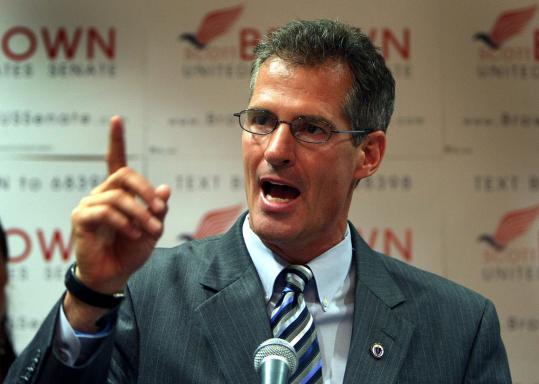
In this week’s Massachusetts Senate debate between Sen. Scott Brown and Democratic challenger Elizabeth Warren, Brown slammed the anti-corporate crusader, the self-styled intellectual catalyst for the Occupy Movement, for accepting $250,000 from the Travelers insurance company to help the company deny claims for asbestos poisoning. He said:

“You chose to side with one of the biggest corporations in the United States: Travelers Insurance. When you worked to prohibit people who got asbestos poisoning, and I hope all the asbestos union workers are watching right now. She denied, she helped Travelers deny those benefits for asbestos poisoning, made over $250,000 in an effort to protect big corporations….”

Brown is accurately stating the way most people look at lawyers and what they do. But he is absolutely mistaken. His characterization of what Warren did is incorrect, and his inference of hypocrisy is unfair.  It is all the worse because he is a lawyer himself. If Senator Brown, as a lawyer, doesn’t understand what’s wrong with his accusation, he should. If he does know, then he is undercutting his own profession for political gain. [NOTE: The original version of the post incorrectly stated that Brown was not a lawyer. My thanks to Mass lawyer James Flood III for flagging the error.] Continue reading

Policies Don’t Fix Unethical Professors

“Here is your assignment, class: Vote for who I tell you to.”

I saw this story and decided it was too obvious to write about. A community college math professor distributes to her class a pledge to vote for Obama and the Democratic slate, and demands that the students sign it—come on! Is anyone going to defend that as ethical? Then a reader sent me several links to the item (thanks, Michael), and after reading them, I was moved to reconsider.

The professor, Sharon Sweet, was put on unpaid leave pending an investigation; I can’t fault Brevard Community College (in Florida) for not firing her yet. What troubles me is the college’s statements that her conduct is just a breach of policy. BCC Spokesman John Glisch told the press that “The college takes this policy [prohibiting employees from soliciting support for a political candidate during working hours or on college property] extremely seriously. It is very important that all of our faculty and staff act in that manner at work and while they’re on campus.” So college provosts are reminding employees about the policy.

Let’s be clear. Associate Professor Sweet’s conduct was an abuse of power and position, an insult to the autonomy of the students and an attempt to take away their rights as citizens, disrespectful to them and the values of the nation, and an attempt to circumvent election laws and to subvert democracy. It was also, quite possibly, illegal. If a college needs to have a policy to stop teachers from behaving like that, it is hiring the wrong kinds of teachers—individuals whose ethics are those of totalitarian states, and whose respect for individual rights are nil. This was an ethical breach of major proportions, not a policy misunderstanding. No teacher should require a policy to tell her that this conduct is indefensible and wrong. Continue reading

Comment of the Day: “Yes, Reporters Engaged in ‘Collaboration’ On Questions For Romney. Good!”

Dwayne N. Zechman, who has one or two other Comments of the Day to his credit, has authored another in response to the post regarding conservative alarms over evidence that reporters coordinated their questions before Mitt Romney began a press conference on the protests and violence at Middle East embassies. My position was that there is nothing sinister in this as long as it results in the politician or candidate being grilled actually answering legitimate questions. Reporters should do this with all question sessions, if politicians insist on spinning, ducking, and prevaricating. Obviously, if reporters employ this strategy with Romney and not the President, that raises an ethical problem, but a different ethical problem.

Here is Dwayne’s Comment of the Day in response to the post, Yes, Reporters Engaged in “Collaboration” On Questions For Romney. Good!.  I’ll have a further comment at the end.

“I *do* have a problem with the Press Corps acting this way because it sets up a dangerous future license for them to engage in groupthink with no checks and balances against it. (Indeed, the First Amendment would correctly, though tragically, protect it.) Continue reading

THIS is Hindsight Bias, So You’ll Know a Jerk When You Hear One

I haven’t watched a Red Sox game for over a month now; more on that soon. I do check on the game results however, and observed with interest that Red Sox manager Bobby Valentine, currently being dressed for the guillotine by New England sportswriters who want him punished for a miserable season in which his own work has been outstanding, is being criticized today in a textbook example of hindsight bias at work. I am flagging it for any of you who might want to explain the phenomenon to the next jerk who criticizes you for a reasonable choice you made not knowing how it would turn out, based on the jerk’s knowledge of how it in fact did turn out.

My least favorite personal run-in with hindsight bias was the time I lost a poker hand—and a lot of money– in Vegas despite having four of a kind in a game of seven card stud. The old man sitting next to me looking pathetic also had four of a kind, and in a higher denomination, the odds of two four of a kind hands appearing in the same deal in a non-wild card game being approximately six-gazillion to one. Naturally, I was betting the limit until the old man called my hand—he said later that he felt sorry for me. When he revealed that he had my four sevens beat with his four %$#@%$*& tens, it caused a genuine uproar in the casino, and the dealer said that he had never seen the like in eight years on the job.

“You should have known he had you beat,” said the ass sitting on my right. That’s hindsight bias. And so is this. Continue reading

“Print the Legend” Ethics: The Unjust Obscurity of Mary Quantrell

Barbara Fritchie, as in the poem. But the Barbara in the poem was really Mary.

Today is the anniversary of the Battle of Antietam, the single most bloody day in the Civil War, with nearly 21,000 casualties on September 17, 1862.  Most of us, at least those of my generation, were introduced to the battle with a poem, “The Ballad of Barbara Fritchie,” by John Greenleaf Whittier, telling the tale of a brave old woman, ninety years old, who confronted Confederate General Stonewall Jackson’s troops as they marched through Frederick, Maryland to the battlefield, by waving Old Glory after the troops had fired at it, and saying,

Shoot, if you must, this old gray head,
But spare your country’s flag,’ she said.

Barbara Fritchie is now an icon, and has been portrayed in novels and films. Her house is a historic landmark, and the town uses her name and the poem to market everything from candy to T-shirts. And, I learned this Sunday, it is all a lie, though not old Barbara’s fault. The poet got his facts wrong, or used excessive “poetic license” because “Barbara Fritchie” pleased his ear better than “Mary Quantrell”, the name of the real flag-waver, and a 90-year old patriot made for a more colorful plot than a mere 30-something with chutzpah. Whittier also made Jackson the antagonist of the tale, when in fact the general was the less flamboyant and famous A.P. Hill. In 1876 Quantrell wrote to Whittier pleading with him to correct the record, signing her letter, in quotes, as “Barbara.” He did nothing. Continue reading

Yes, Reporters Engaged in “Collaboration” On Questions For Romney. Good!

Hidden Camera: The mainstream media meets to plot against Mitt Romney…

Yesterday, the Right Scoop blog breathlessly announced that it had acquired a recording of what an open mic had caught in the discussion among reporters prior . to Mitt Romney’s press conference:

CBS REPORTER: “Yeah that’s the question. I would just say do you regret your question.”

UNIDENTIFIED REPORTER: “Your question? Your statement?”

CBS REPORTER: “I mean your statement. Not even the tone, because then he can go off on …”

UNIDENTIFIED REPORTER: “And then if he does, if we can just follow-up and say ‘but this morning your answer is continuing to sound …”

CBS REPORTER:  “You can’t say that.…”

CBS REPORTER: “I’m just trying to make sure that we’re just talking about, no matter who he calls on, we’re covered on the one question.”

UNIDENTIFIED REPORTER:  “Do you stand by your statement or regret your statement?”

This is it!, proclaimed Rush Limbaugh and, like echoes in a grotto, every other conservative talk show host and blogger, and of course Fox News, bleated the same. The smoking gun! The proof! The mainstream  is engaged in a conspiracy to destroy Mitt Romney and to re-elect President Obama! Just let George Stephanopoulos and the rest try to deny media bias now! Continue reading

A Boy Named Sue, A Woman Named Edward

I think I know where he works…

I have no idea what to make of this: I feel like I fell into a “Seinfeld” episode. Remember the “high talker”?

I received an e-mail yesterday from the executive of a large company inquiring about an ethics training. The first name of the executive was Edward, but when I called the listed number, a very high, very female voice answered the phone. I asked to speak to the executive, and received a perky, “I’m Edward! Thanks for calling me back.”

Come on. Edward? What woman goes by Edward? I was about to make a comment like, “That’s an unusual name—how did you come by it?” when I had an image of “Seinfeld’s” high talker, a short, fat, bald guy, becoming irate when callers mistook him for his girlfriend over the phone. This was a potential client, and I didn’t want to annoy her—or him. On the other hand, surely she, assuming it is a she, knows that her masculine  name causes confusion. I searched through her e-mail messages for any hint of her—if she was a her—gender, and found nothing. Wouldn’t it be reasonable and fair to at least confirm that yes, she was a woman, or yes, he was a male counter-tenor, or yes, he was indeed a castrati, or at least do something to clear up what he…or she, dammit… had to know was confusing to anyone meeting her over the phone? Continue reading