Ethics Observation On The Tempe, Arizona Starbucks Incident

Ethics Alarms does not endorse any organized boycott efforts against any product, business or organization. However, if any corporation is begging to be boycotted, it’s Starbucks…

In case you missed it:

On July 4th, six Tempe, Arizona police officers visited a local Starbucks to get some coffee. The officers paid for their beverages and stood together, sipping coffee and chatting. A barista approached one of the officers, whom she apparently knew by name because he is was a frequent customer, and informed him that a customer  currently in the store “did not feel safe” because of the police presence. She asked the officers to move out of the customer’s line of sight (!) or to leave entirely.

The officers  left, but apparently reported the incident to the Tempe Officers Association, which described the incident on Facebook and added,

This treatment of public safety workers could not be more disheartening. While the barista was polite, making such a request at all was offensive. Unfortunately, such treatment has become all too common in 2019. We know this is not a national policy at Starbucks Corporate and we look forward to working collaboratively with them on this important dialogue.

The Tempe Police put out their own statement:

Starbucks, proving at least that it has not completely lost its mind, quickly apologized to the  Department, with a representative meeting with the police chief.  The statement:

“When those officers entered the store and a customer raised a concern over their presence, they should have been welcomed and treated with dignity and the utmost respect by our partners (employees). Instead, they were made to feel unwelcome and disrespected, which is completely unacceptable,”

Observations: Continue reading

Sunday Ethics Warm-Up, 7/7/2019: BAM! POW! BOOM!

Welcome.

1.BAM! Billionaire sex-predator Jeffrey Epstein was arrested again, but that’s just the tip of the proverbial ethics iceberg:

  • This was the feds doing the arresting, which is confusing, since one of the controversies involving Epstein is a federal non-prosecution agreement that was part of his plea deal, negotiated by a team of super-lawyers including Alan Dershowitz.

This means that the victims in the new prosecution must be different victims from the ones in the case that send Epstein to prison for a paltry 13 months.

  • If so, I’m shocked–shocked!–that a mega-sex trafficker and sexual predator like Epstein hasn’t learned the error of his ways!

Actually, it would be shocking if a billionaire sex predator who got just a slap on the wrist for paying procurers to search the world for underage girls to be ravaged by Epstein and others at Epstein’s private plane, his Palm Beach mansion, and other locales didn’t keep engaging in his extra-curricular passion.

  • Federal prosecutors recently filed court papers in Florida case contending Epstein’s no prosecution deal must stand, with the filing stating,  “The past cannot be undone; the government committed itself to the NPA, and the parties have not disputed that Epstein complied with its provisions.”Now the The victims in the Florida case have until Monday to respond to the Justice Department’s filing.
  • The news media and social media resistance squads are hustling to connect Epstein to President Trump. Are they friends? Were they friends?  Most of the nation’s billionaires know each other: Trump has confirmed that he knows Epstein. Nothing has connected Trump to Epstein’s sex parties, however.

The same cannot be said of Bill Clinton.

  • The Trump connection is Labor Secretary Alexander Accosta. He was the Miami prosecutor who cut the outrageous deal with Epstein. I wrote in detail about the scandal here. Knowing all of this, President Trump still appointed Accosta as his Labor Secretary—you know, “the best people”—and the Senate confirmed him, even though this was a guaranteed ticking time-bomb.

It looks like it may finally blow.  Stay tuned.

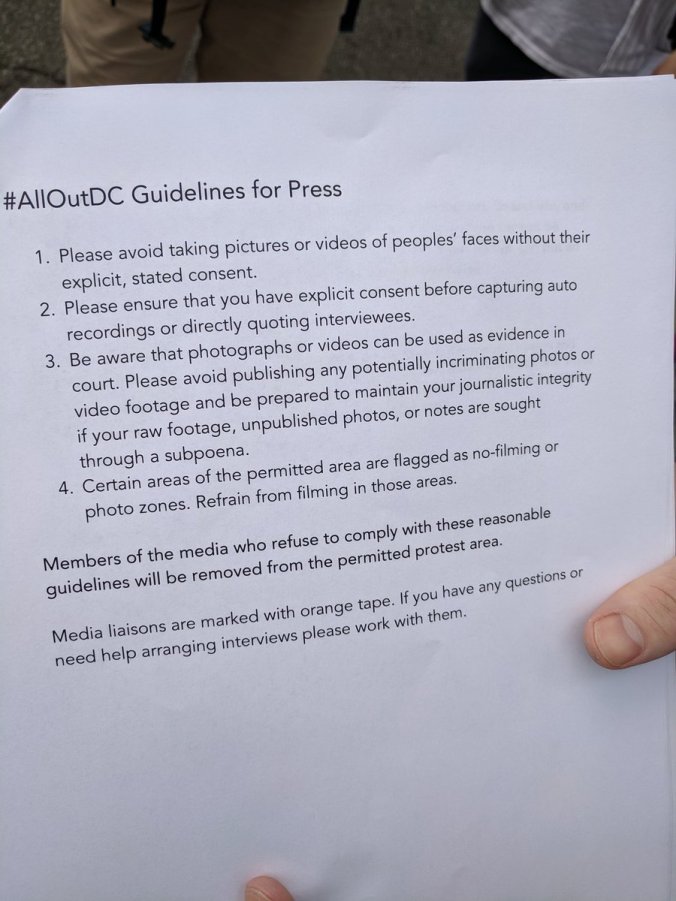
2. POW! Res Ipsa Loquitur? Here is the Antifa’s press guidance distributed in advance of its planned disruption of a conservative protest against what the New York Times calls “perceived censorship of conservatives on social media.”

Hmmm. Continue reading

An Ethics Quiz Returns With A New Context And An Ancient Conundrum, And The Answer, My Friends, Is Still Blowin’ In The Wind…

The Ethics Quiz from 2013, “Peter’s Problem,” that I have re-posted in its entirety below has come circling around like boomerang, in a different context. Then, singer activist Peter Yarrow of Peter,Paul and Mary fame was being attacked by the political Right, which argued that his participation in a political campaign event for a Democratic Congressional candidate was proof of that candidate’s poor judgment. Yarrow, as we were told by PBS when it raised fund by showing Peter,Paul and Mary concerts, had answered a knock on his hotel room door naked when  two teenage sisters, 14 and 17, stopped by in 1969 to seek an autograph. The 14-year old got a lot more than his signature. Yarrow was eventually charged with taking indecent liberties with a minor, pleaded guilty and was sentenced to three months in jail. President Jimmy Carter pardoned him in 1981.

Lat week, Yarrow’ s past (he was 31 then; he’s 81 now)  caused one of his appearances to be cancelled, but this time it wasn’t those Puritanical conservatives complaining about Yarrow’s “if it feels good, do it” sexual misconduct (which most of Yarrow’s younger fans in the Peace and Love Era didn’t think was misconduct at all), but the Left’s #MeToo furies.

Yes, Peter Yarrow and his critics have boarded the Harvey Weinstein Ethics Train Wreck.

Since that rollicking night in 1969 , Peter Yarrow has solidified his folk singing and progressive activist status without further public blemishes, and having him associated with an event has usually been regarded as a positive, not a negative, feature when progressives and their causes are involved. John Kerry had him sing at his wedding. Bill Clinton featured him at an Inauguration. He has collected lifetime achievement awards like little Jackie Paper collected painted wings and giant rings.

Last week, however, the Colorscape Chenango Arts Festival, which had  had described Yarrow in its advance publicity for his participation in its annual  September festival as  one of “America’s longtime favorite musicians and performers,”  canceled his appearance, saying in a statement…

“Some members of our community expressed concern, and after further investigation and careful consideration the decision was made to remove Yarrow from the music schedule.”

In the 2013 post, , I criticized Yarrow’s apologetic statement at the time, which was tainted by rationalizations. His statement last week was much better: Continue reading

Saturday Morning Ethics Warm-Up, 7/6/2019: Of Nike, MAGA Hats, Plays, Principals And All Manner Of Idiocy

Good morning.

Commemorating one week without our Rugby, who shrugged off his canine coil Saturday last. It has been a weird and lachrymose seven days, full of reflex attempts to call him, look for him, start to out out food, and more. Worsts of all have been the chance encounters with our neighbors and his admirers, which have ended in everyone involved getting choked up. This is all exhausting, and not conducive at all to adequate focus on other matters.

1. The rest of the story...Marshae Jones, the woman who got her unborn child killed by starting a fistfight with a co-worker, will not be charged for the death of the fetus in the Alabama case I wrote about here.  I thought that would be the result. In the Ethics Alarms reader poll, over 50% felt that she should be charged:

2. Grandstanding idiot alert! Arizona Governor Doug Ducey received applause among those who do not appreciate gratuitous America-bashing and wokeness-groveling  when  he reacted to  Nike’s decision to pull its “Betsy Ross flag” sneakers (because Colin Kaepernick objected) by announcing that he would no longer support state incentives for the company to build  a plant in the Grand Canyon State. Two days later, Ducey arrived  at a 4th of July party wearing Nikes.

I wonder how he managed to forget to wear his Colin Kaepernick tee shirt?

3. Harry Truman’s best quote comes to mind. That would be, “It is amazing what you can accomplish if you do not care who gets the credit.”

Two British playwrights, Allen-Martin and Sarah Henley, have accused actor Idris Elba of misappropriating their work on  “Tree,” a play they worked on with Elba for several years. “Tree” will have its world premiere at the Manchester International Festival this month, but the aggrieved playwrights will not be at the premiere,

They complain that their role in the play’s development has been erased, and that their work is not being properly acknowledged. Elba and and the play’s director say Allen-Martin and  Henley withdrew from the project, and that the show that has evolved no longer reflects their work.

“This whole process has been terribly upsetting, and we’ve felt terrified about speaking out…People need to be better, especially people who inspire others,” the pair wrote  on Medium. Continue reading

Prison Labor Ethics

Prison labor is an ethics issue that I have never considered before. Apparently that’s true of a lot of people. In Massachusetts, an Amherst-Pelham Regional High School  student named Spencer Cliche (great name!) was challenged to undertake an investigative journalism project, He eventually published a 3,000-word exposé  on prison labor topic in his school’s newspaper.

The high school, it seems, had contracted with a local prison to re-upholster its auditorium seats,  taking its low bid for the job over another bid by a local business. As a result of the uproar sparked by Spencer’s work, the school superintendent issued a statement to school staff members promising never to contract with the prison again.

It does not appear, however, that this decision was based on  careful balancing of the ethics issues involved, but rather, as usual, a lazy capitulation to avoid an emotion-based controversy.

The local  newspaper, The Daily Hampshire Gazette, eventually picked up the story. as did a local radio station that featured Cliche’s report as the “question of the morning.” Then the issue was raised by The Marshall Project, a prison and justice system reform project.

In addition to routine prison labor, which is usually handled in a prison facility, there are also state-run “correctional industries,” such as MassCor, which arranges for inmates to do work for  schools, nursing homes, towns, non-profits and other institutions. Obviously, their costs are lower than competing businesses, because prisoners earn less than a dollar an hour on average for their labor, according to Prison Policy Initiative.

Thus we have multiple looming ethics issues, among them…

  • Is it ethical to force prisoners to work at all?

I don’t see how an honest argument can be formulated that argues that it is not. Work organizes the time and attention of the jailed, keeps them occupied, minimizes boredom and the opportunity to get into trouble. Social justice advocates seem to think that prisons should be like summer camps, with sports, crafts, and other pleasant diversions. That approach is both expensive and undeserved. Prison, among other things, is and ought to be punishment.

  • Is it ethical to pay prisoners less than the minimum wage? Isn’t forced labor with no compensation or minimal compensation virtual slavery?

Convicted prisoners forfeit most of their constitutional rights. Some forms of forced labor might rise to the level of cruel and unusual punishment, and prison labor is ripe for abuse (just ask Andy Dufresne, the protagonist of “The Shawhsank Redemption”), but criminals are a burden on society, and warehousing them is expensive. There is nothing unethical about requiring those who have imposed that burden to help alleviate it.

  • Are prison-based businesses like MassCor unethical?

 Cara Savelli, a spokeswoman for the Massachusetts Department of Correction interviewed by the student journalist, defended the program, saying,

Continue reading

Ethics Alarms Encore: “Ethics Quiz: Four Young Children Locked In A Hot Car” (July 31, 2014)


[ I’m a mess today; exhausted, distracted, sad. I’m mad at myself about it too, but you can’t reason away or rationalize away grief. Everything makes me think about my little dog. It’s 85 degrees; gee, is it too hot to walk…oh. Right. I feel like a nap: Hey Rugby, want to…oh. Of course. Silly me. Then that TV commercial comes on with the Jack Russell in the car letting his ears blow in the breeze, smiling. Rugby did that. Crap.

So, lazy though it may be, I’m going to put up an old post of interest, an Ethics Quiz. We’re heading into the “locking kids—and dogs—in hot cars” season, so here’s a post about that topic from five years ago.]

______________________________

Mom and mom advocate Lenore Skenazy writes the Free Range Kids blog, which I have to remember to check out regularly. She is the source of today’s Ethics Quiz, which she obviously believes has an easy answer. We shall see.

Charnae Mosley, 27, was arrested by Atlanta police and charged with four counts of reckless conduct after leaving her four children, aged 6, 4, 2, and 1, inside of her SUV with the windows rolled up and the car locked.  It was 90 degrees in Atlanta that day. The children had been baking there for least 16 minutes while their mother did some shopping. A citizen noticed the children alone in the vehicle and reported the children abandoned.

Skenazy believes that the arrest is excessive—that the mother made a mistake, but that compassion is called for, not prosecution:

“[T]he mom needs to be told that cars heat up quickly and on a hot summer day this can, indeed, be dangerous. She does not need to be hauled off to jail and informed that even if she makes bail, she will not be allowed to have contact with her children…No one is suggesting that it is a good idea to keep kids in a hot, locked car with no a.c. and the windows up. But if that is what the mom did, how about showing some compassion for how hard it is to shop with four young kids, rather than making her life infinitely more difficult and despairing?The kids were fine. They look adorable and well cared for. Rather than criminalizing a bad parenting decision (if that’s what this was), how about telling the mom not to do it again?”

Do you agree with her? Here is your Ethics Alarms Ethics Quiz of the day:

Was it cruel, unfair, unsympathetic or unkind for Atlanta police to arrest Mosely for leaving her four young children locked in a hot car? Continue reading

The Constitution, Law, Rationalizations And Ethics—One Of These Things Is Not Like The Other, II: Double Jeopardy Get A SCOTUS Pass

The first time I recall being made aware that a state and the U.S. could both charge a citizen based on the same act was during the Rodney King Ethics Train Wreck, when after the jury acquitted the LA cops involved and the riots ensued, the Justice Department charged them with violating King’s civil rights. They were convicted, and sent to prison. That sure seemed like double jeopardy to me [See: the Fifth Amendment to the United States Constitution, which provides in part: “[N]or shall any person be subject for the same offence to be twice put in jeopardy of life or limb….]  and I wondered why the Supreme Court allowed it.

Why has remained a good question, but when is clear: in 1876, the Court ruled in United States v. Cruikshank that the government of the United States is a separate sovereign from any State:

This does not, however, necessarily imply that the two governments possess powers in common, or bring them into conflict with each other. It is the natural consequence of a citizenship which owes allegiance to two sovereignties, and claims protection from both. The citizen cannot complain, because he has voluntarily submitted himself to such a form of government. He owes allegiance to the two departments, so to speak, and within their respective spheres must pay the penalties which each exacts for disobedience to its laws. In return, he can demand protection from each within its own jurisdiction.

Thus the bizarre construct known as the dual sovereignty rule was born. It means that double jeopardy doesn’t apply when a state and the nation try the same individual for the same criminal act. It seems unfair, because it is unfair. It is, however, old. Continue reading

Ethics Quiz: The Revoked Harvard Acceptance

Kyle Kashuv is the  Parkland, Florida student who bucked the trend and took the side of the Second Amendment while his fellow students were being hailed as moral exemplars for attacking the NRA and touring the country as vocal and self-righteous anti-gun activists.  While David Hogg and the rest became go-to guests on CNN and MSNBC’s talking head shows, Kashuv  launched a career as a junior conservative pundit, hanging out on Fox News.  Harvard College, which never found a young celebrity it didn’t want to recruit as long as he or she could spell C-A-T, accepted him for its 2023 Class.

Then some text  messages using racial epithets and expressing anti-minority sentiments that  he exchanged with other Marjory Stoneman Douglas High School students months before the massacre “surfaced online.” That means some of his classmates who don’t like his non-conforming politics decided to sabotage his academic aspirations.

Harvard contacted Kyle and demanded that he explain himself.  Kyle resorted to the old “that’s not who I am” trope so well-worn by celebrities and sports figures who have faced public relations crises created by social media posts they made when they were nobodies with a handful of followers. Kashuv’s problem is that in those cases, an adult was saying that he or she was “not the same person” as the foolish child from the misty past, while in his case, he is disavowing who he was just two years ago. Continue reading

Ethics Hero Or Ethics Dunce? The Rogue Valedictorian

I couldn’t find an appropriate graphic for this story, so I decided to post this, my favorite photo of anything, ever.

[My mind is made up about this one, but because my brain is fried after my just completed Rhode trip, I’m willing to be dissuaded.]

Nataly Nolastnamebecauseapparentlyshesoldenoughtobeapublicjerk-Buttooyoungtoaccepttheconsequencesofheractions (I wonder what nationality that is?) was the valedictorian  at the San Ysidro High School  graduation ceremonies. All was going well with the young woman’s speech, which, according to the communications director for the Sweet Union High School District, had been duly approved by the San Ysidro school administration, when her oratory suddenly took a dark and unexpected turn.  After expressing gratitude to her friends, family and some teachers at the school, she began using her moment on stage to throw metaphorical bombs and settle scores.

“To my counselor, thank you for letting me fend for myself,” she said. “You were always unavailable to my parents and I, despite appointments….You expressed to me your joy in having one of your students be valedictorian when you had absolutely no role in my achievements.”

Ms. Nolastnamebecauseapparentlyshesoldenoughtobeapublicjerk-Buttooyoungtoaccepttheconsequencesofheractions moved on to attacking the administration staff, for “teaching me how to be resourceful” because, she claimed,  they failed to inform her of scholarships in a timely manner. Then she really got down to it, telling the audience about a San Ysidro teacher who , she said,“regularly” came to class up drunk.  Natalie thanked the teacher sarcastically for warning students about “the dangers of alcoholism.”

With a final coda—- “I hope that future students and staff learn from these examples”—she left the stage to the cheers of her fellow students.

Here is the Ethics Hero argument, which I expect some, especially some  current high school students, to make: Continue reading

An Unjust “Three Strikes” Sentence Is Cancelled…After 23 Years

Ken Oliver (R) with his father, post-release.

The theory behind “three strikes” laws is that it  restrains habitual law breakers by upping the risks every time they engaged in their favorite pastime. It makes criminal culpability cumulative: three smaller crimes add up to the same punishment as one big one. These laws first arrived in the 90s, under President Clinton. I remember my reaction at the time was 1) maybe it will work as deterrenceand really reduce crime and 2) if a twice-convicted criminal knows that the third “strike” will send him away for a long time and commits a felony anyway, that’s his choice, and nobody should feel sorry for him.  I admit that I still have vestiges of this rationale lurking in my brain; it’s the Baretta Principle, from the TV show that made Robert Blake a star before he had his wife killed: “Don’t do the crime if you can’t do the time.”

Ironically, Blake did do the crime and never had to do the time, but then, he was a star. His career hasn’t been going so well, though.

There is some evidence that “three strikes” laws work. Some states, like California, have recorded dramatic drops in  crime rates since the enactment the measure.  In a 2011 report, Los Angeles reported crime had decreased by half since 1994, when its “habitual felon’ statute went into effect. Data from other studies suggests that this is an illusion. Continue reading