Ethics Quote of the Day: Calvin Coolidge

“There is no right to strike against the public safety by anybody, anywhere, any time.”

—-Calvin Coolidge, then Governor of Massachusetts, soon to be Vice-President and later President upon the death of Warren G. Harding, in a September 14, 1919 telegram to labor leader Samuel Gompers on the occasion of the Boston police department strike.
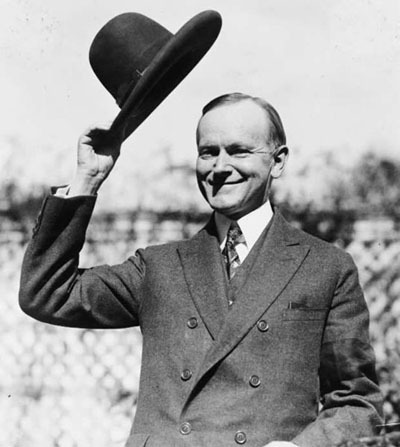
Cal made his words count.

The Boston police were fired for extorting the city, and Coolidge’s words were in the air when President Ronald Reagan responded to an illegal strike by air traffic controllers by firing the strikers and banning the union.

Now Chicago’s teachers are striking, not against the city management that is denying their demands, but against the children of the city and their families.

What would silent Cal say? I think I can guess. Harming children and families for higher wages is as much extortion as leaving a city unprotected against crime, and cannot be defended ethically. The defense will be, inevitably, “Well, management is unfair, and their offer is unjust. What are we supposed to do?”

The answer is: something else.

__________________________________

Facts: Chicago Tribune

Source: Wikipedia

Graphic: Washington, Jefferson and Madison Institute

Ethics Alarms attempts to give proper attribution and credit to all sources of facts, analysis and other assistance that go into its blog posts. If you are aware of one I missed, or believe your own work was used in any way without proper attribution, please contact me, Jack Marshall, at  jamproethics@verizon.net.

Booing Ethics: Ethics Lessons for Both Parties That They Will Not Learn

Nobody booed you, God. Stop listening to Hannity…

Remember a year ago, during the Republican presidential primary debates, when unruly Republican boors in the various audiences , in sequence, cheered an accounting of the convicted murderers put to death by the Texas penal system, shouted “Yeah!” to Wolf Blitzer’s questioning whether uninsured Americans should just be allowed to die without medical care, and jeered a videotaped soldier who declared himself as gay before asking if the candidates would support the recent elimination of “Don’t Ask Don’t Tell” as military policy? Neither did I, until I started researching this post. Boy, the pundits and the Democrats had a great time with those incidents, attributing the nasty attitudes of a few jerks to the entire party and the candidates themselves. The candidates, including Mitt Romney, didn’t exactly cover themselves in glory either, as none of them had the wit, courage or principles—any one of the three might have sufficed—to tell the jeering, cheering and blood-thirsty audience members that they were a disgrace to the party.

As anyone who thought about it could have predicted, now the shoe is on the other foot, and the Golden Rule has come full circle. Now it is Democratic jeerers who are objects of criticism, and they stand accused of booing not gays but God himself. Like the Republicans in 2011, the Democrats and their candidate, President Obama, are being painted by their adversaries as being one with the catcallers. I could be wrong, but I think this incident is rather more consequential than the GOP embarrassment in the primaries, if only because 1) it’s closer to the election and 2) many more people are paying attention now. Continue reading →

Unethical Quote of This And Any Other Month: Bonnie Pollack

“It was a real dilemma. I decided to do the right thing.”

—-58-year-old Bonnie Pollack of Manhattan, a doctoral student in social welfare who lives in Manhattan, telling the Wall Street Journal about the time she threw away her husband’s absentee ballot after promising to mail it, because she knew he was voting Republican. She didn’t tell him about the fate of his vote for years.

This photo of a baby polar bear has nothing to do with Bonnie Pollack, but it cheered me up after having to think about her. UPDATE: Now I find out that it’s a toy, so I’m depressed  all over again. If you can’t even trust cute, all is lost.

Ms. Pollack’s jaw-dropping admission appears in an article called “The Marriage Problem That Comes Every Four Years,” but is an example of the year-round ethics problem that makes life intermittently miserable for us all: people whose concept of right and wrong consists of arrogance, self-righteousness, and a full embrace of “the ends justify the means” without any moderation.

Let us do an ethics audit of Bonnie’s words and deeds: Continue reading →

Oh! THAT’S What Manners Were For!

A young woman posted a harrowing and depressing personal account on the web, describing the  gauntlet of daily sexual harassment attractive females must endure just going through life. “I decided it was important,” she writes, “because in my own way, I can (unfortunately) point out exactly what is wrong with men when they don’t realize how hard it is to be a woman.  How we do not have equal opportunities and freedoms in everyday life.  How most men, even good caring men, have no clue what we go through on a daily basis just trying to live our lives.”

What follows should make every man angry and every woman angrier, a sickening story of a subway ride that became a nightmare, simply because too many young men think of pretty women as quarry, rather than human beings.

She writes, Continue reading →

Ethics Dunce: Novelist R J Ellory

“Jellybean”

Yes, he really did: best-selling British crime novelist R J  Ellory actually went on Amazon, and using fake names like “Jellybean” and “Nicodemus Jones,” wrote rave reviews of his own books . In one review, he called one of his novels a “modern masterpiece” and wrote that it “just stopped me dead in my tracks.”

How embarrassing. Sales a little soft lately, R J? He also used fake identities to post negative reviews of his rivals’ works. Continue reading →

Exposing the Fact Check Game

Ethics Alarms generally doesn’t deal in links alone, but I just had the experience of working for several hours on an ethics issue only to see an excellent post on the same tipic pop up on my computer screen, rendering my work both moot and inferior.  James Taranto, the sharp, funny, perceptive Wall Street Journal political blogger and wag  has long been fuming about the bias and incompetence of so-called “fact-check” features, as have I. He has never before done as thorough an analysis of their performance, however, as today, and it bears reading.

Taranto is a conservative, and the charge of leftward bias accompanies his commentary, but I don’t see how it could be otherwise. If there is a right-leaning fact-check feature, I haven’t encountered it. I continue to respect the Annenberg Foundation’s Factcheck.org, as it does the best job of controlling its own liberal bias and generally avoids the devices Taranto flags in his article. Still, its bias is often detectable, as I told its managing editor a few years ago when she addressed a luncheon I attended. She denied it; I had examples. She was not happy with me. Continue reading →

The Significance of Paul Ryan’s Marathon

Interviewer : Are you still running?
Paul Ryan: Yeah, I hurt a disc in my back, so I don’t run marathons anymore. I just run ten miles or [less].
Interviewer : But you did run marathons at some point?
Paul Ryan: Yeah, but I can’t do it anymore, because my back is just not that great.
Interviewer : I’ve just gotta ask, what’s your personal best?
Paul Ryan: Under three, high twos. I had a two hour and fifty-something.
Interviewer : Holy smokes. All right, now you go down to Miami University…
Paul Ryan: I was fast when I was younger, yeah.

Thus did Republican Vice-Presidential candidate Paul Ryan describe his athletic exploits to ABC News reporter Hugh Hewett. But it was bad information: Runner’s World did some digging, and discovered that Ryan, intentionally or unintentionally, fictionally improved his best marathon time by an more than an hour. That “intentionally or unintentionally” is as important as the media and blog sleuths are making it out to be. Continue reading →

Ethics Quiz: The No-Tolerance Catch 22


Should you trust this guy to be reasonable?

The Des Moines Register reports on a jaw-dropping example of “no-tolerance” management at its saddest, and the astounding fact that it did not, in fact, occur at a an educational institution, but at a bank.

Wells Fargo Home Mortgage  fired 68-year-old Richard Eggers because in 1963, when he was 18, he put a cardboard cutout of a dime in a Laundromat washing machine and was duly convicted of operating a coin-changing machine by false means. Since that time, after spending two days in jail (they were strict in Iowa back then), Eggers has been on the straight and narrow. He is a Vietnam veteran, and tells the press that he can’t remember his last speeding ticket. He has also been a loyal and effective employee of Wells Fargo for seven years. So why fire him over a stupid and trivial crime he committed when Kennedy was President, TV was black and white, Mary Tyler Moore was exciting male viewers in her Capri pants on the brand new “Dick Van Dyke Show,”and people trusted Uncle Sam? Continue reading →

Unethical Mindsets: “You Can’t Be A Feminist If You’re Anti-Abortion”

Oxymoron?

I don’t know how I ended up on the Bea Magazine site, but I did, and I made the mistake of reading an article and a comment thread on the topic of whether feminists can be “pro-life,” or anti-abortion, if you aren’t a fan of euphemisms. As I expected, but not as I hoped, the consensus was that indeed, opposing abortion requires one’s ejection from the feminist tent, at least in the view of this particular cadre of feminists.

“Brillliant Nora Ephron,” the post by Diane notes, wrote that “You can’t call yourself a feminist if you don’t believe in the right to abortion.”  Well, Nora wasn’t so brilliant that day, because this is classic backward reasoning. It is framing reality by using ideology, the crystallization of confirmation bias into its most dangerous, poisonous and historically destructive form. It embraces the statement, “my mind’s made up, don’t confuse me with facts.” Indeed, it requires that facts be seen, filtered and interpreted through a pre-existing template that requires and then dictates a given result. Continue reading →

Ethics Hero: Kent Anthony Clemens, Bank Robber

With bank robbers, the bank alarms go off, but the ethics alarms don’t. This is the exception.

Proving that it’s never too late to do the right thing (well, almost never), Kent Anthony Clemens successfully robbed a bank in a small North Dakota town and escaped to Topeka, Kansas, where he gave much of the money to his sister. Then he felt bad about it and called 911, telling the police to come and arrest him.

Admittedly, this is a case in which the ethics alarms sounded a bit late, but they sounded nonetheless. The temptation is to minimize the virtue of Clemens’ conduct in turning himself in, because it just speeded up the inevitable, but that may not be the case. The news story notes that Williston, like many towns in North Dakota that have been victimized by vastly increased crime in the wake of the state’s oil boom, is strapped for law enforcement personnel and overwhelmed with unsolved cases. The amount Clemens stole wasn’t much ($700), and it’s not unlikely that he would have gotten away with his heist. But there he was when police arrived in response to his call, sitting on his front porch wearing the same outfit that surveillance cameras showed him in when he knocked over the Gates City Bank. Continue reading →