Thanks For The Memories, Greta Friedman: This Encore’s For You!

kiss

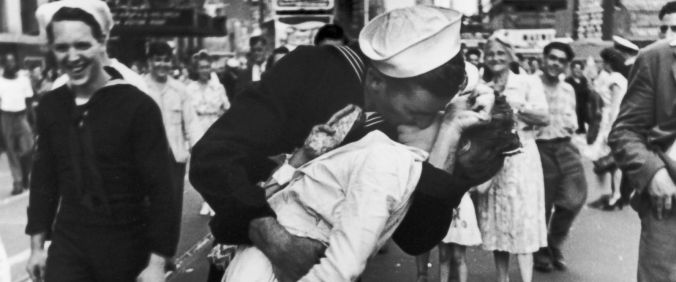
I was puzzled about why an old 2012 Ethics Alarms post was suddenly getting heavy traffic today, and until I read that GretaFriedman had died. She was the nurse famously kissed by a never-identified celebrating sailor on V-J Day, frozen in history forever thanks to a now iconic  Life magazine photograph.  I had written about Greta, that moment, and the determination of a lot of tunnel-visioned feminists and sexual-terrorists to turn what was a beautiful thing into something ugly and sinister in the distorted world they see through their shit-tinted glasses. The post was called “The Times Square Kiss, and Feminist Blogs’ Fanatic Crime Against Joy.”

I’m always a bit nervous when I go back and read old posts I’ve forgotten about; I’m afraid I won’t agree with them, but thankfully, I usually do. I do in this case. In fact, I really like the post, and am proud of it. On the theory that most current Ethics Alarms readers haven’t seen it before, I’m reposting today, in honor of Greta:

The blog posts at issue make me angry. Usually it is silly to be angry about mere opinions, I know. However, the opinion registered by “Lori” on the blog Feministing, taking her cue from another feminist blogger, is a symptom, a symptom of the scourge of pernicious, political-correctness zealots, who refuse to recognize the important distinctions between malice and human beings being human, and seek to wipe out that distinction by distortion, sophistry, historical revisionism and bullying. Continue reading

Jacoby Ellsbury, Catcher’s Interference, And The Perplexing Ethics Problem Of “Using A Shield As A Sword”

interference

I led two legal ethics seminars for the Oregon State Bar yesterday. For some reason the issue of “using a shield as a sword ” kept coming up.

“Using a shield as a sword” is when lawyers game the ethics rules. Many local bar associations include a pledge within their creeds promising not to intentionally use the ethics rules as a tactical weapon; still, it’s not an enforceable promise. Examples are limited only by a lawyer’s devious ingenuity, but they usual involve one side creating a conflict of interest for the opposing firm or lawyer that will force the lawyer to withdraw from the case. One ploy: a lawyer recruits a key expert witness specifically because she was once a client of the the lawyer on the other side, making it impossible for her to be impeached on the witness stand by that lawyer because he would have confidential information about her that he would be bound to keep secret, even while being required to represent his current client by ripping her credibility to shreds.

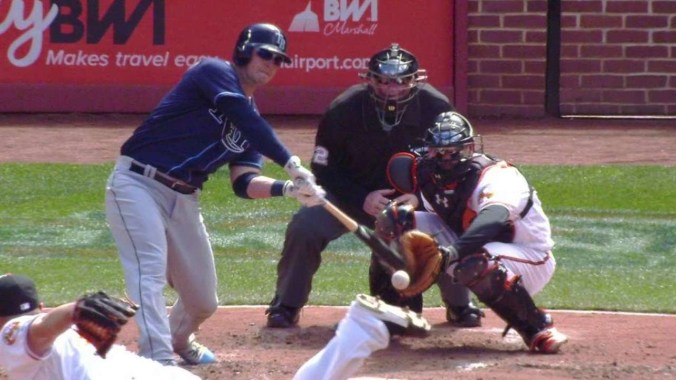
What does this have to do with Yankee centerfielder Jacoby Ellsbury? Well, Ellsbury is in the process of shattering an obscure baseball record: number of times reached base on catcher’s interference during a season. Catcher’s interference refers to instances in which a catcher makes any contact with a batter or his bat during a pitch. Usually, this involves the batter’s bat hitting the catcher’s glove, as in the photo above. When that happens, a player is awarded first base. The rule is based on fairness and  designed to protect the batter, but apparently Ellsbury has perfected the weird practice of using it as an offensive weapon.

Jacoby Ellsbury became the single-season record holder in catcher’s interference calls  in July with his ninth instance  getting rewarded for it. The record was formerly held by Roberto Kelly, who did this eight times in 1992.  Since breaking the record, Ellsbury has gotten catcher’s interference called three more times, for a current total of 11 with almost a month  left to the season. He is also second all-time in catcher’s interference with 23. The career record belongs to Pete Rose with 29; since Rose is baseball’s all-time leader in games played and career at bats, we would expect him to hold this record. No one else in baseball history has more than 18. Ellsbury is only five catcher’s interferences shy of Rose’s mark, and has done it in less than a third of the at bats. Continue reading

Ethics Quiz: Ad Hominem Or Not?

I frequently find myself correcting commenters who accuse me of ad hominem attack when I diagnose their problem, based on their arguments as jerkism or mental deficiency. (I recently found one legal blogger who actually states that if a commenter uses the term incorrectly, the comment will be rejected). Ad hominem is an argument fallacy that holds that if a messenger is flawed, his or her argument can’t be valid. It’s a cheap debate tactic, and unethical. If I conclude, however, that your argument is so idiotic that it could only be devised by an  idiot and thus designate you as one in so many words (because you have a right to know), that’s not ad hominem.

African-American pastor Mark Burns is a rafter-shaking speaker and an unusual and useful advocate for Donald Trump. He has been on cable news segments frequently, and even spoke at the GOP Convention. Being black, he is obviously roundly detested by those who regard Trump as a bigot, indeed by those who just dislike Trump generally. This almost certainly includes journalists on CNN, a Hillary stronghold.

A member of the black fraternity Kappa Alpha Psi alerted CNN that  Burns had claimed to have been a member,  but there was no record to support it. This set CNN on a quest to check all of Burns’ credentials and biography items, and it found that he had other dubious claims. Confronted on the air by (also African-American) CNN reporter Victor Blackwell with these discrepancies, Burns stuttered, humina-huminaed, protested, lied (his web site bio had been “manipulated” in some way, he said—the Weiner Excuse: “I’ve been hacked!”), and finally stormed out of the interview, which is to say, he ran.

Mark Burns is a Trump ally and supporter of note because he is a black pastor. He is still a black pastor. He makes a case for why blacks should support Doonald Trump. That case does not in any way rely on his military record or where he went to school, or, for that matter, how well he responds to having his honesty and integrity challenged on TV.

Your Ethics Alarms Ethics Quiz of the Day is...

“Was CNN’s attack on Pastor Burns fair and responsible, or..

Was it an unethical ad hominem attack designed to discredit a Donald Trump ally?”

Continue reading

Curse You, Political Correctness Bullies! Now You’re Forcing Me To Defend Lena Dunham!

Dunham2

A downside of running an ethics blog is that you have to defend really disgusting people from time to time: Harry Reid, Bill Clinton, Donald Trump…and now Lena Dunham. In fact, this story rescued the “Girls” creator from a different post here, as she recently had to apologize for an online newsletter rant that attacked the character of NFL star Odell Beckham Jr. and attributed various sexist attitudes to him based purely on the fact that he showed no interest in her when they were seated together at a recent function. ( Legitimate reasons why he may have ignored her: he had other things on his mind, she’s not his type, she’s a professional jerk, she’s Lena Dunham).

Before I have to defend Dunham, who is an awful person based on available evidence, let me make a few observations. One is that fame in the 21st Century can expose the unsavory and unethical nature of the famous far more than it did in pre-social media days. This is part of Donald Trump’s plight. Another is that Twitter and social media are literally traps for jerks, and it is amazing that so many of them keep getting caught, even with the bodies of previous trap-ees littering the immediate landscape. Finally, I wonder if there are still publicists around in the tradition of my late friend, Bob McElwaine. and if there are, why doesn’t Lena hire one to save her from herself? Bob was a Hollywood Golden Age publicist who saw his job as keeping the fact that his clients were jerks secret. He was great at it: his major client was Danny Kaye, a truly vile, troubled and nasty individual whose public persona was exactly the opposite.

All right, enough stalling.

For some reason, this Dunham tweet from five years ago surfaced, and has led a social media lynch mob to attack Dunham as being a racist…

Dunham tweet

Pop quiz: What exactly is it about the tweet that makes it racist?

The answer is “Nothing.” Racism requires attributing negative features or conduct to an individual or group based solely on racial bias and prejudice. It is not racism to base conclusions on statistical reality. Interestingly, most of the attacks on the tweet claim that the tweet is anti-Asian. It is racist to attribute virtuous qualities, like a reluctance to rape, to a race? Wow! Apparently the tweet is being condemned as a slur on Asian manhood. Since when is it manly to rape someone? Silly me: I assumed that Dunham was referring to well-documented  cultural support of respect for women, law-abiding conduct and other ethical virtues in Asian-American families.

Or is the complaint that by assuming an Asian-American is less of a threat than a male of another race, Dunham was by extension saying that other races were more of a threat? This would most fairly interpreted as an anti-white slur, however, since whites make up almost 75% of the population of convicted rapists. I thought anti-white bigotry was OK in political correctness circles! Continue reading

Ethics Observations On The Financial Massacre Of The Aurora Massacre Plaintiffs

James Holmes’s 2012 attack on the Century Aurora 16 movie theater showing “The Dark Knight Rises” killed 12 people and wounded 70 others. Many of the survivors and relatives of those killed sued Cinemark, the theater’s owner, in state and federal court, arguing that lax security was the cause of the attack. Cinemark’s defense was that the shooting was unforeseeable. Two suits went forward, one in state court and one in federal court, with different plaintiffs. Cinemark prevailed in both. After the recent jury verdict for Cinemark in the state court case this summer, the company had sought nearly $700,000 from the victims under the “loser pays” Colorado law, which directs that the winning side in a civil case is entitled to recover its legal costs from the losing side. This is the predominant system in England and Europe. The litigation costs of Cinemark in the federal case are likely to be more than $700,000, maybe a lot more.

What’s going on here (the best question to begin any ethics inquiry)? Well…

1. The law suits were a terrible idea. This was the result, in part, of the increasingly popular ideological virus in our society that is slowly reprogramming previously functioning brains to believe that nobody should have to pay for their misfortunes, and that somebody with deeper pocket and more resources should always be obligated to pay instead. This is increasingly a staple of leftist thought: the government, insurance companies, corporations, people with more money, all of them should be potentially on the hook when misfortune strikes others, because that’s fair.

2. It’s not fair, though.  It is profoundly un-American and unethical.

If those parties have caused the damage, or had the power and responsibility to mitigate it, or promised to pay for it, then there are ethical arguments to support them paying some or all of the expenses. But if something terrible happens to you, those people should have no more obligation to be accountable for your harm than you should have responsibility for taking care of them. That’s not the message sent by the culture though. Lawyers love the message that if you are harmed, somebody else can be found to ease your pain. They love it, because they can share in the bounty if a lawsuit seeking damages prevails, and this attitude guarantees more lawsuits. Continue reading

The Complimentary Room Service Tip Dilemma

I don’t know why these ethics conundrums always attack when I’m on the road, but they do.

Today I am briefly in Atlantic City on business, and last night, just prior to a terrible night’s sleep, I put out one of those door-hangers with a breakfast order on it, to be delivered at 7:30 AM. The room’s pen didn’t work until I wrote over my room number a few times: I thought the 7 in “702” looked a little funky, but it was definitely a seven. Or so I thought: 7:30, then 7:45 rolled around the next morning, and no breakfast.  When I called Room Service, they explained that they thought I had written 4o2, hence no room service.

What? First of all, it didn’t look like a 4. Second, my name was still on the thing: if there was any question about the room, why wouldn’t they check using my name?

After giving Room Service some well-deserved grief, I was told that my order would be up “in a minute.” A minute turned out to be 20 minutes, but a nice young woman eventually arrived with my coffee and pancakes, and told me that management was paying for breakfast.

Hmmm…did this mean she lost her tip? It seemed churlish to ask her, so I said, “Well, they won’t be paying your tip (though for all I know they would), so here…” and I dug into my wallet for a few dollars. But I didn’t have a few dollars. I had a one, a ten, and a bunch of twenties. Giving her a one would look cheap (though it well might have been a tip on top of the one she would get from my order anyway), and a ten was excessive. I gave her the ten.

Now I’m wondering: can I get reimbursed for that? My client is paying for the room, and the comped breakfast actually was a gift to him, not me. The ten dollar tip, though, was entirely discretionary on my part, and I usually don’t ask for travel reimbursements for expenses like that.  So the comped breakfast is going to benefit my server, unjustly enrich my client, and cost me an extra ten bucks.

It doesn’t seem fair, somehow. Well, my server’s smile when I gave her the ten dollar bill was almost worth it.

Almost.


Comment Of The Day: “The Barefoot Contessa and the Compassion Bullies: An Ethics Drama”

Angry-Blogger

I haven’t made one of the spammed Ethics Alarms hate comments a Comment of the Day for a while, but this one really asked for it. The commenter, who calls herself Sarah Bradley but isn’t, was spitting vitriol over a five-year old Ethics Alarms post that I remember well, the story about a mother’s attempt to shame and bully a cooking show star, Ina Garten, who politely turned down her sick son’s “Make A Wish Foundation” request that she hold a special live cooking exhibition just for him.  The mother  used her blog to call down the web Furies on the chef’s head, and I, as you may notice that I often do, pointed out that the conventional wisdom that the chef deserved the abuse was ethically obtuse, writing in part…

Garten’s refusal was not wrong, and it was not justification for criticism. There are many legitimate reasons for her choosing not to give Enzo an audience, including just not wanting to do it. Do all of us have an obligation to do a favor for a stranger simply because they asked for it? No. Do we have an obligation to do the favor if the stranger is sick? Young? Old? Dying? No, no, no and no. Accept any other answer, and we are declaring that whenever the Make-a-Wish Foundation delivers a request, it is really a demand, backed by the threat of public humiliation….dictatorship of the desperate, attack of the compassion bullies.

Would I make Enzo’s wish come true, under almost any circumstances? Yes. Ina Garten doesn’t have to. Would most celebrities? Yes…and Ina Garten still doesn’t have to. Being kind and generous is ethical, but saying no when there is no ethical duty to say yes is not unethical. If Enzo is making a request, then the request can be refused. If its isn’t really a request, but an order, Enzo has no right to issue it. There is a duty to rescue. There is a duty to confront and report wrongdoing. But a duty to comply with the random desires of sick children? Absolutely not.

I wish all of my posts were as clear and well-argued as that one. Yet “Sarah” thought it was deserving of an abusive, ethics- and logic- free attack, because she reasons like about 85% of the commenters on most blogs and news aggregating sites. There no objective logic, no balancing of interests, no understanding of values, no ability to distinguish rationalizations from ethical analysis, no ability to see a complex situation from multiple perspectives, no objectivity. All there is to support “Sarah’s” indignation and fury is knee-jerk emotion and pre-digested platitudes. She is typical of the average member of the public who has never been trained in logic or ethics, doesn’t understand why that’s a handicap, and who allows their lizard brain to guide them through life, making society and the culture a mine field for the rest of us.

I didn’t get into the ethics field to help people like Sarah, because people like Sarah are too far gone to help. I’m an ethicist to try to help people, and their kids, and anyone they may have an influence upon, to avoid becoming like her. When you can’t think any clearer than Sarah, you are incompetent at life, and others will suffer.

Here is Sarah Bradley’s Comment of the Day, on the post, The Barefoot Contessa and the Compassion Bullies: An Ethics Drama: Continue reading

A Horror Story From The Law vs. Ethics Files: The Mario Hernandez Saga [UPDATED and BACKDATED!]

Mr. Hernandez? Mr. Unger would like a word with you...

Mr. Hernandez? Mr. Unger would like a word with you…

This is complicated.

Occasionally a trusted source sends me to a link or a news item that turns out to be old, sometimes many years old. I assume it is current (I need to learn to check the dates), write the post, and then find out that what I wrote about took place in 1978. I usually trash the post. There have been a few like this. Now this story came to me from a trusted source, and linked to a current story, or so I thought. The post, on a site called “America Now,” is dated August 25, 2016. But WordPress pointed out, right at the bottom, that I had in fact written about Mario Hernandez’s citizenship problems two years ago. What? For a second I thought there were TWO Marios (Mario brothers?), who had the same problem, but no, they are the same guy.

The story  I was given today, based on this New York Times story from May of 2014, led to the post below. There is an ending to the story, which was explicated by me in the post of two years ago. However my two posts were on two different ethics issues, and today’s though inspired by a stale story, is still ethically useful. Pretend Mario plight isn’t two years old: that doesn’t alter the principles involved, or my analysis. I’ll tell you what happened at the end of the post..

***

Continue reading

Unethical Tweet Of The Month: Novelist Ann Rice

Can you see your hypocrisy when you look in the mirror, Ann?

Can you see your hypocrisy when you look in the mirror, Ann?

“The sex scandal at Fox matters; it’s at the heart of the GOP contempt for women as citizens and human beings.”

—-“Interview With The Vampire” author Ann Rice, on Twitter.

This is signature significance in so many ways. To write this in a public forum, one has to be completely corrupted by partyism, tunnel-vision, bias and the certainty that you are operating in an environment populated with millions of similarly disabled individuals. It also helps to be either dishonest or ignorant, or both.

Let’s try to count all the ways Rice’s tweet is unethical:

1. Sexual harassment scandals occur in all kinds of organizations, including otherwise virtuous non-profits and models of progressive thinking. The University of California at Berkley–the infamously right wing institution— has one going on right now. Yale has been covering up a sexual harassment scandal involving a world-famous ethicist.  These are just  examples of sexual harassment that make it to the headlines. I work in the field: believe me, there is no monopoly by Republicans or conservatives in this area. For Rice to insinuate otherwise is nothing more than disinformation born of her own biases.

In the alternative, she knows this is absurd, and is lying.

2. The statement embodies guilt by association at its worst. How about this: “The Brian Williams scandal at NBC matters; it’s at the heart of the Democratic Party’s contempt for the public as citizens and human beings” ? There’s no ethical difference: both statements are unfair and dishonest. I’ll wager that the percentage of Democrats who work for NBC is significantly greater than the proportion of Republicans who work at Fox. The political parties have nothing whatsoever to do with either situation.

3. Ailes’ engagement in harassing conduct is difficult to deny, especially after so many past employees have surfaced to bolster the accusations made in the recent lawsuit. Whether there is a wider problem beyond Ailes is completely unproven. Personally, I don’t doubt it: when leaders of organizations model such conduct, it typically corrupts the entire culture. However, it is far too soon to make the kind of leap Rice is making, which not only assumes company-wide harassment but somehow attributes it to another organization, the Republican Party.

4. Most of all, and to save the  best and funniest for last, has Rice never heard of Bill Clinton? Continue reading

Health And Survival Rationing Ethics

cointoss

Beginning in 2012, Dr. Lee Daugherty Biddison, a critical care physician at Johns Hopkins and some colleagues have held public forums around Maryland to solicit the public’s opinions about how life-saving medical assistance should be distributed when there are too many desperately ill patients and not enough resources. The exercise was part of the preparation  for Biddenson’s participation in preparing official recommendations for state agencies that  might end up  as national guidelines regarding when doctors should remove one patient from a ventilator to save another who might have a better chance of surviving, or whether the young should have priority over the old.

Ethically, this is pure ends justifying the means stuff. The Golden Rule is useless—How would you like to be treated? I’d want to be left on the ventilator, of course!–and Kantian ethics break down, since Immanuel forbade using human life to achieve even the best objectives…like saving a human life. Such trade-offs of life for life (or lives) is the realm of utilitarianism, and an especially brutal variety….so brutal that I doubt that it is ethics at all.

When Dr. Biddenson justifies his public forums by saying that he wants to include current societal values in his life-for-a-life calculations, she is really seeking current biases, because that’s all they are. On the Titanic, it was women and children first, not because it made societal sense to allow some of the most productive and vibrant minds alive to drown simply because they had a Y chromosome, but because that’s just the way it was. Old women and sick children got on lifeboats;  young men, like emerging mystery writer Jacque Futrelle (and brilliant young artist Leonardo DiCaprio), went down with the ship. That’s not utilitarianism. That’s sentimentalism.

The New York Times article mostly demonstrates that human beings are incapable of making ethical guidelines, because Kant was right: when you start trading one life for another, it’s inherently unethical, even if you have no choice but to do it. Does it make societal sense to take away Stephen Hawking’s ventilator to help a drug-addicted, habitual criminal survive? Well, should violating drug laws sentence a kid to death? TILT! There are no ethical answers, just biased decisions. Continue reading