Unethical Quote Of The Week: New York Times Publisher Arthur Sulzberger Jr. [UPDATED and CORRECTED]

“Our followers on social media and our readers across the internet have come together to collectively serve as a modern watchdog, more vigilant and forceful than one person could ever be. Our responsibility is to empower all of those watchdogs, and to listen to them, rather than to channel their voice through a single office.”

—-New York Times publisher Arthur Sulzberger Jr, announcing that the Times was eliminating its “public editor” and its public editor position.

The decision was bad enough, the disingenuous excuse was almost worse. Yes, by all means, the Times doesn’t need an independent, internal expert on journalism ethics to blow the whistle when the Times ignores its duties of competence, independence and objectivity and breaches its own ethics code: the overwhelmingly left-wing readers the Times panders too daily will keep it on the straight and narrow! Besides. why does the Times need an ethics cop now? After all, the public’s trust in the news media, of which the Times is supposed to be the role model, has never been higher!

Well, no, actually, the public’s trust in journalism has never been lower, and the New York Time’s blatant bias during the 2016 campaign and in the wake of Donald Trump’s election is one of the main reasons. Tell me: if an organization finds its public trust diminishing drastically, which act shows a sincere interest in addressing that distrust and reversing it…

A. Hiring an independent journalism ombudsperson who investigates instances of dubious journalism ethics and reports to the public in the paper, no matter what the results, entering criticism and recommending changes as needed, or

B. Eliminating the above position entirely?

The New York Times chose B. What this indicates is that the Times doesn’t care about the public trust, just its readers’ trust. It knows most of its current readership wants an aggressive progressive advocacy rag, not bold, objective and independent journalism. When a new less-progressive-than-usual op ed writer dared to suggest that critics of climate change orthodoxy be listened to respectfully, Times readers tried to get him fired. Continue reading
Quick United Ethics Plane Wreck Passenger Addition: The Journalists And Others Smearing Victim David Dao

Which one is David Dao? What is he like? What has he done? IT DOESN’T MATTER…

I had to post this as soon as a comment on the original post mentioned recent revelations about the abused passenger on—and then off–  United Flight 3411 yesterday.

David Dao (that’s his name) will naturally be the object of research by the news media, because he’s now a public figure and they are overwhelmingly scum. However, whatever exposure his past and present receives as a result of his unwelcome celebrity due to a United employee fingering him for no particular reason as a passenger to sacrifice to solve problems of the airline’s own making, none of it has any relevance to the episode. There is no justification for further injuring Dao by invading his privacy. It is a cruel and unethical thing to do. It is unethical journalism, because the details of the doctor’s life do not contribute anything to an understanding of the story and the issues that the conduct of United raises.

Never mind! This is the Paul Newman film “Absence of Malice” crossed with “Airplane”—an innocent bystander is swept up in a controversy, and as a result is embarrassed before the world because journalists never consider the Golden Rule, and seldom care about fairness, decency, compassion or the consequences of what they publish. “The public has a right to know,” they posture. Really? Why does the public have any right to know about Dao, besides what they see on the YouTube videos?

TMZ, a bottom-feeding celebrity site,  first dug up Dao’s history, posting a click-bait headline.  The Courier-Journal, a Kentucky affiliate of USA Today, then piled on with a story about the “doctor with [a] troubled past.’  The New York Daily News,  The New York Post, The Washington Times, The Chicago Sun Times, D.C.’s ABC affiliate  and People Magazine all joined the fun, the game being “Let’s see if we can further embarrass and humiliate this man, because United didn’t do enough already.” People’s expose was titled “Revealed: All About the Doctor Dragged Off Overbooked United Flight — and His Troubled Past.”

Did I mention that the woman whose life is put on the front page in “Absence of Malice” kills herself? (Melinda Dillon received an Oscar nomination for the role.) Continue reading

From The Ethics Alarms “Fake News That Deniers Of Mainstream Media Bias Claim Isn’t Fake News But It’s Still Fake News” Files: The New Michael Brown Video And CNN

As we all remember, teen-aged African- American Michael Brown was arrested and subsequently shot to death by Ferguson police officer Darren Wilson after he was attacked  by Brown. The narrative, based on a lie told by Brown’s friend and accepted as fact by the news media, that the teen was shot while shouting “Don’t shoot!” and holding his hands up, sparked riots in Ferguson and demonstrations elsewhere, as well as racial tensions that still continue. Much to its disappointment, the Obama Justice Department couldn’t find evidence that Wilson behaved improperly under the circumstances, and he was never charged.

From the New York Times:

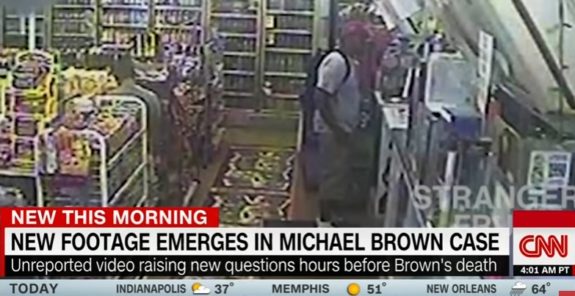
[P]olice released a security video from a nearby store that showed Mr. Brown pushing a worker and taking cigarillos minutes before the shooting. But a second, previously unreported video from that same convenience store included in a new documentary is raising new questions about what happened in the hours before the shooting on Aug. 9, 2014.

The footage shows Mr. Brown entering the store, Ferguson Market and Liquor, shortly after 1 a.m. on the day he died. He approaches the counter, hands over an item that appears to be a small bag and takes a shopping sack filled with cigarillos. Mr. Brown is shown walking toward the door with the sack, then turning around and handing the cigarillos back across the counter before exiting.

Jason Pollock, a documentary filmmaker who acquired the new tape, says the footage challenges the police narrative that Mr. Brown committed a strong-armed robbery when he returned to the store around noon that day. Instead, Mr. Pollock believes that the new video shows Mr. Brown giving a small bag of marijuana to store employees and receiving cigarillos in return as part of a negotiated deal. Mr. Pollock said Mr. Brown left the cigarillos behind the counter for safekeeping.

What does the new video, which the store owners deny shows what Pollack says it does, have to do with the circumstances of Brown’s shooting, and whether Officer Wilson was in fear of bodily injury, requiring him to use deadly force?

Nothing. Not a thing.  Nada. Zippo. What occurred hours before Brown encountered Wilson had no impact on the subsequent events. It doesn’t matter whether Mike Brown was selling drugs, stealing something, making funny faces, or clog dancing. It doesn’t change the evidence that he tried to wrest Officer Williams’ gun from him, fled the police car, and turned and charged the officer.  The video literally doesn’t matter, any more than a video of “Pootie Tang” or “The English Patient.”  Because it doesn’t matter, the video has no significance to what does matter, whether the police shooting was just, or racially motivated.  It isn’t news. It isn’t useful or enlightening. If it is represented as news, then the public is being misled. Continue reading

Ethics Quiz Follow-Up (And An Ugly One): The Congressional Art Competition Winner’s Painting [UPDATED]

clay-painting-back

Well now we have a definitive answer to the Ethics Alarms Ethics Quiz that asked whether  it was responsible, fair, and ethical for Congressman Lacy Clay (D-Mo) to have the painting above displayed in the U.S. Capitol, and we don’t even have to use the ethics decision-making process I included in the post. (I note ruefully that readers were challenged to use the method to reach a conclusion, and none did.)

We don’t have to use it, because we now know some things we didn’t know at first, or at least I didn’t. Based on news reports when I first posted, I assumed that the work by high school senior David Pulphus was chosen by a designated committee, and that Clay was bound by the terms of the contest to hang the winning painting in the Capitol. That would have made the treatment of the obviously inflammatory artwork, which depicts the false Black Lives Matter narrative that Mike Brown was gunned down in Ferguson by a racist cop without cause, an ethics conflict, pitting the First Amendment and the obligation to fulfill  a commitment against the inclusion of racially divisive art in the Capitol, which is irresponsible.  Now we know, however, that Clay himself helped choose the painting, and that he did so despite the fact that the painting directly violated the rules of the contest, and thus was ineligible:

“While it is not the intent to censor any artwork, we do wish to avoid artwork that is  potentially inappropriate for display in this highly travelled area leading to the Capitol.Artwork must adhere to the policy of the House Office Building Commission. In accordance with this policy, exhibits depicting subjects of contemporary political controversy or a sensationalistic or gruesome nature are not allowed. It is necessary that all artwork be reviewed by the panel chaired by the Architect of the Capitol and any portion not in consonance with the Commission’s policy will be omitted from the exhibit. If an entrant is unsure  about whether a piece of artwork is acceptable, he or she should contact the staff of his or her  Member of  Congress; the congressional staff can speak with personnel who can determine whether the artwork would be accepted.”

The painting is beyond question  “depicting subjects of contemporary political controversy or a sensationalist or gruesome nature.” In allowing the painting to be entered, participating in selecting it, seeing that it was chosen as the winner, and hanging such an inflammatory work in the Capitol, Rep. Clay was… Continue reading

Ethics Quiz And Analysis Exercise : The Congressional Art Competition Winner’s Painting

ferguson-painting

The painting above, by high school senior David Pulphus, is now hanging in the U.S. Capitol complex, its award for being selected as the first place prize-winner in Missouri Democrat Rep. Lacy Clay’s annual Congressional Art Competition last May.  It is not clear whether Clay personally selected “Untitled #1” as the winner or had a part in the section, but the African American congressman  praised the work according to a press release:

His visually stunning acrylic painting on canvas entitled, “Untitled #1” will be displayed at the U.S. Capitol Complex.  Pulphus will travel to Washington, DC, courtesy of Southwest Airlines, to unveil his winning entry.  The painting portrays a colorful landscape of symbolic characters representing social injustice, the tragic events in Ferguson, Missouri and the lingering elements of inequality in modern American society….

In his remarks to the overflow crowd of young artists, parents and teachers who gathered at Webster University’s new downtown St. Louis campus in the historic Arcade Building, Congressman Clay said, “Tonight, we are celebrating our sixteenth year of recognizing outstanding young artistic talent. As you can see from the artwork on display here, the level of talent is truly impressive. Your work is inspiring, and I encourage all of you to continue to develop your creative abilities.”

Your first Ethics Alarms Ethics Quiz of 2017 is to answer this question:

Was it responsible, fair, and ethical for Congressman Clay to have this painting displayed in the U.S. Capitol?

I think it is a tough question. In fact, it’s an excellent opportunity to begin the year by practicing and applying one of the ethics decision-making processes, like this one from the Josephson Institute,  in the Tools section: Continue reading

14 Ethics Musings On The Death Of Francisco Serna

keith-scott

Scott and Serna.

From The Washington Post:

Slightly after midnight on Monday, police in Bakersfield, Calif., received a call concerning a man thought to be brandishing a weapon in a residential neighborhood.

Shortly after police arrived, 73-year-old Francisco Serna — who family members said was suffering from the early stages of dementia — walked out of his home and into his driveway. When Serna, who was unarmed, did not comply with officers’ orders to remove his hands from his jacket pocket, one officer fired seven shots at him, killing him.

During a canvass of the premises that lasted at least until the following afternoon, police did not find a firearm on or near Serna. Instead, they found a crucifix.

Questions and Observations:

1. The shooting occurred two days ago, on December 12. There have been no organized protests, or community groups, family lawyers or anyone else suggesting that the shooting was murder, or an example of police animus toward the community. Why not?

2. The circumstances of the shooting were notably similar to the police involved shooting of Keith Scott in Charlotte, North Carolina, except that in the case of Scott, the officer believed the victim had a gun, and he did have a gun. Nonetheless, that shooting triggered two days of rioting. Why?

3. In the Scott shooting, both officer and victim were black. In the recent shooting in Bakersfield, officer and victim were white. Why did one shooting become a racial incident and the other not, when the conduct of the police officers were essentially identical, and the provocation for the shootings  were similar as well?

4. One difference in the two episodes is that in Charlotte, a false narrative was launched by a family member to make the shooting appear to be a case of excessive force with a police cover-up. Is it just felicitous that this did not occur in Bakersfield, or was the Charlotte episode different in some way that caused events to resemble the aftermath in the Ferguson and Freddie Gray police-involved deaths?

5. If Francisco Serna had been black and all other facts the same, is there any reason to believe that the aftermath, including recriminations, accusations and attacks on police, the justice system and the nation’s culture, would have been any different than they have been every time an unarmed black man, or a black man who was reported as being unarmed, has been shot by police? If there is not, what does that tell us? Continue reading

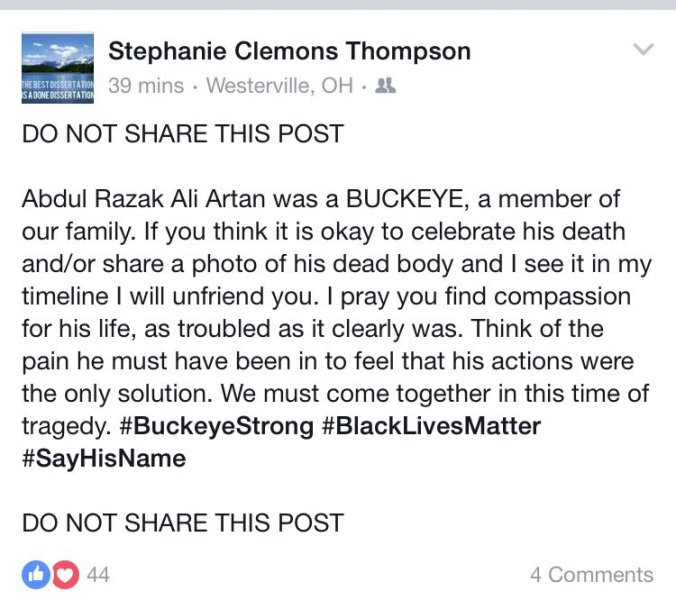
No Charges In The Keith Scott Shooting, And An Ethics Test For Black Lives Matter

stephanie-clemons-thompson-fb-post

Yesterday,  Mecklenburg, North Carolina District Attorney Andrew Murray announced that the investigation into September’s fatal police shooting of Keith Lamont Scott had found no legal wrongdoing. This meant, in addition to the fact that officer Brently Jackson, who is black, would not face trial, that the two-days of riots inflicted on Charlotte after the Scott’s death were even more inexcusable than riots generally are. People who claimed on social media that they had seen the shooting and that Scott was unarmed admitted to investigators that they hadn’t seen what they said they saw. Evidence in the case showed that Scott stepped out of his SUV  holding a gun—his DNA was retrieved from the weapon found at the scene—and ignored at least ten commands from the five officers on the scene to drop it. Individuals who behave like that are likely to get shot, and deserve to be. No case, no outrage, no systemic racism.

Following the shooting, however, this was a Mike Brown encore, complete with angry, loud, false accounts and social media rumors focused on making Scott’s death another rallying point for race-hucksters, politicians who felt they could benefit from dividing the country by color, and irresponsible pundits.

From the Ethics Alarms post on September 21: Continue reading

Thanksgiving Ethics From The “Fear Of Being Shot Causes Broken Ethics Alarms” Files

Bridgeport, Connecticut police stopped cars on the day before Thanksgiving, and surprised the motorists by handing them turkeys rather than tickets.

Awww!

Too bad it’s per se unethical conduct, an abuse of power and position, and a dangerous precedent. This is unpleasant déjà vu, for I’ve written this post before, more than once, and as many times in this year than the previous seven years combined. It’s pretty obvious why. Police, who were being shot and ambushed all over the country last week, are desperate to endear themselves to citizens and validate their role as a beneficent force in the community, which needs no validation.

“It’s a way of giving back, reaching out to the community and making sure everyone has a meal for thanksgiving,” says Bridgeport Police Capt. Roderick Porter, not getting it at all. I wonder what would have happened if one of those turkey stops was a fleeing felon. Would objections have been raised if the white cops only stopped black motorists, to say “We like you! We really like you! Here’s a turkey!”

Here comes the déjà vu again: As I wrote about the ice cream caper, which was pretty much the same thing: Continue reading

The Charlotte Riots: Good Work, Everybody! It Is Now Officially Impossible For Police Officers To Do Their Jobs…Now What?

http://www.youtube.com/watch?v=_vJqBFlLdHc

Thank you,  George Zimmerman. Thank you, Mike Brown, and Freddie Gray. Thank you, Marilyn Mosby, Barack Obama, Ta Nihisi Coates. Thanks, Charles Blow, and Al Sharpton, MSNBC, Sabrina Fulton,  Lezlie McSpadden, and the Democratic National Committee. Thanks, Baltimore Police, Ferguson Police, and Bill DeBlasio.  Thanks, Eric Holder. Thanks, Black Lives Matter. And thanks to you too, Michael Slager, Timothy Loehmann, and the other trigger-happy cops who made their fellow officers around the country vulnerable to accusations of racism and murder by your incompetence. Thanks to all of you and others, it is now impossible for police to do their jobs without fear of being demonized and destroyed if they are wrong, or sparking riots and violence if they are right.

Now what are we supposed to do?

 A Charlotte, North Carolina police officer named Brentley Vinson, an African American, shot and killed Keith L. Scott, 43, after he posed an “imminent deadly threat” to police officers by refusing to drop the weapon he was carrying when ordered to do so.  The shooting sparked night of rioting and violent confrontations between police and “protesters.”

According to police, officers were searching for a suspect with an outstanding warrant. Around 4:00 pm yesterday, police observed Keith Lamont Scott inside his car. (Scott was not the person being sought.) Scott exited the vehicle carrying a firearm, got back into his vehicle, and when officers began to approach his car, got back out of it, again carrying his handgun. Officers ordered him to drop it, and he did not.  The officers fired their weapons at Scott, who was hit and fell. They immediately requested medial assistance and began performing CPR.

Following the pattern of the Ferguson and Freddie Gray incidents, unverified reports spread through social and broadcast media that the victim was a disabled man, holding only a book and no weapon. A woman claiming to be the victim’s daughter used Facebook Live to give her angry, emotional and quite possibly fanciful account of what was transpiring. About a hundred protesters arrived at the site of the shooting. #KeithLamontScott began to trend on Twitter.

Continue reading

The Pitzer College “POC Only” Roommate Wanted Ad [UPDATED]

"Now THAT's not racism. Why do you honkies have so much trouble understanding this?"

“Now THAT’s not racism. Why do you murderous honkies have so much trouble understanding this?”

A roommate-wanted notice posted on Facebook by a Pitzer College student has turned into yet another racial controversy. The student, along with two Pomona College students,  were seeking a fourth to join them in an off-campus house. The notice included “POC only” –person of color only—and this got them immediately called out as racists by some other students.

The ad is not racist. The text reflects a bias, as in “preference,” but that isn’t necessarily racism. Everyone has freedom of association in this country, or should. Human beings are more comfortable with those whom they perceive as being more like them. There is nothing wrong with that, but even if there is, it is human nature. There is nothing to be done about it, and there shouldn’t be anything done about it other than to help each other understand that tribalism is divisive and  a pre-programmed bias that we should fight, because getting past it makes us better neighbors, members of society and human beings.

Still, I don’t want to live with someone who doesn’t want to live with me, but who is going to accept me into a living situation based on a feeling of obligation. A house seeking someone else to share the rent isn’t a public accommodation, and there is no ethical principle demanding that the roommates can’t or shouldn’t specify the kind of individual they think would best complete the group. What if the other three are all white, and are seeking someone different from them to make the house more diverse? Is it equally offensive if the ad sought an athlete, or someone overweight (who wouldn’t make the three hefty roomies feel unattractive), or a good student, or an actor, or someone with a good sense of humor? Why? Such requirements are not a per se indication of anything but personal preferences, and personal preferences aren’t racism.

Is the “POC only” addendum unethical? Technically, it fails Kant’s “what if everybody does it?” test,  for if everybody did it, white students would have nowhere to live. There you have an example of where Kant’s Rule of Universality is worth musing about but often isn’t applicable. Some conduct is ethical despite Kant because the idea that it would become universal is too ridiculous. I want to live with a baseball fan. I don’t want to live with someone who is going to be listening to punk rock. If three roommates can look for a female fourth, or a gay fourth, or a Spanish-speaking fourth—and they can without nicking any ethics principles at all—then they can insist on racial or ethnic qualifications too.

Is it better ethics to be accepting of all equally? Sure it is. But not exhibiting exemplary ethics isn’t unethical. Again, it’s just human.

There is more to the story however. When some students commented on Facebook that the notice was racist, the replies from the students posting it and others expanded the controversy.

The Claremont Independent, a student paper that covers all five of the Claremont colleges (as well as two graduate schools), of which Pitzer is a member, published some of the comments, and they show the anti-white animus and double standards now roiling race relations in the U.S. Continue reading