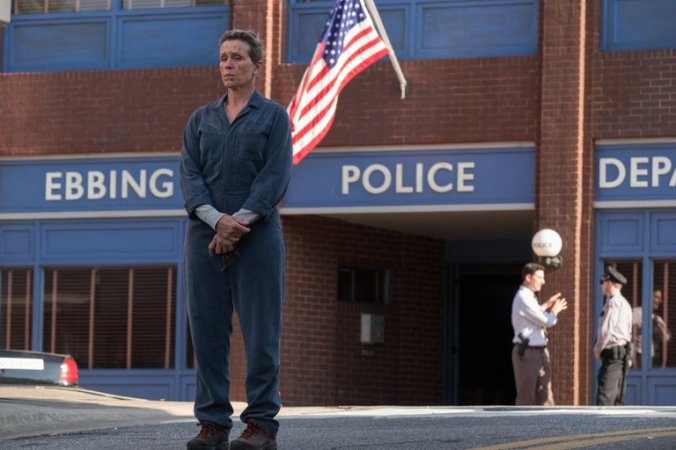
Ethics Review: “Three Billboards Outside Ebbing, Missouri”

I watched last year’s “Three Billboards Outside Ebbing, Missouri,” twice, just to make sure it was the profound ethics movie I thought it was. It is. None of the reviews described it that way, of course. Here is the New York Times:

“The movie opens on low boil with Mildred behind the wheel of her station wagon near three derelict billboards…she uses the billboards to announce her crusade … a way to get things jumping (the investigators, the tale) and splash some foreboding on an outwardly pacific scene. Much of the story involves the ripples of outrage, confusion and buffoonery that the billboards inspire and that soon envelop almost everyone Mildred knows. Months after her daughter’s death, grief has walled her in; isolating and seemingly impenetrable, it is inscribed in the hardness of her gaze and in her grim new identity as a mother of a dead girl. The billboards turn that grief into a weapon, a means of taking on the law and assorted men — a threatening stranger, a vigilante dentist and an abusive ex (John Hawkes) — who collectively suggest another wall that has closed Mildred in….”

None of which addresses what is remarkable about the film, which is that it shows what causes our ethics alarms not to ring—Frances McDormand as Mildred and Sam Rockwell as Dixon, a racist and vicious deputy, in particular demonstrate  what it is like to be driven by non-ethical considerations of the darkest and most passionate sort—and more important, what causes them to start ringing again. Most reviewers described this as a dark and depressing film. The ethics alarms are mostly off again as the film ends, and that is ominous, but its main ethics message is uplifting in many ways. “Three Billboards” teaches us that even broken, ignorant, alienated human beings have the capacity to access their innate instincts for compassion, justice, forgiveness, selflessness and kindness, and even when our ethical selves seem permanently overcome and decisively defeated, they can burst out again, in control, salvaging what’s best about the species.

There is a moment early in “Three Billboards” that signals that it is not only going to show us what monsters anger and grief can transform us into, but also that what George Washington’s list of 110 Rules called “that little spark of celestial fire called conscience” is remarkably resilient.  A sheriff—the ethics compass of the story, played by Woody Harrelson— visits Mildred after her billboard messages embarrass him and roil the town. She is hard and cold as marble as he tries to explain his failure to find her daughter’s rapist/killer, even after he reminds her that he is dying of cancer. Suddenly the sheriff has a violent  spasm: he coughs up blood on himself and Mildred. And we see her fury evaporate in an instant. The compassionate and caring mother she once was emerges, if only for a few moments. ( McDormand is such a superb actress that she pulls off the sudden transition convincingly and movingly: you believe it, though it is like watching Mr. Hyde turn into Dr. Jekyll in the snap of a finger.) Later, when again her fury has been aroused, we see the same woman firebomb the police station and watch implacably as her nemesis deputy burns. A warning: just because the ethics alarms can ring doesn’t mean they are working well enough.

Sam Rockwell’s character also reveals surprisingly that his ethics spark has not been entirely extinguished, again thanks to a catalyst supplied by the sheriff. This transformation caused considerable  criticism of the film among critics and artists in Hollywood, and some attribute the film’s failure to win the Best Picture Oscar to the fact that a racist is redeemed and revealed to have an ethical core. But except for the sociopaths and psychopaths among us, admittedly a disturbingly large group, we all have that ethical core. We have the ethics alarms too, ready to be re-activated, even if they aren’t in perfect working order. Yes, this is  even true of racists. So much of our current political discourse is driven by the false construct that a single belief or a single lapse of reason marks an individual as irredeemable. Its easier to marginalize and demonize them that way. But it isn’t true.

Indeed Ethics Alarms often declares certain conduct and words as signature significance, proving that an individual is unethical because such actions and thoughts are alien to ethical human beings. “Three Billboards Outside Ebbing, Missouri” reminded me that people may be unethical–Mildred and Dixon, the deputy, could never be called ethical, for ethical people don’t set police stations on fire or throw young men out of second story windows, as Dixon does—but that even unethical individuals can find their ethics if you give them a chance.

And if they can find their ethics, so can all of us, and so can society. There is hope.

________________________

Addendum: I cannot leave “Three Billboards” without a salute to one of its most powerful scenes, when Mildred tells a priest why she doesn’t care what he has to say when he comes to her home to admonish her for the messages on the billboards:

Bingo.

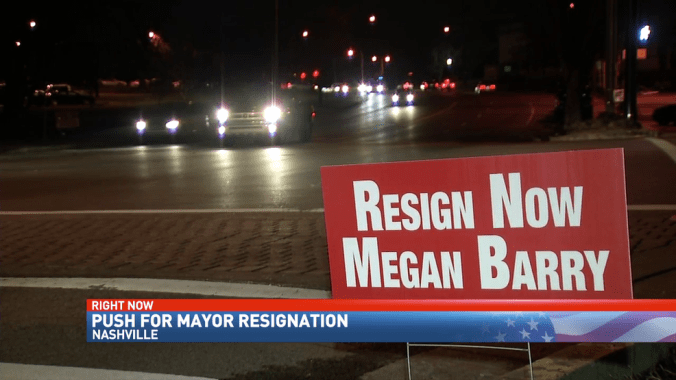
Unethical Quote Of The Week: Nashville Mayor Megan Barry’s Resignation Statement

Nice whitewashing job!

“While my time as your mayor concludes today, my unwavering love and sincere affection for this wonderful city and its great people shall never come to an end. No one is as excited about this city, and its bright and limitless future, than I am. Nashville, with its boundless energy, its infectious optimism, its never- encountered-an-obstacle-it-couldn’t-overcome attitude, will, in the years ahead, continue its steady march toward the very top of the list of great American cities. It’s a continued climb that I will watch, but I will watch as a private citizen, and I will be tremendously proud nonetheless.

While today is primarily about the smooth transition from my administration to that of Vice Mayor Briley, I would be remiss if I didn’t acknowledge and thank the thousands and thousands of people who have reached out to me, written me, encouraged me, comforted me, worried endlessly about me, and most importantly prayed for me during these many difficult and trying months.In two and a half short years, we have made great strides and progress on affordable housing, transit, public education, youth opportunity, quality of life, and our economy.

None of this would have been possible without my incredible staff, our talented department heads, and all of the dedicated men and women of the Metropolitan Government who have worked hard to make the lives of Nashvillians a little better each day.They got up yesterday, they got up today, and they will get up again tomorrow devoted to making sure our city sings.

And I sincerely hope and believe that my own actions will not tarnish or otherwise detract from all of their great work. It has been the honor and it has been the privilege of my entire professional life to have had the blessing of this opportunity to be your mayor.Thank you in advance for the support that I am sure you will give to Mayor Briley in the days and weeks ahead.

God bless this wonderful city.

I love you, Nashville.”

Megan Barry, now ex-Mayor of Nashville, following her resignation after pleading guilty to theft of public funds.

Ethics Alarms has previously covered the exploits of Barry, who had a romantic relationship with the chief of her security detail, a married man, and who refused to resign when it came to light, saying that God would forgive her. Finally, after various revelations that suggested illicit and excessive compensation somehow made their way to her huggy-bug, both Barry and paramour Robert Forrest had to plead guilty to theft of property over $10,000 — a Class C Felony. She will pay $11,000 to the city in restitution and serve three years’ probation, as will Forest, though he will have to pay back $45,000 to the city. Continue reading

Comment Of The Day: “How Many Rationalizations Can You Spot In This Op-Ed?”

In the post, How Many Rationalizations Can You Spot In This Op-Ed?, I challenged readers to read the depressingly meat-headed New York Times op-ed by a defender of Nashville mayor Megan Barry. and challenged them further to identify all of the rationalizations and fallacies it contained. Only one of you took on the challenge in its full, horrible scope, in part because not everyone pays to get past the Times paywall. Fortunately one who did take it on was the newly-minted Michael West, who dissected the essay as if it were a pithed frog.

Here is his Comment of the Day, freeing me from the obligation to post the answers to my question.

Having reviewed the Rationalizations List, here’s my go:

Paragraph 2:
“Along with this confession, the mayor offered the kind of full-throated apology we almost never get from public officials: “I accept full responsibility for the pain I have caused my family and his,” she said. “I knew my actions could cause damage to my office and the ones I loved, but I did it anyway.””

But she doesn’t accept full responsibility. If she did, and clearly her affair led to extreme financial irregularities which amount to defrauding the public, then accepting responsibility probably requires resignation.

Paragraph 3:
“She ended her statement with a pledge: “God will forgive me, but the people of Nashville don’t have to. In the weeks and months to come, I will work hard to earn your forgiveness and earn back your trust.””

I don’t think “God will forgive me” is a rationalization. It may be an actual deeply held belief, but the State of Tennessee is a bit more hard-nosed. At best this is just poll-tested platitude, but at worst, it is meant to convince some people to forgive her also (which makes it a diversion, not a rationalization). Working to earn their forgiveness and trust is an appeal to 21A Ethics Accounting: Criminal’s Redemption. She thinks future “good works” can atone for past sins. They cannot. What atones for past sins is having that sin and its effects blotted out, which in the case of defrauding the public, the only atoning that works is resignation.

Paragraph 4:
“This promise did not seem like an act of damage control. This is the way Megan Barry really talks. The language of full emotional availability is her native tongue.”

Appeal for sympathy, which is the opener for the next string of rationalizations.

Paragraph 5:
“Perhaps that’s why this city loves her. She hugs schoolchildren. She looks genuinely joyful at city parades and festivals. She grieves that too many Nashville teenagers are slain by guns. When Max Barry, her own son and only child, died suddenly last summer, the people of Nashville wept with her. When she spoke openly about the drug addiction that killed him, we marveled at her courage and admired her resolve to bring addiction out of the shadows of shame.”

This is Ethics Accounting again. She’s a really great person…so it’s implied we should overlook this one thing.

Paragraph 6:
“But in a red state like Tennessee, this liberal mayor also has powerful opponents, and they are not idiots. An editorial in the conservative Tennessee Star wasted no time in calling for her resignation: “Barry and the fawning, liberal Nashville media are trying the Clinton defense.””

This is a diversion away from the miscreant by accusing the accusers of bad faith motives. #48 Haters gonna hate. Her critics are ONLY demanding accountability because they want a political advantage or want to win a tactical maneuver. Continue reading

How Many Rationalizations Can You Spot In This Op-Ed? [UPDATED!]


At the beginning of the month we discussed the scandal in Nashville, Tennessee, where the female mayor, —the news media tried oh so hard to bury her party affiliation deep in reports, but she’s a Democrat— was carrying on an adulterous affair with the head of her security detail.  Some quotes from the Ethics Alarms essay to refresh your memory for the horrors to come:

—She apologized “for the harm I’ve done to the people I love and the people who counted on me” but said she won’t be resigning. In a news conference, she said nothing illegal happened and no policies were violated.

—“I know that God will forgive me, but that Nashville doesn’t have to,” Barry said. “And I hope that I can earn their trust and I can earn your trust back, and that you will forgive me

—-This is classic appearance of impropriety.

—-In the Bill Clinton mold, the mayor is framing this as a matter of marital fealty rather than official misconduct—which it is—so she can argue that it’s just “personal private conduct.”

—-The conduct is unethical whether there are policies or not.

—-This is sexual harassment. The officer was a subordinate, and she was his boss, with the power to fire him or worse. There can be no genuine consent in such situations. In these cases with the typical genders reversed, neither the news media, nor the public, nor, in all likelihood, a hypothetical jury, would see it that way.

—-Barry’s playing the God Card is grounds to remove her all by itself.

—-Come on, #MeToo, show some integrity. Get this workplace predator kicked out of office.

Interestingly, a prominent and respected female, feminist Democrat who comments here with distinction argued in the comments to that post that this wasn’t even a newsworthy story outside of Nashville. Also interestingly, the New York Times disagrees, and even published a spirited—but stupid!—defense of Barry’s conduct, arguing that unlike, say, Al Franken, who was forced to resign for pre-political career conduct and unproven post-political career allegations, the fact that a Democratic mayor—FEMALE! Don’t forget that she is female!–was using state-paid employees under her supervision as a personal, state-funded dating pool does not mean she’s untrustworthy or qualified for high office.

Okey-dokey then! What we have here is an old-fashioned convenient double standard!

And this just in! Nashville’s main newspaper, the Tenneseean, reports that Rob Forrest, the Mayor’s married lover, earned substantially more overtime than the other bodyguards on Barry’s secuirty detail, $173,843.13  between July 2015 and January 2017, which was nearly $53,000 more than the other four bodyguards received combined. But, as several internet wags have noted, let’s be fair: Rob was doing more for the mayor than those other bodyguards..

Now let’s all read the op-ed*, by Margaret Renkl , whom the Times proudly describes as ” a contributing opinion writer.” This time around, I won’t get into such matters as the odd silence of the #MeToo warriors, who have set out to destroy successful men who were accused of being boorish on a single date. I won’t even question the competence of the Times editors, allowing such unethical, illogical, poorly reasoned hypocrisy to make its way into its pages to make Times readers more ethically inept than they already are. No, I just want to focus on Renkle and her claim that Barry shouldn’t have to resign, and the unethical rationalizations for wrongful conduct she gainfully employs along the way.

Here is the complete current list (some new rationalizations will be added soon, but this is plenty). These are just the titles; go here to get the full descriptions. Continue reading

The Nashville Mayor’s Affair

Nashville’s first term mayor Megan Barry admitted yesterday that she had an extramarital affair with the police officer in charge of her security detail. She apologized “for the harm I’ve done to the people I love and the people who counted on me” but said she won’t be resigning. In a news conference, she said nothing illegal happened and no policies were violated. Her office released records of her text messages, calendar and travel expenses and records, and Barry said she will be transparent in cooperating with possible investigations. She accumulated more than $33,000 in travel expenses combined between her and the officer  from January 2017 to late October 2017, but claims all of the trips were business-related.

“I know that God will forgive me, but that Nashville doesn’t have to,” Barry said. “And I hope that I can earn their trust and I can earn your trust back, and that you will forgive me.”

Observations: Continue reading

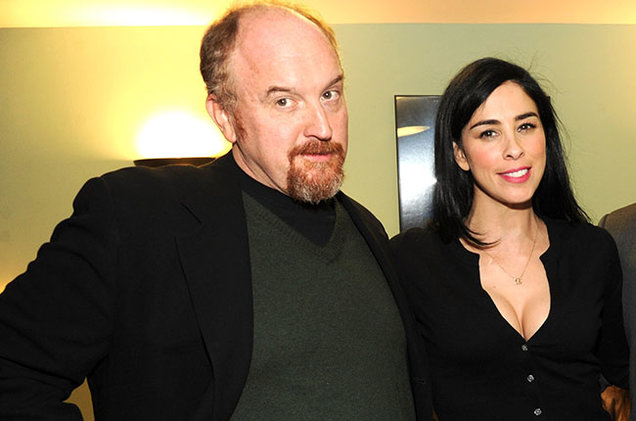
Ethics Quote Of The Week: Sarah Silverman

“I love Louie, but Louie did these things. Both of those statements are true. So, I just keep asking myself, can you love someone who did bad things? Can you still love them? I can mull that over later, certainly, because the only people that matter right now are the victims. They are victims, and they’re victims because of something he did.”

—Comedian Sarah Silverman, speaking of her friend and fellow comic Louis C.K., whose career is in freefall after revelations by five women that he masturbated in front of them.

I hope Sarah doesn’t have to ponder her question too hard, because the answer should be obvious.

Of course you can love someone who did bad things. Everyone of us has, and probably does. Good people do bad things. Loving and lovable people do bad things, even terrible things. Being loved is one of the crucial life experiences that makes people better.

There are limits, of course. Still, at the root of Silverman’s question is the narrow intolerance and self-righteousness that are polarizing and fracturing our society. I find it ominous that she would ask the question.

Comments Of The Day (2): “Desperate Ethics Quote Of The Week: Louis C.K.”

There were two Comments of the Day  on this post.

The first is a lovely and compassionate one from Charlie Green regarding Louis C.K.’s eloquent admission of misconduct and appeal for forgiveness; the second, a reminder of the importance of forgiveness from Zoltar Speaks!, often at sword-points with Charles on other issues. Both are worthy of separate posts, and I hope Charles and Zoltar don’t feel slighted by being asked to share. In this case, I felt that the pairing was complementary.

First, here is the Comment of the Day by Charles Green on the post, Desperate Ethics Quote Of The Week: Louis C.K.

A friend said, and it rings true, “to be a comedian, you have to be afraid, confused, and conflicted; and all of them are very angry.” Indeed, it’s their confusion and anguished conflict that makes them so interesting to us.

The best thing Louis CK said in his response was, “It’s now time for me to listen.” Contrast that with Michael Richards’ anguished attempt to continually go public with his attempts at self-analysis and self-justification – an abject failure. When “there’s something happening here, and you don’t know what it is…” – apparently the case in for Louis CK – the one smart thing for him to do is shut up and listen. Deeply.

When you’re faced with a situation you honestly don’t understand, and your career depends on your continued inability to make sense of it, the dumbest thing you can do is to suddenly attempt public self-psychoanalysis.

Most comedians – think Joan Rivers, or Redd Foxx, Kathy Griffin or Sarah Silverman – have crossed the line a few times, and not just in jokes falling flat. That’s why they work out material in small late-night dive joints. We depend on, thrive on, their ability to walk just up to the line, and not cross over it. And some of them cross the line in their lives off-stage as well.

There’s no excuse for Louis CK doing what he did, and talented friends like Pamela Adlon will suffer collateral damage. He couldn’t see where the line was, and now he’ll bring down still more victims with him.

Among other things, it’s a shame.

***

Now Comment of the Day #2 on the same post, this time authored by Zoltar Speaks! Continue reading

Comment Of The Day: “Ethics Essay Of The Month: Andrew Sullivan”

luckyesteeyoreman‘s first comment here was in 2012. He has participated in our colloquy with passion humor and perception through over a thousand comments He has had Comments of the Day before, but not like this one—I’m note sure anyone has made a comment like this one. His catalyst was Andrew Sullivan’s essay on tribalism, and the comment was lost for a day in WordPress Hell, then languished as my time to spend on Ethics Alarms was taken up by transportation and the annoying things called “teaching ethics” and “making money, though not nearly enough.”

I’m sorry it took so long to post this. It’s thoughtful and pure, unadulterated luckyesteeyoreman, which translates loosely into “worth the time to read it.”

Here is luckyesteeyoreman‘s epic Comment of the Day on the post, Ethics Essay Of The Month: Andrew Sullivan:

(I don’t have a title for this – only sub-section titles. I beg pardon in advance for unreadability. Maybe it should be titled “Lucky’s Madcap Mangled Manifesto #1 of 2017.”)

Andrew Sullivan, in his essay “America Wasn’t Built for Humans” (alternately titled, “Can Our Democracy Survive Tribalism?”) did not address two particular opposed tribes. I will discuss them, giving them my own choices for labels. I will blame one of the two tribes entirely for the current state of human affairs. I cannot envision any resolution of the conflict, other than the virtual annihilation of one or both tribes. Make no mistake: The conflict and its impacts are historically cyclical, humanity-wide, and universal – not some uniquely American problem.

TRIBES IN CONFLICT

In one tribe are the “governists.” One might be more comfortable with calling that tribe “governmentalists.”

Members of the governist tribe view governance and its machinations – created, continually reformed, and sustained by an ever-omnipresent government, a source and repository of ultimate power – as the sole institution that is essential to the fulfillment of human needs. To the governists, governance must embody ultimate means of power and control over all people, over all other life forms, and over all resources known to be required for (1) sustainment of the lives that are subject to control, and (2) sustainment of the needed means for such power and control.

In the tribe that is irreconcilably at conflict with the governists are the “ownwayists.”

Ownwayists view themselves, as individuals, as sources and repositories of need-fulfilling power – power independent of the powers of government. Ownwayists view their individual power largely as sufficient for need fulfillment, but, limited by their own individual human limitations – where that power is not additionally limited by external forces. Thus ownwayists are unavoidably and eternally conflicted within themselves, over the need for government – powers external to themselves – to combine and orchestrate individuals’ powers synergistically.

A PAUSE: A reader might perceive that statists and individualists are synonyms for governists and ownwayists, respectively. I would have used those terms, if I had felt confident that they are accurate for the tribalism I am aiming to discuss here. I leave to others smarter than myself the resolution of any issue about the best, or correct, labels for the two tribes. In this essay, I will proceed using forms of governist and ownwayist.

The conflict between governists and ownwayists is exposed when ownwayists perceive (correctly or incorrectly) that governists are creating, or have created (knowingly or unknowingly) what I am calling Synergy Despoliation (SD). I could elaborate further here on that specific phenomenon, but have chosen not to. SD can evidence itself in, for examples, inefficiencies of governance; failures of governments to enable the meeting of human needs; and impositions of insufficiencies upon governed individuals which often, but not always, stem from excessive government control of the powers of those individuals.

TRIBES AND TRIBALISMS 

DUALITY…

BLENDING, EVEN SWITCHING

Taking of power from individuals by governments happens, whether those so deprived are ownwayists or governists, and whether those with the power to deprive are ownwayists or governists operating within governments. Acquiring, holding and wielding of governance powers is not necessarily more coveted by any given governist than by any given ownwayist. Nor are there (yet) any inherent obstacles to access to governance powers that completely preclude any ownwayist from holding a position in government that is coveted by any governists. Any given individual can be conflicted internally, between co-opting oneself to governism and relying tenaciously and exclusively upon ownwayism, and on what extents one would embrace both.

Governments will hire from both tribes. In some cases governments will “spawn,” even transition and transform, governists and ownwayists such that some individuals re-set, and even switch, tribal affiliations. In the long run, however, any given government and its governance will eventually favor the existence, pre-eminence, and ways of the most “pure” governists.

In the final outcome, throughout history, governments and their governance continue to rise and fall, regardless of their tribal demographics. The conflict between the two tribes continues throughout history, too, regardless of the forms or tribal demographics of governments.

NATURAL SELECTION AND ITS RESULTS Continue reading

Ethics Essay Of The Month: Andrew Sullivan

I used to read Andrew Sullivan’ blog regularly: he was smart, gutsy,a good writer, and willing to buck conventional wisdom> then the gay marriage controversy heated up—Sullivan is gay– and Andrew lost it. His focus and once-reliable rationality became distorted by anger, bias and emotion. He eventually gave up blogging because he determined that it was emotionally unhealthy; maybe he finally recognized that he needed a break. By that time, I had stopped reading him.

His brilliant essay in New York Magazine suggest that Andrew has his groove back, which means that his observation are thoughtful and worth pondering. The topic is tribalism, and he writes in part,

Over the past couple of decades in America, the enduring, complicated divides of ideology, geography, party, class, religion, and race have mutated into something deeper, simpler to map, and therefore much more ominous. I don’t just mean the rise of political polarization (although that’s how it often expresses itself), nor the rise of political violence (the domestic terrorism of the late 1960s and ’70s was far worse), nor even this country’s ancient black-white racial conflict (though its potency endures).

I mean a new and compounding combination of all these differences into two coherent tribes, eerily balanced in political power, fighting not just to advance their own side but to provoke, condemn, and defeat the other.

I mean two tribes whose mutual incomprehension and loathing can drown out their love of country, each of whom scans current events almost entirely to see if they advance not so much their country’s interests but their own. I mean two tribes where one contains most racial minorities and the other is disproportionately white; where one tribe lives on the coasts and in the cities and the other is scattered across a rural and exurban expanse; where one tribe holds on to traditional faith and the other is increasingly contemptuous of religion altogether; where one is viscerally nationalist and the other’s outlook is increasingly global; where each dominates a major political party; and, most dangerously, where both are growing in intensity as they move further apart.

Sullivan goes on to explain that this development is antithetical to the model the Founders intended for their new nation:

The project of American democracy — to live beyond such tribal identities, to construct a society based on the individual, to see ourselves as citizens of a people’s republic, to place religion off-limits, and even in recent years to embrace a multiracial and post-religious society — was always an extremely precarious endeavor. It rested, from the beginning, on an 18th-century hope that deep divides can be bridged by a culture of compromise, and that emotion can be defeated by reason. It failed once, spectacularly, in the most brutal civil war any Western democracy has experienced in modern times. And here we are, in an equally tribal era, with a deeply divisive president who is suddenly scrambling Washington’s political alignments, about to find out if we can prevent it from failing again.

Bingo.

Sullivan explains the evolutionary basis of tribalism and why it is so deeply rooted in the human psyche. Then he writes, Continue reading

Holiday Encore: “Christmas: the Ethical Holiday”

darth-vader-christmas

I googled “Christmas ethics” yesterday, and guess what came up first. This Ethics Alarms post, from December 25, 2010.

I fix a couple of things, but it is basically the same. If I were writing it anew, I might not use the loaded term “war on Christmas,” which those who are trying to shove Christmas out of the national culture indignantly deny. It isn’t a war, exactly, just a relentless, narrow-minded and destructive effort to take something that has been enduring, healthy, unifying and good, and re-define it as archaic, offensive, divisive, and wrong. Call it the suffocation of Christmas, or perhaps the assassination of Christmas. Whatever one calls it, the process has progressed since 2010.

We’ve discussed on various comment threads quite a bit about how Christmas music has almost vanished from radio. It has also been effectively banned from public schools, who are terrified of law suits in era when parents might sue over their child being warped by learning “Rudolph the Red-Nosed Reindeer.” “Here Comes Santa Claus!”, another one of Gene Autry’s liveliest Christmas hits, one he wrote himself(unlike “Rudolph”), has been declared musica non grata everywhere but on nostalgia satellite radio. It is such an up-beat song; Bing Crosby sings it with the Andrews Sisters on his iconic “Merry Christmas!” album. Why is it unwelcome today? It is unwelcome because the lyrics say we are “all God’s children,” and ends with “Let’s give thanks for the Lord above.” Can’t have that.

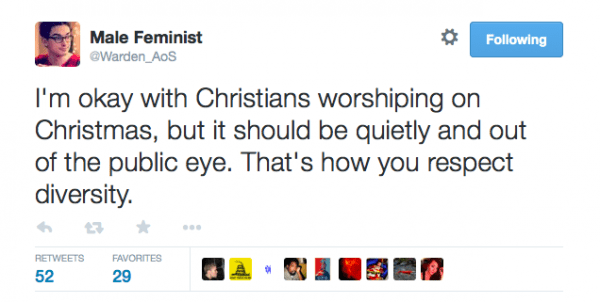
The ascendant attitude toward Christmas is both anti-religious and non-ethical. In my neighborhood, there are far more Star Wars Christmas figures, including Yule Darth Vader ( though thankfully not the 18-ft. Hammacher-Schlemmer version pictured above) and Christmas Storm Troopers, than any suggestion of peace, good will or love. Even these non-sectarian displays are too much for the Diversity Fascists, like this guy:

diversity-tweet

Such people believe that a healthy national culture embracing love, charity, generosity and kindness is disrespectful, and their society-rotting ideology is as much of a threat to our nation as terrorism. I don’t know how to reverse the damage already inflicted on our society, but I do know that we have to try. Reinvigorating Christmas and the ethical values it stands for would be a good start.

Merry Christmas, everyone—and I do mean everyone.

Finally, here’s the post..

Continue reading