From Oklahoma, A Remarkable Ethics Lesson

hartmanparkinglot_610x458

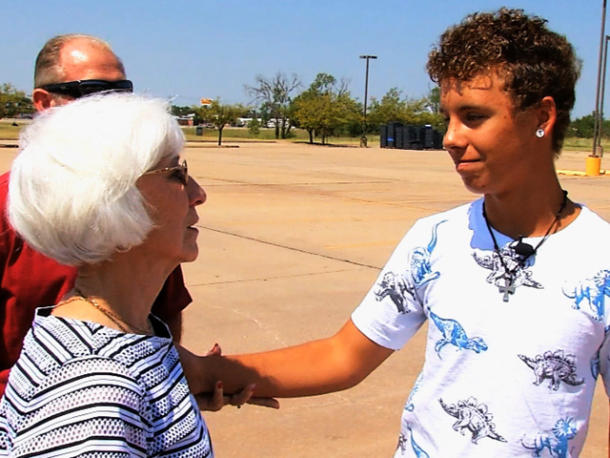
Young Christian Lunsford was disgusted when he saw the TV report about the mugging of seventy-eight-year-old Tona Herndon of Bethany, Oklahoma, robbed while visiting the gravesite of her husband of 60 years, who had died just two weeks earlier. It wasn’t merely that the mugger took a purse and $700 from a vulnerable and grieving woman, but that the culprit was Christian’s father. He had been quickly arrested, and his mug shot, shown on TV, was all-too-familiar to his fifteen-year-old son. Christian’s parents divorced when he was two, and his contact with his father had been minimal as the elder Lunsford kept ending up in jail. The teen had recently heard from his dad, however, when he sent Christian $250 to pay for his participation in a school band trip.

The latest crime, however, moved Christian to do something exemplary. He contacted Tona Herndon and asked her to meet him in a church parking lot. When she did, he mugged her too, as a tribute to his father.

No, that’s not what happened: I was just messing with you. Continue reading

Ethics Dunces: Bismarck, N.D. Supporters Of A.J. Clemente, The Obscene Ex-Newscaster

A.J. Clemente.

A.J. Clemente.

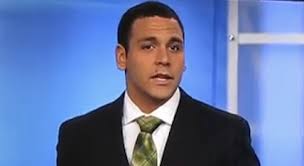
In an earlier post I referenced A.J. Clemente, a newscaster for KFYR-TV in Bismarck who debuted in his new role by saying “…fucking shit!” on the air, because he didn’t know his mic was on. Not surprisingly, he was fired. Now, apparently, many viewers have come to his defense and are admonishing the station for being too harsh.

The station is not being too harsh. The station is upholding correct professional standards, and removing an unprofessional employee whom they do not trust and have no reason to trust. The episode showed him to be careless, reckless and, obviously, subject to obscene outbursts, which only are appropriate if you are David Ortiz. Ah, but some of the good citizens of Bismarck, displaying the same entrenched ethics cluelessness that led to the nomination of the ridiculous Mark Sanford, ex-Romeo governor, to lose a GOP House seat in South Carolina, don’t comprehend accountability, trustworthiness or responsibility, because to them, the only values that matter are forgiveness and compassion. The technical terms for such people are “patsies” and “marks.” They would cripple society, business and government with their mindless, deadly niceness. Examples: Continue reading

“House of Cards” Ethics: Zoe’s Unethical Tweet And The Right To Talk To Just One Person

house_of_cards

At the risk of stirring up the incorrigible defenders of the vigilante Applebee’s waitress, I must again point out that using social media to make a private indiscretion a public disgrace is terrible, grossly unethical conduct that threatens our freedom, trust,privacy and quality of life. The fact that the practice is gaining acceptance as something to be feared and expected is a frightening cultural development, and we are all obligated to do what we can to condemn it and eradicate it before it becomes a toxic social norm.

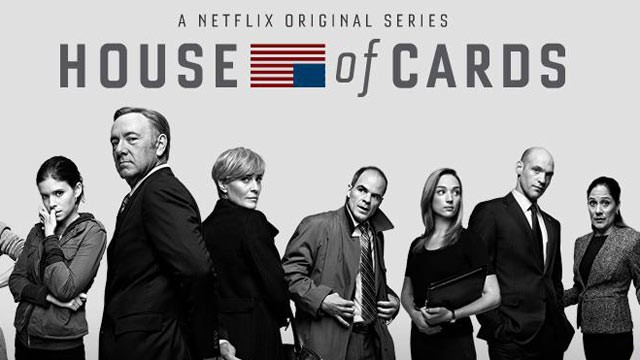
The Netflix political drama “House of Cards” provided a perfect example of what is wrong with this despicable trend in its fourth episode.  Zoe Barnes, the ambitious, unethical reporter in league with Kevin Spacey’s deliciously diabolical House Majority Whip, has brought her newspaper’s editor to the point of apoplexy in a confrontation in his office.  Already considering leaving for greener pastures, the reporter goads her sputtering boss into calling her a misogynistic epithet that she senses is just on the tip of his tongue. “Go ahead,” she taunts. “Say it.”

“You’re a cunt,” he finally replies. Zoe whips out her smart phone and tweets this exchange to her thousands of followers. “Call me whatever you want, “she sneers, “but remember, these days, when you’re talking to one person, you’re talking to a thousand.”

Wrong—not unless the person you’re talking to is unethical, vindictive, has rejected the social conventions of private conversation and is consigning the Golden Rule to the cultural trash heap. Continue reading

Ethics Dunce: Any South Carolinian Who Votes For Disgraced Ex-Governor Mark Sanford

You'll never know if this movie is still playing in the Mark Sanford Head Multiplex...

You’ll never know if this movie is still playing in the Mark Sanford Head Multiplex…

When Mark Sanford was last entrusted with high elected office in South Carolina, he…

  • Carried on a clandestine adulterous affair with a South American “soul mate” when he was supposed to be serving as the governor of the state,
  • Went AWOL from the state and his duties, telling aides that he was “hiking” in South America when he was really doing something very different in Argentina,
  • Used official funds to pay for his personal affair,
  • Lied about it,
  • Humiliated his wife and family while embarrassing South Carolina and his party, and
  • Was censored by the state legislature.

Now, displaying a level of gall only politicians and Hollywood actors can achieve, Sanford is back seeking office in South Carolina, running for the open seat in its 1st Congressional District. His strategy appears to be that old stand-by of the habitual miscreant, evoking the virtue of forgiveness and redemption, as well as suggesting that God wouldn’t rule out voting for him. In his first TV ad, Sanford says that he has learned about a “God of second chances.” Continue reading

Jonah Lehrer Shows Us A Level One Apology: Remorse, Regret, Contrition. Sincerity? Who Knows…

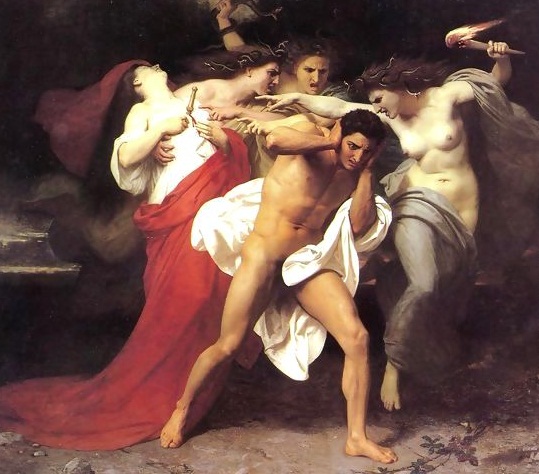
The-Remorse-Of-OrestesWhen we last looked in on writer Jonah Lehrer last summer, he had detonated his career and credibility with a series of incidents of serious professional misconduct that led to his ignominious firing from The New Yorker, where he once was regarded as a rising star. First he was caught plagiarizing himself, recycling a previously published work as an original  essay for the magazine. That led to an investigation showing that this was not the first time he had taken such an unethical short-cut. Finally, it was discovered that he had fabricated Bob Dylan quotes in his best-selling book about, ironically enough, creativity. When confronted about this, Lehrer lied. Soon he was out of a job and condemned to the limbo reserved for writers who deceive their readers: Jason Blair, Stephen Glass, James Frey, Janet Cooke, and others. It is not a pleasant or profitable place to be.

Lehrer was recently invited to speak to a gathering at the Knight Foundation, and chose the forum to deliver an apology for his conduct. It would be difficult, I think, to deliver a better one. On the Ethics Alarms Apology Scale, the most ethical apology, at the top of the scale, is this one:

1. An apology motivated by the realization that one’s past conduct was unjust, unfair, and wrong, constituting an unequivocal admission of wrongdoing as well as regret, remorse and contrition, as part of a sincere effort to make amends and seek forgiveness.

That is exactly what Lehrer delivered to the Knight Foundation, and through his blog, the rest of us. He said…

“..I am the author of a book on creativity that contained several fabricated Bob Dylan quotes. I committed plagiarism on my blog, taking, without credit or citation, an entire paragraph from the blog of Christian Jarrett. I also plagiarized from myself. I lied to a journalist named Michael Moynihan to cover up the Dylan fabrications.

“My mistakes have caused deep pain to those I care about. I am constantly remembering all those people I’ve hurt and let down – friends, family, colleagues. My wife, my parents, my editors. I think about all the readers I’ve disappointed, people who paid good money for my book and now don’t want it on their shelves.I have broken their trust. For that, I am profoundly sorry. It is my hope that, someday, my transgressions might be forgiven.

“I could stop here. But I am convinced that unless I talk openly about what I’ve learned so far – unless I hold myself accountable in public – then the lessons will not last. I will lose the only consolation of my failure, which is the promise that I will not fail like this again. That I might, one day, find a way to fail better.

“The lessons have arrived in phases. The first phase involved a literal reconstruction of my mistakes. I wanted to have an accounting, in my head, of how I fabricated those Dylan quotes. I wanted to understand the mechanics of every lapse, to relive all those errors that led to my disgrace. I wanted to understand so that I could explain it to people, so that I could explain it in a talk like this. So that I could say that I found the broken part and that part has a name. My arrogance. My desire for attention. My willingness to take shortcuts, provided I don’t think anyone else will notice. My carelessness, matched with an ability to excuse my carelessness away. My tendency to believe my own excuses.

“But then, once I came up with this list of flaws, and once I began to understand how these flaws led to each of my mistakes, I realized that all of my explanations changed nothing. They cannot undo what I’ve done, not even a little. A confession is not a solution. It does not restore trust. Not the trust of others and not the trust of myself. What’s more, I came to see that my explanations were distracting me from the more important reality I need to deal with.

“Because my flaws – these flaws that led to my failure – they are a basic part of me. They are as fundamental to my self as those other parts I’m not ashamed of. This is the phase that comes next, the phase I’m in now. It is the slow realization that all the apologies and regrets are just the beginning. That my harshest words will not fix me, that I cannot quickly become the person I need to be. It is finally understanding how hard it is to change.

“Character, Joan Didion wrote, is the willingness to accept responsibility for one’s own life. For too long, I did not accept responsibility. And by not accepting responsibility – by pretending that all of my errors were accidents, that my carelessness was not a choice – I kept myself from getting better. I postponed the reckoning that was needed.

“There is no secret to good decision-making. There is only the obvious truth: We either confront our mistakes and gain a little wisdom, or we don’t and remain a fool.”

You can read the whole speech here. Continue reading

Consequentialism, Bias, Moral Luck and Malpractice on PBS’s “Downton Abbey”

downton_abbey

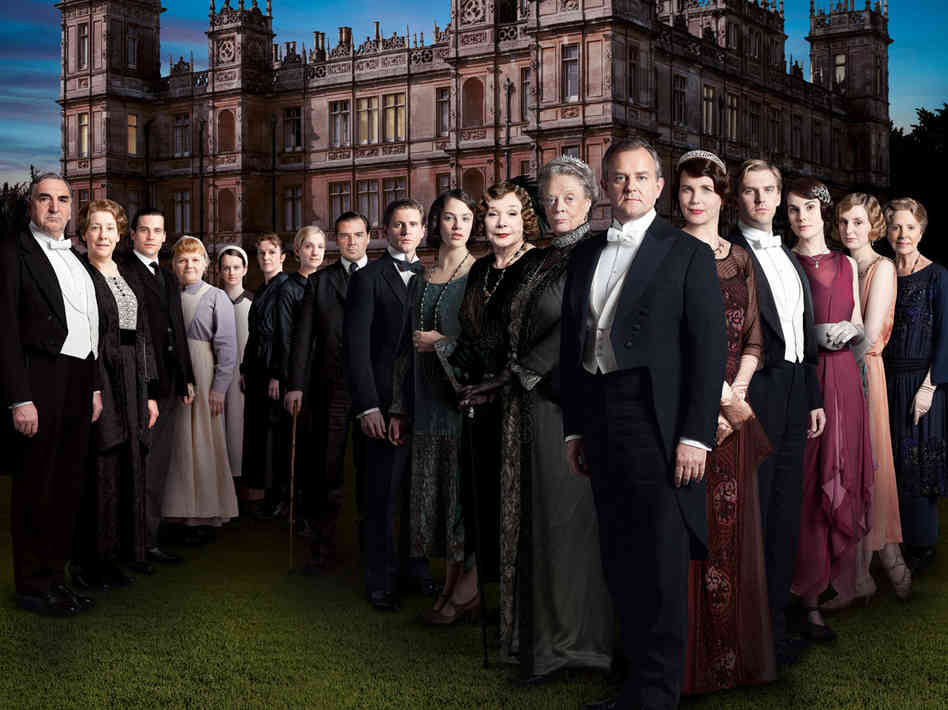
The fourth episode of the PBS sensation “Downton Abbey” provided a clinical examination of how bias of all kinds can rule the most important decisions in our lives, and how moral luck so frequently determines our conclusions about whether those decisions were right, wrong, or really, really wrong. It also shed some light on the  current policy conundrum of how best to consider medical malpractice suits—as a fair and necessary means of rewarding the victims of professional errors, or as a decidedly unfair device that distorts the practice of medicine and inflates its costs without improving treatment.

For those who have not caught the trans-Atlantic mania of following the saga of the Earl of Grantham and his extended family as they try to maintain their life of luxury as members of the landed aristocracy post-World War I, here are the relevant plot points of the most recent episode (in the U.S.; Great Britain is a season ahead of us):

Sybil, the much loved but rebellious daughter of the Earl is staying at the family estate (all right, castle) as she prepares for childbirth. (She and her Irish revolutionary husband Tom are on the lam from British authorities, but never mind that). The Earl naturally wants the best medical care for his daughter, and rejects the long-time family physician, Dr. Clarkson, for the task, because he has made some faulty diagnoses of late that led to all kinds of sorrow in last season’s drama. So the Earl calls in a renowned surgeon to the upper crust who is upper crust himself, Sir Philip Tapsell. (He appears to be an arrogant, pompous jerk, but the show’s writers show him giving sage and well-worded advice to the Earl’s non-Irish revolutionary son-in-law on the delicate matter of his sperm count, so we know he’s not a fraud as well.)

The Earl’s American but far too deferential wife Cora (in case you wondered whatever happened to the cute Elizabeth McGovern from “Ordinary People,” the answer is, “This!”) seeks to rescue Dr. Clarkson from a stinging snub by insisting that he come to Downton Abbey and be present for the childbirth as what we would call a consulting physician to Sir Philip, who doesn’t want one. Two head-strong doctors and hostile doctors looking after the same patient—yes, this will work out well.

Sure enough, Sybil’s pregnancy takes an ominous turn. Her ankles are swollen (“Perhaps she has thick ankles!” huffs Sir Philip, pooh-poohing the symptom. “She does not!” replies loyal Dr. Clarkson), her mental state is confused, and there is protein in her blood. Clarkson concludes that Sybil is toxemic and believes she could suffer eclampsia if she isn’t taken to the hospital immediately for a Caesarian section. Sir Philip dismisses him as a hysteric hack, and insists that Sybil’s pregnancy is normal and fine. Since Caesarians were risky in the 1920’s, often resulting in the deaths of the mother, the baby, or both, he believes Dr. Clarkson is giving irresponsible advice. As critical minutes tick away, Lord Grantham asks Clarkson if he can guarantee that Sybil will survive the ordeal of a Caesarian. “There are no guarantees,” he replies, correctly. Not hearing what he wanted to hear, the worried father turns to Sir Phillip and asks how certain the blue-blood doc is that the operation is unnecessary. “Completely certain,” is the ridiculous reply.

Announcing that certainty is a better bet than equivocation, Lord Grantham decrees that Sybil will remain at the castle to have her child, which she promptly does. All seems to be well, too, with a healthy baby, a beaming mother, a relieved family, and a smugly gloating Sir Phillip. But then Sybil goes into the violent seizures characteristic of eclampsia, and it is too late to save her. She dies. Dr. Clarkson’s diagnosis was correct. The family is devastated; Sir Philip is stunned, Cora is furious at both him and her husband, and the Earl of Grantham is feeling guilty.

Got that?

Cora’s anger, the Earl’s guilt and the vindication of Dr. Clarkson are all the result of a bad-tasting recipe of hindsight bias and moral luck. Sybil might have not gone into convulsions. She might not have survived the Caesarian, in which case Dr. Clarkson would be the one looking incompetent, Sir Phillip would say “I told you so,” and Cora would be furious at a different doctor but the same decision-maker, her husband, who would still be sleeping in the guest room. Continue reading

Ethics Hero Emeritus: Eric Lomax, 1919-2012

Eric Lomax was a hero of forgiveness.

Eric Lomax, his book, the Bridge on the River Kwai,, and his friend, the man who tortured him.

In 1942, Eric Lomax, was a 19 year old  member of the British Royal Corps of Signals stationed in Singapore when he joined thousands of British soldiers in surrendering to the Japanese. It was 1942. He was one of those shipped to Thailand and became one of the slaves laboring to build the Burma Railway, also known as the Death Railway. The building of the railroad and the brutal treatment of the English prisoners by their Japanese captors  formed the plot of the classic 1957 David Lean film, “The Bridge on the River Kwai,”

After Lomax was discovered to have built a radio receiver from spare parts, he was mercilessly tortured and interrogated by his captors.  After his release, fantasies about murdering his main torturer, a man named Nagase Takashi, obsessed him. Lomax spent the early years of his retirement in the 1980s looking for Takashi, and eventually learned that he had become an interpreter for the Allies after the war. In 1992, he stumbled across an article profiling Nagase and noting that he was haunted by guilt over his mistreatment of one British soldier. That soldier, Lomax realized, had been him. He arranged to meet the man who tortured him, and whom he had spent the rest of his life dreaming of murdering.

Torturer and victim met in 1993, on the infamous bridge Lomax had been forced to help construct (and which was not blown up, the film ending notwithstanding). Continue reading

Ethics Heroes: Papa Roach

Ethics Alarms’ 2011 Commenter of the Year tgt, who found this story and passed it on, asks,

“How is a horrible stoner rock band more ethical than everyone in politics?”

It’s a great, if sorrowful, question.

A.V. Club has a feature (which could be called “Start a Feud”) in which it asks a rock performer what song he or she hates, and why.  Jenn Wasner, one half of the Baltimore indie-folk duo Wye Oak (“a blend of Southern culture and Northern sensibilities…”) submitted to this invitation to get in trouble, and fingered the song in the video above, “Scars,” by Papa Roach.

Criticizing the work of other artists in the same field is unprofessional at best, gratuitously unkind and disrespectful. Papa Roach’s members would have been within their rights to fire back something less than complimentary in defense, at very least the observation that ethical musicians don’t take gratuitous shots at one another. What the band did however, was this: it sent Wasner flowers. Wasner was convinced it was some kind of diabolical trap, and tweeted as much. The band tweeted back: Continue reading

Ethics Train Wreck Chronicles: Villains, Victims, Hypocrites and Unlikely Heroes In the Contraception / Limbaugh / Fluke Debacle

If this isn’t the Ethics Train Wreck of the Year, we have something truly horrible in store for us down the line. A no-so-brief brief re-cap:

  • The Obama Administration announces that church-run institutions like hospitals and universities will still be required to offer insurance coverage for abortions, sterilizations and other medical matters that might be in direct opposition to church beliefs. It’s a cynical move, designed to cater to the Democratic base at the expense of religious institutions. It is also irresponsible, since it jeopardizes the huge proportion of medical services performed by church institutions.
  • Conservatives scream that the measure is a breach of religious freedom. The is either ignorant or a lie. The Constitution has no provision requiring the government to make special accommodations for churches or church-operated institutions.
  • Caught by surprise by the intensity of the backlash, the Administration crafts a “compromise,” which is essentially deceitful sleight-of-hand, form over substance. The insurance companies now have to provide those services but the religious institutions don’t have to pay for it. But of course they will, through increased premiums elsewhere.
  • Flagging the deceit, Republican attacks on the measure continue. Democrats successfully frame the debate as a conservative attack on contraception, which it is a misrepresentation, and a “war on women,” which is ridiculous and unfair. The issue is churches being forced to provide or pay for services that violate their faith—which the government has every right to do.
  • The controversy activates GOP presidential candidate Rick Santorum, who is a fringe extremist in sexual matters and toes the Roman Catholic line. He really thinks birth control is immoral. This position, which is unethical, is suddenly given exposure it doesn’t deserve in the 21st Century Continue reading

Ethics Dunce: Sandra Fluke

Made for each other.

Well, now the jig is up on Sandra Fluke. Yes, she was the victim of Rush Limbaugh’s gross verbal assault. But she rejected his apology, which was direct and unequivocal, saying…

“I don’t think that a statement like this issued, saying that his choice of words was not the best, changes anything, and especially when that statement is issued when he’s under significant pressure from his sponsors who have begun to pull their support.”

So now we know who and what Rush’s adversary and momentary victim is. She is a steely-eyed activist who isn’t interested in mutual dialogue, fair play or civil discourse, only ideological victory. She thinks she has America’s most popular conservative pundit on the ropes, so she refuses to be gracious and to match an apology with acknowledgment and forgiveness. In this she reveals herself as no different from Limbaugh, who never gives a thought to fairness or courtesy to his perceived opponents. He sees his job as the destruction of “the bad guys.” So does she. Continue reading