Tales of the Indiana State Legislature: “Your Baby Is A Racist!”

Indiana State Rep. Vanessa Summers. (All right, not really, but I couldn't resist. Read the story and you'll get it.)

Indiana State Rep. Vanessa Summers. (All right, not really, but I couldn’t resist. Read the story and you’ll get it.)

Can it get worse than this? During the debate  in the Indiana House  over the Religious Freedom and Restoration Act,  state Rep. Vanessa Summers, (D-Indianapolis) rose to set a new record in outrageous race-baiting.

“I told [Republican colleague] Jud McMillin I love his son, but he’s scared of me because of my color.”

Responding to a rumble of protest from her assembled colleagues, Summers insisted, “It’s true.” When challenged on the assertion later. she defended her accusation, saying:

“He (the eighteen-month-old child) looked at me like I was a monster and turned around and cried. And I told him (McMillin) you need to introduce your child to some people that are dark-skinned so he will not be scared.”

There are so many take-aways from this episode that it’s difficult to know where to begin, or where to stop.

Continue reading

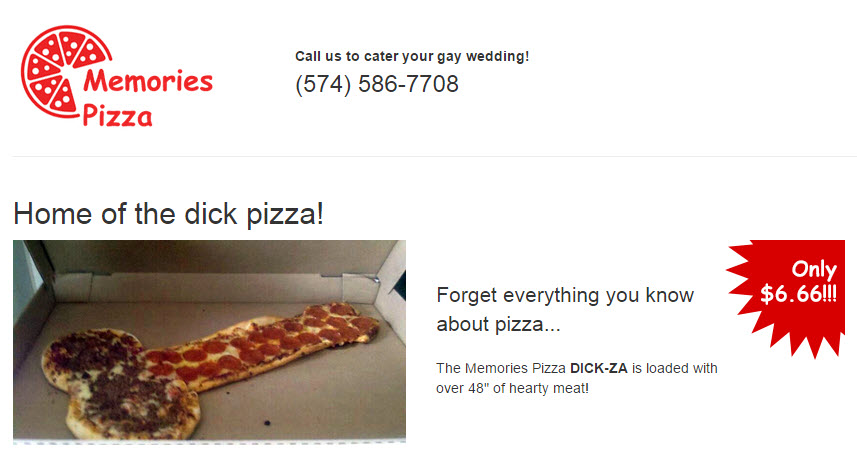
Well-Earned But Wrong: The Parody Website And The Attack On Memories Pizza

Memoriespizza

It is difficult to work up much sympathy for Memories Pizza, the Indiana pizza place that rushed to be known as the first business to announce that it plans on refusing to serve gay customers under the cover of Indiana’s new and poorly thought-out religious freedom law.  Oh, I agree that it was thoughtful of the owners to help show that the law, regardless of the neutral words used, was intended to be a rallying point for anti-gay advocates who want to fight back against what they see as a frightening cultural shift that they don’t understand and can’t accept, but the owners are still, to be blunt, morons.

Announcing that the law would allow them to refuse to cater a gay wedding, they injected their biases into a debate they were neither legally, ethically, morally or intellectually equipped to participate in. Crystal O’Connor, whose family owns the small-town pizzeria, spouted off  that “If a gay couple came in and wanted us to provide pizzas for their wedding, we would have to say no,”  as the national debate over the law was heating up. Well, no, Crystal, you wouldn’t have to, and the law probably wouldn’t protect you if you did. Baking pizza is not the exercise of religion, and nothing in the Bible says “Thou shalt not send pizza to the reception of a wedding you disapprove of.

I just heard one of the law’s supporters from a “family values” group that spends much of its time, words and money attacking homosexuality swear to Chris Cuomo on CNN that the law has nothing whatsoever to do with Indiana embracing anti-gay bigots (and tricking them into thinking that stunts like Crystal’s are acceptable). “It’s about conscience, ” he intoned, without giggling. But the law says nothing about conscience either.It prevents the government from  substantially burdening the exercise of religion. Catering an event, religious or not, is not a religious act, nor is a wedding reception a religious ceremony. It is no more legitimate to say that your conscience forbids you from selling pizza to strangers than it is to say that your conscience forbids you from letting a transsexual into your cab. O’Connor, not surprisingly, doesn’t comprehend the law. Continue reading

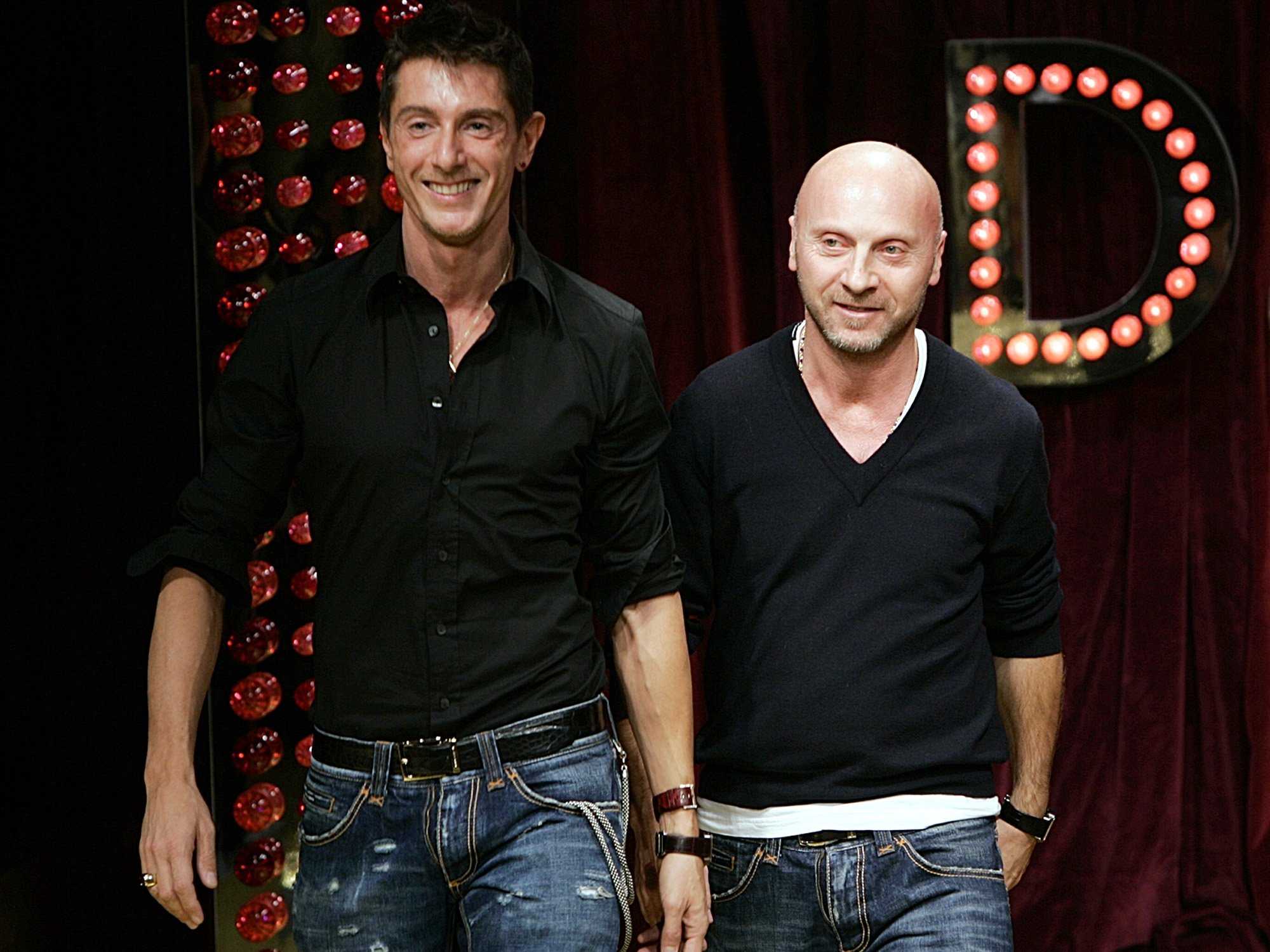
Boycotting Dolce And Gabbana: Gays Becoming What They Once Hated Most

After centuries of oppression, Gays have finally achieved the right to openly be who they are as long as they don't piss of Elton John.

After centuries of oppression, Gays have finally achieved the right to openly be who they are as long as they don’t piss of Elton John.

Stefano Gabbana and Domenico Dolce are Italian fashion design superstars, meaning that I pay no attention to them whatsoever, and don’t understand the priorities of anyone who does. Nonetheless, they have a rich and famous international clientele.. The two men were once romantic partners, but no longer; how they are just business and artistic partners, and continue to thrive.

Their thriving, however, has suffered from a self-inflicted setback. In an interview with the Italian magazine Panorama, the pair declared their lack of support for same-sex families with children created by in vitro fertilization.  “I am not convinced by those I call children of chemicals, synthetic children,” Dolce told the magazine. “Rented uterus, semen chosen from a catalog.” Gabbana added, “The family is not a fad. In it there is a supernatural sense of belonging.”

The Horror: a non-conforming opinion from prominent gay fashion icons! Can’t have that! Lapsed pop superstar Elton John, who has two sons through in vitro fertilization with his husband, David Furnish, took the remarks as a personal attack and proclaimed a boycott of the Gabbana & Dolce label. “How dare you refer to my beautiful children as ‘synthetic,’ ” Mr. John wrote on social media. “Shame on you for wagging your judgmental little fingers at I.V.F. Your archaic thinking is out of step with the times, just like your fashions. I shall never wear Dolce & Gabbana ever again.” Thus was born the hashtag #BoycottDolceGabbana.”
Continue reading

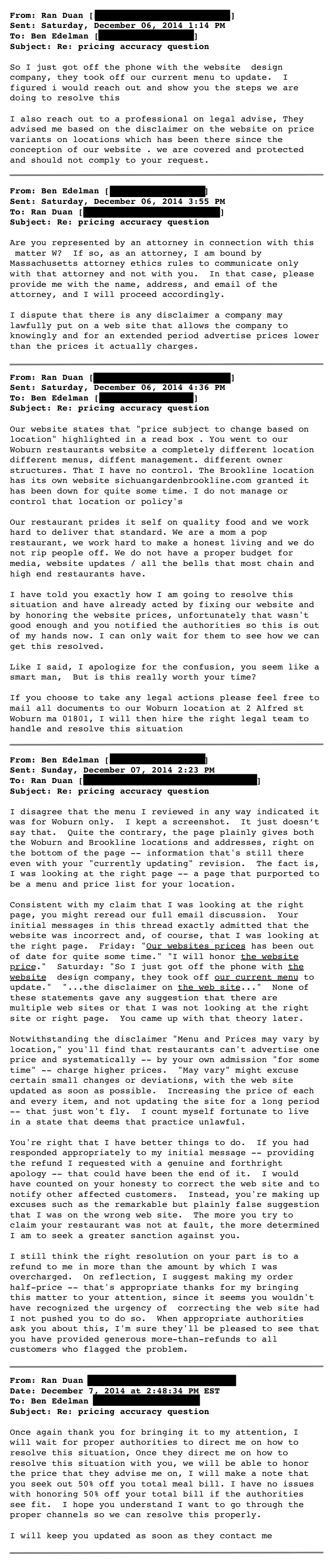
Ethics Quiz: The Harvard Prof and The Erroneous Chinese Restaurant Menu

Perfect! Just what you need to handle that pesky flea, Professor!

Perfect! Just what you need to handle that pesky flea, Professor!

Ben Edelman, a rather well-noted Harvard Business School professor, had this fascinating exchange with a local Szechuan restaurant:

Edelman 1Edelman 2Your Ethics Alarms Ethics Quiz:

“Is Prof. Edelman’s conduct ethical?”

Continue reading

Ethics Quiz: The Beautiful Young Woman In Georgetown

beautiful-face

Late last night, the previous post regarding the video showing a woman being repeatedly shouted at by rude and intrusive males as she silently walked down New York City streets sparked an ancient memory from my past.

The incident before my career shift into ethics, indeed before I was married. I was in Georgetown on a lovely fall day (like this one), and it had been a lousty week. I was feeling lost and depressed. Suddenly I was aware of the young woman walking slightly ahead of me toward the corner of Wisconsin and M streets, Georgetown Central. She wasn’t merely beautiful, but heart-stoppingly beautiful, the kind of rare combination of perfect genetics aesthetic taste who makes one realize how dishonest Hollywood’s representation of humanity is. Maybe this young woman would have blended into the scenery in Tinseltown, but I doubt it very much. Greek myths described how mortals, if they saw a god or goddess in their true form, would be instantly burned to ash, and that was almost the effect this woman had on me.

Yet she did not have the aura of a star or a model who was aware that she was gorgeous and conscious of her effect on those around her—I have seen that many times. Beautiful people generally know they are beautiful and are used to being treated differently because of it; they sometimes have a “leave me alone” force field around them, and this woman didn’t have that either. For some reason, perhaps because the jolt she had given me renewed my flagging enthusiasm for life in general at that moment—I literally never do this, not before and not since—when we reached the corner together, I turned to her and said, as I recall it,

“Excuse me, I don’t want you to take this the wrong way, but your are incredibly lovely, and seeing you today has made me happy, when I was anything but happy before.  I just wanted to say thank you.”

Your Ethics Alarms Ethics Quiz:

Was this wrong?

Continue reading

Hollaback And Awareness of Street Harassment—What’s the Point?


If people who engage in specific unethical conduct know it is unethical and don’t care, does it serve any useful purpose to tell people who know it is unethical and would never do it or tolerate it that the unethical individuals are engaging in it?

I wonder.

From Vox:

Hollaback, an organization that wants to stamp out street harassment and intimidation (a.k.a. catcalls), produced a video in which it videotaped a young woman walking around Manhattan for 10 hours this past August. A hidden video camera was placed in the backpack of a man walking in front of her, catching every catcall, whistle, and even one persistent character who walked alongside the woman for five minutes.

The results are startling. According to Hollaback, there were over 100 instances of verbal harassment in that 10-hour walk, not including winks and whistles. In the video, the woman remains silent. She is dressed in a T-shirt and jeans.

Check the link to Hollaback, and you will see that the organization claims that “you have the power to end street harassment.” No, really you don’t. There can’t be a law against shouting out to someone ( to its credit, legislation isn’t one of the group’s recommendations), and the tradition of men harassing attractive women on the street is old and persistent. This isn’t an everybody does it excuse, this is an “assholes will be assholes, and there will always be assholes” statement of fact. I would expect that street harassment is getting worse, thanks to counter-productive muddled feminist efforts like the recent video with little girls repeatedly saying “Fuck.” Women killed chivalry by treating it as an insult—indeed, it was subordinating and condescending, but at least well-intentioned—and are surprised now that its polar opposite thrives? See, the chivalrous men, those with manners, were called pigs and made to feel guilty about being nice. The men who intentionally and openly harass women? They can’t be made to feel guilty. They do this because they like it.

Remember “the Hunger Project”? It was essentially a 1970’s scam that purported to seek an end to world hunger by saying that it could be ended without really doing anything that could possibly accomplish that goal. Gullible members gave money to the organization, and felt they were doing something to end hunger by giving, when all they were really doing was supporting a group that said world hunger could be ended. Is Hollaback any different? I know there is a long list of “actions” it recommends, but none of these  are likely to penetrate the culture that causes the problem. Basic ethics—the Golden Rule, mutual respect for others, manners, civility—already tells us that shouting at women on the street is disgusting and wrong, and civilized human beings don’t do it, ever. Nor do groups of civilized human beings engage in this conduct.

Men who harass women on the street are exactly like men who have indiscriminate and irresponsible sex, or men who drink so much they can’t hold a job, or men who cheat on their wives, or men who molest children. Nobody needs to tell them that civilized, ethical people think this is wrong. They know it’s wrong. They do it because they like it.

There is no chance, none, zero, that increasing awareness among the comparatively few people who don’t know this is a vile social behavior (I was surprised that the harassment in ten hours wasn’t worse) will do anything to end or even reduce it. So what’s the point?

This, in Vox’s last sentence…

“The video is a reminder that men asserting their dominance over women and intimidating them is simply all too common.”

That’s the message. The awareness campaign is designed to make sure everyone regards women as victims of men generally, and to group men who would never engage in this kind of boorish and threatening conduct with those who do. Then all men can be vilified and placed on the defensive. Dare you question whether a woman should have her contraception paid for, regardless of means? Why, you are just like those harassers on the street, asserting your dominance over women!

I will decline Hollaback’s invitation for the self-indicting trap it is.

Nice try, though.


Introducing Rationalization #46: Zola’s Rejection, or “Don’t Point Fingers!”

fingers-pointing

J’accuse …!” ( “I accuse…!”) was a famous open letter to French president Félix Faure, published  January 13, 1898 in the newspaper L’Aurore by novelist Émile Zola. It accused the French Government anti-Semitism and a breach of justice in the prosecution and imprisonment of Alfred Dreyfus, a French Army General Staff officer sentenced to lifelong penal servitude for espionage. His well-argued accusation was the epitome of effective finger-pointing, and played a major role in bringing down a corrupt government.

Nonetheless, pointing fingers where they need to be pointed, when they need to be pointed, is inconvenient for the incompetents, miscreants, con artists, spinners and otherwise accountable parties so accused. Thus they and their allies often exploit this peculiar rationalization, which is better described, perhaps, as rationalization fertilizer, since it is a catalyst for the employment of many others, including the Biblical rationalizations. “Don’t point fingers!”, or its common variation, “Stop pointing fingers!” provides protection for the very people who most deserve to be pointed to, allowing them to deny culpability, avoid the just consequences of their failings, and best of all, divert appropriate attention from what they have done or not done to the supposed meanness and vindictiveness of critics who want to make sure the same mistakes don’t occur again, especially with the same officials in charge.

And, ironically, the cry “Don’t point fingers!” is often followed by those who cry it pointing fingers themselves, at others. It has unlocked, in such circumstances, the use of Rationalization #7, The Tit-For-Tat Excuse, which holds that one party’s unethical conduct justifies similar unethical conduct in return. Continue reading

On Mockery, The Streisand Effect, Incompetent Lawyers And The Sleeping Yankee Fan

ESPN cameras caught Andrew Rector sleeping in his seat in the fourth inning of  the April 13 Boston Red Sox-New York Yankees game. In the time-honored tradition of TV play-by-play when something funny, weird or, most especially, sexy is spied in the stands, ESPN commentators Dan Shulman and John Kruk  began making fun of him. The clip ended up on YouTube, naturally, and thus on various sports websites, followed by the various idiotic, cruel, gratuitously mean-spirited insults, usually composed by brave anonymous commenters.

This is a familiar pattern of unethical public mockery, and we have become inured to it. Though the ESPN team’s jibes were rather mild in nature, and Rector’s legitimate embarrassment quota would be far, far less than, say, that of George Costanza when this happened at the U.S. Open, let me say for the record that picking fans out of the crowd at sporting events and making fun of them, whatever they are doing, is generally a rotten thing to do. I know: it’s public, you know you might be on camera, and the fine print on the ticket stub puts you on notice. Unless, however, the conduct involved is actually newsworthy or despicable (as in instances where an adult has snatched a baseball from a child), the Golden Rule applies. Who knows why Rector was sleeping? Maybe he was up all night with a dying relative or a grievously ill child—Shulman and Kruk don’t know. And if he chooses to pay for a ticket and nap during the game—and it wasn’t exactly a scintillating game, I should add—so what? Continue reading

Ethics Dunces: Paula Deen and “Uncle Bubba”

uncle-bubba-s-oyster

Like breaking up via text message and telling your spouse you want a divorce in an e-mail, here’s a crummy use of technology that we should hope doesn’t catch on.

Uncle Bubba’s Seafood & Oyster House, a restaurant owned by Paula Deen and her younger brother, Earl W. “Bubba” Hiers Jr., told all of its employees that the place was going out of business on its Facebook page, and that was all. The message:

“Since its opening in 2004, Uncle Bubba’s Oyster House has been a destination for residents and tourists in Savannah, offering the region’s freshest seafood and oysters. However, the restaurant’s owner and operator, Bubba Heirs, has made the decision to close the restaurant in order to explore development options for the waterfront property on which the restaurant is located. At this point, no specific plans have been announced and a range of uses are under consideration in order realize the highest and best use for the property.The closing is effective today, Thursday, April 3, 2014. Employees will be provided with severance based on position and tenure with the restaurant. All effort will be made to find employees comparable employment with other Savannah restaurant organizations.”

Yechh.

Cruel, rude, impersonal, cowardly. Also callous, lazy and inefficient: how many employees were told by third parties about the announcement?

Well, at least Paula’s not a racist. I wonder if the Food Network fired Paula via Facebook? I’m pretty sure it didn’t.

_____________________

Pointer: Evil HR Lady

Facts: CBS

Twelve Post-Veto Ethics Observations On The Arizona “Religious Freedom” Bill

veto2

1. As we now know, Governor Brewer vetoed AZ SB1062, the so-called “religious freedom” bill that was widely (and accurately) interpreted as support for discrimination against gays. In the previous post, I suggested that her delay in doing so sent a message that was as hostile to gays as the law itself: if she felt the law was ethically wrong, then she should have and would have announced that she would not sign the bill long ago. Instead, she waited to see how much economic damage the law would do to the state, and then vetoed it, not because this was the right ting to do, but because it was the pragmatic thing to do. (As the satiric Borowitz Report put it, “The state of Arizona found itself in the middle of a conundrum today as it awoke to the awkward realization that gay people have money and buy stuff.”) USA Today noted that, to the contrary,”Some political insiders believe Brewer has allowed furor over the legislation to build to thwart social conservatives’ attempts to push a similar bill later.” I doubt it, but if so, Brewer allowed her state and her fellow Republicans to be represented nationally as homophobic for as long as possible to spare herself the inconvenience of vetoing a second bill.

2. Despite the extravagant debate over the bill, almost no commentators actually published the bill’s text in the commentary. The reason appears to be that since the bill is really an amendment of an existing law, it takes a modicum of intelligence to figure out what’s going on. Here it is (the original law is in black; the new text is in blue; what has been removed in the amended version is struck through): Continue reading