Morning Ethics Warm-Up: 7/24/17

Good Morning…

…and gee, it’s good to be back home! You have no idea how good it is.

1. ARRRGH! I returned to Ethics Alarms with 6 pending comments, and I want to apologize profusely for the back-up, especially to poor Paul Schlecht, whose avatar inexplicably makes WordPress hold every single one of his comments  in moderation until I rescue it. Only one post got up yesterday, and that was a close call: I was in resort/airport/travel Hell yesterday in Daytona  Beach, then Charlotte, pretty much from the moment I got my wake-up call at 6 AM to when my plane finally arrived at D.C.’s Reagan National Airport at just short of 1 am. today.

At least my law firm retreat seminar on legal ethics and technology was lively, but now I am way behind on posts, and also not exactly at the top of my game. Again, my apologies to all. And I’ve got to get a new laptop without a jumping cursor and that doesn’t crash my browser every 20 minutes or so.

2. I mentioned last week that the New York Times Sunday Review section is a weekly exercise in anti-President Trump porn. I couldn’t find a Sunday Times yesterday, so as a test, I’m going to open the copy my wife saved for me and look at the section now.

Let’s see…well the above the fold story is a feature about “why women aren’t CEOs.” The anti-Trump shot doesn’t come until the last paragraph, where the author, Susan Chira, couldn’t help herself from quoting Hillary Clinton as she blamed misogyny for her defeat. The Deplorables, you know. The second story on the front page is a mocking piece by a British historian, about a new Trump Doctrine, but with the term in scare quotes. How dare the President stand up for Western Civilization, we are asked to consider? This author, Stephen Wertheim, claims that the Trump administration’s problems with Iran, North Korea and China are based in racism and religious bias.  (Obama’s problems with the same nations were, presumably, based on a sincere concern for peace.) The  essay is also fairly anti-American, but concludes with the insult that the problem with the President isn’t so much what he does as who he is.

This is essentially the argument of “the resistance.” You know. Bigotry.

Let’s see—that piece took up all of page two, so we move on to page three. Two op-eds are there, one again mocking the ex-press secretary Sean Spicer, which the Times editorial board had already done, and the other, by Frank Bruni, attacking Jared Kushner. It closes with this, in part:

His counsel to Trump has been flawed, to say the least. He reportedly lobbied for the firing of James Comey, which didn’t turn out so well….I hear that he feels persecuted. Wronged. In that regard, too, he’s like his father-in-law, though Trump wears his self-pity, fury and ruthlessness right out front, for the whole world to see.

This is the company line. Actually, firing Comey turned out spectacularly well: the President was able to get rid of a highly placed leaker who had proven himself incompetent and untrustworthy. Bruni and the Times feel it was a mistake because the completely legal, appropriate, indeed overdue dismissal brought down the ire of the news media determined to get rid of the President. Message: When will you learn that we call the shots, you fool?

In fact, the President and his entire family have been persecuted by the Times from the very beginning, in obvious contrast to the news media’s disgusting fawning over the Clintons and Obamas, and even their chilly respect for the Bushes.

On to page four! Oh! Here’s a cartoon of the President as Donald Duck, and an op-ed by a New York City mother about how embarrassing it is to have a toddler who–The Horror!—likes the President of the United States! Beneath that screed, with a picture of Don, Jr., is an op-ed attacking another member of the President’s family in a piece about “men who never grow up.” The Trump boys are lumped in with Billy Bush, Ryan Lochte (the moronic Olympic swimmer), the fortunate college rapist Brock Turner, and the police officers who shot Tamir Rice!  Funny, the nation’s most prominent perpetual adolescent, who embarrassed the whole nation by using the White House as his passion pit, is never mentioned.

The non-Trump stories then take over for a few pages, and we’re finally at the editorial page. Two of the three editorials attack the President’s policies as the embodiment of evil: one condemns the very concept of the Election Integrity Commission— did you know that trying to find out how much actual voter fraud there is constitutes voter suppression?—and the other uses the President’s border wall plan as a prop to level general insults.  The rest of that page is devoted to a special selection of Letters to the Editor critical of…Donald Trump! Every one, all ten. You’re right, NYT, the paper doesn’t reflect this opinion thoroughly enough. On the facing page, two of the three op-eds consist of more Trump bashing. Maureen Dowd is one, but to be fair, all she does is level snark at everyone. The other is a second attack on Jared Kushner, because one per section is not enough.

The total: Nine Trump-hate pieces, plus ten anti-Trump letters, and not a single supportive word, balanced analysis, or defense. And the Sunday Review section is like this every week.

3. I can’t believe I’m writing this. The Discovery Channel’s always idiotic and often misleading “Shark Week” told audiences that Olympic Gold  Medal swimmer Michael Phelps would be racing a Great White Shark in the ocean. Admittedly, most potential viewers should be smart enough to figure out that there had to be a catch (no pun intended) despite the misleading title “Phelps vs. Shark: Great Gold vs Great White.”  They should be, but we know they aren’t, based on the other stupid shows they fall for on the network, and also because there have been three “Sharknado” movies with a fourth on the way. That Discovery Channel title is a lie: Phelps never was in the water with a shark; he never saw a shark; he never raced a shark. He “raced’ a computer-generated shark that was put into the film after Phelps was safe and dry. Some of Phelps’ gullible fans are annoyed.

They should be. On the other hand, they are morons. The entire exercise should have taken about 6 seconds, the amount of time it takes to say “White sharks swim faster than humans, even Olympic champions. Bye.” Continue reading

Ethics Jump-Ball At The 7-11

Boy, you better be quick if you want to be “pay it forward” in Alexandria, Virginia.

Today I dropped by the local 7-11 for a quick purchase and was third in a line of four. Being served was a very tall—basketball player tall—, very striking young African American man, late 20s, early 30s,  in a three- piece suit and tie. He had his items on the counter for checkout, and excused himself briefly to go out to his car where he said he had left his wallet. A few seconds later he stepped back into the store and said, “Never mind. I’m sorry, I left my wallet at home,” and started to leave. I hesitated maybe two seconds and started to speak, as did the man ahead of me. I was about to say that I would pay for his items, but the guy behind me, short, stocky, white, about 50, and noticeably missing a few teeth in front, stepped out and said, “Hey, man, I’ve got it.”

The young man looked surprised and said, “Are you sure?” “Of course. Is that it?” replied the older man, pointing to the counter.

“Just pay it forward, friend,” said the man in front of me.

“Thank you,” said the Kareem Abdul Jabbar look-alike.  I really did think he looked like Kareem, early 70’s vintage, but handsomer. He also appeared a lot more affluent than his shorter benefactor. “Here’s my contact information…” and he reached into his pocket.

“No, no, come on, that’s not necessary,” said his new friend,, flashing his missing teeth in a big smile. “I’ve got it. We’re all in this together.” And he paid the clerk.

The tall black man shook his hand, and they both held the clasp for a few second. “Thanks so much,” he said.

After he left, both I and the man in front of me congratulated the winner of this ethics jump ball, saying that we both were about to do the same thing, but he had been quicker.

“Oh no!” he said suddenly, eyes twinkling. “I just spent my last dollar! Now I can’t pay for MY stuff!”

“See? I’d really have you both then, wouldn’t I?”

And we all laughed.

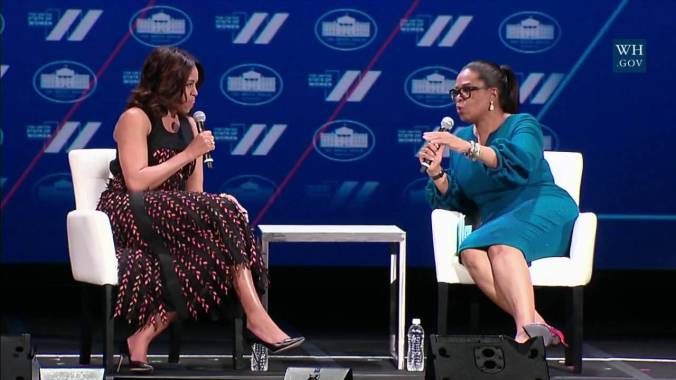
Unethical Quote Of The Month: Michelle Obama; Runner-Up: Her Husband

michelle-and-oprah

“We feel the difference now. See, now, we are feeling what not having hope feels like. Hope is necessary. It’s a necessary concept and Barack didn’t just talk about hope because he thought it was just a nice slogan to get votes. He and I and so many believe that — what else do you have if you don’t have hope,What do you give your kids if you can’t give them hope?”

First Lady Michelle Obama, in an interview with Oprah Winfrey broadcast last week.

I was going to ignore this unforgivable  statement, as there have been so many notable melt-downs from progressives and Democrats that if I commented on all of them it would be all freak-out, all the time on Ethics Alarms. However, the video really bothered me, and the timing of the remarks were so inappropriate—Let’s ask Syrians, who your husband decided to abandon in their desperation when he allowed his promise of a “red line” to  evaporate  as Assad turned his chemical weapons on them, how much hope they have, Mrs. Obama!—that I tried to think of any previous First Lady who so blatantly abused her role as a non-partisan symbol of stability and optimism for all Americans. There hasn’t been one. No First Lady, even the outspoken Barbara Bush or the activist Eleanor Roosevelt, has come close to declaring that hope was dead in America. It is especially irresponsible for a First Lady to talk like this as her husband leaves office. His predecessor was gracious, and the First Family owes its successor the same courtesy and respect. Continue reading

Holiday Ethics Assigment: Quick! Watch These 25 Great Old Ethics Movies Again Before You Go Bonkers Too!

movie-theater

I am compiling a new list of great ethics movies to help those troubled by the recently completed Presidential campaign, the election and its aftermath. I haven’t decided whether to reveal it piecemeal, or collectively as I have before, but I do need to begin by presenting the previous list of 25, actually the combination of several previous posts. Ethics films I have covered individually since those lists debuted, like Spotlight and Bridge of Spies, will eventually be added.

For now, here’s the top 25. Don’t pay attention to the order.

1Spartacus (196o)

The raw history is inspiring enough: an escaped gladiator led an army of slaves to multiple victories over the Roman legions in one of the greatest underdog triumphs ever recorded. Stanley Kubrick’s sword-and-sandal classic has many inspiring sequences, none more so than the moment when Spartacus’s defeated army chooses death rather than to allow him to identify himself to their Roman captors (“I am Spartacus!”)

Ethical issues highlighted: Liberty, slavery, sacrifice, trust, politics, courage, determination, the duty to resist abusive power, revolution, love, loyalty.

Favorite quote: “When a free man dies, he loses the pleasure of life. A slave loses his pain. Death is the only freedom a slave knows. That’s why he’s not afraid of it. That’s why we’ll win.” [Spartacus (Kirk Douglas)]

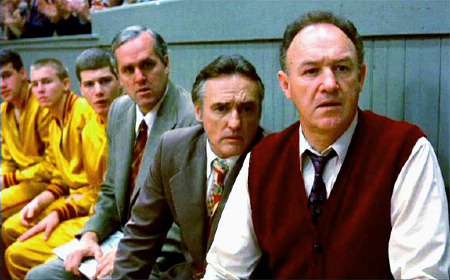
2.  Hoosiers (1986)

“Hoosiers” is loosely based on true story, but its strength is the way it combines classic sports movie clichés—the win-at-all-costs coach down on his luck, the remote superstar, over-achieving team—into a powerful lesson: it isn’t the final victory that matters most, but the journey to achieving it.

Ethical issues highlighted: Forgiveness, generosity, leadership, kindness, courage, loyalty, diligence, redemption.

Favorite quote: “If you put your effort and concentration into playing to your potential, to be the best that you can be, I don’t care what the scoreboard says at the end of the game, in my book we’re gonna be winners.” [ Coach Norman Dale (Gene Hackman)]

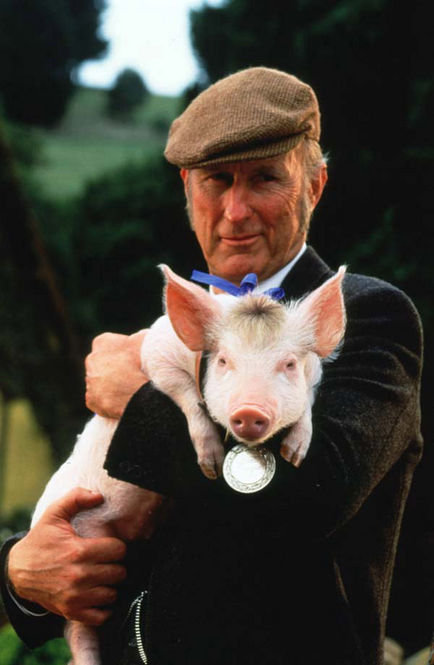
3. Babe (1995)

A wonderful movie about the virtues of being nice, the greatest civility film of all time. Second place: “Harvey.”

Ethical issues highlighted: Civility, kindness, reciprocity, loyalty, courage, love, friendship, bigotry, bias.

Favorite quote: “Fly decided to speak very slowly, for it was a cold fact of nature that sheep were stupid, and there was nothing that could convince her otherwise…The sheep decided to speak very slowly, for it was a cold fact of nature that wolves were ignorant, and there was nothing that could convince them otherwise”  The Narrator (Roscoe Lee Browne) Continue reading

My Ethics Hero: Some Guy In The Harris Teeter Meat Section

I was doing some quick shopping yesterday at a large Harris Teeter supermarket in Alexandria, Virginia. My list from my wife included an option—always a doorway to a shopping confidence crisis—between a whole chicken, a small marinated chicken, or two large chicken breasts. I had decided on the marinated bird, but couldn’t find them where they usually were, and was more or less frozen, like the “hosts” in “Westworld” get when Anthony Hopkins wants them quiet, staring where I expected them to be.

“I’m going to buy one of them, the question is, which one?” a jaunty, relaxed voice close behind me said. At that moment I realized I had been staring at turkeys (I wasn’t there to buy one), and I turned around, not startled but curious, to face a broadly smiling, handsome, bearded African-American man about my age, probably a little younger.

“Isn’t it a little early?” I asked, smiling back. Being habitually disorganized, I am typically shopping  for everything the day before Thanksgiving.

“Oh, no, not for me!” he said, laughing. And he told me that he was going to cook up one or more turkeys for his church on Sunday. We talked about the ways he cooked his turkeys; he preferred to smoke them. He was also a grilling specialist. He took out his phone and showed me pictures of his specialty, ribs. We talked about his favorite recipes, and his church, his family, and its Thanksgiving plans, as I told him about mine. I mentioned that my wife was our traditional Thanksgiving chef, and that got the discussion turned around to marriage. We both have been married a long time, and he took me by the shoulders and talked intensely about commitment in relationships.

I had a twenty-minute conversation with this delightful stranger, just standing by the meat section. Finally, I announced  that I had to finish my assignment, and wished him wonderful holidays. I offered him my hand and introduced myself; he shook it firmly, and gave his name in return. Then we spontaneously hugged each other, which I never do, being from Boston and trained to be reticent in such intimacies, he flashed that terrific smile, and we parted.

My encounter with this exuberant gentleman suddenly made me feel good about life, my community, the country and the human race as I had not for a very long time. I think we’ll be all right. All that had happened was that a stranger just reached out and began a conversation about something two people shared, showing openness, kindness, human interest and trust, and a connection was made. That’s all it takes.

I start conversations with strangers a lot; it was something my father did. He was better at it than I am, and my friend in the Harris Teeter meat section is obviously a grandmaster. But as the holidays approach, and I keep reading these essays about families boycotting each other because of Trump-Clinton divides, it is so obvious that my dad and my turkey buddy are the wise ones.  We’re all just human beings together on a short and unpredictable trip: we should  just focus on that, and reach out.  Why is it so hard? Continue reading

Ethics Hero: World War II Vet Burke Waldron

It is a day late, but I finally have my Memorial Day post.

Thank-you, Burke Waldron, for your service, for making me feel young, and for having the integrity not to embarrass yourself, your contemporaries, and everyone else by making pathetic attempt at throwing a baseball.

I’m not sure which elements of Ethics Hero 92-year-old WW II veteran Burke Waldron displayed yesterday, as he threw out the ceremonial first pitch at the Seattle Mariners game on Memorial Day. Call him a holistic hero. He’s a hero, like all of the fallen soldiers—including my dad—of past wars, because he risked the horrors of combat to defend our nation and the values it stands for…well, at least until Donald Trump is President.

He’s a hero because he represented his generation yesterday with style, verve and energy, running to the pitcher’s mound—in his uniform!as thousands cheered. Most of all, to me, he’s a hero because he took his assignment seriously, and didn’t emulate the pathetic rockers, politicians and even retired athletes who defile their first pitch honors by throwing the ball like a 7-year-old T-ball player, because they couldn’t be bothered to practice. Petty Officer, 2nd Class Waldron threw a strike to his catcher…

…just like another war hero, Ted Williams, did in his last appearance on a baseball field, at the 1999 All-Star Game in Boston. Continue reading

Ethics Hero: Fate, Providence, God, Luck, Mr. Irony, Chancey McCoinky-DinkFace, Or Whoever Was Responsible For This Story, Because It’s WONDERFUL

I love this story. It is just what I needed. I have been smiling for hours, and though my website is going through a slump, my business is at a critical juncture, my nation faces an uncertain future, everything seems to be spinning out of control, and I’m still fat, bald and frustrated by unfulfilled ambitions, hopes and dreams…damn. It is a wonderful world, isn’t it?

The Heimlich maneuver was developed by Dr. Henry J. Heimlich in 1974. It is estimated that the anti-choking technique has  saved approximately estimated 50,000 U.S. lives, and thousands more worldwide.

Now you can add 87-year-old Patty Ris to the list. She has just sat down to eat dinner with other seniors at a group table in the dining hall of Cincinnati’s Deupree House, a retirement home, when her first bite of hamburger lodged in her throat. She began choking, unable to daw a breath. Luckily, a 96-year-old man sitting next to her jumped up from his chair, grabbed her, and  deftly used the abdomen-squeezing maneuver to successfully pop the obstruction our of her windpipe and her mouth.

That 96-year-old man was Dr. Heimlich himself. In all these years, he said, he had never had the opportunity to use the method he devised to save someone who was really in peril.

“I felt it was just confirmation of what I had been doing throughout my life,” he said proudly.

Perfect.

__________________________

Source: New York Times

More Oscar Ethics: Ethical Quote (Graham Moore) and Unethical Quote (John Legend) Of The Month

“When I was 16 years old, I tried to kill myself because I felt weird and I felt different, and I felt like I did not belong. And now I’m standing here, and so I would like this moment to be for this kid out there who feels like she’s weird or she’s different or she doesn’t fit in anywhere: Yes, you do. I promise you do. Stay weird, stay different, and then, when it’s your turn, and you are standing on this stage, please pass the same message to the next person who comes along. Thank you so much!”

—-Graham Moore, 2015 Oscar winner for best adapted screenplay for the movie “The Imitation Game,” in his acceptance speech.

“We live in the most incarcerated country in the world. There are more black men under correctional control today than there were under slavery in 1850.”

John Legend, accepting the 2015 Oscar for Best Song for “Glory” from “Selma.”

Legend’s statement is technically accurate, but misleading in many ways, inflammatory, destructive, and irresponsible.

When you heard it, did you make the distinction between “in prison” and “under correctional control”? Most didn’t—I didn’t— and that was intentional. This is deceit. Correctional control  includes those in prisons, but also those in jails awaiting trial or serving short local sentences; those on parole; and others on probation.  Like all the fake and misleading statistics that fly around, this one is inflated to induce a “Wow!”  A person under probation or parole can live a completely normal and free life, if he or she can avoid breaking the law and some extra rules. Slavery it’s not. Continue reading

On Its 100th Anniversary: Remembering The Great War’s Christmas Truce Of 1914

christmas-truce-1914-H

On December 7, 1914, as the horrible, pointless, world-disrupting “War to End All Wars”  was only five months old, Pope Benedict XV suggested a truce for the celebration of Christmas. The governments of the battling nations rejected the idea, but in the days leading up to  Christmas and after, many of  the soldiers in the trenches of this ugly conflict took the Pope’s advice.

On December 20, Germans soldiers in some areas took in British wounded from the no man’s land between the warring armies. A German soldier reported on December 22 that both sides had been heard singing Christmas Carols in the trenches. German troops arriving into the lines had begun bringing Christmas trees, and some men placed them on the parapets of the fire trenches. Then, on Christmas Eve, many German and British troops serenaded each other across the lines. Allied soldiers reported that sometimes their singing was accompanied by German brass bands. Then, Christmas Day, 1914, some of the German soldiers left their trenches and  carefully approached Allied lines, shouting“Merry Christmas” in French and English. Allied soldiers climbed out of their trenches, and shook hands with the men who had only recently been trying to kill them. Some even exchanged exchanged gifts of cigarettes and and food. There were even instances where soldiers from opposing sides played soccer: in England, one organization is holding a match next week against a German team to commemorate such contests. Continue reading

Obama Fires Hagel: The Flat Learning Curve Budges

Scapegoat

Sniffs the Weekly Standard:

How Do You Spell Scapegoat? H-A-G-E-L.

Chuck Hagel, apparently fired as Secretary of Defense, was exactly who and what Obama wanted, a weak Defense Secretary willing to carry out the President’s plan of demilitarizing of the U.S. and reducing U.S. power abroad. But that plan has led to rapidly deteriorating stability around the globe, and with ISIS appearing to be winning while the U.S. has restricted itself to bomb runs and “advisors,” Obama had a choice. He could, as he has consistently done for six years, refuse to acknowledge that his policies were misfiring and that his team was failing, thus giving the public no reason to believe that he knew, or perhaps even cared, that his ideology didn’t translate into desirable real world results. He could continue blaming others—Republicans, bad luck, Bush—for failures, and keep his loyalists in their jobs no matter how incompetent they appeared. In the alternative, he could signal that he was not satisfied with the status quo, and let heads roll—you know, like real leaders do. Continue reading