Leadership Trust: Is This Finally The Public’s Tipping Point On President Obama?

giant-jengaTipping points are events that establish major shifts in public attitudes and the culture, and what determines a tipping point varies from circumstance to circumstance. When the switch is flipped on public trust, a leader is done for, at least in a democracy. This is why, in a parliamentary system,  prime ministers call for elections at such times, or even resign. It’s a tradition the U.S. might do well to consider.

The tipping point on the George W. Bush presidency was glaringly obvious: it was the botched handling of Hurricane Katrina, even though that particular fiasco was mostly an example of effective  blame-shifting by New Orleans mayor Ray Nagin. Bush had already accumulated many legitimate reasons to doubt him, but the traditional American eagerness to like and trust whoever holds the same job as Washington, Lincoln and FDR had kept his presidency afloat…until it drowned in Katrina. All was downhill from there.

Interestingly, nobody at the time argued that Americans should support the lousy response to Katrina because not doing so would cripple the Bush presidency going forward. But I digress..

Now it appears that the Obama proposal/decision/ argument—who knows what it really is?—to engage in a limited missile attack on Syria may be the public tipping point on Obama’s leadership, the moment when the veils fall and the nation reluctantly but decisively admits that the man it elected—twice—as its leader cannot be trusted. If so, it is remarkable this took so long, testimony to how much we all wanted our first African-American President to succeed. The tipping point for me was years ago. Following the Bush experience, I thought that the bungled government handling of the Gulf oil spill would clinch it, but no. Then came the Benghazi mess, with an ambassador and other Americans murdered without any decisive response other than deceptive spin and obfuscation to avoid electoral consequences—the I.R.S. tea party harassment (still being investigated, and looking worse all the time)—the NSA revelations, and the growing evidence that while the Affordable Care Act may not be the cataclysmic socialist disaster conservatives claim it is, it is also far from what the President promised. No tipping point though, until Syria, and the consequences flowing directly from the President’s undisciplined off-the-cuff rhetoric—a constantly repeated flaw in his leadership style.

Now, as tipping points do, this current controversy is resuscitating all of the past incidents, and serving as the catalyst for a reappraisal of Obama’s leadership. The looming conclusion is that he cannot be trusted.

Occasionally am beaten to the punch by a pundit or blogger who delivers an essay that says exactly what I was preparing to write, even as I was almost finished writing it. Such a pundit is Forbes contributor Merrill Mathews, who delivered an article on that publication’s website over the weekend, titled “What Happens When You Can’t Believe A Thing The President Says?” (My title was going to be “When Trust Is Gone”).

Some key quotes from the article: Continue reading
Ethics Quote of the Day: “Emily Webb”

“Goodbye to clocks ticking — and my butternut tree! And Mama’s sunflowers — and food and coffee — and new-ironed dresses and hot baths — and sleeping and waking up! Oh, earth, you’re too wonderful for anyone to realize you! Do any human beings ever realize life while they live it — every, every minute?”

—- Emily Webb, the heroine of Thornton Wilder’s 1938 drama “Our Town,” in her climactic speech in Act 3, cutting short the one day in her life she has been permitted to relive after dying in childbirth.

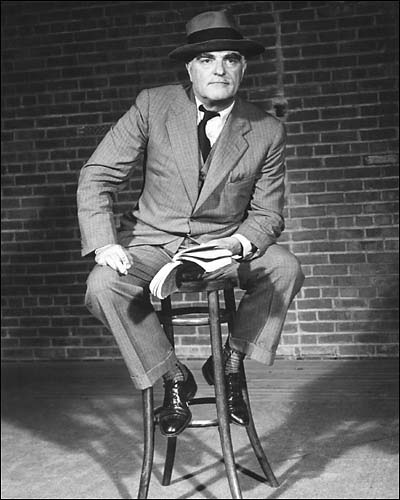
Thornton Wilder

Thornton Wilder

It’s a gorgeous spring Sunday in Northern Virginia, and by happenstance Garrison Keillor chose today’s installment of his “Prairie Home Companion” to allude to Emily’s famous,  heart-breaking speech at the end of “Our Town.” The speech is so familiar to many of us that we tend to forget how perfect and right it is, one of those remarkable, inexplicable times when a writer manages to express the important thought that is beyond expression.

Emily’s speech reminds us that the ultimate unethical act is wasting the remarkable opportunity that is a human life, and, at the same time, failing to appreciate the wonder that passes by our senses in the process. The answer to Emily’s question is, of course, no—nobody, not poets, not geniuses, not heroes nor saints—realize life every minute. Wilder’s, and Emily’s immortal words, however, spur us to try.

On this beautiful day, in this beautiful country, Emily’s speech is an excellent catalyst for calm, resolve, perspective, and hope.


Unethical Column of the Century: CNN’s L.Z. Granderson

OK, maybe I’m exaggerating.

But not much.

L.Z. Granderson’s role model. I’m not kidding.

In a horrifying opinion column, the regular CNN political pundit L.Z. Granderson evoked the virtues of public apathy and unchecked government conduct with warped logic and unethical rationalizations, to make the case that the public should merely shrug off scandals like “Fast and Furious.” I was only able to finish reading it without retching it by imagining Granderson’s motives for writing such mind- and culture-poisoning swill. At least, as an African-American journalist, a liberal and a Obama supporter (I know I repeat myself), he has the self-respect, fairness and integrity not to claim that critics of Attorney General Holder’s Waterloo are being racist. Like the race-baiters, however, he is in denial, and willing to throw principle to the wolves to protect the first African-American Attorney General, though far from the first corrupt and incompetent one.

In a column with the descriptive and idiotic title, “Don’t be nosy about Fast and Furious,” Granderson argues…

“…Times have changed. Yet, not everything is our business. And in the political arena, there are things that should be and need to be kept quiet…..there comes a point where the public’s right to know needs to take a back seat to matters like national security and diplomacy. Heads should roll because of the Fast and Furious debacle. We don’t need every detail of that operation to be made public in order for that to happen. If it were an isolated sting, maybe. But it is at least the third incarnation of a gun-running scheme stretching across two administrations, which means we could be pressing to open Pandora’s Box. We do not want to open Pandora’s Box, not about this and certainly not about a bunch of other potentially scandalous things the federal government has been involved with.” Continue reading

My 15 Hollywood Cures For A Paterno-Penn State-Sandusky Hangover, Part 2

Part 1 listed the first seven of my 15 cinematic remedies for Penn State-inspired ethics ennui. Part 2 includes the final eight. Please don’t take the order too seriously; I could have shuffled the whole batch. I also tried to include as many genres as possible. When it comes to ethics, good lists can be compiled using all Westerns, all sports movies, all war movies, courtroom drama or science fiction. Here we go…

8Spartacus (196o)

The raw history is inspiring enough: an escaped gladiator led an army of slaves to multiple victories over the Roman legions in one of the greatest underdog triumphs ever recorded. Stanley Kubrick’s sword-and-sandal classic has many inspiring sequences, none more so than the moment when Spartacus’s defeated army chooses death rather than to allow him to identify himself to their Roman captors (“I am Spartacus!”)

Ethical issues highlighted: Liberty, slavery, sacrifice, trust, politics, courage, determination, the duty to resist abusive power, revolution, love, loyalty.

Favorite quote: “When a free man dies, he loses the pleasure of life. A slave loses his pain. Death is the only freedom a slave knows. That’s why he’s not afraid of it. That’s why we’ll win.” [Spartacus (Kirk Douglas)] Continue reading

My 15 Hollywood Cures For A Paterno-Penn State-Sandusky Hangover, Part 1

For this hangover, movies work better.

The past week, as much as any week within memory, has caused me to despair about the culture, the state of ethical values in America, and my own futile efforts to try to bring some light to the darkness. My mood was not only ravaged by the Penn State scandal (and Penn State’s students’ scandalous reaction to it), but also the continued drift and incompetence in our government and the lack of any apparent leadership or courage to address the problems of our economic system, other than to complain about them.

In such times—there have been others, though happily not many—my spirit urgently needs an infusion of inspiration and hope, and fast: as Al Pacino reminds us in “Scent of a Woman,” there is no prosthesis for an amputated spirit. This is when I turn to the movies that speak to me of courage, redemption, and ethical virtues validated. They are my lifeline; I can’t write or think about ethics from the bottom of a pit. I’ve got only a few days before Thanksgiving, after all. This is no time to be cynical and dubious about the course of humanity and the United States of America, a nation I love and admire.

Thus I am going to take a brief detour from the usual format of Ethics Alarms, with your leave and forgiveness, and share with you the fifteen movies that I will turn to as I try to recharge my enthusiasm, inspiration, and hope. Here are 1 though 7; the rest will be along shortly:

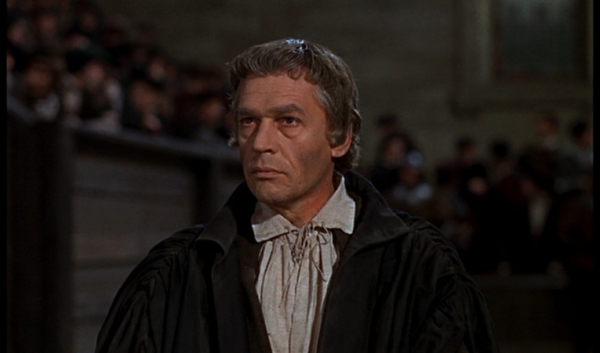
1. A Man For All Seasons (1966)

Hardly the most upbeat film to start the list, but probably the greatest ethics movie ever made.

Ethical issues highlighted: Integrity, honesty, courage, leadership, corruption, abuse of power.

Favorite quote: “Why Richard, it profits a man nothing to give his soul for the whole world… but for Wales?” [Sir Thomas More (Paul Scofield)] Continue reading

Thanking Dick Williams…Finally

The late Dick Williams, doing what great leaders do

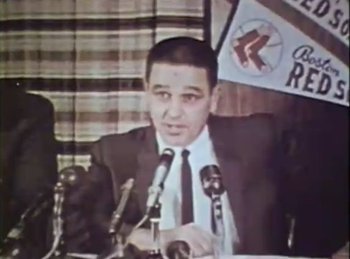
If you are not a baseball fan, or under the age of thirty, you probably never heard of Hall of Fame manager Dick Williams, who died yesterday at the age of 84. I never met Williams myself, but I have been indebted to him for four decades. I never told him the immense difference he made in my life, just by doing his job.

In the winter of 1967, I was a devoted fan of my home town team, the Boston Red Sox, and had been since 1962.  Over that period I had listened to every single baseball game on my transistor radio when a game wasn’t on TV, which was most of the time, or when I wasn’t at the game, which was almost always the case. I was the only person I knew who followed the team, and for good reason: it was torture. The Red Sox were hopelessly mediocre on the way to awful, and hadn’t had a winning season in more than ten years.

It is a great character builder to follow the fortunes of a terrible baseball team. Almost every day, for six months, you are let down, and yet return to the scene of your despair the next, attempting to muster hope while steeling yourself against likely disappointment. You find yourself finding things to appreciate other than winning: the gallant veteran player who “plays the right way” (Eddie Bressoud, shortstop, 1962-1965); the exciting rookie who gives promise of a better future (Tony Conigliaro, right fielder—rest in peace, Tony); the unique talent who is worth watching for his own sake (Dick Radatz, relief pitcher, 1962-1966). These things help, but following a perennial losing team and caring about them is like being punched in the gut four or five days a week without knowing which day you’re getting it.

Since 1965, I had always reserved seats for the first day of the season and one of the last two home games, just in case those last games would be crucial to a (hahahaha!) Red Sox pennant drive. This was especially pathetic, since the team was getting worse. They had finished in a tie for 9th place in 1966, and as the 1967 season loomed, Vegas had them installed as 100-1 underdogs to win the American League pennant. In truth, the odds should have been longer. Nonetheless, I wrote the Red Sox and got my tickets, this time for the next to last day of the season.

The team was full of rookies and near rookies, and appropriately had hired a minor league manager, Dick Williams, to be the new skipper. Williams was something else, however: he was a gifted leader. One day, in the middle of Spring Training, a Boston scribe asked the new manager what the prospects were for the upcoming season. Would the team escape the cellar? Would there be forward progress? Williams’ answer was instant front page news:

“We’ll win more than we lose.” Continue reading

The Comment of the Day: “The White Male Scholarship”

Tim LeVier defends the controversial white male scholarship, as well as other scholarships determined by race and gender. Here is his Comment of the Day, in response to my post, “The White Male Scholarship”:

“…This is actually a subject that I feel passionate about for exactly the reasons you state. I’ve mentioned on this blog (in the comments) before about how I feel with regards to student groups that support every student except the straight white male. What’s a guy like me to do when everyone’s at their meetings? The names of their groups suggest exclusion of others and create an unwritten rule that you should only attend if you meet the qualifications.

“With regards to student groups, I think your post would be more accurate. I think there’s more opportunity for all individuals to flourish in mixed student groups plus it spreads awareness of your “race-based” goals when you aren’t just ‘preaching to the choir.’

“However, for scholarships, surprisingly, I have to take the opposite approach. I think it’s because I believe that with scholarships, it’s about providing opportunity, whereas with student groups it’s about taking opportunity. Continue reading

Sigh. Cliff Lee Isn’t An Ethics Hero After All

I just pulled a post designating new Philadelphia Phillies pitching ace Cliff Lee an Ethics Hero “because more than any free agent sports figure in recent history, he displayed  integrity, common sense, sound life priorities and courage by deciding where he wanted to ply his trade based on factors other than the size of his paycheck alone.” Sadly, Cliff’s honor is hereby revoked. As the details of the deal he has agreed to with the Phillies emerged this morning, it appears that he did not, as reported earlier, forgo the opportunity to make an additional $50 million dollars by signing with the New York Yankees or Texas Rangers. Arguably, he took the richest deal.

Sigh. Continue reading

Heeding the Christmas Season Ethics Alarms

Yes, it has come to this. The period between Thanksgiving and Christmas season is a pre-unethical condition, getting worse every year. (Pre-unethical conditions are situations that experience teaches us deserve early ethics alarms, since the stage is set for habitual bad conduct.) The financial stresses on the public and the business community in 2010 will only fuel the creeping tendency to ignore the moral and ethical values that are supposed to underlie the winter holidays—charity, gratitude, generosity, kindness, love, forgiveness, peace and hope—for the non-ethical considerations that traditionally battle them for supremacy: avarice, selfishness, greed, self-pity, and cynicism. Combine this with the ideological and political polarization in today’s America and the deterioration of mutual respect and civility, and the days approaching Christmas are likely to become an ethical nightmare…unless we work collectively to stop that from happening. Continue reading

Integrity Check for Barack Obama

The Los Angeles Times compared the themes and tones of President Obama’s speeches in 2008 and now, again on the campaign trail but facing a very different set of challenges. What they discovered was both provocative and depressing:

His message of national unity and reconciliation had been replaced by a stark warning against cynical Republican tactics, vague threats to America’s political system and the urgent need to keep the GOP marginalized. There was less hope, more fear…
Obama in Portland suggested that “foreign-controlled corporations” were bankrolling a “misleading, negative” ad campaign that serves Republicans, but offered no evidence.”We don’t know,” he said. Continue reading