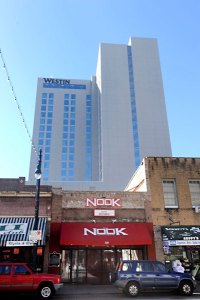
The photo says it all.
In Austin Texas, Westin opened a large hotel next to the Nook Amphitheater, which is famous venue for live music in a city with a strong music culture Westin is now suing the Nook because its music is disturbing the guests. The complaint states that the Nook plays “chest thumping bass” seven nights a week until 2 a.m. making some rooms uninhabitable.and thus harming the hotel’s business.
Law professor and invaluable ethics story source Jonathan Turley notes that the case recalls the now defunct “coming to the nuisance” doctrine. The defendant in such a case once could move to dismiss a nuisance claim on grounds that the plaintiff moved next door only to challenge the activities, business and even the existence of it neighbor in court. Turley writes,
The doctrine originated in early common law with cases like Rex v. Cross, 172 Eng. Rep. 219 (1826). The Court held:
“if a certain noxious trade is already established in a place remote from habitations and public roads, and persons afterwards come and build houses within the reach of its noxious effects; or if a public road be made so near to it that the carrying on of the trade becomes a nuisance to the persons using the road; in those cases the party would be entitled to continue his trade, because his trade was legal before the erection of the houses in the one case, and the making of the road in the other.”
American courts found the doctrine to hinder growth and work against the common good, particularly as populations in cities expanded into rural areas.
But, Turley explains, even in the absence of the “coming to the nuisance” defense, defendants have had some support from the courts: Continue reading




 Ethics Alarms