Jim Lehrer’s 16 Rules Of Journalism. Awww! How Quaint!

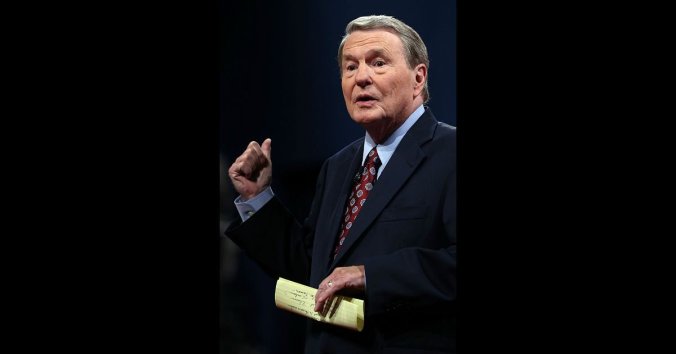
I can’t say I watched the MacNeil-Lehrer Report on PBS (and later after Robin MacNeil’s retirement in 1995,  the PBS NewsHour hosted by Jim Lehrer alone ) more than a handful of times in my life. I wish I had. (I should have: when Lehrer moderated Presidential debates, as he did eleven times, there was never any hint of bias or favoritism, unlike virtually every other debate.)   Lehrer died last week at the age of 85, and his 16 Rules of Journalism, which he often condensed to nine, were published in many news sources upon his passing.

I found myself wondering what various editors and young reporters were thinking as they read Lehrer’s tenets of his now-rotting profession’s integrity. Could they possibly think that the rules accurately reflected widely held and embraced standards of reporters today? Did they read the list with confusion, wondering what in the world this old guy was babbling about? Perhaps they regarded Lehrer’s aspirational list as an archaic and amusing reflection of a bygone era, as many regard George Washington’s 110 Rules of Civility, with its exhortations like Rule #9:

“Spit not into the fire, nor stoop low before it; neither put your hands into the flames to warm them, nor set your feet upon the fire, especially if there be meat before it.”

I wonder. I do know that Lehrer took his rules seriously, though sometimes falling short of his own standards. Below is the version of his rules that he explained in a 1997 report by The Aspen Institute. It’s an excellent, excellent list, reflecting an experienced and ethically astute professional’s keen understanding of what his profession is supposed to do for our society, and the best way to do it.

How many of them do you think motivate journalists today? Continue reading

Lunchtime Ethics Snack, 1/17/2020: Dirty Money, Dirty Baseball, And “Parasite”

Yum or Yecchh?

1. And the baseball cheating scandal is still roiling! I feel sorry for ethics enthusiasts who are missing out on this fascinating episode because they shut down when baseball is mentioned. One emerging issue that focuses on “woke” (and in some quadrants, sadly, female) leadership models has become evident. The two managers fired in the sign-stealing scandal were part of the “new wave” of “collaborative” baseball managers that teams embraced in recent years. They are sensitive to the players’ needs; they don’t give orders as much as set flexible boundaries; they are not confrontational, and they absorb and guide the culture of the clubhouse rather than dictate it. Then we learn, in MLB’s report on its investigation, that when Houston’s A.J. Hinch discovered (in 2017) that his bench coach and his players were operating an elaborate sign-stealing operation that he knew violated the rules , he made it known that he disapproved, but never ordered them to stop. Now baseball commentators are saying that the Astros need to hire an “old school” manager (like the ones who have been put out to pasture over the last five years) who will be leader, who will lay down the law, and who won’t shy away from confrontation for fear of not being “collaborative.”

Duh. How did anyone come to think effective leaders should do otherwise? Leaders need to lead. Leading doesn’t have to be autocratic, but a leader who acts like Hinch did in this matter is no leader at all.

In another revelation regarding the scandal, the report by Baseball Commissioner Rob Manfred states that when Manfred put teams on notice in a Sept. 15, 2017 memo that using electronic means to steal and relay opposing teams’ signs during games would henceforth be  severely punished, Houston General Manager Jeff Luhnow “did not forward the memoranda and did not confirm that the players and field staff were in compliance … Had Luhnow taken those steps in September 2017 it is clear to me that the Astros would have ceased both sign-stealing schemes at the time.”

This is gross managerial negligence, and it puts Lahlow’s self-serving statement that he had no involvement in his team’s cheating in perspective. Continue reading

Ethics Observations On The CNN Democratic Candidates Debate [Corrected]

The full debate transcript is here.

(Or you could read “Moby-Dick” instead,  here, which I highly recommend.)

  • After enduring a long analysis of the December debate, the Ethics Alarms assembled shouldn’t need a sequel so soon— I don’t know what the Democrats think they’re accomplishing by having two of these guaranteed fiascos within a three-week period.

Virtually everything said last night we’ve heard before; every impression of this weak,weak,weak slate of candidates was already established.

  • Yes, it’s good to have the field whittled down to a manageable six, but it also wrapped in neon the hypocrisy of the Democratic party. The party of women  had just two women on stage, one a near impossible dark horse, and the other old, white, and whether Bernie said so or not, unelectable. The party “of color” had  no black, Asian, Native American  or Hispanic representatives on stage (, I won’t make the obvious Elizabeth Warren crack, only allude to it here, which I guess is the same thing.) The supposed party of the young presented four candidates over 70. The party that hates the rich had one billionaire and three millionaires among the six. The party that wants to smother the First Amendment right to spend money to promote political candidates (or attack them) by voiding Citizens United includes one aforementioned billionaire who has literally bought his way into the debates, and another, Mike Bloomberg, lurking in the wings.

This is not, in short, a party of integrity. Res ipsa loquitur. Continue reading

Apologies And Other Fallout From The Baseball Cheating Scandal (Updated, And Updated Again)

Ex-Astros manager Hinch and “dead man walking” Alex Cora, the cheating mastermind.

Since I posted the initial commentary on Major League Baseball’s tough punishment of the Houston Astros for their illegal sign-stealing (there are legal ways to steal signs too), there have been some interesting developments with ethical implications.

The full MLB report  can be read or downloaded here.

  • One promising development is the widespread discussions of organizational culture that have been taking place in the media. When Astros owner Jim Crane announced that he was firing GM Jeff Luhnow and manager A.J. Hinch, both suspended for a year by the Commissioner of Baseball, he made it clear that the team needed to reform its culture, which had metastasized from  “play to win”  into a “win by any means necessary.”  There were signs of this in Houston long before the sign-stealing was known, when in 2018 the team traded for relief pitcher Robero Osuna while he was suspended for domestic abuse and facing trial—even though the Astros had previously announced a “no-tolerance” policy regarding players and domestic abuse. The team really needed a closer, you see.

The Astros culture, we now can see, was thoroughly compromised by ethics rot, and eliminating one or two managers won’t fix the problem immediately.

  • A prime enabler of that rot was Jeff Luhnow, who traded for Osuna. After he was fired yesterday, he issued this apology:

Continue reading

Breaking: Major League Baseball Clobbers The Houston Astros For Their Sign-Stealing Scheme, And Red Sox Manager Alex Cora Is In The Cross-Hairs

In November, I proposed that the Houston Astros should be punished severely for their sign-stealing during the 2017 and 2018 seasons, the first of which resulted in a World Series Championship. Major League Baseball’s investigation is complete, and today the wrath of the Baseball Gods rained down on the team. MLB didn’t take my advice (stripping the team of its titles), but the actions it dis take were surprisingly and appropriately tough.

The Astros, you will recall,  used illegal cameras and video monitors to steal the signs of opposing catchers at Houston’s Minute Maid Park, then signal those signs to their hitters before pitches by banging on trash cans. This occurred throughout the 2017 regular season and postseason, and during the 2018 season as well. Baseball’s Commissioner Rob Manfred suspended Astros Manager A.J. Hinch and General Manager Jeff Luhnow, fined the team $5 million (the most allowed under the MLB rules)  and took away the team’s top two draft picks in both 2020 and 2021. Hours after the announcement, the Astros fired both Hinch and Luhlow, with owner Jim Crane  saying, “We need to move forward with a clean slate. [We] will not have this happen again on my watch.”

All of this is as it should be. The MLB investigation indicated that Hinch had not been involved in the sign-stealing, but was aware of it and allowed it to continue.

Now the saga moves on to, <sigh>, the Boston Red Sox. Continue reading

In The Dead Of Winter, Welcome Baseball Ethics News

The Athletic’s Jayson Stark reports  that automated ball and strike calling is now inevitable, and we may see it as early as 2022. He writes, “The mental games used to inch the strike zone this way or that has long been a tool of the game’s best – from the hitters whose impeccable eye define it, to the pitchers’ whose pinpoint control push to expand it – but an automated zone will all but abolish the in-game politicking of the strike zone, giving hitters a new advantage they have long been without: certainty. Robot umpires will define the strike zone with better precision than their carbon-based forerunners – but first the humans must decide what they want that strike zone to be. For those particularly fond of strike zone drama, appreciate it now, because deciding on the parameters of the automated zone might be one of the last great strike zone debates before the robots take over.”

Good.

Once computer graphics allowed TV viewers to see blatantly botched ball and strike counts in real time, this development became a serious matter of trust and integrity. The baseball Luddites who continue to argue that missed ball and strike calls are part of baseball’s charm and should be retained  as “the human factor” have sounded progressively more desperate and ridiculous as the seasons pass.

Statistical analysis has shown decisively how much a bad ball or strike call even early in the count can change the outcome of an at bat and a game. Look at this chart:

Continue reading

Let Us Thank Rep. Al Green For His Candor And Integrity In Confirming That The Resistance, Democrats and The Anti-Trump News Media Are Lying

It is amazing to me that so many commentators,elected officials and Facebook demagogues insist on denying both the fact and the significance of the fact that the plots to remove President Trump from office began the second he was elected, thus establishing the dishonest and illegitimate nature of everything that was to come. This is gaslighting. Fortunately there is Rep. Al Green of Texas, who isn’t the brightest bulb on the impeachment tree but is at least refreshingly candid, I suspect because he sees nothing wrong with trying to reverse an election that was determined by racists, misogynists and idiots.

Green already handed a brightly wrapped gift to those who accurately maintain that whatever the virtues and deficits of the President, the Democratic effort to remove him “by any means possible” is an abuse of the Constitution and destructive to the stability of the republic. That gift was his guileless statement, “I’m concerned that if we don’t impeach this president, he will get reelected.” Green has also said  that the House may continue to impeach Trump after he is acquitted by the Senate and if he is re-elected. But Al wasn’t through yet, and for this we should be grateful. Continue reading

Ethics Hero: Frances Arnold

I’m sure there are a lot of people doing ethical things and not  trying to deliberately make me embarrassed to be a member of the human race—just not on social media, and not in the news. And there is Frances Arnold.

She is an American chemical engineer and the Linus Pauling Professor of Chemical Engineering, Bioengineering and Biochemistry at  Caltech. Professor Arnold was awarded the Nobel Prize in Chemistry in 2018 for pioneering the use of directed evolution to engineer enzymes. “Directed evolution” is a method used in protein engineering that mimics the process of natural selection to steer proteins or nucleic acids toward a user-defined goal. You know..this:

She had published a  paper on enzymatic synthesis of beta-lactams in May 2019 in the Science journal. When she discovered recently that her research could not be replicated, however, Arnold repudiated her own paper, and pronounced it the product of shoddy research.

“For my first work-related tweet of 2020, I am totally bummed to announce that we have retracted last year’s paper on enzymatic synthesis of beta-lactams. The work has not been reproducible,” she posted on Twitter. “It is painful to admit, but important to do so. I apologize to all. I was a bit busy when this was submitted, and did not do my job well.”

A short, clear, Level I apology, and it is refreshing to know that there are scientific geniuses who use the word “bummed,” and who do not write like Timnit Gebru.

On one hand, I wonder if it is easier for a Nobel winner to admit something like this. On the other, I am certain that the more eminent a scientist is, the harder it is to reveal a serious error. No matter how one looks at it, Professor Arnold exhibited integrity, honesty, humility and courage, may have done as much for science by showing how an ethical scientist handles an error as she did with her work on directed evolution.

I would be more certain about that if I understood what the hell directed evolution was.

_________________________________________

Use this link if you are sharing on Facebook: https://twitter.com/CaptCompliance/status/1213583009942622208

Sunday Before Christmas Ethics Ornaments, 12/22/19: Googling Ethics, “Cats,” Goldman Sachs, De Niro, Trump Derangement

Here’s hoping that the the next three days rescue the Spirit of Christmas…

…because the last few weeks have been a downer, man.

1. Googling ethics:  Phillip Galanes, at Social Q’s was consulted by a woman who had bad vibes about her girlfriend’s new love, so she googled him, and found out, as she suspected, that he had some serious red flags in his past. She told her friend, who had discovered the bad news herself, but who was hurt and angry that the inquirer did a background check on her boyfriend. “Was I wrong?” she asked. In his answer, Gallanes implies that she was, although “everybody does it.” I’d like a nice, succinct, substantive explanation of by what ethical theory it can ever be wrong to access publicly available information about anyone. This isn’t an issue of privacy, because the information isn’t private. There was nothing wrong with the inquirer’s motives, because she was concerned about her friend.

I’d call this the Ick Factor at work. It seems unethical because the fact that anyone can check our lives out online is creepy. The research itself, however, is ethically neutral. The ethics comes in with how the information is used.

2. I guess I have to mention “Cats”…since it is getting the most spectacular negative and cruel reviews since “Showgirls,” and maybe before that. “Exorcist II, The Heretic” perhaps. Oddly, the usually hyper-critical New York Times is not one of the worst defilers, but here was what the reviewer really found objectionable :

“It’s too bad that no one seems to have thought through the semiotics of Victoria’s chalky white cat face, given that Hayward is of mixed race and that the heavy is Idris Elba’s predatory Macavity. Elba seems to be having a fine time, but come on!”

Ah! The old “mixed-race actress in whiteface being menaced by a black actor playing a cat” racist imagery!

I can’t wait for them to write down these rules. Continue reading

From The Ethics Alarms Archives: “Integrity Surrender For The U.S. Marines”

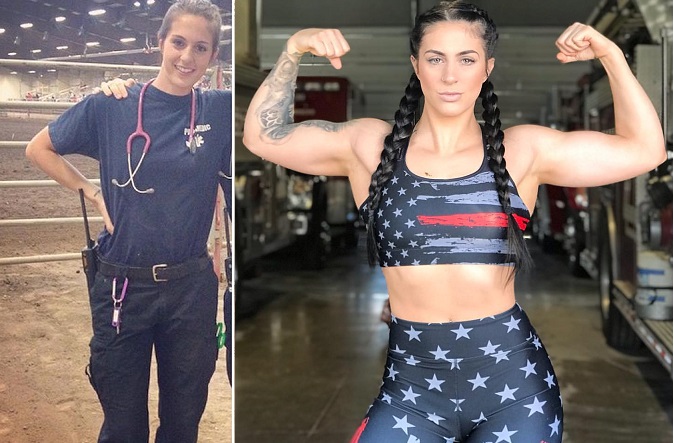
Frequent commenter Steve (not to be confused with Steve-O-in-NJ or Steve Withspoon, also veteran combatants here) asked my opinion about an article titled “Marines’ Obsession with Pull-Ups May Be Hurting the Corps, Study Finds.”

To begin with, it’s a  misleading headline. The real subject of the piece, in Military.com, is the alleged hostility being fostered toward female recruits because of their disparate and less demanding physical requirements, including pull-ups. I was sure that I had written about the Marine pull-up controversy before, and sure enough I had, in 2013, (My, how time flies.) Re-reading it now, I felt that the Ethics Alarms post was relevant background to evaluating the article, which includes this…

The idea that female Marines can do fewer pull-ups than their male counterparts and get an equal score “did not sit well” with men, researchers wrote. “Are [women] required to meet equal physical standards? No, it doesn’t take a scientist to study that,” one gunnery sergeant said. “They need to do this many pull-ups, and I need to do this many. Is that equal? No. Four and four is equal. 20 and 20 is equal. That’s equal. So either we’re equal, or we’re not.”

Somehow, the author spins the findings into a rationalization for allowing the unequal standards to continue, writing at the beginning of the article,

Marines are putting an “extreme emphasis” on the number of pull-ups leathernecks can do, a recently published internal study found. And that, some fear, could result in other important qualities that are vital to the Corps’ mission being overlooked. Participants in a study on Marine Corps culture were often focused on pull-ups as a best measure of a person’s value and worth, researchers found. Marines’ ability to lift their own body weight on a pull-up bar was “routinely what Marines referenced when discussing physical standards, a Marine’s value, and physical readiness,” the report’s authors wrote.

I hadn’t checked the name of the author until after I read the article and was struck by how the title and first paragraphs attempted to ignore the ethics issue involved. Guess the writer’s gender. Yup, you’re right.

Here was my article in 2013, (and I wouldn’t change a word); I’ll have some final comments at the end: Continue reading