Ethics Dunce: Logan Paul

I was blissfully unaware of the existence of Logan Paul until this morning. He’s a unique creation of the cyber-age, a 22-year-old college drop-out whose occupation is “social media entertainer.” He makes daily videos–“vlogs”—that he posts on his YouTube channel. It has 15 million followers, along with his hundreds of thousands of others across social media, and is regarded as major cultural force, for what, I have no clue. He is, of course, rich.

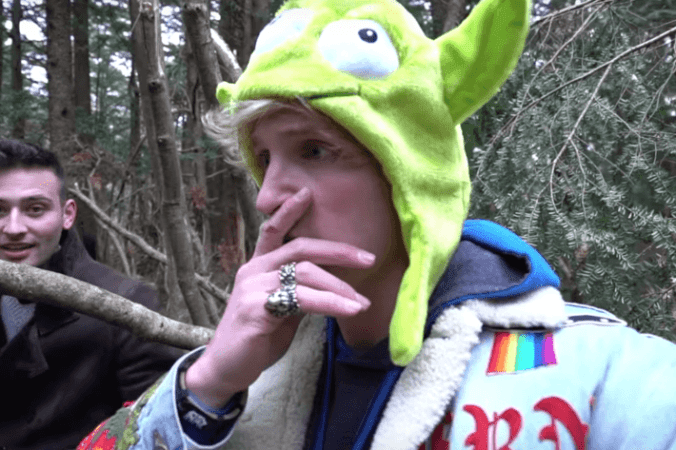
In pursuit of more followers and cash, he posted a video, since  removed from YouTube available elsewhere online, that features a dead young man, lying in a Japanese forest known as the “Suicide Forest,” which lies at the base of Mount Fuji. Paul began by telling his YouTube fans,

“This definitely marks a moment in YouTube history Because I’m pretty sure that this has never hopefully happened to anyone on YouTube ever. Now with that said, buckle up!”

With that titillating intro, Paul described the reputation of the Aokigahara Forest at the base of Mount Fuji. It is a popular site for distraught Japanese to end their lives, and is thus known as “the Suicide Forest.”  Locals also say the forest is haunted, another exiting feature that Paul and his companions hyped as they walked along. Then they come across the dead body. The video blurred his face. “Yo, are you alive?” Paul shouted at the dead man. As a camera zoomed in, Paul described the body’s condition, and speculated that the death was recent.

After making the obligatory observation that depression and mental illness are not a joke, Paul’s group left the scene and he began joking, with the mugging and giggling his fans are accustomed to seeing on his vlogs. At the end of the video he encountered a young fan and told him, smirking and pointing the way, “I have one piece of advice. Don’t go over there!”

And yes, he was wearing that hat (above) the whole time.

 The video was posted over the weekend, and did not receive the desired response. Many expressed horror that a young man’s body would be used a a prop, and that Paul would be cavalier about mental illness, depression and suicide. Now the Cyber Furies are after him, and threatening to turn him from web star into a web pariah. Continue reading

Ethics Hero: World War II Veteran Marvin Strombo

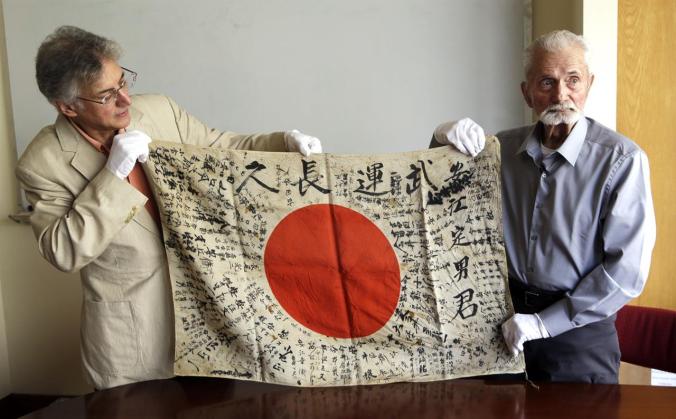
Many Japanese soldiers during World War II went into battle carrying small “Rising sun” flags, the red sphere on the field of white, with the white field decorated by hundreds of classmates, family members and friends. The flags were for good luck, and to link soldiers to their loved ones while they fought for the Emperor.  I had never heard of this practice until today; my father served in the European theater, so he would not have known that many American soldiers took these personal talismans from the bodies of fallen Japanese soldiers as war trophies.

U.S. Marine Marvin Strombo was such a soldier. A member of  an elite sniper platoon during the bloody battle for the Pacific island of Saipan in 1944, he had taken a flag from a dead Japanese soldier lying on his left side—he remembered that the young man looked like he was  asleep—after he noticed something white sticking out from his jacket.

The flag with all the inscriptions on it hung behind glass in Strombo’s gun cabinet in his home in Montana for decades until 2012, when the son of his former commanding officer contacted him for assistance with a book he was writing about the exploits of his father’s platoon. (ARGHHH! I just remembered that I haven’t gotten back to a member of my Dad’s unit who wrote me a couple of months ago!) Working with the author,  Strombo learned about  the Obon Society, a nonprofit organization in Oregon that works to locate and return the personal Japanese flags to the families of the fallen soldiers who carried them. Researchers determined that the dead soldier Marvin’s flag had belonged to was named Yasue Sadao. What Strumbo thought was calligraphy were really the signatures of 180 friends and neighbors, including 42 relatives, who saw Yasue off to war from Higashi Shirakawa, a small village of about 2,400 people in the mountains roughly 200 miles west of Tokyo. Continue reading

Morning Ethics Warm-Up: 7/2/17 [UPDATED]

1. I wonder when and if the LGTBQ community will ever grow up. I had an annoying exchange yesterday when a Facebook friend began whining that President Trump hadn’t done or said anything to honor Gay Pride Day, proving again that he was the spawn of Satan. A friend of that friend then added, to the usual flood of “likes”—all you hve to do is insult the President to get likes— that for him to honor Gay Pride Day would be like Hitler observing ceremonies for Holocaust victims. Of course, nobody had the integrity or the decency to point out what an idiotic comment that was, so I did. When will people stop making me defend Donald Trump? He is the first and only President to enter office fully accepting same sex marriage (unlike Obama and Clinton) and the unending slur that he is hostile to gays is the product of two factors: fearmongering (He was going to put gays in camps!) and bigotry (If he’s a Republican, he must hate gays.) One response to my rejoinder was someone posting this NBC story as a “rebuttal.” The sum total of the anti-gay actions of the Trump administration, according to this alleged indictment? Here’s the description:

“For many LGBTQ Americans, the early days of Trump’s Republican administration have been fear-inducing. A series of Cabinet appointments have been roundly criticized by LGBTQ advocacy groups. An early draft of a reported executive order legalizing broad discrimination against LGBTQ people threw the community into a panic. The dismantling of Obama-era protections through executive orders came with the simple stroke of a pen.”

This is modern day fake-news journalism at its most obvious. All  the paragraph says is… Continue reading

Comment Of The Day : “Incident At Big Bowl”

John Billingsley has been participating here for less than two months, and this is his first Comment of the Day. He explores some of the broader labor, management and cultural  issues behind the curtain in my rueful account of  inept service at an airport fast food restaurant.

Here is John’s Comment of the Day on the post, “Incident at Big Bowl.”

I believe this is an issue that goes much deeper than it appears on the surface and Son of M and Tom M in their analyses have identified some of the issues at the root of the problem. Son of M said, “I don’t know that people at this level of employment have EVER cared or are ever going to.” There are some who care, and they can be identified when you are served by them, but I agree that most them appear not to. I think this is because our culture overall is not respectful of the people who do those jobs and so they have no reason to respect themselves as a person who performs that work.

I had the opportunity to live in Japan for about two years. That was over 40 years ago, and I still remember the complete professionalism of just about every service worker I encountered. Of course, it is a cultural thing. I wish people who provide services here could develop the attitude that it is not demeaning to be a service worker.

Tom asks, “Why is all of the blame on the employees?” Continue reading

Don’t Feel Too Bad, Americans: Ethics Alarms Aren’t Ringing In Canada, North Korea Or Japan, Either

It’s an International Ethics Dunce parade!

donald-trump-humane-society

1. Ontario, Canada

The Windsor-Essex County Humane Society in Ontario thought it would be really clever to use the Donald Trump phrase that many believe disqualify him to be President in an ad to adopt kitty-cats. It featured a photo of Trump and said, “You don’t have to be a star to grab a pussy … cat.”

Amazing. Not one person in the chain of custody of this—I would say obviously, but when so many people miss it, I guess it’s not—offensive ad had an ethics alarm sound.  Nobody had the sense, prudence or guts to say,

“Uh, guys? Hello? You do realize that this is using a phrase describing sexual assault while alluding to the one who used it to describe sexual assault? You do realize that “pussy” alluding to female genitalia is vulgar and uncivil, right? No? Here, let me explain it to you…or hwo about this: there is no way this won’t spark criticism. Is that what you want?”

Sure enough,  the ad promoting cat adoptions this week for $50, was taken down shortly after it appeared this week.

The society offered a pathetic apology. Melanie Coulter, executive director of the humane society, “explained” it was an attempt to make light of the U.S election campaign, though it also “made light” of sexual assault, contemptuous attitudes toward women,  and obscene rhetoric.

“We are obviously sorry if people are offended by the ad — that wasn’t our attempt in the least,” Coulter said. “Our attempt was to find homes for cats that need them.” She also added that the shelter took in more than a hundred cats in the last week.

For the record, the rationalizations here are…

3. Consequentialism, or  “It Worked Out for the Best”

13. The Saint’s Excuse: “It’s for a good cause”

19A The Insidious Confession, or “It wasn’t the best choice.”

It also suggests that I need to add “We meant well” to the list as a sub-rationalization to #13.

****

contest-winner

2. Kuroishi, Japan

Continue reading

Ethical Quote Of The Week: President Obama, Threading The Needle In Hiroshima

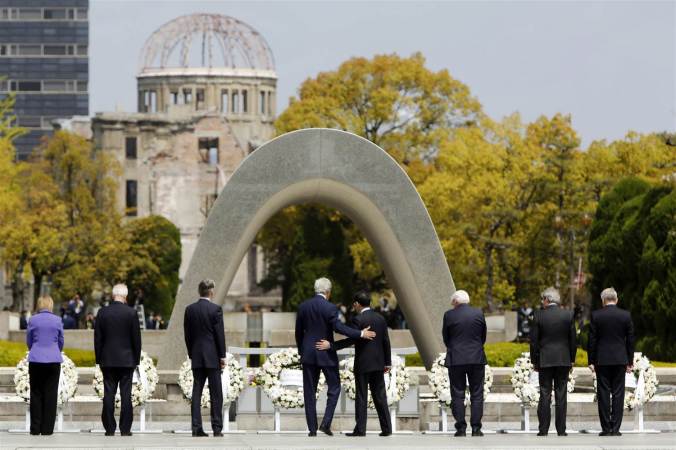
Obama at hiroshima

“We come to mourn the dead, including over 100,000 Japanese men, women, and children, thousands of Koreans, a dozen Americans held prisoner.”

—-President Obama, speaking at the Hiroshima’s Peace Memorial Park in Japan, in a controversial visit to the site of the Unites States’ decisive use of the atom bomb to defeat Japan without an invasion in 1945.

Good job. Whoever drafted the speech—it may well have been Obama himself—perfectly threaded the needle, simultaneously making a compassionate diplomatic gesture and yet including an unmistakable reference to who was really at fault for the carnage. Those Korean casualties were captured and enslaved citizens of a sovereign nation, acquired as Imperial Japan swept over Asia like locusts. Those prisoners were prisoners of war, and horribly mistreated ones.

The passage of time made Obama’s subtlety more appropriate than President Harry Truman’s typically blunt response to an Aug. 9, 1945 telegram from  Samuel Cavert, the general secretary of the Federal Council of the Churches in Christ in America, saying he was “greatly disturbed” by Truman’s use of the bomb: Continue reading

Ethics Quote Of The Week: Secretary of State John Kerry

Kerry Hiroshima

“It is a stunning display. It is a gut-wrenching display. It is a reminder of the depth of the obligation every one of us in public life carries … to create and pursue a world free from nuclear weapons.”

—-Secretary of State John Kerry in Japan, as he toured the Hiroshima Peace Memorial and Museum this week before meeting foreign ministers at the G-7 Summit.

I couldn’t quite bring myself to call this an unethical quote, though it is an infuriating one. It is certainly a stupid quote, but we all know John Kerry’s verbal and intellectual deficiencies, and he was indeed in a tough spot. What would have been an appropriate statement to make in this setting, that would not risk insulting his hosts and setting off yet another debate about Hiroshima that would be a distraction from the G-7 Summit’s objectives?

While I agree philosophically with the editors of the Federalist that it would have been more satisfying if Kerry had said that the display was “a reminder of the depth of the obligation every one of us in public life carries to stop extremist regimes like Iran from obtaining nuclear weapons” or perhaps that it was “a reminder of the depth of the obligation every one of us in public life carries to ensure that we are well prepared for the next force that threatens peace,” each carried its own diplomatic and political risks. So would “Sorry you made us do this, but we didn’t bomb ourselves at Pearl Harbor,” which is what I would have been tempted to say. I’m no diplomat, however, as you may have noticed. Continue reading

Ethics Quiz: Japan’s Official Apology To The Korean “Comfort Women”

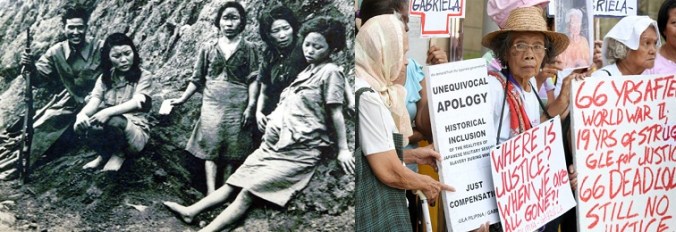
comfort-women

Before and during World War II, the Imperial Japanese Army forced an estimated 400,000 women and girls from occupied territories, primarily Korea, China, and the Philippines, into sexual slavery for the convenience and “comfort” of Japanese soldiers. That the women were kidnapped, raped, and in many cases murdered is not in dispute, but for cultural and political reasons the Japanese government has never accepted full responsibility for the nation’s mass crime, or acknowledged its true nature. To the contrary, Japan has protested memorials to the Comfort women in various locales, including the United States. Japan officially maintains that the women were ordinary prostitutes, and that no crimes were committed toward them. This is a long, bitter controversy between South Korea and Japan particularly.

Pressure from the United States on both Japan and South Korea to resolve the issue had been building, and on December 29, 2015, the two nations reached an agreement by which the Comfort Women issue was considered “finally and irreversibly” resolved. Under the agreement, the Japanese government issued this negotiated statement:

The issue of comfort women, with an involvement of the Japanese military authorities at that time, was a grave affront to the honor and dignity of large numbers of women, and the Government of Japan is painfully aware of responsibilities from this perspective. 

As Prime Minister of Japan, Prime Minister Abe expresses anew his most sincere apologies and remorse to all the women who underwent immeasurable and painful experiences and suffered incurable physical and psychological wounds as comfort women.

As part of the resolution, the Japanese government pledged to contribute one billion yen (about $8.3 million), out of the Japanese government’s budget to a foundation established by the Korean government dedicated to assisting the surviving Korean Comfort Women. Forty six survive. They had no part in the agreement discussions.

The deal is unpopular in South Korea. Critics immediately complained that the agreement is inadequate. Of course it is. $8.3 million would be moderate damages in the U.S. for a single woman who was kidnapped and forced into sexual slavery. Japan is not going to accept full responsibility for the war crimes, and that should be obvious after so many decades and such stubborn denial.

The ethics question that is a bit more challenging is whether the apology is worth the paper it is printed on, or even a true apology. After the agreement, Prime Minister Shinzo Abe  stated: “there will be no future reference at all to this issue [the Comfort Women issue]. We will not raise it in the next Japan-Korea summit meeting. This is the end. There will be no more apology.” Many Koreans feel that an official apology followed immediately by a statement that says, in essence, “There, that should shut them up!” is cynical and worthless. As a Korean issues website put it, “If an apology is not followed by contrition and self-reflection, but instead by gloating—-does that apology mean anything?”

Good question! Let me rephrase that as the Ethics Alarms Ethics Quiz of the Day:

Is the official Japanese apology for the crimes against the Korean Comfort Women ethical?

Continue reading

Hiroshima Ethics And The Washington Post’s Misleading “Five Myths” Feature

Atom bomb cloud

The Washington Post’s Sunday “Five Myths About…” feature is a weekly irritation, as it begins with a misleading definition, and proceeds to a series of dubious and sometimes dishonest conclusions. In spirit it is like the fact-checking columns,  (though, ironically, the Post’s less than most) in that it claims to “disprove” opinions. This week’s installment, however, was too much.

Gregg Herken was this week’s guest bloviator, and the Post gave the emeritus professor of U.S. diplomatic history at the University of California a chance to plug his books on the atomic bomb, so I don’t blame him for taking it. I do blame him for allowing the column’s format and the editors to turn what could have been informative and edifying into lazy scholarship, sophistry, and nit-picking. Now I don’t want to read his books.

His entry was called “Five myths about the atomic bomb.” As is typically the case, no myths were debunked. Myths, in the parlance the Post is evoking, are a “traditional stories of ostensibly historical events that serve to unfold part of the world view of a people or explain a practice, belief, or natural phenomenon.” They are, by definition, false. Herken, however, neither identifies nor disproves any true myths. What he does is offer contrary opinions to those of others that are as provable as true as the opinions he claims to be debunking, which is to say, not provable at all. That means that the headline/title states an unprovable assertion as fact: “These statements are untrue.” Herken cannot ethically say that, but he does anyway.

Bad historian. Bad.

Herken starts off well:

“On Aug. 6, 1945, the United States dropped an atomic bomb on the Japanese city of Hiroshima. Another bomb fell Aug. 9 on Nagasaki. Decades later, controversy and misinformation still surround the decision to use nuclear weapons during World War II. The 70th anniversary of the event presents an opportunity to set the record straight on five widely held myths about the bomb.”

His first myth is that “The (Hiroshima) bomb ended the war.” Continue reading

The Sixth Annual Ethics Alarms Awards: The Worst of Ethics 2014 (Part 4 of 4)

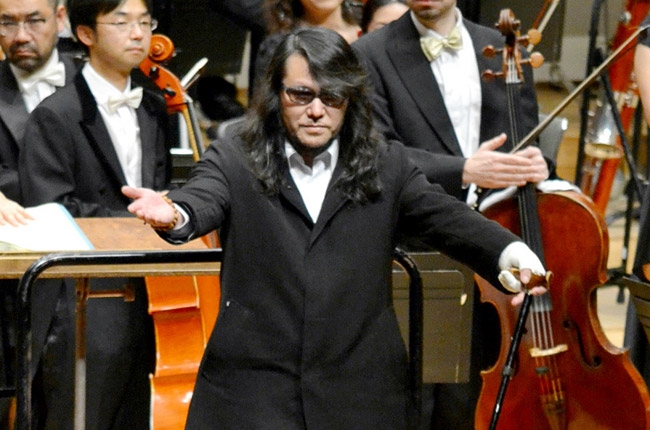
mamoru-samuragochi2

Outrageous Hoax Of The Year

Mamoru Samuragochi, the composer sometimes known as “The Japanese Beethoven” because he composed critically acclaimed works despite being deaf, was exposed as double fraud: he didn’t compose the works that made him Japan’s most popular classical composer, and he isn’t even really deaf!  Samuragochi hired a musical ghostwriter named Takashi Niigaki to compose more than twenty compositions for Samuragochi since 1996.

Funniest Outrageous Hoax

Fake Panda

This.

Unethical Artist Of The Year

Performance artist Maximo Caminero, who  walked into the Pérez Art Museum in Miami, entered a special exhibit of sixteen ancient Chinese vases painted over in bright colors by celebrated Chinese dissident artist Ai Weiwei, picked up one of them, and immediately after a security guard instructed him not to touch the exhibit, allowed the vase to fall from his hands, shattering into bits. Caminero admitted that smashing the pottery, which was valued at a million dollars,  was intentional, and was his protest against in support of local artists like himself whose work is not exhibited at the museum while the art of international artists like Weiwei is.

Unethical Veterinarian Of The Year

Fort Worth, Texas veterinarian Lou Tierce lost his license for five years as a result of, among other transgressions, his telling the owners of a Leonburger (it’s a very big dog) that their pet was terminally ill and had to be euthanized, then secretly keeping the dog alive in a small cage so he could use Sid’s blood for transfusions to Dr. Tierce’s other canine patients. Eventually an assistant at the clinic blew the whistle and alerted Sid’s owners, who rescued their dog and sicced the law on the worst veterinarian since Dean Jones menaced Beethoven.

Unethical Doctor Of The Year

Dr. Nancy Snyderman, NBC’s medical expert, endangered the public by defying a voluntary quarantine for possible Ebola exposure,  because she just couldn’t bear to be without her favorite soup.

Scam of the Year

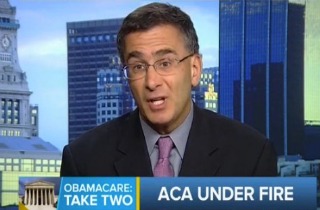
Jonathan-Gruber-1

The Affordable Care Act.

 Unethical Federal Agency Of The Year

The Secret Service. Lots of competition in this category: the Veterans Administration, the I.R.S., the CDC, the Justice Department, NSA…but when you essentially have one job to do and do it badly, sloppily carelessly and dangerously, there’s really not much more to say Continue reading