From The “When Ethics Fail, The Law Takes Over” Files: The Dumb Teacher, The Fragile Student, And The Bucket

A toilet at Patrick Henry High....

A toilet at Patrick Henry High….

Yyyyyyup! The American public school system continues to impress. As they used to say, “Get a load of this!

In 2012 Gonja Wolf was an art teacher at Patrick Henry High School in the San Diego Unified School District. She was monitoring a 25-minute study hall. Administrators at the school had told teachers that frequent bathroom breaks for students would undermine the study hall’s purpose, which was uninterrupted study. They also told teachers to use their common sense. Unfortunately, Ms. Wolf had no common sense.

When a young woman in the class, a freshman, asked to go to the restroom, Wolf ordered her to urinate in a bucket in an adjacent supply room rather than use the bathroom during class.  The bucket was there because Wolf, a think-ahead type of person, purchased the bucket, she said, to serve as a toilet in case of a security lockdown, and had even used the bucket for emergency peeing herself. (I should have put this story in the “I Can’t Believe I’m Writing This” file.) She said she misunderstood the school’s instructions about bathroom breaks, but thought it was a good idea. To have students pee in a bucket. She actually said this under oath.

Yes, sadly, Gonja Wolf is an idiot. Continue reading
From The “Illiteracy And Incompetence Are Unethical” Files: Moby Dick Restaurant Loses Its Lease

moby

I love this story! Just when I was despairing over the widespead ignorance in the U.S., Canada steps up.

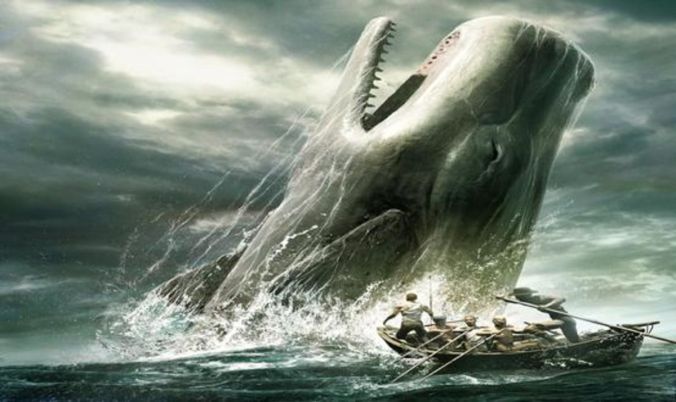
In Vancouver, Mengfa International owns  a commercial building, and in May 2015,  agreed to lease it to Moby Dick Restaurant, a fish-and-chip franchise. The building council won’t allow it, though. They feel that the restaurant’s name is offensive, and its offensive sign would lower property values.

Asks Drew Curtis’s Fark: “What’s so offensive about “Moby”?

This is a Niggardly Principle classic.

Mengfa is suing.

Did Apple Kill The Little Girl?

driving_-selfie-car

A Christmas Eve tragedy from 2014 has sparked another ethically provocative lawsuit.

James and Bethany Modisette were driving through Denton County, Texas, on the evening of December 24, 2014, when they had to stop their car due to a traffic incident ahead of them on the Interstate. Their children, Isabella, 8, and Moriah, 5, were in the back seat, Everyone in the vehicle had a seat belt fastened.

Meanwhile, Garrett Wilhelm, idiot, was chatting away on his phone using the FaceTime app, and didn’t notice that the traffic ahead of him was stopped. His car rear-ended the Modisettes’ vehicle at 65 mph. Little Moriah was killed.

Now the Modisettes have filed a lawsuit against Apple, the maker of the app and the iPhone it was used with, citing a “failure to install and implement the safer, alternative design … to ‘lock out’ the ability of drivers to utilize the FaceTime application.” In the suit, the parents claim the company didn’t warn FaceTime users like Wilhelm that “the product was likely to be dangerous when used or misused in a reasonably foreseeable manner.” Continue reading

Now THIS Is A Conflict Of Interest…Or Is It?

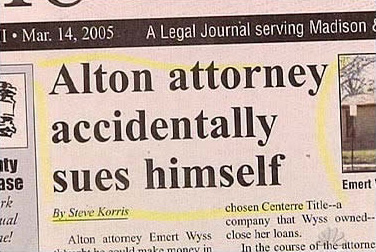
alton_attorney_accidentally_sues_himself

Is it a conflict of interest for a lawyer to represent a client suing herself? Lawyers are all forbidden to bring adverse actions against their own clients; it is the conflict of all conflicts, a pure breach of loyalty. Does this mean, then, that even when a statute requires a plaintiff to sue herself as a defendant, it can’t be done without breaching the ethics rules?

The case is Bagley v, Bagley, and both Bagleys are the same Bagley.

State Farm Insurance Company handled Barbara Bagley’s car insurance. She was driving when her car flipped and killed her common law husband.  To compel State Farm to indemnify her, Bagley, in her dual capacities as sole heir and personal representative of the estate of her husband, was required to bring this suit against herself as the negligent driver. Bagley as plaintiff and as her husband’s heir brought a cause of action pursuant to Utah Code section 78B-3-106, Utah‘s wrongful death statute, alleging that the defendant—her— negligently caused her, that is, the plaintiff’s husband’s death, thereby depriving his sole heir –the plaintiff, but also the defendant—of his “love, companionship, society, comfort, care, protection, financial support, pleasure, and affection.”  She also brought a second cause of action pursuant to Utah Code section 78B-3-107, Utah‘s survival action statute, alleging that the defendant—her again— negligently caused the deceased to experience pain and suffering prior to his death, entitling Bagley’s late husband’s estate to other damages. Continue reading

Oooooh, Sneaky, Uber!

fine-print

Fine print alert!

Uber, the controversial  ride-sharing giant, quietly changed its terms of service to foist mandatory arbitration on its users. This is a common tactic of large corporations lately, taking away consumers’ rights to sue when they are harmed due to negligence. Arbitration is often full of hidden biases, with a natural  financial motivation for less-than-ethical arbitrators to tilt in the direction of the companies that pay them.

The change means that a passenger injured in an Uber vehicle due to its driver’s negligence would be required to arbitrate any claims for personal injuries before the American Arbitration Association, because the passenger had technically agreed to the terms and conditions of the Uber contract every passenger must accept. How would  long-time customers know about the change from the original Uber conditions? They wouldn’t, unless they regularly cruised the company’s website.

On July 29, 2016, Judge Rakoff from the Southern District of New York ruled that the notice of Uber arbitration terms was not sufficient to let riders know that  they were waiving the right to sue, and thus the mandatory arbitration provision was unenforceable. Uber’s response was to send an email to its users, announcing that it was updating its terms effective November 21, 2016.  Uber also instructed its users to read the new Terms and stated it had “revised our arbitration agreement.”  Now they have you, because Uber users can no longer claim that they didn’t know about the new terms. When you use the service, you are stuck. You have waived the right to sue.

There is a large “but,” however.

An Uber user can still reject the November 21, 2016 Terms by providing Uber with written notice by mail, by hand delivery or by email within 30 days of November 21, 2016. Like many companies, Uber’s “notice” consists of a hard-to-find section on its website. The mechanics of rejecting the new terms information are virtually buried on Uber’s legal page, and read, Continue reading

Ethics And The Broadway Star’s “Accidental” Pregnancy

In July, just four months after the show opened to rave reviews, producers closed the hit Broadway musical, “Shuffle Along, Or The Making of the Musical Sensation of 1921 and All That Followed.” “Shuffle Along,” with 10 Tony nominations this year, had the makings of a long-running bonanza, but producers decided that when its acclaimed star, multiple past Tony Award winner (six!) Audra McDonald, had to leave the cast due to a surprising pregnancy (the actress was 45), it was too risky to continue. As soon as a replacement was named, ticket sales plummeted.

The show, which was capitalized for up to $12 million, had purchased a $14 million insurance policy from Lloyd’s of London to cover any damages arising if McDonald “was unable to perform because of an accident or illness.” Now producers are asking Lloyd’s to pay up, covering losses created by the pre-mature closing of the musical and by the  effects on the production occasioned by other health issues related to McDonald’s pregnancy while she was still performing.  “Since the beginning of previews of the Show, Ms. McDonald was unable to appear in numerous performances of the Show due to circumstances related to illness, a knee injury, and her pregnancy,” a lawsuit says. Her role was a strenuous one, requiring, among other things, a lot of tap-dancing.

Why the lawsuit, you ask? Lloyd’s says that the policy’s terms haven’t been met, arguing that the actress’s pregnancy and the associated medical conditions were neither due to an ‘accident’ nor an ‘illness’ under the policies.” The show’s position, as articulated by a lawyer representing the show, is that”‘Shuffle Along’ bought an insurance policy to cover it in the event that Ms. McDonald was unable to perform, and she was unable to perform.”

I love this story! It has everything—cold-eyed insurance executives, a perhaps manipulative diva, the sanctity of pregnancy, buck-passing, Hail Marys, feminist taboos, and Broadway!
Continue reading

From The “Why People Hate Lawyers” File: The Lawyer Who Bit Off More Than He Could Chew

"Bit--off--too-much--chicken--no---plastic---knife---ARRRGH!"

“Bit–off–too–much–chicken–no—plastic—knife—ARRRGH!

Paul Newton Jr., a lawyer in Gulfport, Mississippi, sued Popeye’s after he required emergency surgery to remove a chunk of fried chicken from his throat last November. He claims the fast-food restaurant was negligent and caused his near fatal accident because it didn’t include a plastic knife along with the “spork” in his drive-through order.

Newton says he consumed  the meal (two chicken breasts, an order of red beans and rice, a biscuit and a soft drink…YUM!) in his office, and had to “hold a chicken breast in his hands and to tear off pieces thereof with his teeth.”In the  lawsuit , the lawyer maintains Popeyes had a duty to provide the appropriate utensils so customers will be able “to cut their purchased food orders into appropriate portions.”

Newton abandoned his chicken suit–well, not his chicken suit, but his chicken lawsuit— the Huffington Post reported, after receiving “extreme comments directed to me and my family.”

Like “Learn to eat!”, maybe? Continue reading

Ethics Quote of the Week: Popehat’s Ken White

ionesco-rhinoceros

“[L]ying about Trump’s legal affairs doesn’t help. It helps promote lying, not Clinton (or anyone else.) This week social media is full of a narrative that the mainstream media is “ignoring” that Trump is on trial for rape and racketeering in December. That’s dishonest…Trump is historically awful. That’s not a reason to promote narratives that damage us as a nation. Lying about the nature of allegations, and treating allegations as presumptively true, damage us as a nation. “

—-Attorney/blogger Ken White, explaining the “rape trial” and “racketeering charges” against Donald Trump that Clinton supporters have been citing on-line and off as an “It’s not the worst thing!” rationalization (#22) to deflect criticism of Hillary Clinton

On Popehat, where he reigns supreme, former prosecutor and current lawyer Ken White has posted an essay called  “The Facts About A Couple of Pending Lawsuits Against Donald Trump,”  a blessed service to all of us who want to make the social media defenders of Hillary Clinton stop trying to corrupt everyone else with spin, lies and rationalizations.

Three main talking points of distraction and disinformation have been issued to followers by the panicked Clinton campaign to spread hither and yon. (Like Ken, I know that Trump must lose, but I want Clinton’s victory to be as unpleasant and marginal as possible.) The first and most insulting is the tried and true “vast conspiracy” against little ol’ Hillary, mostly because she’s a woman. The second is the lie that she’s no more dishonest than other politicians. (This one infuriates me, as it is demonstrably false, and attempts to set the standard for acceptable, institutionalized trustworthiness for U.S. public servants to Hillary’s miserable level for all time. This is, perhaps, the greatest long-term danger she poses to the nation.)

The third is the “how can anyone care about those stupid e-mails when Trump has a rape trial in December?” smear. I’ve been bouncing around Facebook trying to explain why this argument makes my friends look like idiots, but they, like the townspeople in Ionesco’s allegorical comedy “Rhinoceros” who start sprouting horns, pawing the ground and grunting, seem to have collectively given in to mindless conformity.

Ken explains why the third talking point is irresponsible: at this point, there are only allegations. “The fact that I hate Donald Trump does not mean that the allegation is or is not true,” he says.

The “rape trial” is a particularly misleading situation. Ken: Continue reading

Ethics Dunce: “Rolling Stone” Founder/Owner Jann Wenner

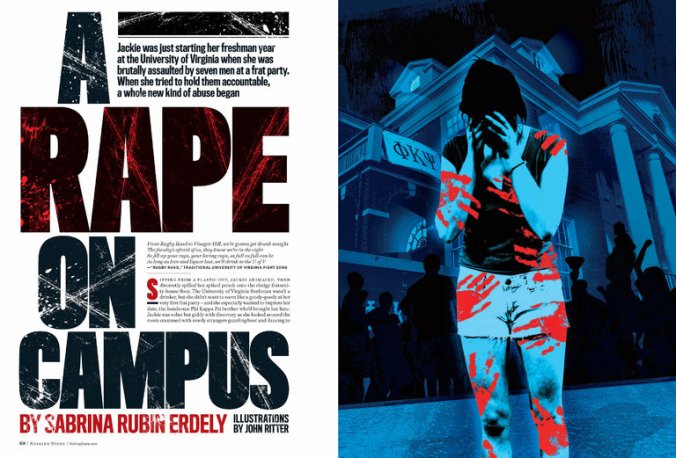
rape-on-campus


I’ve been awarding Ethics Dunces for more than a decade now, and I’m beginning to find the title too generic. For example, Jann Wenner, in this instance, is a particularly repugnant Ethics Dunce. In short, the title’s too good for him.

Wenner’s iconic baby, Sixties relic Rolling Stone magazine, is a defendant in a  $7.5 million lawsuit brought by Nicole Eramo, a former Associate Dean of Students at the University of Virginia, who claims that the 2014 Rolling Stone article “A Rape on Campus” depicted her as a villain in the shocking story, which was ultimately shown to be about a gang rape that never happened. (Ethics Alarms covered this episode extensively, an ethics train wreck, here.) Testifying in video excerpts from his deposition, Wenner said his magazine was wrong to retract the  article, despite the fact that it was based on false allegations. In his videotaped testimony Wenner claimed that much of the material in the article was accurate

How Dan Rather of him! In a classic example of agenda-driven reporting, Rolling Stone writer Sabrina Rubin Erdely accepted the tale of a never-identified student called  “Jackie” who claimed to have been brutally raped at a party that never happened, at a misidentified fraternity, primarily by one student who was falsely accused. Because of the article, the  fraternity system at the University was temporarily shut down and permanently subjected to more stringent regulations. The male student body was tarred as teeming with sexual predators. The entire thesis of the article was based on the fabricated rape account. There is no ethical justification to continue to present such an article after its diseased heart must be removed. Continue reading

Sanctioned Race And Gender Bias In Tort Compensation?

For its next witness, the defense calls the distinguished  forensic economist...

“For its next witness, the defense calls the distinguished forensic economist…”

I was going to make this an ethics quiz, but there really is only one answer. The practice is ethically indefensible, and noxious too. The only question is how and why it is still occurring.

One reason may be that not enough people know about it. I certainly didn’t. Kudos to the Washington Post for shining light on a terrible, and terribly unethical, practice.

The American tort system frequently uses race and gender statistics to calculate the damages victims or their families should receive in compensation after someone is catastrophically injured or killed by another individual’s negligence or misconduct. Experts are allowed to testify regarding what a particular victim might have achieved and earned during their lives, were they not dead, or brain-damaged, or paralyzed. Race and gender are among the factors allowed into that calculation.

Writes the Post:

As a result, white and male victims often receive larger awards than people of color and women in similar cases, according to more than two dozen lawyers and forensic economists, the experts who make the calculations. These differences largely derive from projections of  how much more money individuals would have earned over their lifetimes had they not been injured – projections that take into account average earnings and employment levels by race and gender.

Continue reading