Now THIS Is A Frivolous Lawsuit!

Sounds noble in theory, but it doesn’t always work when the one saying “no” is a judge.

Lawyers and the public mean different things when they call a lawsuit “frivolous.” The public and the news media mean that the suit is silly, desperate, based on a crazy theory or unlikely to succeed. Lawyers, however, know that suits that seem  silly, desperate, based on a crazy theory or unlikely to succeed sometimes win. Sometimes, they even change the law for the better. ABA Rule 3.1 explains,

Rule 3.1: Meritorious Claims & Contentions

A lawyer shall not bring or defend a proceeding, or assert or controvert an issue therein, unless there is a basis in law and fact for doing so that is not frivolous, which includes a good faith argument for an extension, modification or reversal of existing law….

Comment:The filing of an action or defense or similar action taken for a client is not frivolous merely because the facts have not first been fully substantiated or because the lawyer expects to develop vital evidence only by discovery. What is required of lawyers, however, is that they inform themselves about the facts of their clients’ cases and the applicable law and determine that they can make good faith arguments in support of their clients’ positions. Such action is not frivolous even though the lawyer believes that the client’s position ultimately will not prevail. The action is frivolous, however, if the lawyer is unable either to make a good faith argument on the merits of the action taken or to support the action taken by a good faith argument for an extension, modification or reversal of existing law.

The guy currently  suing me for defamation, for example, hasn’t quite crossed the “frivolous” line, though he is arguing that what is clearly opinion is an assertion of fact, contrary to all existing jurisprudence. His appeal, however, while batty, does make an argument that I assume in in good faith, that a Supreme Court case supports his definition of libel. It doesn’t, but he has the right to make an argument in the hope that some judge or appellate panel will agree. Of course, he is also not a lawyer, so he can’t be held responsible for violating legal ethics.

This guy can be, however: Continue reading

Morning Ethics Warm-Up, “Happy Birthday George Washington!” Edition

Good Morning!

1 The Indispensable Man...This is George Washington’s birthday, and every American alive and dead owes him an unmatched debt of gratitude. A useful assessment of why this is true can be found here.

Not only was Washington indispensable as the military leader who won the Revolution, he was also, it seems likely, the only human being who could have navigated the impossibly difficult job of being the first President of a new nation attempting an unprecedented experiment in democracy. The precedents he set by his remarkable judgment, presence, wisdom, character and restraint continue to be a force today. Washington was also perhaps the most ethical man who has ever been President. The principles that guided him from his youth and that resulted in his being the only man trusted by the brilliant but often ruthless Founders who chose him to lead their new country can be reviewed here, but two of them tell us what we need to know about Washington’s ideals…the first,

Every action done in company ought to be with some sign of respect to those that are present.

…and the last,

 Labor to keep alive in your breast that little spark of celestial fire called conscience.

Revoltingly, the average American is largely ignorant regarding the great man whose face adorns the one dollar bill. For example,  a recent YouGov survey asked respondents who was the best President in U.S. history. 16% of Americans selected Ronald Reagan, and 16% selected Barack Obama. Abraham Lincoln took third place with 15%. Washington finished fourth,but only 10% of those surveyed named him as the best President,  14 percent of Republicans, and only six percent of Democrats. I assume that Reagan, and I hope even Obama, would find these results ridiculous. They tell us that citizens can not distinguish politics from virtue. They tell us that the schools teach neither history nor critical thought effectively. They tell us that Democrats regard the fact that Washington was a slaveholder more notable than the fact that he made the United States possible. They tell us that the nation is losing a connection to its origins, heroes and values. It tells us that most of the public is ignorant of things that competent citizens must know.

It tells me that when an advocate cites a poll that says, “Americans want this,” the proper response is “Why should anyone trust their judgment? They think Regan and Obama were better Presidents than George Washington.”

2. Children’s Crusade update: Both CNN and HLN are flogging the high school student protests virtually to the exclusion of any thing else. The total commitment to aggressive and emotional advocacy on the part of the mainstream news media was disgraceful after the Sandy Hook school shooting, but this is worse; just when I think our journalism has hit the bottom, it finds a way to go lower.

This morning on HLN, I was greeted by an extremely articulate Marjory Stoneman Douglas High School survivor who said,  confidently and radiating certitude, “These episodes are completely preventable.” Putting such nonsense on the air, even when spoken by an attractive, sympathetic, youthful idealist who perhaps cannot be blamed for not knowing what the hell she’s talking about,is irresponsible and incompetent. It is no different from saying “The Holocaust never happened,” Barack Obama was born in Kenya” or “The world is ruled by the Illuminati.” “These episodes are completely preventable” is, from the mouth of anyone qualified to be on television talking about gun policy, a lie, and from someone like this young woman, as naive as professing a belief in Santa Claus. Such statements should not be presented in a news forum as a substantive or serious position. A news organization has an ethical obligation either to correct the misinformation, or not to broadcast it without context, like “Here is the kind of arguments these child activists are making, making serious and coherent debate impossible.”

When the crawl across the bottom of my screen added another argument from one of the activist students—has there ever been a time when the policy analysis of people lacking high school diplomas has ever been given so much media attention and credibility?—that read, “Student protester: “People are buying guns who don’t need them,” I switched to the Cartoon Network

Right, kid, let’s pass laws that prohibit citizens from buying what the government decides they don’t need.

Continue reading

But…But… It Doesn’t Mean He’s Not A Good Lawyer!

RIP, Snoopy.

This is a fascinating example of the legal community’s incomprehensible standards regarding who is and who isn’t fit to practice law.

In New York,  the bar took away lawyer Anthony A. Pastor’s license after he violently killed his girlfriend’s poodle “Snoopy.” See Matter of Pastor, 2017 NY Slip Op 06729, (App. Div. 1st Dept. Sep. 28, 2017).

An autopsy revealed that Snoopy  had nine broken ribs, a crushed kidney and massive internal bleeding, all at the hands of Pastor.

In disbarring Pastor, [ Matter of Pastor, 2017 NY Slip Op 06729, (App. Div. 1st Dept. Sep. 28, 2017)], the court noted that the sentencing judge’s comments that the respondent’s conduct “‘showed almost incomprehensible violence, and malice,’ that the dog was in ‘excruciating pain’ up until she lost consciousness while respondent ‘sat down at his computer in the most cold-blooded manner, and went to work, knowing that the dog lay dying, . . . on the floor behind him.’”

Nice.

But what does it have to do with whether the creep is a competent, honest, trustworthy lawyer?

Again I note that John Edwards never faced discipline for his massive deceptions and machinations, while his wife was dying of cancer, and while he was running for President. This conduct directly implicated trust and character, yet the refrain of Edwards’ colleagues was that his deceptions and cruelty, while clearly unconscionable, did not involve the practice of law, and thus did not preclude Edwards continuing to be regarded as a trustworthy lawyer. Are they kidding? I wouldn’t trust John Edwards to mail my water bill. Still, I hear this argument all the time in my legal ethics classes. One hypothetical is about a law partner who is caught cheating at poker in a regular game among fellow attorneys. Does that conduct mandate reporting him to the bar for discipline? Most lawyers say no.

They are wrong. Continue reading

Update: Astoundingly Unethical Lawyer-Hypnotist In Prison, And Disbarred.

Good.

Fine on the way to prison, where he will be hypnotized and will spend his 12-year sentence thinking he's a chicken...

Fine on the way to prison, where he will be hypnotized and will spend his 12-year sentence thinking he’s a chicken…

I hadn’t followed the story of Michael Fine since I wrote about him in 2014. This was the Sheffield, Ohio lawyer who hypnotized female clients so he could sexually molest them. When I wrote the post, two victims had been identified. The final tally was six, and there may have been more.

In September of 2015, Fine pleaded guilty to five counts of kidnapping and one count of attempted kidnapping.  He admitted to using his skill in  hypnosis to control the female clients, forcing them submit his sexual desires against their conscious will. Last week, Fine was sentenced to 12 years in prison. He had already been permanently disbarred by the Ohio Bar. Fine was not a licensed hypnotist, but needless to say, he was an unethical hypnotist too.

Judge Patricia Cosgrove told Fine at his sentencing, “At the lowest point in their lives when they came to you for help in the throes of painful divorces and custody battles, you took advantage of them. You took advantage of their trust and faith in you by sexually abusing them. You deserve to be punished.”

Ya think?

When I mentioned this case in some 2015 legal ethics seminars, many lawyers refused to believe it. I even lost a law firm client because one lawyer complained that I showed insensitivity by making a mild joke about the story, which did and does remind me of something out of a bad Adam Sandler movie.  It is the strangest example of unethical lawyering I have encountered, but I am confident that a stranger one will appear eventually.

________________________

Pointer: Fred

“Zodiac” And Real Lawyer, Fictional Lie Ethics

zodiac Belli

One of the problems with being an ethicist is that every movie seems like an ethics movie.

I watched “Zodiac” last night, struck by how much it resembled “Spotlight,” and not just because Mark Ruffalo had similar roles in the two films. It is a long, intense 2007 movie about the frustrating 1960s and early 1970s manhunt for the serial killer who called himself the “Zodiac” while killing seemingly random victims in the San Francisco Bay Area, and taunting police, Jack the Ripper-style, by sending them  letters, blood stained clothing, and in a special touch, ciphers mailed to local newspapers. The case remains unsolved.

What set off my ethics alarms, however, was a scene based on an actual incident in the case. From the website “Zodiac Killer Facts”:

On the night of October 11, 1969, the Zodiac murdered cabdriver Paul Stine and removed a portion of the victim’s shirt. Days later, the killer mailed an envelope to the offices of The San Francisco Chronicle. Inside, the Zodiac had included a blood-soaked piece of Stine’s shirt along with a letter that traumatized the Bay Area for decades. In his customary cavalier style, The Zodiac wrote, “School children make nice targets. I think I shall wipe out a school bus some morning just shoot out the frunt tire and pick off the kiddies as they come bouncing out.”

The Zodiac’s threat to assassinate school children terrified children and parents everywhere, and created a nightmare of security concerns for police and school officials. Armed men escorted children to and from schools while patrol cars and even aircraft followed along and monitored the surrounding area. As media coverage of Zodiac’s murderous plans increased and fears of a horrific ambush grew, a local television station was the setting for a chilling scene.

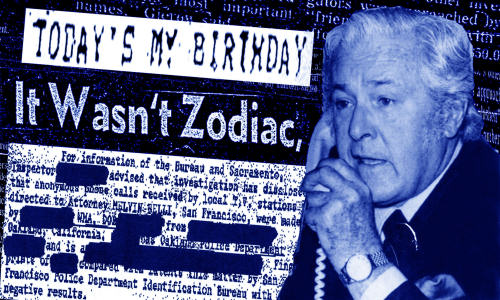
In the early morning hours of October 22, 1969, the Oakland police department received a phone call from a man claiming to be the Zodiac. The caller said he wanted famous Boston attorney F. Lee Bailey to appear on a local television talk show, but told the operator that he would settle for San Francisco lawyer Melvin Belli in the event Bailey was unable to appear.

Hours later, Belli was the guest on the show with host Jim Dunbar. A man called the KGO television station several times, and, in conversation with Belli, claimed he was the Zodiac and that his name was “Sam.”

Continue reading

Dear Legal Profession: How Can We Respect And Trust You When You Police Yourself Like THIS?

Justice_broken3

I’ve been defending my profession a lot here lately, but I also recognize that there is a very good reason why such incidents as the surprisingly generous sentence in the “Affluenza” case and the drug court judge who suffered an alcoholic relapse on the bench are wrongly interpreted as proof of inequities and double standards in the legal system. The reason is that those who oversee the system do inexplicable things that appear to the outside world as not only a lack of integrity but also the apparent inability to realize how such conduct undermines the public trust.

Both of these recent news stories are cases in point:

I. The Imaginary Government Lawyer

In 2012, the Nebraska state supreme court disbarred lawyer David Walocha for not paying his bar dues and proceeding to practice law for 13 years with a suspended license. At the end of 2013, the District of Columbia Bar had to decide what to do with former Justice Department attorney Laura Heiser, who practiced 21 years with a suspended license in the District. What was her punishment? She received an informal admonition, which is the least severe form of disciplinary action.  Continue reading

Love Your Lawyer? Bad Idea. Love Your Client? Even Worse.

This is all your fault, Arnie!

A Connecticut lawyer under fire for commencing a lawyer-client relationship with a woman with whom he was romantically involved made the novel argument that it is good to be in love with your client.  This indicates a profound misunderstanding of human nature and the nature of a lawyer’s duties.

Almost ten years ago, the American Bar Association recommended that state bars include a direct prohibition against lawyers having sexual relations with their clients, and the majority of the states did so. As I have mentioned before, it’s a dumb rule, too broad and too narrow simultaneously, a classic example of how some kinds of unethical conduct do not lend themselves to precise rule-making.  The main problem with the no-sex rules is that they are unnecessary. The legal ethics rules are replete with exhortations to maintain objectivity, independent judgment and to avoid conflicts of interest. Common sense suggests that it is irresponsible to confuse one relationship by adding another; professional standards dictate that combining a professional relationship of independence and with romantic relationships is wrong.  As the D.C. Bar’s Rules of Professional Conduct point out in its comments to Rule 1.7, Conflicts of Interest: Continue reading

Possessed Lawyer Ethics

Is it unethical for a lawyer to claim she is possessed by a client’s dead wife?

This  question has been puzzling professional responsibility experts for decades. Okay, not really. In fact, surprisingly, it just doesn’t happen all that often. But in Arizona, a lawyer is now facing suspension for claiming that she was possessed by the spirit of a client’s dead wife, then lying about it under oath. The dead wife is being accused of illegal immigration.

[OK, I made up that part, too. Sorry; couldn’t resist.]

The ABA Journal reports that the lawyer, Charna Johnson, began representing a client during his divorce proceedings. Continue reading