Advocacy Ethics And Larry Tribe’s “Betrayal”

Bought, believed, or both?

Bought, believed, or both?

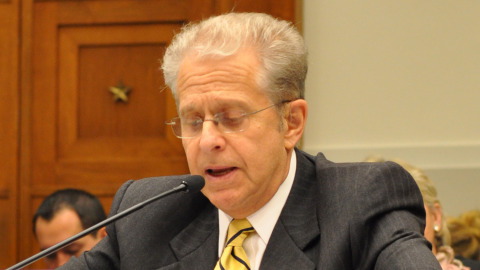
One of my favorite topics here, the public’s (and news media’s) misunderstanding of legal ethics and the function of lawyers, recently broke into the news with a crash as progressives saw Barack Obama’s constitutional law professor at Harvard and liberal icon Lawrence Tribe go before Congress and testified against the President’s climate change initiative, the Clean Power Plan, saying that it was the equivalent of “burning the Constitution.” This has been called every name in the book by progressives, from betrayal to greed to dishonesty.

“Laurence Tribe must not have been sworn in over a Bible today before testifying before Congress, because if he had been, that Bible would have burst into flames after his phony testimony about EPA’s legal authority to set standards for unlimited carbon pollution from power plants,” said David DiMartino, adviser to the Climate Action Campaign.“But I guess we shouldn’t be surprised— a wad of coal industry money burning a hole in your pocket can make you do strange things,” he added.

Indeed, Tribe was hired to represent its interests by Peabody Energy, the world’s largest private-sector coal company, and is the company’s counsel in a lawsuit that seeks to invalidate the EPA plan. That is what lawyers do, and what they exist to do: represent citizens and companies as they seek to avail themselves of their guaranteed right to use the law to protect their interests. Continue reading

When Is It Ethical For Lawyers To Testify Against A Client? Here’s An Example…

Next time, stick to baseball hypotheticals, Darrell.

Next time, stick to baseball hypotheticals, Darrell.

From Panama City, Florida comes this rare legal ethics scenario. Darryl Mack, 22, accepted 20 years of prison in exchange for a no contest plea to a murder charge, after he learned that his original attorney in the case would be testifying for the prosecution. The revelation by an accused  criminal’s own lawyer of what most think are privileged statements would be devastating evidence, which is why lawyers are almost always prohibited by the ethics rules from doing this.  Mack had been trying to block the testimony on that basis. However, Circuit Court Judge James Fensom ruled those statements could be used against Mack at trial. Why? It is because of a useful and necessary exception to the ethics rules known as the crime-fraud exception.

If you are a “Breaking Bad” fan, this one of the reasons Saul is a crook, not a lawyer.

“The last thing a lawyer wants to do is testify against his client,” the prosecutor in the case explained. “But it is not reasonable to ask your lawyer to be your conspirator.” That means that a request for such advice is regarded by the profession as a request for assistance in breaking the law, and a lawyer cannot ethically give such advice. Such a request isn’t confidential, and isn’t privileged. A lawyer doesn’t have to reveal such information, but he also risks being charged as an accessory if the proposed crime is committed.

Timothy Hilley, Mack’s initial legal counsel, testified in a closed courtroom that Mack had posed a hypothetical to him at the end of a jailhouse interview, and Hilley viewed it as a veiled statement of  intent to commit murder. Mack allegedly asked his then defense counsel what would happen if a witness was unavailable for the trial, a question Hilley took to refer to a witness to the July shooting death of 24-year-old Tavish Greene, the victim in the murder Mack was charged with.

“Mack was on his way to leave, and he walked over to door and he said, ‘Could those statements be used if he was murdered,’” Hilley testified.
“I said, ‘No, it would be hearsay.’” Mack then asked, “How much time do I have?” Hilley said. “And I didn’t catch it at first, but then he asked again, ‘How long before trial?’ ” Mack left the room after Hilley told him the trial could begin as soon as June.  The lawyer reported the incident to the State Attorney’s Office, and withdrew as Mack’s attorney. Continue reading

Life Imitates Saul

Lawyer Billboard

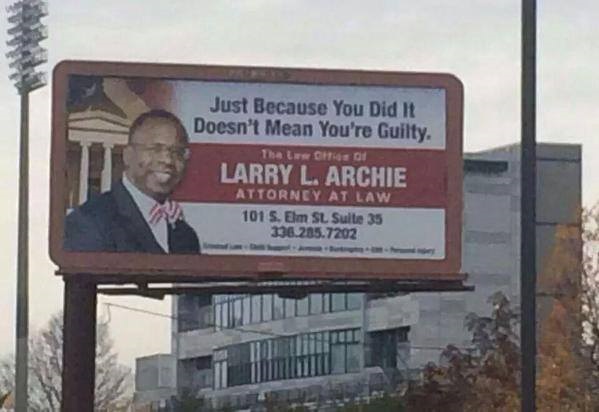
 The billboard ad of North Carolina lawyer Larry Archie has drawn a lot of attention in the state and on legal ethics forums.

Some observations:

1. I was a little late seeing “Breaking Bad” ( I tend to avoid show with drug dealers as heroes) so I didn’t see the obvious connection between the popular AMC show’s cynical, unethical and effective slime-ball lawyer Saul Goodman, played by Bob Odenkirk, and last year’s jaw-dropping—but funny!—video ad for the services of Pittsburgh criminal lawyer Daniel Muessig.

2. This is why we ignore popular culture at our peril….and I think the legal profession needs to stop laughing and start worrying. People really do think Saul who is a criminal lawyer, is typical, and bar associations are doing very little to dissuade them. This is irresponsible, dangerous, and stupid. The profession has a duty to educate the public about how lawyers are supposed to act and why, and if it whiffs on that obligation (as it has for about the last hundred years) public respect for the justice system will continue to drop. Continue reading

The Strange And Unethical Case Of The Aging, Ageless, Part-Time Actress

Cheer up, Junie! Remember the sage words of the great Satchel Paige: “How old would you be, if you didn’t know how old you was?”

Cheer up, Junie! Remember the sage words of the great Satchel Paige: “How old would you be, if you didn’t know how old you was?”

In October of 2011, Ethics Alarms offered an Ethics Quiz that asked, “Did the Internet Movie Data Base do anything unethical by publishing the actress’s real age without her permission?” The occasion was a lawsuit asking for over a million dollars in damages by an anonymous film actress who claimed that Amazon’s Internet Movie Data Base harmed her career by researching and publishing her real age without her permission. My conclusion at the time was that Actress X was

“shooting at the wrong villain. If there is age discrimination in Hollywood, confront it: a number shouldn’t disqualify her from any roles at all. I am not saying that fighting such a long-standing tradition in the show business culture isn’t a daunting task, but that’s the real problem, not a web service that conveys information about movies and movie stars by publishing facts.”

Well, it’s almost four years later, this dubious case has wound its way to trial, and we are now learning some fascinating things: Continue reading

“Hands Up! Don’t Shoot!” Ethics: The Public Defenders And The Rap Video

defenders30n-1-web

Kumar Rao and Ryan Napoli, two  lawyers who worked for the New York City-funded public defenders group called the Bronx Defenders, ran headlong into an ethics mess when they appeared in a video posted on YouTube the December day after the grand jury voted not to bring criminal charges in Eric Garner’s suspicious “choke-hold” death. In the video titled “Hands Up” (of course), Rao and Napoli comfort a grieving mother at the Bronx Defenders offices as they work on a case involving police brutality. The video also includes the image of a white man in a police uniform with pistols pointed in his face and the back of his head by black men, as rappers chant that it’s “time to start killing these coppers.”

Nice.

The video came under heavy criticism from Mayor de Blasio and others. City-paid public defenders should not be lending their positions and the prestige of their office to calls for retribution and violence. Lawyer Rao defended his appearance, arguing that the video supported the mission of the Bronx Defenders to zealously defend minority clients, and that a rap video was an ideal vehicle to make their services known. Gallant try, but no cigar. That message about killing cops is not part of the organization’s mission presumably, nor is it a responsible message for those in the justice system to appear to endorse. Continue reading

Ethics Alarms Mailbag: Is Arguing In The Alternative Unethical?

No, it isn’t, but I understand why it might  seem that way.

 “I didn’t do it, no one saw me do it, and you can’t prove anything!”

“I didn’t do it, no one saw me do it, and you can’t prove anything!”

An email from ethics issue scout Fred calls my attention to the case of  transgendered female Leyth O. Jamal, 23, who filed a sexual discrimination suit in September claiming that managers at a Saks store in Houston  referred to her as a man, made her to use the men’s restroom and pressured her to dress as a man despite being aware of her transgender identity. She also claimed a male colleague repeatedly asked her whether she was a prostitute in front of customers and colleagues, and threatened her. Saks fired Jamal after she brought a complaint to the Equal Employment Opportunity Commission.

In federal court this week, Saks withdrew its Dec. 29, 2014, court filing asserting that transgender workers are not covered by the gender discrimination ban in Title VII of the Civil Rights Act of 1964. The company  still denies that it discriminated, and has made statements about how it “believes that all persons are protected against sex discrimination under Title VII” of the Civil Rights Act of 1964, which prohibits discrimination by employers on the basis of race, color, religion, sex or national origin. It had argued, however that the plaintiff had based her case not on sex discrimination but on the issue of gender identity and transgender status, which Saks believed fell outside of Title VII’s mandate.

Now Saks is only disputing that there was any discrimination, not that such discrimination was legal. The question posed to me: does this U-turn this look bad for Saks? Is it cynical and unethical? How can you simultaneously argue that what the client alleges isn’t actionable because there’s no law against discriminating against someone for gender identity, and that you didn’t discriminate on that basis, or any basis, anyway? Continue reading

The Murderer and The Unethical Powerpoint

Powerpoint slide

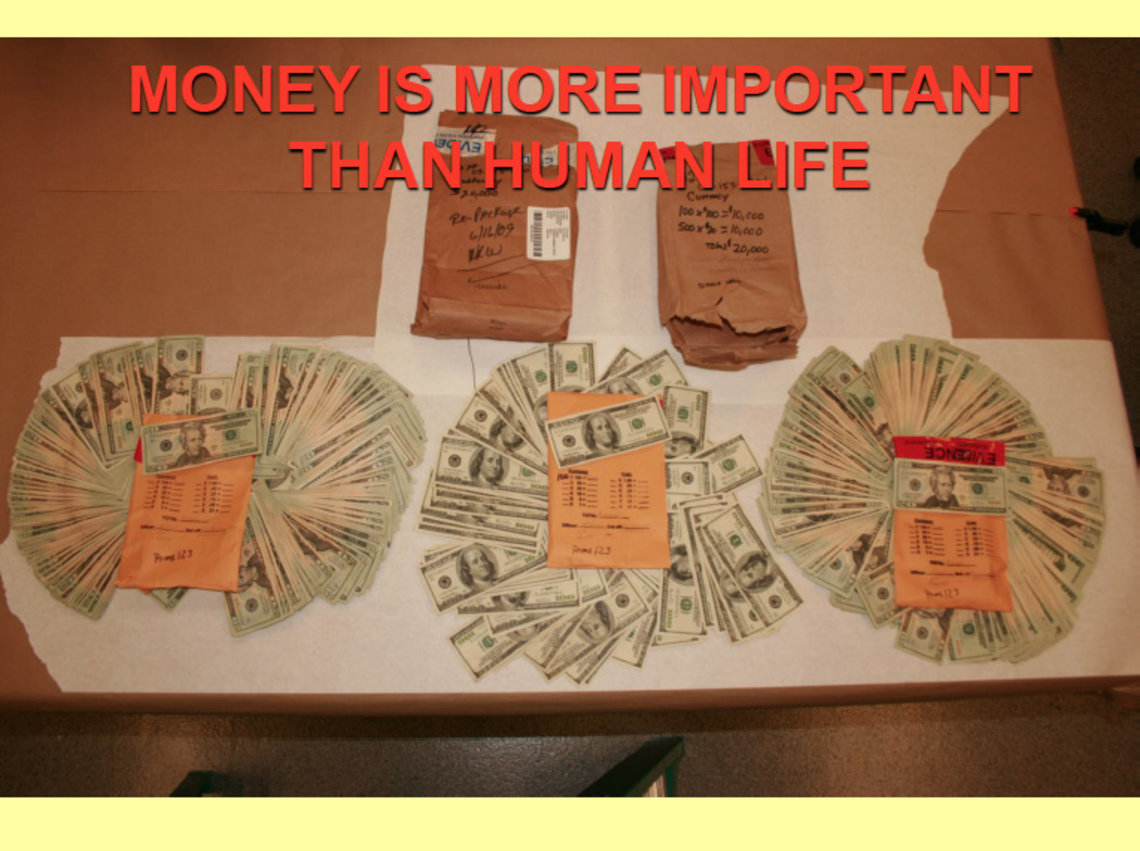
Why didn’t I see this coming? The Washington Supreme Court overturned the conviction of Odies Walker for murder and other crimes in the slaying and robbery of an armored car guard because the  prosecutor’s PowerPoint presentation during his  closing argument constituted “flagrant, pervasive, and prejudicial”  prosecutoral misconduct. While lawyers “may use multimedia resources in closing arguments to summarize and highlight relevant evidence,” the court ruled, “advocacy has its limits.”

The  prosecutor presented a whopping 250 PowerPoint slides to the jury during the summation, including 100 with the caption “defendant Walker guilty of premeditated murder.” The slide above with the caption, “Money is more important than human life,” was typical of the problem assailed by the justices: it was never alleged that Walker said this, or even thought it. Continue reading

The Personal Injury Lawyer’s Sex Doll Ad: Stupid! Funny! But Unethical?

Nah.

Here it is:

There is a dubious principle of advertising holding that as long as the name and the service come through memorably, an ad is a success. This video challenges that assumption. It tells me that the lawyer who let someone talk him into doing an apparently improvised ad with a smut-mouthed rubber sex doll is an idiot, and it is very risky to take legal advice from idiots. Nonetheless, there is nothing unethical about the ad. Does it hold the profession up to public ridicule? No, it holds this lawyer up to public ridicule.

Once upon a time, lawyer advertising was held to be unethical by all state bars, until courts found the restrictions to violate the First Amendment. This kind of ad was what the profession was worried about. A few states, notably Florida (the last I checked), still apply more stringent standards to lawyer advertising than currently apply to used cars and cheesemakers, but as long as an ad lawyer doesn’t make affirmative misrepresentations, it won’t be found to be in violation of the legal ethics rules.

Besides, ads like this one are extremely informative. They tell a potential client everything they need to know about the judgment, reputation and trustworthiness of the lawyer who stars in it. What could be more ethical than that?

_______________________

Pointer: Res Ipsa Loquitur

The Sixth Annual Ethics Alarms Awards: The Worst of Ethics 2014 (Part 4 of 4)

mamoru-samuragochi2

Outrageous Hoax Of The Year

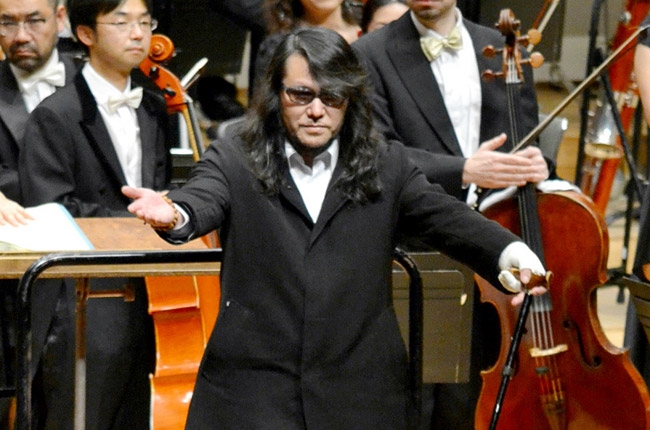
Mamoru Samuragochi, the composer sometimes known as “The Japanese Beethoven” because he composed critically acclaimed works despite being deaf, was exposed as double fraud: he didn’t compose the works that made him Japan’s most popular classical composer, and he isn’t even really deaf!  Samuragochi hired a musical ghostwriter named Takashi Niigaki to compose more than twenty compositions for Samuragochi since 1996.

Funniest Outrageous Hoax

Fake Panda

This.

Unethical Artist Of The Year

Performance artist Maximo Caminero, who  walked into the Pérez Art Museum in Miami, entered a special exhibit of sixteen ancient Chinese vases painted over in bright colors by celebrated Chinese dissident artist Ai Weiwei, picked up one of them, and immediately after a security guard instructed him not to touch the exhibit, allowed the vase to fall from his hands, shattering into bits. Caminero admitted that smashing the pottery, which was valued at a million dollars,  was intentional, and was his protest against in support of local artists like himself whose work is not exhibited at the museum while the art of international artists like Weiwei is.

Unethical Veterinarian Of The Year

Fort Worth, Texas veterinarian Lou Tierce lost his license for five years as a result of, among other transgressions, his telling the owners of a Leonburger (it’s a very big dog) that their pet was terminally ill and had to be euthanized, then secretly keeping the dog alive in a small cage so he could use Sid’s blood for transfusions to Dr. Tierce’s other canine patients. Eventually an assistant at the clinic blew the whistle and alerted Sid’s owners, who rescued their dog and sicced the law on the worst veterinarian since Dean Jones menaced Beethoven.

Unethical Doctor Of The Year

Dr. Nancy Snyderman, NBC’s medical expert, endangered the public by defying a voluntary quarantine for possible Ebola exposure,  because she just couldn’t bear to be without her favorite soup.

Scam of the Year

Jonathan-Gruber-1

The Affordable Care Act.

 Unethical Federal Agency Of The Year

The Secret Service. Lots of competition in this category: the Veterans Administration, the I.R.S., the CDC, the Justice Department, NSA…but when you essentially have one job to do and do it badly, sloppily carelessly and dangerously, there’s really not much more to say Continue reading

A Failure To Understand Legal Ethics Kills

Sunshine-skyway-bridge

This week, John Jonchuck arrived at his lawyer Genevieve Torres’s office in Tampa, Florida dressed in his pajamas. He had his 5-year old daughter Phoebe with him.

Torres’s new client had a history of arrests for domestic battery, driving under the influence, and passing fraudulent checks.  Jonchuck told her he had cared for Phoebe for two years, and asked Torres to file papers that day so he could have full legal custody of his daughter.

There were clues, however, that indicated to Torres that something was amiss….the pajamas, for example. Then her client kept saying that she was God, the Creator. When he asked her to read a Bible in Swedish, and told the lawyer to come with him to St. Paul’s Catholic Church to baptize him, she was pretty much sure he was stark, raving mad, and that his daughter was in peril—especially when he left her office with the ominous statement,  “Don’t file the paperwork. It’s not going to matter anymore.”

Torres called 911, saying that she was his lawyer, and that she believed the little girl wasn’t safe. “He’s out of his mind, and he has a minor child with him driving to the church now,” Torres explained. Hillsborough County sheriff’s deputies found Jonchuck and Phoebe at  the church, where he was meeting with a priest .Jonchuck told them God had spoken to him in the past, according to a Sheriff’s Office report. Deputies determined that he was not a danger to himself or  Phoebe.

Thirteen hours later, Jonchuck dropped Phoebe off Tampa’s Sunshine Skyway bridge, and she drowned in the dark waters below. Continue reading