Introduction
The holiday season traditionally kicks off with Macy’s Thanksgiving Day Parade, and so does this iconic holiday movie. As with most holiday movies, but perhaps more than most, the entire concept of digging into the ethics of the plot of “Miracle on 34th Street” can be criticized as beside the point. Indeed, this ethics analysis of a classic Chritsmas movie received more flack than the previous two (“White Christmas” and “It’s a Wonderful Life” ) combined. The movie, at least the 1947 original, is a classic; I don’t dispute it. It works dramatically and emotionally, it makes people feel good, and it has held up over time. That’s all a Christmas movie is supposed to do, and if it does it without really making sense or avoiding ethics potholes along the way, so what?
I sympathize with this view. However, our ethical standards and ethics alarms are affected by what we see, hear, like and respond to. If popular holiday movies inject bad ethics habits and rationalizations into our character, especially at a young age, that is something we should at least be aware of by the tenth or eleventh time we watch one of them.
One ethical aspect of “Miracle on 34th Street” that must be flagged at the outset is competence. The film is so effortlessly engrossing and convincing that it is easy to forget how easily it could have failed miserably. Actually, it is also easy to remind oneself: just watch any of the attempts to remake the film. There have been four of these, starring, as Kris Kringle, Thomas Mitchell, Ed Wynn, Sebastian Cabot, and Richard Attenborough. That’s a distinguished crew, to be sure. Mitchell was one of the greatest character actors in Hollywood history. Wynn was nominated for an Academy Award (for “The Diary of Ann Frank”) and Attenborough won one, Best Supporting Actor Award in 1967 for “The Sand Pebbles.” Cabot wasn’t quite in their class, but he was a solid pro, and looked more like Santa Clause than Mitchell, Wynn, or Richard Attenborough.
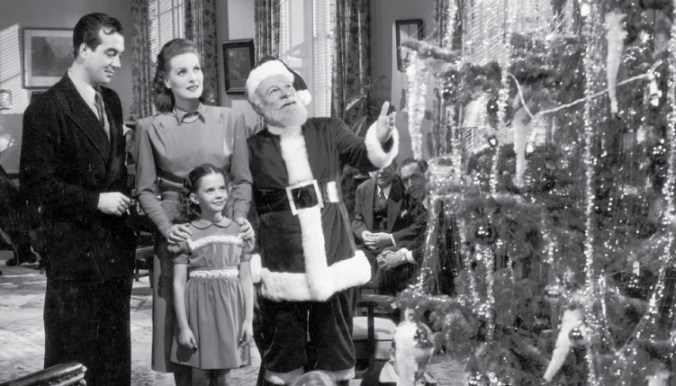
None of them, however, were as convincing as Edmund Gwenn. He made many movies—all without a white beard— and had a distinguished career in films and on stage, but even audience members who knew his work had a hard time reminding themselves that he wasn’t Kris Kringle while they watched the movie. I still have a hard time.
The rest of the cast is almost as perfect. The film is one more example of the special, unappreciated talent of Maureen O’Hara, who never seemed like a movie star, as lovely and strong an on-screen presence as she was. Her ability to anchor great movies while never dominating them is the epitome of the “collaborative art” they always blather about during the Oscars, but which is seldom truly honored. There were Katherine Hepburn movies and Bette Davis movies; there are Meryl Streep movies. Nobody ever talked about Maureen O’Hara movies, just great movies that had Maureen O’Hara essential to making them great. O’Hara was the female lead in four genuine classics: “The Hunchback of Notre Dame,” “The Quite Man,” “How Green Was My Valley,” and “Miracle on 34th Street.” She never won any Academy Awards, nor is she ever named when the greatest Hollywood actresses are named, but how many actresses delivered four classics—not classic performances, but classic films? Hepburn ties Maureen with four: The Philadelphia Story,” “Bringing Up Baby,” “Adams’s Rib” and “The African Queen.” Streep maaay be credited with one, if you count “Sophie’s Choice”; personally, I wouldn’t.
“Miracle on 34th Street” is an ethics movie in part because its artists committed to telling a magical story and charming audiences by working as an ensemble selflessly and efficiently. John Payne, as the idealistic lawyer in love with Maureen, is never flashy, just completely convincing. One reason may be that, as he told an interviewer once, the role of Fred Gaily perfectly matched his own ideals and beliefs. Payne never made another memorable movie in his long career; he was the classic bland, B movie leading man. He made Glenn Ford seem exciting. But he was the perfect choice for this story. Similarly, there have been more impressive child actresses than young Natalie Wood—Margaret O’Brien, to name one; Dakota Fanning, to name another—but none who was better at simultaneously nailing her scenes while never taking a viewer out of the film by making him think, “Wow, she’s so precocious! I wonder if she’s a midget?”
This is the magic of performing talent: they make audiences suspend disbelief because they seem to believe in the story and characters too. The director, George Seaton (who also directed “Airport”), not only wrote the script (that won him an Oscar, and deservedly so) and cast his movie brilliantly, he also made the correct decision to stick with a matter-of-fact, realistic, unadorned style that keeps the story grounded. There are none of the features and gaffes in this film that make other holiday-themed movies inherently unbelievable, like the cheesy battlefield sets in “White Christmas” or the heavenly dialogues in “It’s a Wonderful Life.”
This is why the awful colorized version that Ted Turner inflicted on the world—this was one of the first movies to be subjected to Ted’s “improvement”—was such a disaster. The colored version looks fake, because it is. The original black and white version is set in a mundane, grey world like Doris’s—Maureen’s–view of life itself: no excitement, no romance, no fantasy, just cold, unadorned reality. No heaven, no magic, ghosts, nobody breaking into song and sounding like Bing Crosby. There’s no child’s point of view, like in “A Christmas Story.” No, all of us live in the world we are shown in “Miracle on 34th Street.” We would love the magic to be real, but we don’t believe in it any more.
We want it to be, though—and that’s why this movie works.
Chapter 1.
Meet Kris Kringle
The movie tells us right at the start that 1) the charming old man in the white beard can’t possibly be Santa Claus, and 2) that he’s nuts. That is, he tells adults who are paying attention this as soon as he starts complaining to a New York City storekeeper that his window display has the reindeer mixed up: “You’ve got Cupid where Blitzen should be. And Dasher should be on my right-hand side. And another thing…Donner’s antlers have got four points instead of three!”
Let’s see:
- No Christmas display has ever distinguished between Santa’s reindeer (except for Rudolph), because the individual reindeer have never had any identifying characteristics in reality or myth. Are we to assume that there are name-tags on the models? If so, why wouldn’t Kris be complaining about the features of all of them, not just “Donner’s” antlers?
- The names of the reindeer, even if there are flying reindeer, were 100% the invention of the poem “A Visit from St. Nicholas,” or “The Night Before Christmas,” originally published in 1823. No one has ever claimed that the author had some kind of special info on the actual names of the reindeer when he wrote,
More rapid than eagles his coursers they came,
And he whistled, and shouted, and called them by name;
“Now, DASHER! now, DANCER! now, PRANCER and VIXEN!
On, COMET! on CUPID! on, DUNDER and BLIXEN!
…and anyway, if he did, those were their names 120 years before the movie takes place. Nobody has ever claimed the reindeer were immortal, either. I suppose Santa Claus, in a nod to the poem’s popularity (it has been called the most famous poem of all time), could have adopted the practice of always having the reindeer named after the poem’s versions, and when one Vixen dropped of old age, the young reindeer that took her place became the new Vixen.
I suppose.
- A bigger problem is that the movie’s alleged “St. Nicholas” calls the seventh reindeer “Donner.” It gets confusing here. The original St. Nicholas was Greek, the Christian bishop of Myra, now Demre, in Lycia. Nicholas gave gifts to the poor, in particular presenting three impoverished daughters of a pious Christian with dowries so that they would not have to become prostitutes. THAT would be neat poem! Saint Nicholas is buried in Italy. He was later claimed as a patron saint of children (also archers, sailors, pawnbrokers, and the cities of Amsterdam and Moscow). The name “Santa Claus” is derived from the Netherlands version of St. Nick called Sinterklaas, or “the Christmas man,” de Kerstman in Dutch. This explains “Dunder and Blixen,” meaning thunder and lightning in Dutch, and the movie later confirms Kris’s Dutch origins. (But why does he speak in a British accent?)
Never mind that: why would he call Dunder “Donner”? The “real” Santa wouldn’t. Though the original version of the poem got the names right (we know it’s Blixen and not “Blitzen” because it rhymes with Vixen), various editors, transcribers and the author himself kept changing the names in subsequent printings. Dunder became “Donder” and eventually “Donner,” which is a meaningless Anglicizing of “Dunder.”
Santa Clause, aka Sinterklaas,wouldn’t be confused: he named the beasts. He’s correcting the shop-keeper while passing along a misnomer?
Baloney.
Well, enough of that. The next scene shows Kris encountering the Macy’s Thanksgiving Day Parade Santa pre-parade. He instructs him in the use of his whip on the reindeer! In the German Santa mythology, the jolly old elf used the whip on naughty children, but nowadays, using a whip on either kids or reindeer is pretty much excised from Santa’s methods, and should have been in 1947. It’s an unethical image…
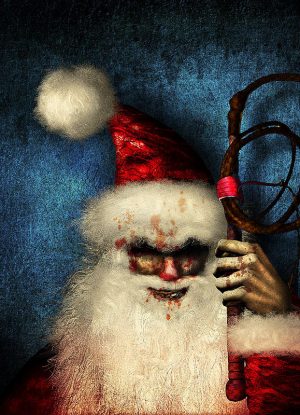
…even though artists have worked hard to confuse us….
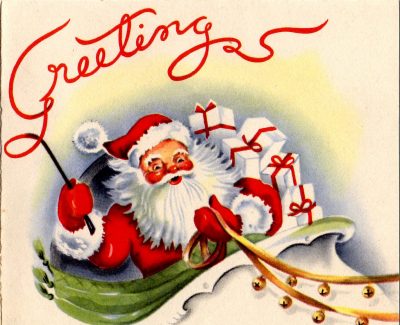
No, an ethical Santa Claus wouldn’t use a whip. He also wouldn’t put a poor old guy with a drinking problem out of work during the holidays, but that’s what Kris does next. He smells liquor on the costumed Santa, and shows no mercy:
“Don’t you realize there are thousands of children… lining the streets waiting to see you… children who have been dreaming of this moment for weeks? You’re a disgrace to the tradition of Christmas… and I refuse to have you malign me in this fashion. Disgusting!”
Then he tracks down Doris Walker, who is in charge of the parade, and gets the man fired. That’s just mean; there’s no way around it. I bet a lot of Macy Santas have had a few nips before and during the parade, and so what? How hard is it to say “Ho Ho Ho”?
Kris manages to get Drunk Santa’s job, having single-handedly gotten him sacked, no pun intended.
Why is Kris, if he’s the real Santa Claus, hanging around New York City and moonlighting in the Macy’s parade when the big night is just around the corner? This is no time for a vacation or boondoggles. If he’s really Santa, he’s goofing off, and he has the gall to tell a temporary parade Santa that he’s risking disappointing children!
Kris is not off to a good start. Continue reading →