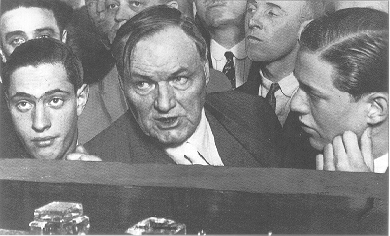
Darrow and his clients
I just commented, on the controversial post here about Judge Boyd and the media frenzy regarding the “affluenza” defense offered by Ethan Couch’s lawyers, that the fact that so many of the comments, many of them angry, focused on the fact that a spoiled, rich kid got a break, or, as they used to say in the old days, mercy, that I began thinking about the famous Leopold and Loeb murder trial. In 2011, I posted a shortened version of Clarence Darrow’s famous closing argument in that trial, one of my favorite of all courtroom speeches, and it seems appropriate to do so again. It is far from a perfect parallel, but any excuse to revisit Darrow at his best is a good one.
Nathan Leopold and Richard Loeb were, like Ethan Couch, young, rich and spoiled; they also were Jewish and gay. Their crime was far worse than Crouch’s: they planned and executed the murder of a child just for the fun or it, and to show that they could outsmart authorities. (Ironically, they were arrested almost immediately). The two teenagers were charged with the premeditated murder of fourteen year-old Bobby Franks. Both defendants were brilliant students (Leopold, the youngest graduate in the history of the University of Chicago; Loeb, the youngest graduate of the University of Michigan), and the sons of wealthy and successful Chicago businessmen. Neither showed any remorse for their terrible crime. There is no question that had they been poor, they would have been sentenced to die, and would have been hanged. Their parents, however, could afford to hire Clarence Darrow, a foe of capital punishment who had never had a single one of his often guilty clients executed. They got their money’s worth.
His summation on August 22, 1924, remains perhaps the most persuasive and eloquent argument against capital punishment ever made in a court or anywhere else. It is also an argument for mercy, and especially mercy for the young. The plea worked: Judge John L. Caverly spared Leopold and Loeb, and he sentenced them to life imprisonment without parole—under the circumstances and in those days of rough justice, a gift. In his sentencing statement, which is posted here after Darrow’s summation, Caverly did not indicate that he was swayed by Darrow’s eloquence or reasoning. Caverly based his sentence on the ages of the defendants. Darrow was counting on this particular vulnerability of Caverly, who had helped establish juvenile justice courts in Chicago. Later, Nathan Leopold suggested that he and Dickie Loeb might have gotten the same result if they had simply submitted their birth certificates into evidence.
I doubt that he would have bet his life on it. The pressure on Caverly to hang these two despicable sociopaths was overwhelming, and having Clarence Darrow put his decision in such heroic terms had to steel his nerve, if it needed steeling. Still, as with Judge Boyd in the Couch case, there is no way to be sure that he would not have spared Leopold and Loeb anyway. Also as in Ethan Couch’s case, critics said this was disparate justice, bought and paid for.
This is a condensed version of Darrow’s closing, edited for The Essential Words and Writings of Clarence Darrow, (2007), that I co-edited with historian Ed Larson. Here is one of the great orators of the 20th Century, one of the great progressive thinkers in our history, and the greatest trial lawyer who ever lived, arguing for the life of two murderers and for the soul of our civilization. I do not share Darrow’s absolute rejection of the death penalty, but I always do for a few hours, at least, after reading this. Continue reading

 Ethics Alarms