Sad Saturday Ethics Distraction, 8/24/2019: The Let Sean Spicer Make A Fool of Himself If He Wants To Edition

I hope you are feeling much happier than I am today.

I just returned from a memorial gathering for a very dear friend’s wife of 37 years, who died suddenly, painfully, and based on what I have heard, unnecessarily at the end of July. One positive take-away from the event: People really aren’t so bad. My friend was stunned and touched beyond measure by the turn-out, with nearly 200 people attending just to say good-bye to her and express their love and support for him. Some traveled great distances,  interrupted vacations, or made it despite illness and handicaps.  I saw friends, former colleagues and acquaintances that had been out of this region for decades, but all it took was an email informing them that their friend, who  is one of those rare people who is always there to render help and support, now needed their support himself.

Gee, those endings of “It’s A Wonderful Life” and “Easter Parade” aren’t as corny as I thought...

1. What a surprise! Only 35% of those polled support impeaching a President who has done nothing impeachable! Choose: Either the Democrats and the resistance have been lying about there being real and substantive high crimes and misdemeanors in order to sabotage the elected President, or there are such offenses, and they don’t have the guts to do their Constitutional duty and act to remove a President who is the existential threat to the nation they have claimed he is since, uh, before he was sworn in, somehow.

The same poll says that 57% would prefer someone else as President. That number is astoundingly low. The Someone Else dude is terrific! What a great President he’d be; I can’t fathom why he’s never made it! I know I sure wish he was President;  I’ve wished he were President ever since Ike left the White House.

Today’s quote from a “someone else” who I would rather set my face on fire than see have any power whatsoever: Bernie Sanders, who, while bloviating that “Climate change is an existential threat to the entire country and the entire world and we must be extraordinarily aggressive,” proposed an impossible, bankrupting, irresponsible 16 trillion dollar plan to “fix” what he doesn’t personally understand, couldn’t explain with a gun to his head, cannot say with certainty how it can be addressed effectively, and could be stumped by a cross examination by any climate change skeptic with a science degree. Bernie doesn’t even understand political science, and that was his college major. Proposing spending trillions of dollars on something you don’t understand is unethical. Isn’t that obvious? Continue reading

Morning Ethics Warm-Up, 8/15/2019: Starring Two Of My Favorite Unethical Websites!

WAKE UP!

Oh, great: started this post at 7 am, hell broke lose at ProEthics, and now it’s after noon. Well, the hell with it: I’m not going back to change the headline or the intro, and I like Lenny’s version of the Stars and Stripes at any time of day.

So there.

1. Unprofessional and dangerous stuff from  Above the Law….as usual. The legal gossip and snark online tabloid is run and written by lawyers who are not practicing law, so they feel free to engage in conduct that lawyers are forbidden from engaging in, like misrepresentation.  Lately the cyber rag has been cyber-ragging on Jones Day, a long-time, distinguished D.C. mega firm. Why are they doing that? Come on, it should be obvious.

ATL takes the position—and it has company— that Jones Day is eeeevil and must be shunned because it represents the Trump campaign. Hence you get headlines like “IF YOU HAD TO GUESS WHICH FIRM WOULD DO THIS:New allegations claim Jones Day lightened the skin and narrowed the nose on the picture of one of their lawyers.” Continue reading

Addendum: To Be Fair, Elizabeth Warren Wasn’t The Only Democratic Presidential Candidate Who Lied About The Death Of Mike Brown Last Week. She Was Just The Worst…

Last week, on Friday and Saturday, Democratic Presidential candidates Elizabeth Warren, Rep. Tim Ryan,  Cory Booker, Kamala Harris, Beto O’Rourke, Kirsten Gillibrand, Bernie Sanders, and New York City Mayor Bill de Blasio all tweeted out deliberately false statements about the shooting of Michael Brown in Fergusen, Missouri 5 years ago, all apparently doing so to pander to African Americans, especially those who don’t read newspapers.

Ethics Alarms focused on Warren, being the biggest and most shameless demagogue of the group, in this post, which concluded,

“Warren isn’t intellectually lazy, or flummoxed by a false narrative. She is pandering. She is lying. She is doing what she evidently thinks will gain her power and the Presidency: saying what she thinks will attract needed support, even though she knows, knows, that it is false. Warren is a law professor and a litigator, and from all reports skilled in both roles. She knows that the facts made it obvious that Brown wasn’t murdered. She knows that competent, fair citizens must not call other citizens murderers when not only have they not been charged, tried, or duly convicted, but when authorities have concluded that there is insufficient evidence for an official accusation.The tweet isn’t a mistake or an opinion. It is a deliberate lie, a public and a defamatory one. I see no reason why Darren Wilson could not sue Warren and win.”

That is still accurate and true. Several Ethics Alarms readers pointed out that Kamala Harris also advanced the long de-bunked narrative that Mike Brown was a nice, friendly, “gentle giant” heading for college who was gunned down by a racist cop while holding up his hands and pleading for his life. Continue reading

Evening Ethics Cool-Down, 8/12/2019: Invasion! Exaggeration! Extreme Injustice!

Did you have an ethical day?

Ethics are cool, you know.

(So was Bing…)

1. The New York Times this morning, apparently determined to double down on the deliberately dishonest assertion that El Paso’s Walmart shooter was channeling the sentiments of “right wing pundits” and the President, plastered a tiny print excerpt from the manifesto—which, last I checked, it has still refused to publish in complete or readable form—on the front page, with the word “invasion” highlighted every time it appeared. As I wrote in Part Two of the Ethics Alarms’ post about the screed (and the news media’s unconscionable conspiracy to withhold it from the public while journalists misrepresent its contents…)

“Yes, it is true that both President Trump and the shooter use the term “invasion,” and to many critics this single convergence is sufficient to claim that the President is “responsible” for the El Paso shooting. “Invasion” is a word, not a theory or a philosophy, and the two apply it differently. President Trump has used it to describe illegal immigration, for which it is a defensible, if inflammatory, description.

Describing legal immigration as an invasion is not defensible—invasions are not legal—and is materially different. Ironically, it is the President’s foes, who intentionally refuse to distinguish between the validity of illegal and legal immigration—just like the shooter!—who have spread the lie that the President has called immigration itself “an invasion.”

Invasion is a loaded and pejorative term, but still a fair and accurate one. Illegal immigration advocates don’t like it because the term frames the unlawful migration as destructive and wrong, which it is. The word is not misleading, as the illegal immigration apologists ‘ use of “immigration” to describe illegal immigration, and “immigrants” (or “migrants”) to describe illegals is. Nor is it deceptive, like calling support for ending the lives of unborn children support for “choice,” or calling the President’s statements “racist: when they meet no definition of racism, or calling thge standard law enforcement procedure of separating children from law-breaking parents when the parents have brought their children along as they breached the law, “putting children in cages.” The obsession with “invasion” is both hypocritical and petulant: it’s a more powerful and more accurate framing of an issue than the progressive cover-words. Yesterday a Level-5 Trump-Deranged Facebook friend started using the word “inaction” as a substitute for “The Second Amendment,” “individual rights,” and the refusal to pass useless, symbolic, incremental laws in hopes of eventually reaching gun confiscation—the real objective. Continue reading

“Unethical” Is Too Mild To Describe Elizabeth Warren, And “Gullible” Is Too Nice To Describe Her Supporters

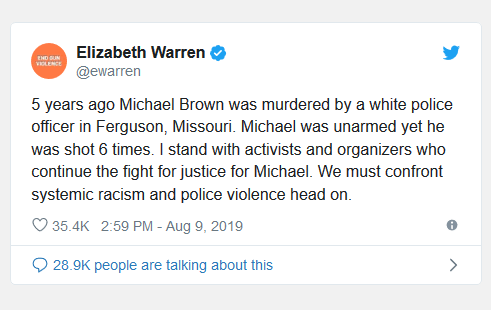
Above is what Massachusetts Senator Elizabeth Warren, who presumes to tell us that she is qualified to be President of the United States,  tweeted to her followers last week. This deliberate and disgraceful lie could be presented on Ethics Alarms as evidence that Warren is an Ethics Dunce. It would easily qualify as an Unethical Quote of the Week (Month…Year…). It is fully qualified as an Unethical Tweet of the Week, in a category that is becoming increasingly contested. None of these, however, quite capture the miserable, cynical, disgusting nature of Warren’s statement. Continue reading

Be Honest Now: Does Anyone Believe The Latest Explanation For Why The Democrats Want The President’s Tax Returns?

I guess it is kind of funny, when you think about it…

On the old Ethics Scoreboard, I had a monthly feature called The David Manning Liar Of The Month Award, “honoring” utterly transparent lies from prominent organizations and people that they obviously didn’t expect anyone to believe. The subpoena issued yesterday by Representative Richard E. Neal (D-Mass) to Treasury Secretary Steven Mnuchin and Charles P. Rettig, the I.R.S. commissioner would get this month’s award if I was still giving it out.

Quick, now: why do Democrats want the President’s tax returns? Is there any doubt whatsoever? Have they been ambiguous about it in the least? They are convinced, because, as we all know, the Orange Man is BAD, that somewhere in his returns is sufficient evidence of serious wrongdoing—that the IRS never noticed nor flagged, mind you, and that occurred before Donald Trump became President—that they can use to concoct a viable impeachment case, or at least use to embarrass and attack him in the coming election.

For a long time the theory was that the returns would provide decisive evidence that the President was involved in an election-stealing plot with Russia, but since that phony premise was thoroughly exploded, Democrats had to find another excuse. The current theory is that since he refused to reveal the returns during the 2016 campaign, he must have something nefarious to hide. This is the totalitarian’s approach to justice, of course. That the Democratic Party and its supporters so easily resort to it ought to give everyone pause.

So we all know why the Democratic House majority is trying to get the President’s returns. The problem is that Donald Trump has the same right of privacy as every other taxpayer. The fact that he broke with recent tradition by not releasing his returns, if Occam’s Razor means anything to you, is best attributed to the fact that no other Presidential candidate of a major party since income taxes were introduced has been an international businessman, with the extraordinary number of transactions and tax maneuvers such status inevitably requires. Pop Quiz: Did H. Ross Perot, when he was running his third party challenge to Bush and Clinton in 1992, release his tax returns? Continue reading

Comment Of The Day from The 4/10 Open Forum

This is a Comment of the Day by Michael R. on what amounts  to a provocative stand-alone post by JimHodgson. He wrote,

Yesterday I taught an ethics course for a group of thirty corrections officers at a local sheriff’s office detention facility, and will teach the same class tomorrow for a second group. The attendees ranged from veteran staff, with ten or more years of service, to recent hires just out of basic training. Ages ranged from early 20s to mid 50s. Due to medical/surgical issues I have recently been “out of the saddle” as a trainer for two years and had not taught this particular course for nearly four years. As we discussed ethical considerations in the corrections context, I was struck repeatedly by one thing: The older, more experienced officers, who one might have expected to be quite jaded about their role, duties, and in their outlook toward professional / occupational ethical issues, were instead the most thoughtful and consistent in their ethical logic as we dissected various scenarios and case studies involving the application of ethics -or the lack thereof, and they displayed the greatest understanding of ethical concepts and principles. Conversely, the younger and less experienced officers’ reasoning was tilted toward ethical contingencies and excuse-making, and in some cases the idea that “what is acceptable to my peers is ethical.” As I always do, I posed Michael Josephson’s somewhat rhetorical question, “How many times do you get to lie before you are a liar?” To my consternation, some of the younger people seemed to think that the answer could be quantified!

Of course, I have no delusions that any instruction by me can correct an adult’s ethical deficiencies, but I always endeavor to at least provide a fairly comprehensive summary of ethical decision-making principles and processes, the legal and ethical duties of the job, the standards of the institution, and the likely consequences for failing to meet those ethical and legal standards. Based on their responses, I was not encouraged about the future of many of those younger officers. I recalled my own daughter’s experiences with “character education” in school, and our many related discussions about character and ethics, and wondered if these young officers hadn’t shared that educational experience, being of about the same age. If so, I saw little residual evidence of it.

This particular detention facility is seriously overcrowded (nearly 25% over designed capacity), chronically understaffed (no staff positions added since the facility was at 60% of capacity), and has about a 40% annual staff turnover (mainly newer hires leaving for better-paying, less stressful jobs). A round of retirements about five years ago decimated the ranks of the most experienced staff. Over 50% of staff have less than four years experience. The corrections officer’s duties include a multitude of low-visibility discretionary decisions that often involve the use of coercive authority, and making ethical decisions is essential.

Here was Michael R.’s Comment of the Day in response: Continue reading

Morning Ethics Warm-Up, 12/20/18: I Promise, I’m Looking Hard For Uplifting Ethics Stories For The Holidays. And Failing….

Good morning!

(If I don’t get the lights on the tree  today, I’m hurling myself into a pit of rabid reindeer…)

1. Open Forum report: Another intense, varied, and impressive performance by the Ethics Alarms crew in my absence yesterday. 23 different commenters raised and debated the following issues, many of which I haven’t touched yet, because I am wholly inadequate to my task. Among them:

  • The ethics of fighting a specious criminal charge,
  • Texas’ school districts for making employees sign a pledge not to boycott or advocate against Israel?
  • The bump stock ban
  • The plea deal of Jacob Walter Anderson
  • “The Innocent Man”
  • The Xmas package-snatcher trap.
  •  Stepha Velednitsky
  • “Without Precedent: Chief Justice John Marshall and His Times” by Joel Richard Paul.
  • The yellow vest protests and the meager US coverage of them
  • Prada Monkey
  • Trump’s decision to  pull out of Syria

2.  Favorite dishonest and manipulative note out of many in the 12/18  Times:   Reporters Carl Hulse and Julie Davis write in“Tennessee Senator, A Proven Deal-Maker, Won’t Seek Re-election”…

Senator Lamar Alexander, Republican of Tennessee and one of the last bridges to bipartisanship in the Senate, announced on Monday that he would not seek re-election in 2020…His decision to leave is more evidence that Washington has become less attractive to legislators interested in steering a middle course on seemingly intractable issues such as education and health care….

Fake news, and deliberate distortion. In fact, Alexander’s decision may have nothing to do with the job becoming “less attractive to legislators interested in steering a middle course,” and his own words, meaning his own stated reason for leaving, don’t suggest that at all. Alexander is 78. In 2020, he would be 80, meaning that by the end of a new term he would be 86, or sick, or dead. “I’ve had my turn,”  Alexander is quoted as saying. “Everything comes to an end sometime, and it is good to know when that should be.” He also said that he wants to leave the Senate “at the top of my game.”

The current U.S. news media is untrustworthy, dishonest, incompetent and despicable, and frankly, I am beginning to regard anyone who continues to deny this the same way. Continue reading

Saturday Ethics Warm-Up, 12/15/2018: A Good Firing, A Good Trend, A Bad Law, An Unethical Complaint, And A Tardy Confession

Rain rain go away; come back another day; Jackie wants to GET THE %$#^&@!!! Christmas tree up and start the annual  10 hour HELL of decorating it!

1. Is Facebook blocking Ethics Alarms? Several readers have reported that their efforts to share posts have been foiled. I can’t post links to it; my last several tries on two different posts have gleaned an error message. No one has shared a post to Facebook anywhere for nine days, which is very unusual. The last Ethics Alarms post with any shares was the “Kiss the Girl” post, which had quite a few.

I also have no idea what to do if Facebook is blocking the blog, and not much motivation to do it. Increasingly I am finding that my Facebook friends are making me lose respect for them with their constant virtue-signaling to the Left and refusal to accept any contrary opinions without stooping to personal insults. The “Facebook community” standards are incompatible with ethics commentary? I’m not surprised, and it can bite me.

I have literally never written anything that would justify social media censorship, assuming fair, responsible and free speech-respecting social media.

2. “The best people.” Ryan Zinke is finally leaving the Cabinet, and the President will be looking for a new Interior Secretary. The former Montana congressman and Navy Seal had an ethically tone-deaf and politically controversial tenure, facing nearly 20 federal investigations ― one of which his agency’s inspector general recently referred to the Justice Department for possible criminal violations. Like Trump himself, Zinke was incapable of recognizing that when you embark on a controversial policy mission, you have to stay squeaky clean, or the news media bring you down. This is simply stupid, arrogant and self-destructive.  Zinke should have been fired months ago.

3. Hooray!The NFL isn’t as criminal as it used to be! I guess that’s something. It was reported that “only” 36  incidents occurred in 2018 that ended in the arrest of an NFL player, down (so far) from 49 last year, and 80 a decade ago.

I guarantee that you can count the parallel incidents in Major League Baseball on one hand, every year.

4. Obamacare was declared unconstitutional in federal court, whatever that means.  I don’t know at this point whether the decision has a prayer of surviving. I do know that the legislation is and was a fiasco, and that this is what one gets when a party decides to rush major legislation through while by-passing the other party, a President repeatedly lies about it to get public support based on misinformation, and the bill is voted on with few, if any, legislators actually reading the law.

I also continue to marvel at the number of otherwise intelligent Americans who continue to idolize President Obama, who is responsible for this mess and claims it as his “signature achievement”—all while the same Americans rail about President Trump’s “lies.” He has not made a single misstatement in the past two years that has been a fraction as consequential as Obama’s lie about the Affordable Care Act. Continue reading

The “White Christmas” Ethics Guide (REVISED And UPDATED)

I’m looking at some holiday movies to add to the Ethics Alarms library of annotated classics—no, ethics and “A Christmas Story” are irrelevant, it being a child’s remembrance and hardly literal–but I might as well begin with  revising and revisiting the “White Christmas” guide, which first appeared in 2012. 

I still like the film—my wife hates it—being a fan of all four stars, especially Bing and Danny, as well as the director, Michael Curtiz.  I do like it a bit less each time I see it, mostly from an ethics perspective, and the successive revisions reflect that.

I still get misty when the old general, played by Dean Jagger, gets saluted by his reunited army unit, which has gathered at his struggling, snowless, Vermont inn on Christmas Eve to remind him that he is still remembered and loved. Nonetheless, “White Christmas” is by far the strangest of the Christmas movies, and also the most unethical. Though everything works out in the end, the characters in the sloppy plot spend the whole movie lying, extorting, betraying, manipulating and generally mistreating each other, always with no recriminations at all, and usually with no consequences either.

In his addendum last year to my original post, Michael West found the film foundering from the second the opening credits ended. He began with the script for the opening scenes—General Waverly* is played by Dean Jagger; Captain Bob Wallace is Bing Crosby, and Private Phil Davis is Danny Kaye:

Opening Scene in the Jeep as they hear the Entertainment show.

GEN CARLTON (To Adjutant): What’s this all about, Captain?

ADJUTANT: A little entertainment for the men, sir. Tonight’s Christmas Eve.

GEN CARLTON: These men are moving up tonight, General Waverly. They should be lined up for full inspection!

GEN WAVERLY (To Carlton): You’re absolutely right. (To Adjutant): There’s no Christmas in the Army, Captain.

ADJUTANT: Yes, sir.

GEN WAVERLY (To Carlton): There’s always a slip-up or two during a change in command. The men get a little loose. But I know I’m leaving them in good hands.

GEN CARLTON: (To Waverly): Thank you, General. (To Driver): Sergeant, take me to headquarters immediately! We’ll have those men turned out on the double!

The Sergeant looks at General Waverly.

GEN WAVERLY: Goodbye, Sergeant. Take the short cut.

SERGEANT: Yes, sir!

The jeep pulls off and makes a half circle. The Adjutant makes a gesture, as if to stop it. Waverly stops him. The Adjutant turns to him.

ADJUTANT: That’s not the way back to headquarters!

GEN WAVERLY: Joe, you know that, and I know that, but the new General doesn’t know it. Or he won’t for about an hour and a half.

ADJUTANT: That Sergeant’ll be a private tomorrow!

GEN WAVERLY: Yes… isn’t he lucky?

SCENE CHANGE TO ENTERTAINMENT SITE:

CAPTAIN BOB WALLACE and PRIVATE PHILIP DAVIS are doing a number on stage to entertain a mass of 200 or so soldiers. GENERAL AND ADJUTANT just starting to take seats, off to one side where they are not noticed by the performers. ABOUT 6 SOLDIERS seated in audience. They look off, see General, start to rise. The General notices them – motions for them to sit down again, indicating he doesn’t want attention called to himself. Captain Wallace sings “White Christmas”.

CPT WALLACE: Well that just about wraps it up, fellas. It’s certainly too bad General Waverly couldn’t be here for this little yuletide clambake ’cause we really had a slam bang finished cooked up for him. I guess by now you know the Old Man’s being replaced by a new Commanding General fresh out of the Pentagon…it’s not a very nice Christmas present for a division like us that’s moving up. The Old Man’s moving toward the rear. That’s a direction he’s never taken in his entire life. Well all I can say is we owe an awful lot to General Waverly and to the way…

GEN WAVERLY: ATTENTION!

Every man is at attention and every head has turned to where General Waverly has taken up a position near the front of the platform.

GEN WAVERLY: Captain Wallace, who’s responsible for holding a show in this advanced area?

CPT WALLACE: Well sir as a matter of fact it was…

PVT DAVIS: …me Sir! It was my idea sir. Uh, I mean when you gotta entertainer sir of the caliber of Captain Wallace, sir…I mean sir…it’s Christmas Eve, sir. And well, sir, I mean that if you were in New York, Sir, you’d have to pay six sixty or even eight eighty to hear a great singer like Captain Wallace, sir.

GEN WAVERLY: I’m well aware of Captain Wallace’s capabilities. Who are you?

PVT DAVIS: Er…Phillip Davis, sir. Private First Class, sir.

GEN WAVERLY: Well, at ease, Davis.

DAVIS: Yes, Sir!

WAVERLY: I said, At Ease!

DAVIS: Oh, uh, Yes, sir, thank you sir.

WAVERLY: This division is now under the command of General Harold G. Carlton, and I don’t want anyone to forget it — not that he’ll let you. He’s tough — just what this sloppy outfit needs. He’ll have you standing inspection night and day — you may even learn how to march. And if you don’t give him everything you got, I may come back and fight for the enemy. Merry Christmas!

ASSEMBLED MEN: Merry Christmas!

GEN WAVERLY: Well, I guess, all I can say is, how much I…what a fine outfit…How am I going… (to Wallace) don’t just stand there, how am I going to get off…?

CPT WALLACE: We happen to have a slam-bang finish…He turns to the musicians, gives the downbeat.

They play “THE OLD MAN,” which is sung by the entire outfit.

ARTY FALLS IN VICINITY…Soldiers crouch…then finish singing.

GENERAL AND ADJUTANT DEPART.

MORE ARTY FALLS, ON SITE…Men scatter. Captain Wallace and Private Davis try to get men to cover. Private Davis man handles the Captain to cover as a wall collapses where he had just been standing.

For starters, we see a mass of soldiers in an open air situation within effective range of enemy artillery fire. A single well-placed artillery round could eliminate approximately 200 soldiers — more than an entire World War 2 Infantry Company (whose authorized strength is about 190-195 men; but given this stage of the war and attrition, this could easily be 2-3 companies of EXPERIENCED soldiers). Someone in the chain of command KNOWS this to be true and authorized this gathering despite the obvious danger. We know for certain that the Adjutant knows what the gathering is, as he answers in line #2 precisely what is going on. But an Adjutant has no command authority, so someone else authorized the gathering. We have to assume General Waverly didn’t know until the Adjutant answered General Carlton’s inquiry based on General Waverly’s later questioning of Captain Wallace. We can’t ever be sure who actually made the decision to have the entertainment occur at that location since Private Wallace, breaking an incredible number of military bearing protocols, interrupts a Captain, to answer a General. This Private, Private Davis, accepts all responsibility for the decision to expose upwards of 2 companies-worth of men to devastating artillery fire.

This information leaves us with two options: Either it really was Private Davis’s idea to have the venue at that location, in which case, Private Davis’s commanding officer and the various commanding officers AND EVERYONE ELSE in their chain of command are colossally INEPT for agreeing to the idea. The second option is that Captain Wallace DID indeed make the decision to have the venue at that site, and now he’s standing there like a lump allowing a subordinate to cut him off mid-sentence, a military no-no, and then allowing the subordinate to take the heat of any potential censure that was forthcoming. Of course, since he’s a Private trying to cover for his boss, he’ll say anything, so I won’t even ding him for the horrible excuse that 200 men should be exposed to German artillery fire because CPT Wallace is a famous singer – we all know it’s worth dying to hear Bing sing…

But of course, even General Waverly doesn’t seem to mind that 200 of his soldiers are idling around with a population density rivaling that of Bombay, just one artillery strike away from having more in common with mist than with humanity. When HE discovered what was going on by the Adjutant’s answer in line #2, he should have immediately ordered the soldiers disperse and had about two dozen commissioned officers who had every ability to stop the farce standing in his headquarters receiving the most royal dressing down of their careers and maybe a few firings.

What possibly does General Waverly think outweighs the need to disperse a mass of soldiers within effective range of artillery? Why, a Christmas music concert of course! It is Christmas Eve, after all!  Now, the Army does a really good job bending over backwards for the morale, welfare, and recreation of soldiers, much more than was ever considered a military precedent. BUT, we learn from the dialogue, the entire division is on orders to “move up tonight.” This somewhat vague description could range anywhere from simply occupying a section of the line to relieve a unit coming back or it could mean they are initiating a major offensive operation. We learn, however, that this movement, whatever it is, is occurring in mere hours. Having experienced large movements of soldiers myself, I know that if a Division is stepping off in a few hours, the men down to the platoon level are ALREADY in their assembly areas doing final preparations. This is apparent to the new commander, General Carlton, who is astonished that the men aren’t doing their final checks of equipment and gear.

Which leads us to the next bit: General Waverly is none too concerned about the unjustifiable exposure he’s tolerating of his…well, now General Carlton’s men…as we know Waverly has just been replaced by General Carlton, who, trope-tastically, we learn is one of those wretched new leaders who is probably horribly incompetent. The movie lets us know early on that he’s a despicable piss-and-vinegar type when he is mad that the men are having Christmas entertainment. Never mind that we now know that Carlton is severely concerned about a huge mass of men within artillery range open and exposed as well as not anywhere near where they ought to be to initiate movement of the entire Division.

The movie also lets us know he’s a jerk because it pushes the whole “fresh out of ________” trope. The usual way this plays out is the “fresh out of West Point” or “fresh out of ROTC” smear applied to new Lieutenants who assume Platoon Leadership with little to no actual experience. Unfortunately, this doesn’t exactly play out on the General level. Yes, the General ranks expanded rapidly during World War II, but an individual didn’t become one by being a complete buffoon (and yes there are always exceptions — but General Carlton, who seems to have a sense of urgency that no one in Waverly’s sphere of influence seems to possess, does not seem to be the exception).

Never mind, we’ll go on with the traditional “smearing of the new guy who replaces the beloved experienced leader.” In the original script I copied and analyzed, the dialogue was OVERTLY insubordinate and actively undermining of the men’s confidence in their new commander. In the corrected dialogue, though cleaned up a lot, there are still hints of undermining the new guy’s authority before he even makes a decision as the commander. There’s General Waverly’s smart-ass “There’s no Christmas in the Army” jab as a response to Carlton’s concern about the location and timing of the entertainment event — which he says “knowingly” to the Adjutant, who, we must remind ourselves no longer works for the Waverly but for Carlton.

There is the extra-rotten move when Carlton, recognizing the imminent danger as well as the horrifying breach of schedule in implementing the plan of operations, indicates he plans to move to Headquarters immediately to begin rectifying the situation and is undermined either by the Sergeant driving Carlton or by General Waverly himself. The driver decides to undermine Carlton’s ability to fix the problem by taking an extra long route back to headquarters. Between a driver and a singing-private, this division is apparently full of the lowest-ranking guys thinking they know best when to leave a behind-the-schedule division exposed to enemy fire just so they can catch a few tunes from Bing. The only other possible explanation is that General Waverly, himself, with a nod-nod wink-wink, authorized the driver to follow the reckless plan to take an hour-and-a-half detour, which we assume will require another hour-and-a-half correction before Carlton can get to Headquarters. Just as with the Adjutant before, let’s again consider that this driver no longer works for Waverly, but for Carlton The Sergeant is being openly insubordinate.

Even if Waverly was not responsible for the three-hour diversion, he immediately became complicit when the Adjutant, in an apparent realization who his new boss is (Carlton), moved to correct the driver but was stopped  from doing so.by General Waverly

The last bit of insubordination and undermining  the chain of command comes from the subtle digs Captain Wallace makes during his speech. His “Fresh out of the Pentagon” disdain undermines faith that Carlton may be a good commander, followed by the snide “not a nice Christmas present” for the division is enough to get any soldier censured. Soldiers and peers WILL whisper about their leaders, but an open act of insubordination like that? Stamped out like a spark in a dry forest… I won’t even address the fact that it’s a COMMISSIONED OFFICER making the openly insubordinate comments and a CAPTAIN no less. He would be dismissed and transferred immediately.

But hey, I suppose Waverly recognized all their rotten conduct when he feebly tried to make things right by saying “hey guys, he’s a good commander, never mind all the stuff we said before and our attitudes we displayed before!” A few moments later, just to do Carlton some justice, the artillery shelling arrives.

Then the movie moves into its funny guilt extortion phase. Army private Phil Davis (Danny Kaye) rescues his smooth-singing captain, Bob Wallace (Bing Crosby) from being crushed by a falling wall in a World War II bombing raid, and injures his arm in the process. (It’s not a plot feature, but the battlefield set for the entire opening sequence is itself unethically unprofessional by being chintzy even by musical standards: it looks like they are filming a skit for a Bob Hope Christmas Special.  I thought it was lousy when I saw it as a kid. Michael Curtiz deserved better; the man directed “Casablanca.” Show some respect.) Phil then uses Wallace’s debt of gratitude to coerce him into accepting the aspiring comic as a partner in Wallace’s already successful civilian act. This is obviously unfair and exploitative, but Bing accepts the ploy with good spirits, and the next we see  the new team of Wallace and Davis knocking ’em dead and rising in the ranks of stage stars.

The act looks terrible. Bing was never much of a dancer, a game hoofer at best, and you don’t feature the greatest voice in the history of American popular music by having him sing exclusively duets. Nevertheless, all we see of the team’s rise is both of them singing and corny dancing inferior to what Bing did with Bob Hope in the “Road” movies.

Never mind. They have a show on Broadway, and as a favor to a mutual army buddy, they agree to watch the boonies nightclub act of “The Haynes Sisters” (Rosemary Clooney as Betty, and Vera-Ellen, of wasp-waist fame, as kid sister Judy. Did you know that in the “Sisters” number, Clooney sang both parts? ). Bing is immediately smitten with older sister Rosemary, but there is a tiff over the fact that younger sister Judy fooled them into seeing their act: she, not her brother, had sent the letter asking for a “favor.”

This is the first revealed of many lies woven into the script. This one is a double beach of ethics: Judy uses her brother’s name and contacts without his permission or knowledge, and lures Wallace and Davis to the night club under false pretenses.

Bing dismisses Judy’s cheat by noting that everyone “has an angle” in show business, so he’s not angry. Rosemary is, though, and reprimands Bing for being cynical. That’s right: Vera/Judy uses their brother’s name to trick two Broadway stars into watching their little act, and Rosemary/ Betty is annoyed because Bing/Bob (Bing’s bandleader, look-alike, sound-alike brother was also named Bob) shrugs off the lie as show business as usual. True, Betty is technically correct to flag the Everybody Does It rationalization, but shouldn’t she be grateful that Bob isn’t reaming out the Haynes sisters and leaving the club in a huff? OK, nice and uncynical is better than nice and cynical, but Bob is still giving her and Judy a break. As the beneficiary on Judy’s angle, Betty is ethically estopped from complaining that Bing/Bob’s reaction was “I don’t expect any better.” I can, she can’t. He should expect better: accepting unethical conduct allows it to thrive.

As we soon find out, however, Betty often flies off the handle.

Continue reading